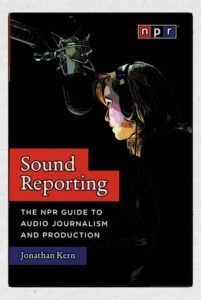
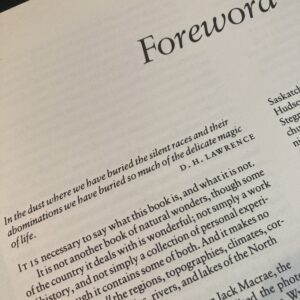
Feb 17, 2012

BookMooch: free, used-book swapping

http://www.bookmooch.com/

BookMooch.com is a huge (as in: 100,000’s of books), free, book swapping site. Why buy a new book when you can save one from the landfill?

It’s free to join and create your account. You start out by posting up some books which you are willing to give away. If someone would like one of your books, they request to “mooch” it from you. If you accept the mooch, you simply ship it to them paying the postage. In return you get a bookmooch “point”.

If you see a book you want, you can request to mooch it. (If the owner accepts, they ship it to you and they pay the postage.) Each mooch costs you one point. You earn points when someone mooches a book from you; you get 1 point for within-the-U.S. mooches, and 3 points if you’re willing to ship internationally. You also get 1/10 of a point for each book you list in your moochable inventory.

ɕ

Jun 7, 2013

Onward!

We are at the very beginning of time for the human race. It is not unreasonable that we grapple with problems. There are tens of thousands of years in the future. Our responsibility is to do what we can, learn what we can, improve the solutions and pass them on. It is our responsibility to leave the men of the future a free hand. In the impetuous youth of humanity, we can make grave errors that can stunt our growth for a long time. This we will do if we say we have the answers now, so young and ignorant; if we suppress all discussion, all criticism, saying, ‘This is it, boys, man is saved!’ and thus doom man for a long time to the chains of authority, confined to the limits of our present imagination. It has been done so many times before.

~ Richard Feynman from, Richard Feynman on the Universal Responsibility of Scientists

Elsewhere, this is 4ubaie1. — slipbox

Feynman wrote several great, short books that are not hard science. This, and “Surely You’re Joking, Mr. Feynman!”, are great places to start.

ɕ

Jun 9, 2013

Eric Idle’s Rules for Reading

Rule 1: Never be without a book.

Rule 2: Skip all Prefaces, Forewords and Introductions.

Rule 3: If you’re bored with a book, chuck it. There are millions of books you will never get to read, so if one doesn’t grab you, put it down.

Rule 4: You don’t have to finish a book. You can always come back to it.

Rule 6: You may read several books at once.

Rule 7: You may skip and skim. This is not a class, this is life.

Rule 8: Try and buy from your local bookshop while you still have one.

Rule 9: There is no rule 9.

Rule 10: Enjoy!

~ Eric Idle from, Eric Idle Blog » Editorial

Elsewhere, this is 4ueibo1. — slipbox

Eric Idle’s – yes, that Eric Idle – ten rules for reading, from Editorial.

ɕ

Dec 31, 2013

Quiet revolutionary

While others accused and attacked, he led by example. While others incited passion, he incited peace. While others were fighting battles, he won the war by teaching us that the entire conflict was based on a lie.

~ Rick Hutchins from, «http://blog.richmond.edu/heroes/2013/10/02/sidney-poitier-quiet-revolutionary/»

I highly recommend Sidney Poitier’s autobiographical, The Measure of a Man.
ɕ

Jun 5, 2014

Des origines a la pratique

Yes! This just arrived…

ɕ

Oct 7, 2014

Coaches must possess character

One of the great myths in America is that sports build character. They can and they should. Indeed, sports may be the perfect venue in which to build character. But sports don’t build character unless a coach possesses character and intentionally teaches it.

~ Joe Ehrmann from, Joe Ehrmann – Wikipedia

ɕ

Dec 11, 2014

How To Live on 24 Hours a Day

As you look back on the year that has just past, do you feel as though you spent another 12 months merely existing instead of truly living? Do you often go to bed at night with an anxious, sinking feeling that you wasted away another precious day of your limited time here on earth? One of my all-time favorite old books addressed this very concern better than anything else I’ve ever read.

~ Brett McKay from, How to Live on 24 Hours a Day

Elsewhere, this is 4uaoho3. — slipbox

104 years old, still readable, and totally apropos of our lives today.

ɕ

Dec 12, 2014

Infrastructure, suburbs, and the long descent to ferguson

The short version is that as the climate degrades and fossil fuels become simultaneously more expensive and less useable, each generation inherits from its more prosperous ancestors an infrastructure that it can’t afford to maintain. Society muddles through from year to year — sometimes even seeming to advance — until some part of that poorly maintained infrastructure snaps and causes major destruction. The destroyed area may get rebuilt, but not to its previous level. The resulting community has less infrastructure to maintain, but is also less prosperous, and so the cycle continues into the next generation.

~ Doug Muder from, Infrastructure, Suburbs, and the Long Descent to Ferguson

Elsewhere, this is 4uweia1. — slipbox

He draws heavily from John Michael Greer’s The Long Descent.

ɕ

Dec 21, 2014

Restoring the Constitution is now a liberal issue

Other than photo ID, these are all things the Founders could have written into the Constitution, but they didn’t. And that should tell you something: Levin’s book isn’t about restoring anybody’s “original vision”; it’s about radically reshaping the American government into something it never was and was never intended to be.

Contrast this with the proposals in retired Supreme Court Justice John Paul Stevens’ new book Six Amendments. Only one of Stevens’ amendments — adding a phrase to the Eighth Amendment to define the death penalty as cruel and unusual punishment — would change what Stevens’ argues was the Founders’ original intent. (Hanging and the firing squad were common in the founding era.) He composed the other five to reverse the drift of wrong-headed judicial interpretation.

~ Doug Muder from, Restoring the Constitution Is Now a Liberal Issue

Elsewhere, this is 4uwere3. — slipbox

ɕ

Apr 3, 2015

Wonder and skepticism

Not only could nobody tell me, but nobody even had the sense that it was an interesting question. They looked at me funny. I asked my parents; I asked my parents’ friends; I asked other adults. None of them knew. My mother said to me, “Look, we’ve just got you a library card. Take it, get on the streetcar, go to the New Utrecht branch of the New York Public Library, get out a book and find the answer.”

~ Carl Sagan

Elsewhere, this is 4a786. — slipbox

Jun 1, 2015

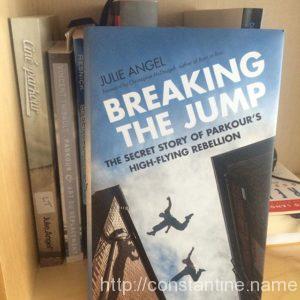
YES!

This arrived at my office while I was away… awesome work Julie! Thank you so much for all the effort that went into this book.

ɕ

Jun 4, 2015

Quiet

http://www.quietrev.com/manifesto/

Elsewhere, this is 4uquma1. — slipbox

The Quiet Revolution: Have you ever read the book Quiet by Susan Cain? Here’s . . . well, her next project? a companion project? you decide.

ɕ

Sep 4, 2015

Days off

Resting the ‘ol bones, and exercising the grey matter, with a superlative book by Vincent Thibault in my new, favorite-spot.

Update: I’ve started an entire series of posts as part of my studying this book. Study inspired by Pakour & Art du Déplacement by V. Thibault.

ɕ

Sep 13, 2015

Parkour & Art du Déplacement

https://www.librarything.com/work/17885382

On September 4th, Vincent Thibault’s latest book, Parkour & Art du Déplacement: Lessons in Practical Wisdom came out on Kindle. (A print version is eminent.)

I was in Québec at the time, and it felt like an early birthday present. I took most of the day off to sit in a beautiful park, on a spectacular day. I devoured the entire book in one sitting. With every page, I became more convinced that I was going to be spending a lot of quality time with this book.

This book brings a fresh approach to understanding and exploring Parkour/Art du Déplacement/Free Running. No pictures, no explanations of techniques. Instead, it provides 90 distinct thoughts and ideas giving you the option of exploring your Parkour/ADD in your own way. You can read the entire book, or dive into one particular idea at a time. If you read it overall as one piece it will give you a great introduction to the Spirit and Philosophy of Parkour/ADD; If you want to “dive deep”, you can pick each of the ideas apart separately and explore them through your own thinking, exploration and communications with others.

The book includes both English and French written by the author — this is an exceptional feature of the book. Rather than being translated, Thibault is able to convey the ideas naturally in both languages. Native speakers of English or French will benefit equally.

Finally, this is the first book (that I’m aware of) which literally bridges the two most important languages encountered in the context of Parkour/ADD. If you are working on one of them as a second language, you can flip between the two language versions of the material and be assured you are getting a nuanced, and accurate, translation of the concepts.

ɕ

Sep 14, 2015

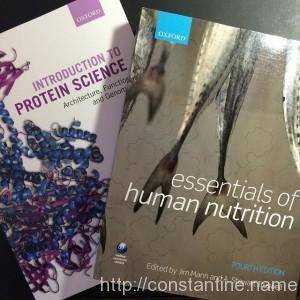
Proteins and Nutrition

Latest additions to the library. Much grey matter exercise ahead!

ɕ

Jan 5, 2016

CANT

This IS why LVPK doesn’t use a certain word.

ɕ

Jun 1, 2016

§6 – I Choose To Fall!

I’ve now read the entire book several times, and Chapter 6 never ceases to inspire!

Three thoughts:

I may not be the strongest. I may not be the fastest. But I’ll be damned if I’m not trying my hardest.

~ unknown

It ofttimes requires heroic courage to face fruitless effort, to take up the broken strands of a life-work, to look bravely toward the future, and proceed undaunted on our way. But what, to our eyes, may seem hopeless failure is often but the dawning of a greater success. It may contain in its debris the foundation material of a mighty purpose, or the revelation of new and higher possibilities.
…
Failure is often the turning-point, the pivot of circumstance that swings us to higher levels. It may not be financial success, it may not be fame; it may be new draughts of spiritual, moral or mental inspiration that will change us for all the later years of our life. Life is not really what comes to us, but what we get from it.

~ Chapter 14, “Failure as a Success”, from Self Control, Its Kingship and Majesty, by William George Jordan, 1907

The application in the Ways is to falls in life. To be able to take a disaster or a great failure, with the whole personality, without shrinking back from it, like the big smack with which the judo man hits the ground. Then to rise at once.

Not to be appalled at a moral fall. Yet it is not that it does not matter. The judo man tries by every means not to be thrown, but when he is thrown it does not hurt him and in a sense it does not matter. It matters immensely, and yet it does not matter.

‘Falling seven times, and getting up eight.’

~ “Falling”, from Zen and the Ways, by Trevor Leggett, 1978

ɕ

Jul 6, 2016

Breaking the bookshelf

Read all the books! Gee… about a hundred books on my to-read pile, where should this one go now that the pre-order wait is finally over?!

ɕ

Aug 22, 2016

Hermann Hesse on the three types of readers and why the most transcendent form of reading Is non-reading

For this reader follows the poet not the way a horse obeys his driver but the way a hunter follows his prey, and a glimpse suddenly gained into what lies beyond the apparent freedom of the poet, into the poet’s compulsion and passivity, can enchant him more than all the elegance of good technique and cultivated style.

~ Hermann Hesse from, Hermann Hesse on the Three Types of Readers and the Most Transcendent Form of Reading – The Marginalian

Elsewhere, this is 4ubahe4. — slipbox

ɕ

Aug 28, 2016

Pioneering scientist Erwin Chargaff on the power of being an outsider and what makes a great teacher

If there is such a thing as a great scientist … that greatness can certainly not be transferred by what is commonly called teaching. What the disciples learn are the mannerisms, tricks of the trade, ways to make a career, or perhaps, in the rarest cases, a critical view of the meaning of scientific evidence and its interpretation. A real teacher can teach through his example — this is what the ducklings get from their mothers — or, most infrequently, through the intensity and the originality of his view or vision of nature.

~ Erwin Chargaff from, Pioneering Scientist Erwin Chargaff on the Power of Being an Outsider and What Makes a Great Teacher – The Marginalian

Elsewhere, this is 4ubaei4. — slipbox

ɕ

Nov 17, 2017

Books are key

Books are key to understanding the world and participating in a democratic society.

~ Carl Sagan

Elsewhere, this is 4a781. — slipbox

Nov 17, 2017

Carl Sagan on the Power of Books and Reading as the Path to Democracy

Books are key to understanding the world and participating in a democratic society.

~ Carl Sagan

Elsewhere, this is 4a781. — slipbox

I don’t think it has to be physical books — recall Mr. Sagan is from the pre-Internet epoch — but definitely *reading*, and definitely you have to be doing the hard work of deciding for yourself what you are reading.

ɕ

Feb 18, 2018

Moloch

In Allen Ginsberg’s poem “Howl” (1955), Moloch is used as a metaphor for capitalism and industrial civilization, and for America more specifically. The word is repeated many times throughout Part II of the poem, and begins (as an exclamation of “Moloch!”) in all but the first and last five stanzas of the section.

~ from Moloch

Elsewhere, this is 4uwiwi2. — slipbox

I just recently, (in the scale of my life,) stumbled over an explicit reference to Moloch. I was all like, “Moloch? Who the what is that? *bookmark*”

I finally got around to reading the WikiPedia article and realized that there’s a huge amount of Moloch wriggled into and behind a ton of the classic fiction which I love.

ɕ

Mar 20, 2018

No instruction manual

The fact that you can’t remember an agreement you made with yourself doesn’t mean that you’re not holding yourself liable for it. Ask any psychologist how much of a sense of past and future that part of your psyche has, the part that was storing the list you dumped: zero. It’s all present tense in there. That means that as soon as you tell yourself that you should do something, if you file it only in your short-term memory, that part of you thinks you should be doing it all the time. And that means that as soon as you’ve given yourself two things to do, and filed them only in your head, you’ve created instant and automatic stress and failure, because you can’t do them both at once, and that (apparently significant) part of you psyche will continue to hold you accountable.

~ David Allen, from Getting Things Done

…yes another quote from the GTD book.

In the first half of my life — say to age 40 — I made a HUGE MISTAKE: I presumed that I had a reasonable understanding of how my brain worked. I don’t mean at a physiology level; I still don’t really understand that. I mean at a day-to-day-doing-stuff, when-I-do-this-then-this-happens, this-is-how-one-lives sort of level. Like how I thought I knew how to use my brain to decide what to eat, what to work on, what to read, what to do with my time . . .

Now why on earth did i think I had any idea?

Seriously: You think of “me” as this “self-thing” located behind your eyes, but that “you” is just “running” in/on your brain. So have you ever tried different ways of running your life? How do you know reading some such book will or won’t change your life? Maybe you should experiment with everything. Try something radical: Pay attention to the results. You’re ALREADY following lots of advice — my advice, your mother’s advice, the TV ads’ advice, your doctor’s advice — but have you ever bothered to figure out what the results are? Then make a deliberate change intended to move you toward a specific goal. Observe results. Then make another change. Then another. And another.

I mean, it’s not like your entire life depends on the choices you … oh wait. *lightbulb*

ɕ

Mar 28, 2018

Code of conduct, and Principles

[We] spent weeks drafting the core principles that would support our classroom. We scribbled them down, and over the years they have become clearer and more concise:

Defining humanity, both masculinity and femininity based on the strength of your relationships and the contributions you make to society.

Developing relational skills with teammates, parents, siblings, teachers and friends and learning to maintain and sustain strong positive friendships.

Developing empathy toward others so that you can be supportive and understanding.

Practicing good sportsmanship before, during, and after practices, games, and events, and in life.

Defining success in life as being relationally successful and having a cause bigger than yourself.

Acting with integrity in every area of your life

Contributing to society by taking it upon yourself to get invollved in actions and projects that make the world better in some way.

Becoming an advocate of justice and an ally with others by speaking up on behalf of others and against injustice.

Refraining from committing acts of injustice, including bullying, harassment, racism, sexism, homophobia, and other forms of hurtful behavior and not accepting or tolerating this kind of behavior in others.

Refraining from violent behavior and learning how to resolve conflict in a postiive and productive manner.

Developing a coherent narrative by making sense of your life experiences, good, bad, and ugly.

~ Joe Ehrmann, InSideOut Coaching pgs 166-7, https://www.librarything.com/work/11172773

And…

COACHES’ CODE OF CONDUCT

The purpose of our coaching is to help boys become men of empathy and integrity who will lead, be responsible, and change the world for good.

Be mindful never to shame a player, but to correct him in an uplifting way. Affirmation!

Believe in every player. Remember, “In youth is where miracles are made.”

Protect our players. Be big enough to build up, not tear down. Our kids are getting attacked from many places that we don’t often see and of which we are not aware.

Remember our job is to put our players in a position where they can develop to their fullest potential through proper teaching and nurturing.

Each player is part of our family, deserves every chance to succeed, and deserves the utmost respect.

Coaches can disagree in meetings but never in front of our players or anyone else outside our family. Disagreements are saved for private meetings.

Our players are student-athletes and we are teacher-coaches. We hold ourselves accountable as teachers of young men and the lessons they need in order ot navigate masculinity and life.

If you do not know, say so and get approprate information. Don’t bluff our kids! They know the difference.

Remember that parents are our parnters. We strive to work with each family in helping their sons succeed. “Every boy is a son to his mother and father.”

Love your players and the other coaches.

No profanity!

Know the difference between shaming and coaching. No screaming, shaming, swearing, or sarcasm.

Don’t be afraid to apologize! We all make mistakes. When mistakes are made publicly, apologize publicly; when mistakes are made personally, apologize personally.

We are nurturing successful people, not just successful athletes.

Treat all opposing coaches and their taems with the honor true competitors deserve.

Respect all referees, officials, and timekeepers. They are imperfect and trying their best just as we are.

Regardless of our wins and losses, we will be successful if we carry out the above items.

Because I am a role model who has the power, position, and platform to make a positive difference in the lives of my players, I commit to this code of conduct. When failing to live up to our standards I will allow for accountabiity and take responsibility for my actions.

~ Joe Ehrmann, InSideOut Coaching pgs 191-3

These are much bigger than my usual pull-quotes. …both in the sense of word-count and in the sense of potential value if they were more widely known.

Ehrmann is writing in the specific context of sports-coaching boys in primary schooling, but one could easily trim out the parts that are specific to sports and still be left with a very useful set of principles, and a well-thought-out code of conduct. If you coach– no actually, scratch that– If you are a human being, I highly recommend you read this book.

ɕ

Jun 6, 2018

Sleep smarter

The International Agency for Research on Cancer has now classified overnight shift work as a Group 2A carcinogen. This means that staying up late repeatedly, and working overnight, is a strong enough cancer-causing agent to be lumped in with lead exposure and UVA radiation. That might sound crazy, but there s now a ton of scientific data showing exactly how this happens.

~ Shawn Stevenson, pg 43 of Sleep Smarter

Shift work that involves circadian disruption? Carcinogen.

A while back I wrote a piece on Sleep. It turned into three parts and after writing it, I felt I had only scratched the surface. Then I stumbled over this book.

I read the book and it’s really good! I blasted through it agreeing all the way. If you know everything about sleep, you’ll still enjoy seeing it all laid out in an approachable fashion. If you have NOT YET MASTERED SLEEP — wait, what is wrong with you?! Sleep is the single most important thing in your life. It is the activity you spend the most aggregated time doing. Remind me why you have not spent time studying sleep and improving yours?

ɕ

Jun 11, 2018

That royal road to the physical and mental derangement of mankind

And here I would like to add a word of warning to those I am trying to help, for a study of the letters in which the writers tell of experiencing difficulty in understanding, show signs of having been written after a quick reading rather than a close and careful study of the subject matter. I read recently an article suggesting that people should practise reading quickly, although the habit of too quick reading in which understanding becomes dominated by speed — that royal road to the physical and mental derangement of mankind — is an only too common failing today. This is only one example of the habit of too quick reaction to stimuli in general, and to its prevalence may be traced most of the misunderstandings, misconception and misdirecrion of effort manifested by the great majority of people today in conducting matters relating to the body politic.

~ F Matthias Alexander, in the 1941 preface to new edition of “The Use of the Self”, The Use of the Self by F.M. Alexander

There is nothing new under the sun.

ɕ

May 3, 2019

What feels right is probably wrong

This leads me to the point I wish above all to emphasize, namely, that when a person has reached a given stage of unsatisfactory use and functioning, his habit of ‘end-gaining’ will prove to be the impeding factor in his attempts to profit by any teaching method whatsoever. Ordinary teaching methods, in whatever sphere, cannot deal with this impeding factor, indeed, they tend actually to encourage ‘end-gaining.’ The instruction given to the golfer of our illustration to keep his eyes on the ball is typical of the kind of specific instruction given by teachers generally for the purpose of eradicating specific defects in their pupils, and, as we have seen in this case, this instruction was a stimulus to him to try harder than ever to gain his end, and so to misdirect his efforts worse than ever.

~ FM Alexander, The Use of the Self, pp66-67, 1932 (emphasis added)

I think there’s a lot more context necessary for that to make sense. One could go read the book; It’s small. But setting that aside for the moment.

Alexander raises the important point that what feels right may in fact be wrong. So the harder I try to do something correctly, by trying to do what feels right, the more likely I am to reinforce doing what is wrong. This starts to make more sense once I understood that the Brain is a Multi-layer Prediction Model. Once something is modeled incorrectly—when I move this way, it feels right—it’s going to be really difficult to change that model.

ɕ

Jul 15, 2019

§17 – Be that guy

After too many readings to remember, I’m still at a loss to summarize my thoughts. The difficulty is that this is an area of my life with which I currently struggle daily.

There is a basic challenge-level to reality: There is a stone in my shoe. It’s time to mow the lawn. This bill should be paid. I’m great at handling huge numbers of these basic sorts of challenges. Unfortunately, the positive thinking of chapter 17 doesn’t give me a handle on solutions to basic challenges. …and I am completely swamped with these sorts of basic challenges.

Don’t conflate basic with easy. All of the easy, basic challenges I have under control; They are already done, or are managed by reliable systems. What I’m left with are the remainders—a pile of difficult, basic challenges. Things for which positive thinking still gives me no purchase.

I don’t have much of a grasp on this chapter. But then, that’s why I’m studying this book and using its chapters as jumping-off points for my thoughts.

ɕ

Aug 7, 2019

§19 – One word

What is it, in this sport or project, that moves me, motivates me, nourishes me—and helps me thrive and shine?

~ Vincent Thibault

What facilitates my flourishing? Today, I’m going to say it’s space.

Not physical space—although there’s a nice metaphor here about having things planted too closely in a garden and how that affects the plants’ flourishing. No, not physical space; I’ve plenty of that.

Perhaps not even mental space—I’m certainly buffeted about by the myriad winds of demands and responsibilities. But with very few exceptions, I’ve created all of those zephyrs. No, although I have left myself no mental space, I am able usually to create it on demand.

Most likely it’s emotional space. The idea that we need room to soak in the emotional experiences that go along with the reality of things, events, and people, and to do that with no specific “why” in mind.

ɕ

Aug 14, 2019

On being wrong

I’ve come to realize that I love being wrong.

I spent so many years reinforcing the thought that I could be the guy; The guy who swoops in and solves the problem when things get technically complicated, the guy who swoops in and creates order and process out of the chaos, the guy who swoops in and gets things done. Setting aside the analysis of whether or not I was actually particularly good at that, I did “I can be that guy” so much that I had convinced myself that I am that guy.

In The Coaching Habit, Michael Bungay Stanier talks about the Karpman drama triangle. I’ve certainly played all three roles of Persecutor, Victim and Rescuer. But I realize now that I’m addicted—or perhaps I can be hopeful enough to say was addicted?—to being the Rescuer. In the past year or so it’s become clear to me that it’s vastly more healthy and fun(!) to be part of a team that solves problems and gets things done.

To be the person who asks a question that opens a flood gate of discussion.

To be the person who understands that one’s purpose was to have been instrumental in creating the environment last week, so this week the team solves the problem on its own.

To be the person who is a complete and utter success, by having simply contributed a small addition here, a minor adjustment there.

ɕ

Aug 15, 2019

Books

I read now for the same reasons I read then — to feel less alone. But I read for more than that: Reading teaches me the answers to problems I haven’t had yet, or to problems I didn’t even know how to describe. And when I feel less alone with what troubles me, it is easier to find solutions. A book to me is like a friend, a shelter, advice, an argument with someone who cares enough to argue with me for a better answer than the one we both already have. Books aren’t just a door to another world — each book is part of a door to the whole world, a door that always has more behind it. Which is why I still can’t think of anything I’d rather do more than read.

~ Alexander Chee, from A Velocity of Being, which I found via, Alexander Chee’s Lovely Letter to Children About How Books Save Us – The Marginalian

Elsewhere, this is 4ubaae3. — slipbox

I’ve mentioned elsewhere that growing up, it was a 20-minute drive to anything. A true bookstore, or even a public library, was farther still.

But I do distinctly remember the feeling of being among books. At a book store, at my high school’s library, at the closest [small] city’s public library, and eventually at my university’s two libraries. To be honest, I don’t know when last I thought of that feeling, until it bubbled up, just now as I write. The lighting. The sound-scape. The smells. The furtniture. And of course the books. Knowledge and experiences and surprises and questions beyond belief.

(Woa! I just remembered the huge amount of time I spent thinking about one day having a proper study. My own personal library, meets workspace, meets inner sanctum. And I’m reminded that I’m currently obsessed with finding a good chair for reading.)

But it’s all about the books.

Carl Sagan captured it best when we said, “Humans work magic.”

ɕ

Aug 21, 2019

Just a chair

It’s all about the context. I find that having certain spaces where I do certain things works wonders. For example, if I want to do certain kinds of work, I sit here and all my tools are arrayed. In general, the act of showing up at the designated area and having the environment pre-set to be conducive to the activity is often enough to get my brain to shift into the mode I need.

Have you ever tried to find a chair for reading?

For about a decade I’ve had a typical Pöang chair from Ikea that I sit in to read. It’s absolutely horrible for reading. But it’s better than any chair I have in my house. So buy a chair Craig! …if only I could find one.

High enough at the back so I can rest my head. The whole chair tipped back far enough that I can completely relax and have all of my body settle into the chair. Feet flat on the floor. Padded arm rests. Arm rests high enough that when I hold the thing I’m reading it’s up at eye level.

Sorry. This quest is driving me bonkers.

ɕ

Sep 2, 2019

Reading is a superpower

The genuine love for reading itself, when cultivated, is a superpower. We live in the age of Alexandria, when every book and every piece of knowledge ever written down is a fingertip away. The means of learning are abundant—it’s the desire to learn that’s scarce. Cultivate that desire by reading what you want, not what you’re “supposed to.”

~ Naval Ravikant

Elsewhere, this is 4a180. — slipbox

Sep 11, 2019

Impermanence

I don’t know why we long so for permanence, why the fleeting nature of things so disturbs. With futility, we cling to the old wallet long after it has fallen apart. We visit and revisit the old neighborhood where we grew up, searching for the remembered grove of trees and the little fence. We clutch our old photographs. In our churches and synagogues and mosques, we pray to the everlasting and eternal. Yet, in every nook and cranny, nature screams at the top of her lungs that nothing lasts, that it is all passing away. All that we see around us, including our own bodies, is shifting and evaporating and one day will be gone. Where are the one billion people who lived and breathed in the year 1800, only two short centuries ago?

~ Alan Lightman from, The Accidental Universe

It seems obvious to me that apprehending the impermanence of everything is necessary in order to remain sane. Obviously my entire existence is an immeasurably tiny fraction of an instant. Obviously there is no ultimate “point” to all of this. Obviously there is no one true meaning of life.

It removes a lot of baggage and struggle once you realize that reality is in fact the real situation you are in.

…and then you’re free. Free to create, conjure, combine, laugh, love, learn, run, ramble, perable, talk, commiserate, procreate, invent, integrate, mix, mingle and just generally ENJOY LIVING.

ɕ

Oct 12, 2019

Be proactive

While the word “proactivity” is now fairly common in management literature, it is a word you won’t find in most dictionaries. It means more than merely taking initiative. It means that as human beings, we are responsible for our own lives. Our beavior is a function of our decisions, not our conditions. We can subordinate feelings to values. We have the initiative and the responsibility to make things happen.

~ Stephen Covey

Elsewhere, this is 4a453. — slipbox

Oct 17, 2019

Begin with the end in mind

Each part of your life can be examined in the context of the whole, of what really matters most to you. By keeping that end clearly in mind you can make certain that whatever you do on any particular day does not violate the criteria you have defined as supremely important, and that each day of your life contributes in a meaningful way to the vision you have to your life as a whole.

~ Stephen Covey

Elsewhere, this is 4a450. — slipbox

Oct 22, 2019

Put first things first

The degree to which we have developed our independent will in our everyday lives is measured by our personal integrity. Integrity is, fundamentally, the value we place on ourselves. It’s our ability to take and keep commitments to ourselves, to “walk our talk.” It’s honor with self, a fundamental part of the Character Ethic, the essence of proactive growth.

~ Stephen Covey

Elsewhere, this is 4a570. — slipbox

Oct 27, 2019

Think win/win

Most people tend to think in terms of dichotomies: strong or weak, hardball or softball, win or lose. But that kind of thinking is fundamentally flawed. It’s based on power and position rather than on principle. Win/Win is based on the paradigm that there is plenty for everybody, that one person’s success is not achieved at the expense or exclusion of the success of others.

~ Stephen Covey

Elsewhere, this is 4a139. — slipbox

Oct 31, 2019

Territorial, not hierarchical

It has to be territorial, not hierarchical. Meaning real success comes from the inside out, not the outside in. Real success is the process, not the product. It’s what we would do if there were nobody else in the world, yet it depends in the end on everyone else in the world. The essential expression of our art is that of a gift. We draw from that which is most ourselves–and then offer that essence to our fellow travelers on this planet, to help them, entertain them, show them they’re not alone … asking nothing in return (well, maybe enough to pay the rent, we hope.)

~ Steven Pressfield

Elsewhere, this is 4a489. — slipbox

This is a classic that has nothing at all to do specifically with writing. If you are involved in creating anything, you will find this is a great article with a long list of elements of success. (“Elements of Success” is his title.) After you read this, you should run—not walk—and get a copy of his book War of Art; you can thank me later.

Anyway.

The paragraph above really spoke to me. The idea that “success is the process” is something I keep losing hold of. Like a swimmer who keeps forgetting that kicking effectively and continuously is a necessary part of staying afloat and getting there, I keep forgetting that the process is success and I begin to struggle.

ɕ

Nov 1, 2019

Seek first to understand, then to be understood

You’ve spent years learning how to read and write, years learning how to speak. But what about listening? What training or education have you had that enables you to listen so that you really, deeply understand another human being from that individual’s own frame of reference?

~ Stephen Covey

Elsewhere, this is 4a102. — slipbox

Nov 3, 2019

Depth of learning

Working deep is the answer for me. To be happy, to feel good about myself, to not feel guilty about sucking up my share of oxygen on the planet. I have to get back to it.

~ Steven Pressfield from, Writing Wednesdays: Depth of Work

Elsewhere, this is 4usewi2. — slipbox

I too am drawn to deep work. I wonder if there’s anyone who is not?

But for me, deep work seems to not be enough. I also need deep learning. I need to spend two uninterrupted hours reading something, (perhaps S Ambrose’s Eisenhower, or T Ferris’s Tribe of Mentors,) with stops to copy out quotes, detours to lookup some detail, bookmarking of another author’s work, and so on. My mind is one large pressure-cooker, and I need to regularly vent the pressure, pop the lid and jam new stuff in before sealing it back up again on medium heat.

Roughly a quarter of U.S. adults (27%) say they haven’t read a book in whole or in part in the past year, whether in print, electronic or audio form, according to a Pew Research Center survey conducted Jan. 8 to Feb. 7 [2019].

https://www.pewresearch.org/fact-tank/2019/09/26/who-doesnt-read-books-in-america/

Elsewhere, this is 4upefa1. — slipbox

Interesting article that digs into who exactly is, and isn’t, reading. Want to change your life?

Read more.

ɕ

Nov 6, 2019

Synergize

What is synergy? Simply defined, it means that the whole is greater than the sum of its parts. It means that the relationship which the parts have to each other is a part in and of itself. It is not only a part, but the most catalytic, the most empowering, the most unifying, and the most exciting part.

~ Stephen Covey

Elsewhere, this is 4a166. — slipbox

Nov 11, 2019

Sharpen the saw

It’s preserving and enhancing the greatest asset you have–you. It’s renewing the four dimensions of your nature: physical, spiritual, mental, and social/emotional. … “Sharpen the saw” basically means expressing all four motivations. It means exercising all four dimensions of our nature, regularly and consistently in wise and balanced ways.

~ Stephen Covey

Elsewhere, this is 4a436. — slipbox

Feb 19, 2020

Single-serving sized visits with books

Imagine you have a book problem. (Don’t judge me, please.) You’ve read countless books. You’ve given away countless books in an attempt to get the foundation of your house to stop settling to one side. You’ve gone through your to-read book shelves and culled as many as you can bear over to the normal shelves, resigned to being okay with never reading them.

…and you still have hundreds of books that you really want to read.

There are two common ways that people recommend reading books: One-at-a-time, (whether thoroughly and carefully cover-to-cover or by breezing through them more quickly,) and multiple-at-a-time. In both ways however, you intend to pick some book and to completely, (whatever that means to you,) read the book.

I want to explain a third way: Single-serving sized visits.

Begin by allocating a set amount of time. Something like 45 minutes seems to work well for me, but it can be any amount that you can do in one sitting. Extra bonus points if you can make this a recurring thing you do regularly.

You will need post-it notes and a writing instrument. You will not need a bookmark.

You’re going to pay a short visit, (say 45 minutes,) to your book collection by picking one book. Take the book (and your post-its and your writing instrument) and head for your reading spot. (You do have a designated reading spot, right? :)

Spend 45 minutes reading the book however you wish. Skim it. Read the prologue. Dig deep into chapter 4. Start reading at page 88. Turn it upside down and read it [upside down] backwards. Whatever. If you really don’t like the book, you can walk out on the date and put the book on your read pile.

As you read it insert post-its…

  1. …on the upper edge of pages whenever you find a reference to any other book. It doesn’t have to be a book you have, or have read, or even want to read. Just start leaving “top” post-its referring to books. Write the name, (and author, etc., as much or as little as you like—”I have this”, “I want this book”, whatever) on each note.
  2. …on the outer edge of pages whenever you find something interesting. A quote, an idea, killer prose, whatever. Write a note explaining the reason you like what you’re noting, maybe try to position the post-it, and include a little arrow that points to the part—Or just a blank post-it, and write directly in your book if that’s your style.

After the allotted time, your visit is over. Put the book back, either in the to-read area, or maybe in the read-these area. (If you bother to distinguish.)

Over time, you will slowly get to know more and more of your books. You won’t feel like you need to read the books—you already know you can’t possibly finish them all. At least this way you’re going to have hundreds of great little visits with these ideas you’ve collected.

Over time, you’ll find more and more top post-its as you build mental links to other books. You’ll find all those side post-its marking ideas you like. You can also pick up a book and see what you think of it— I’ve never touched this book. [It has no post-its.] I clearly love this book. [It furry with notes.] When you want to recommend a book, you are likely to have post-its that have the good bits you’ll want them to see first. The top post-its are going to suggest other books in your collection you might want to visit next.

…and on and on.

ɕ

Feb 22, 2020

Time management

As addicting as it is, desire is the enemy to proper time management. Poor sleeping habits, unhealthy lifestyle choices, and just plain dissatisfaction are all byproducts of a poorly managed life.

~ Ryan Holiday from, 5 Stoic Lessons On Time Management

Elsewhere, this is 4udaso2. — slipbox

Time management is the only thing—the only major skill critical for leading a good life… Time management is the only thing which no one ever attempted to teach me explicitly. Everything else was covered to some degree: science, religion, morality, philosophy, work ethic, hygiene, sexuality, language, geography, personal finance, and more, depending on how you want to subdivide all the stuff in my head.

Time management isn’t the most critical thing to know. Language and critical thinking are the top two, because with those two and sufficient time you can bootstrap everything else. However, things would be far better for everyone, if the third item on the list of must-have skills to be Human was a basic grasp of Time Management.

For me, I was trying to fix my sleep when it became obvious that I needed to arrange my day around sleeping. That lead immediately to an entirely new need for time management. “I need to be at work by 8,” is not Time Management (with capitals.) I then took a circuitous route discovering the needs and methods of Time Management.

But where do I wish I had actually started? That’s an excellent question. Right around 18 years old, I wish someone had handed me a copy of this tiny book: How to Live on 24 Hours a Day by A Bennet.

ɕ

Mar 22, 2020

To choose one’s attitude

We who lived in concentration camps can remember the men who walked through the huts comforting others, giving away their last piece of bread. They may have been few in number, but they offer sufficient proof that everything can be taken from a man but one thing: the last of the human freedoms—to choose one’s attitude in any given set of circumstances, to choose one’s own way.

~ Viktor Frankl

Elsewhere, this is 4a36. — slipbox

Mar 30, 2020

It’s really good to be really bad

This is an idea I’ve come across repeatedly during the research I’ve conducted for my various books. There’s something incredibly valuable in the deeply frustrating yet rewarding pursuit of mastering something hard.

~ Cal Newport from, The Deep Benefits of Learning Hard Things

Elsewhere, this is 4ucabo19. — slipbox

This idea comes up all over the place, and for good reason. Nearly 3,000 years ago, people like Marcus Aurelius where writing things about the absolute necessity of continual self-study and self-improvement. Books such as G Leonard’s, Mastery and countless bits on the Internet about self-improvement. My personal, direct efforts applied to myself—find some idea, reflect on it, then figure out how (if! of course) to apply it to myself… My efforts remain ongoing.

( I need a special character, or something, that I can put before these questions, to make it clear that I mean this entirely in a non-judgemental way– I only intend to spur your thinking… )

What are you up to?

ɕ

Apr 22, 2020

Stop drifting

Stop drifting. You’re not going to re-read your Brief Comments, your Deeds of the Ancient Greeks and Romans, the commonplace books you saved for your old age. Sprint for the finish. Write off your hopes, and if your well-being matters to you, be your own savior while you can.

~ Marcus Aurelius

Elsewhere, this is 4a71. — slipbox

Normally I would simply let a quote from Aurelius stand on its own. If you’re not familiar with Meditations—Aurelius didn’t choose that title for what he wrote, it was added to his work much later—it was a collection of writings he meant only for himself; this is the emperor of the Roman empire remonstrating himself.

Here’s a second helping of remonstration: Explore. Dream. Discover.

I write this blog for myself. (And no, I’m not laboring under the delusion that I’m creating a work for the ages like Aurelius’s, Meditations.) But I am simply pleased if you, Dear Reader, find my ramblings interesting. I am genuinely delighted if anything I write stimulates your thinking. I am downright ecstatic if any of my questions catalyze your changing the course of your life.

Do you read regularly, and what have you chosen to read with the aim of changing the course of your life?

ɕ

Apr 28, 2020

Honing your craft

We’ve created this fantasy world where everyone is just 30 days of courage boosting exercises and life hacks away from living an amazing life.

But when you study people like Martin, who really do live remarkable lives, you almost always encounter stretches of years and years dedicated to honing craft.

~ Cal Newport from, Closing Your Interests Opens More Interesting Opportunities

Elsewhere, this is 4ucabo13. — slipbox

This is the eternal challenge of seeing the forest through the trees; of maintaining perspective.

I’m constantly reminded of the scenes in the Hobbit where they are trying to walk through 250 miles of a forest named, Mirkwood. “Do not leave the path,” is the only guidance they are given. After what seems like endless daily struggles, they eventually dispatch a party member to climb a singularly large tree to the uppermost branches. Unfortunately, even from that lofty perch all that could be seen was more forest forever and ever in every direction. In fact, they were in a low lying area, reasonably close to the forest edge. Crushed by the misleading perspective, their journey takes a turn for the worse.

I have so many projects where I start into the forest with the best intentions. I steel myself with, “I know this is going to turn into a slog at some point, and I’m going to remember why I went into the forest to give me the strength to carry on!” Yeah, that never works out. If the project is actually worth doing, then the forest is necessarily crushingly vast and the journey through must eventually become hopeless. Of course it’s hard; that’s what makes it worth it.

The secret? You have to love living in the forest, just for the sake of living in the forest. Then every morning is an adventure. Sure, some days are going to suck, but every morning will begin a new day of opportunity.

ɕ

May 4, 2020

Frog or bird?

He described himself as a frog not a bird, as he enjoyed jumping from pool to pool, studying their details deeply in the mud. The bird’s-eye perspective was not for him, and he had a lifelong suspicion of grand unified theories.

~ Robbert Dijkgraaf from, Remembering the Unstoppable Freeman Dyson

Elsewhere, this is 4uqure1. — slipbox

Freeman Dyson’s, Frogs and Birds is also worth a read.

There is such an insanely huge amount of things I want to read. Web pages, PDF files, ePub documents in Kindle and Nook, and of course stacks of physical books. I read a lot, but of course I’ll barely scratch the surface of just the things I’ve actively decided I want to read. Fortunately, I’m no longer reading to reach a goal, or to finish.

My mind is but a tiny eddy of order, maintained every so briefly within the grand arc of time.

…and what fun it is to go frolicking through the works of mankind, sharing the occasional bit here with you!

ɕ

May 5, 2020

Blindingly obvious

A few weeks ago I had a rapid sequence of ideas related to reading books. All of these are blindingly obvious in hindsight:

One can gang books together when reading. Grab Aurelius’s Meditations, Frankl’s, Man’s Search for Meaning, Seneca’s Letters, and Epictetus’s Discourses, Handbook and Fragments—and read a little from each of them in each sitting. Or grab the Constitution of the United States, The Federalist Papers, the Anti-Federalist Papers, and Stevens’s Six Amendments. (What “gang” of books springs to mind for you?)

One is permitted to place multiple bookmarks in the same book. Yes I’ve long advocated adding sticky notes to mark various things in a book as I go along. But the idea of reading in multiple places simultaneously in the same book hadn’t really occurred to me.

One can make their own bookmarks from 1/4″ satin ribbon! I have all sorts of bookmarks; things which slide onto the edge like a paper-clip, printed cards (“Remain calm. I’m the Doctor.” for example) with the usual string or ribbon from the end, 3×5 cards stuffed in randomly, and large sticky notes. But it’s way cooler to cut a length of ribbon and drape it through the book… just like really cool and expensive books which arrive with a bookmark sewn into their binding.

If you’re cutting ribbon to make bookmarks, you can easily attach it into the book just like the fancy books’ marks. Cut it long enough to: lay one end between the last two pages of the book, tight in against the binding, with the end near the top of the page, and the ribbon laying down the page. Flip a few pages on top of it to hold it in place, and lay the ribbon back up across the entire book again tight in against the binding. Now you have a bookmark that feels like it’s sewn into the binding when you grab the lower portion sticking out of the book as your mark.

My final thought in that recent cascade was of course: Okay, wow, I really have a book problem.

ɕ

May 11, 2020

Tell me if this sounds crazy

All of our books have a small dot on their spine.

It’s one thing to try to keep your books physically under control. It’s another task for Sisyphus to keep track of your books in general. Here’s how I do it:

  • Create a free account over on LibraryThing. Set up three collections: One for the books currently in our possession; “Library.” A second for books we’d love to have join us; “Wishlist.” A third for books that have passed through; “Previous.”
  • Get some small stickers, (1/4″ round ChromaLabels work great,) and some sticky notes.
  • Add each book to your “Library” collection in LT and put a sticky note inside the cover marked “LT”. I also track digital books, so I tag all the books in LT with “physical” or “digital”. Then put a dot on the spine so you don’t have open the book to check if there’s a sticky note inside.
  • Why both? Some books can’t accept the spine sticker, and sometimes the dot falls off. So the sticky inside the cover is the definitive mark that a book is in LT.
  • New book arrives? Add it to LT’s “Library” collection, tagged as “physical”, insert sticky note in the front, and add a dot to spine.
  • Book leaving my possession? Remove the dot and sticky note, and shift the book to the “Previous” collection in LT.

As you come across books you might want to read, add them to your Wishlist collection in LT. My Wishlist contains hundreds of books. (That’s not a brag, that’s a confession.) LT has a notes field and I often leave a clue about where/why I’m adding the book. When I later—having forgotten all about that book—go into LT to add it, only to discover it’s already there… “Hmmm, that’s twice now I’ve ‘discovered’ this book. Maybe I should read this book sooner than ‘some day’?” Such books I then tag, “priority.” I’ve about ~20 books tagged priority at the moment.

Yet another reason this is useful is that you can search via the LT website, or the mobile app, to see if you have/have-had any book. You can even wander through a bookstore, and know that your Wishlist is always in your pocket.

Does that sound crazy? Dammnit, that does sound crazy now that I typed it all out.

ɕ

Aug 28, 2020

Not satisfied

Of all people only those are at leisure who make time for philosophy, only they truly live. Not satisfied to merely keep good watch over their own days, they annex every age to their own. All the harvest of the past is added to their store. Only an ingrate would fail to see that these great architects of venerable thoughts were born for us and have designed a way of life for us.

~ Seneca

Elsewhere, this is 4a382. — slipbox

That quote opens Holiday’s, The Daily Stoic, which I have been circling through for a few years. Fortunately, I didn’t try to study Philosophy too early in life; it took me a couple decades once I started trying to improve myself for me to be ready to really listen. I hope you are far ahead of me.

In recent months I’ve been spending more time reading. The more I read, the more quotes I find to share, and the quote backlog is currently at level, “ridiculous.” I was scheduling quotes for publication in December of 2022 and finally decided I better schedule them more frequently. I have so many quotes that earlier this year I kicked off a podcast with daily quotes; search for “Little Box of Quotes” wherever you listen to podcasts.

ɕ

Nov 5, 2020

*click*

The power of preserving silence is the very first requisite to all who wish to shine, or even please in discourse; and those who cannot preserve it, have really no business to speak. … The silence that, without any deferential air, listens with polite attention, is more flattering than compliments, and more frequently broken for the purpose of encouraging others to speak, than to display the listener’s own powers. This is the really eloquent silence. It requires great genius—more perhaps than speaking—and few are gifted with the talent …

~ Arthur Martine from, The Art of Ordinary Conversation

Elsewhere, this is 4ufote1. — slipbox

Months ago, I presume, I had marked this Parrish article for later reading because it’s stuffed full of wonderful insight about conversation. That’s something about which I happen to be passionate, you know? Today I was giving it a thorough, leisurely read and the bit I quoted above screamed at me to be the lead quote of a post. I’d wager it caught my eye when I months-ago marked it for later reading. Turns out I have the book containing the original source, Martine, A. (1866), Martine’s Hand-Book of Etiquette, and Guide to True Politeness, pp 8-9, librarything.com/work/1885064/book/101201787

I read the book a decade (or more?) ago when I obtained it. But now I’m inspired to re-read a few of its chapters now that I’ve become reacquainted with conversation as an art in itself.

“Okay, Craig, get to the point.”

Sometimes bricks of thinking and action click perfectly into place. In this case: A web page from 2013 which I’m only just reading in 2020, a different web page I read a decade ago, an author working just after our Civil War, my personal journey, my interest in conversations and podcasting. I quite often worry about all the things I regularly jam into my brain; they’re good things, but they are so numerous that my brain sometimes feels overstuffed! And then, click. It’s all worth it.

Do you have ways of regularly exposing your self to… well… whatever it is you need to feed your mind?

ɕ

Nov 11, 2020

Push and pull

Aside: Like yesterday, there’s no conclusion here today.

A large part of books’ allure is that they never interrupt. They sit inert, exactly where you leave them, (physically or digitally,) and respond the instant you decide you want to engage. You are in total control. Eons ago, I saw the difference between books and the Internet described, overly simplistically, as “pull” versus “push” modes of information flow. That’s true for a book; a book is completely pull oriented. However, the Internet can be used in either mode. It can both “push” information at you and enable you to “pull” information towards yourself.

I became convinced that I needed to pull information towards me and ruthlessly prevent any pushing. This was a simple continuation of my love of books and reading. Reading exposed me to so many new ideas, so I expanded the trawling into the Internet, and to make room for the new things I was finding I squelched things that were being pushed at me. Over many years I began to read trade publications slowly learning which ones were just advertising vehicles and which ones contained real ideas. I joined professional organizations and read their publications. I found web sites that were things I wanted to read and dutifully kept up with them, (either by visiting regularly or by following their RSS feeds.)

I was eventually in complete control of what information I was exposed to. Nothing was being pushed at me against my will, but this became far too much to keep up with. And once the pulling becomes a habit, it’s effectively pushing. I burnt out and crashed hard. I rage-quit a number of things I had been keeping up with, and stopped visiting a swath of great web sites. I began reading physical books more, but this it was only a sort of reset. It left me back at the beginning; I’d learned a lot about how to manage my exposure to information but I was once again starved for new information. These days, I’ve renewed interested in some sort of “knowledge system” and in addition to points I made yesterday it’s also a way to manage this pull-versus-push problem.

More than half a century before blogging, Instagramming, tweeting, and the rest of today’s ever-lowering barriers of entry for publishing content, Bush laments the unmanageable scale of the recorded human experience.

~ Maria Popova from, As We May Think: Vannevar Bush’s Prescient 1945 Vision for the Information Age, the Power of “Curation,” and the Need for Open-Access Science

Elsewhere, this is 4ubaae2. — slipbox

After a bit of cool perspective from history, it gets around to talking about the importance of not just categorizing and compressing information for storage—think “library” or “internet”—but the ultimate importance of being able to use the information. Spot on this topic I’ve been slowly trying to unpack.

So, thinking about a knowledge system in the context of pulling information: I currently have a lot of fresh information that I pull; I could say I’m regularly exposed to many new ends of thread. However, I also want to be able to pick a thread, (or two or three,) and to be able to continuously pull on it. My knowledge system should enable that.

ɕ

Dec 8, 2020

Second order effects

In short, stop optimizing for today or tomorrow and start playing the long game. That means being less efficient in the short term but more effective in the long term. [… I]f you play the long game you stop optimizing and start thinking ahead to the second-order consequences of your decisions.

~ Shane Parrish from, 10 Principles to Live an Antifragile Life

Elsewhere, this is 4ufoaa4. — slipbox

Fundamentally, we humans and our lives are not mathematically tidy.

Aside: I had a math course once—I can’t even remember the material—and the professor said, “it’s a very subtle point that mathematics should model and predict reality.” …or something to that effect. It was mind-bending; but math is part of reality so why wouldn’t reality model itself? *smoke-emits-from-my-ears* The scene, the room, the lighting, everything are burned into my brain.

Heuristics are always and in all cases true but sort of false, because they are imperfect. But the purpose of heuristics is to enable us to wrap our meager brains around the vastly complicated universe. Maths, as in compound interest, exponential growth, 1/r^2 forces, and Fourier transformations, provide models of reality. The comment about second order consequences challenges us to dig deeper into our heuristics, (which are otherwise known more generally as “models.”)

I’ve said this before, here on the blog and out loud: Have you intentionally created the models you have of the world?

ɕ

Dec 11, 2020

The last lecture

The Last Lecture is a summary of all Pausch had learned and all he wanted to pass along to his children. The lecture, entitled “Really Achieving Your Childhood Dreams,” wasn’t about dying rather just the opposite. It was about dreams, moments and overcoming obstacles because “time is all you have…and you may find one day that you have less than you think.”

~ Shane Parrish from, Achieving Your Childhood Dreams

Elsewhere, this is 4ufora2. — slipbox

Perhaps you’ve already heard of this book? I had not. Tidy little article from Parrish makes me want to run—not walk—out and buy this book.

On the other hand: I really have a problem with books. There’s already a few hundred in the anti-library. My wishlist of books contains 410— err, correction, 411 books.

This is such a delightful problem, yes?

ɕ

Mar 15, 2021

Now I feel like I can read this book

The things that worked out weren’t _supposed_ to work, so I realized on my birthday: I had no plan for after 40. As often happens at forks in the path—college graduation, quarter-life crisis, midlife crisis, kids leaving home, retirement—questions started to bubble to the surface.

~ Tim Ferris from, Tribe of Mentors

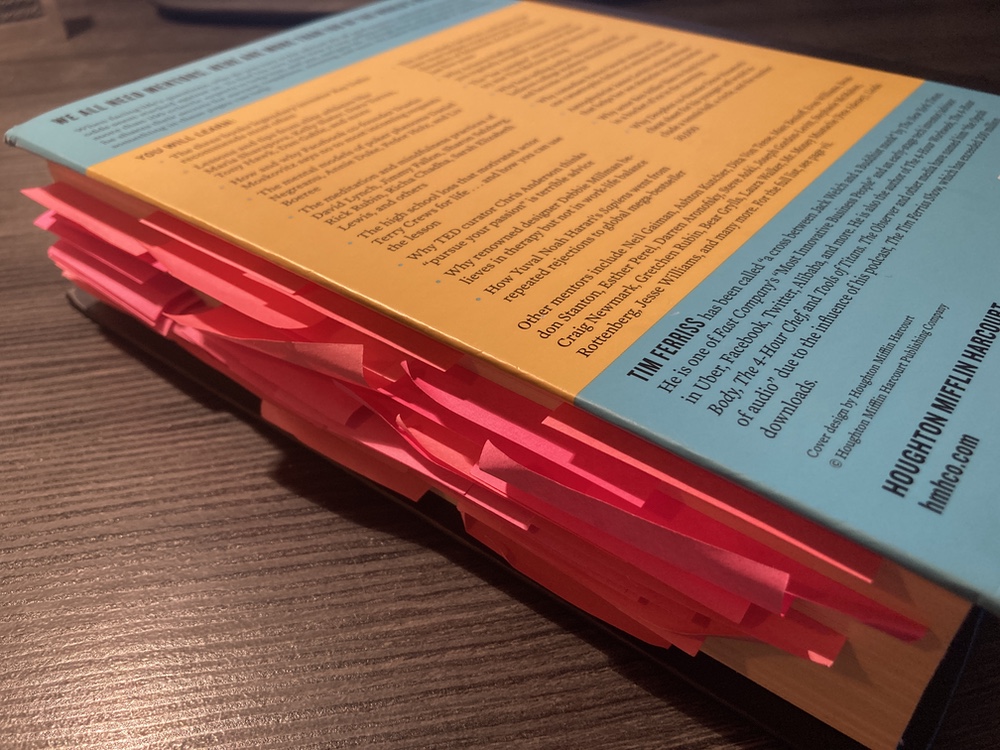
If you’ve not heard of this book, my pull-quote is from Tim’s Introduction… eight lines into the book. The book is 597 pages, and the pages of the book—not including the hard covers, just the pages—are 1-and-three-quarters inches thick. It’s can serve as a functional foot-rest in a pinch. (But interestingly, not as a doorstop since it’s mysteriously light for its size. I keep wondering if the back half of the book is hollowed out, as in a prison escape movie, hiding a whoopie-cushion full of Helium.)

Anyway, if you’ve not heard of this book, find a copy and start reading the Introduction.

This book arrived in our house November, 2018. I started into it and it is, as one would hope, chock full of stupidly interesting ideas from so many different people. I got through 64 pages before, for some reason which I only just today realized, I put it down one evening. And then I didn’t pick it back up for, well, two years. I mean I moved it around a lot, but whatever it was that made me _want_ to read the book, there was something else that made me _not_ want the book.

You ever have sand slipping through your fingers? I didn’t realize it, (until today,) but that’s what made me walk away from the book. Yes there’s some malarky and woo-wu in the book; But there’s so much that I want to dig further into. Back in 2018, what was I going to do with that? …blog about every other page? Instinctively I knew that wouldn’t do _me_ much good.

But today? Today I’m comfortable knowing that I can bump into ideas, mull them over, and produce a contextualized, reduced to something I’m interested, idea… and drop that into the Slipbox.

ɕ

Mar 21, 2021

Mirror image of negative visualization

The fatalism advocated by the Stoics is in a sense the reverse, or one might say the mirror image, of negative visualization: Instead of thinking about how our situation could be worse, we refuse to think about how it could be better.

~William B. Irvine from, A Guide to the Good Life

I use negative visualization very often. “What could possibly go wrong?” is one of my favorite interjections. Everyone thinks I’m making a joke—and in part I am—but what I’m really doing is actually thinking about what could actually go wrong.

I’ve learned, (slowly after far too much struggle because: i dumb,) that the more simple I can keep my life, the better. I want to be clear: The complexity I wrestle with—and which wins and beats me down—is all stuff I’ve invented. Not simply accepted, but outright invented. Things I want to create or see get done or ways I can help when someone asks and on and on and on. My brain is a snow globe of ideas.

And that all springs from my apparently hardwired drive to make things better. So, practicing refusing to think about how it could be better.

ɕ

Elsewhere, this is 4c2se1h1. — slipbox

Mar 27, 2021

A structure to work in

Having a clear structure to work in is completely different from making plans about something. If you make a plan, you impose a structure on yourself; it makes you inflexible. To keep going according to plan, you have to push yourself and employ willpower. This is not only demotivating, but also unsuitable for an open-ended process like research, thinking or studying in general, where we have to adjust our next steps with every new insight, understanding or achievement—which we ideally have on a regular basis and not just as an exception.

~ Sönke Ahrens from, How to Take Smart Notes (2017)

I know I’m reading the right thing when—POW—I feel like a whole bunch of loose threads in my mind suddenly make sense. I’m a master at plans and organizing. (Outlines, processes, Allen’s GTD system, etc..) But my current quest for a knowledge system began in earnest when I could no longer ignore the aching feeling that there was something I’m missing; there’s something I’m not doing correctly. Ahren’s point about “imposing structure” on oneself is the insight. There’s a time for that. (And again, I’ve got that sorted.) I’m gleefully skipping off into experimenting with a new structure to work in. This isn’t all clear to me yet, so these blog posts aren’t going to be perfectly clear either. ¯\_(ツ)_/¯

ɕ

Elsewhere, this is 4c2ko1a. — slipbox

Apr 20, 2021

Anything noteworthy since

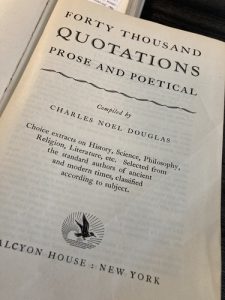
One of my recent acquisitions is this door-stop of a volume, Forty Thousand Quotations Prose and Poetical, published in 1940. Several thoughts spring to mind at this point:

Obviously, this book is 80 years old. Wait, no, that was not obvious to me. I was thinking, “1940… Wow, that’s like 60 years ago,” followed not as quickly as it should have been by, “…no wait, that’s 80 years ago.” So the first thought I’ll share here is that the years pile on like onion-skin pages. Year after year after year after year and before you realize it: Door stop. (Both you have a door stop, and you are a door stop.)

Upon arrival I immediately flipped through it to see what I’d gotten for my $14-plus-shipping. The book says, “prose and poetical,” but I don’t know diddly-squat about this Douglas fellow. There could be forty thousand stinkers better left forgotten. My verdict: The density is low. Perhaps 1 in 4 strike me as even worthy of inclusion in the book. Still, ten thousand quotations prose and poetical are worth 2/10 of one cent each, (in my book.)

It’s said—I’ve heard it said, I’ve said it myself now many times—that our favorite quotations say more about ourselves than of those we’ve quoted.

Is this book a snapshot of 1930’s America? Let this sink in: There’s not a single quote from anyone related in any way to World War II. There isn’t a single modern tech genius in here either. But wait! It was printed in 1940, yes. However the copyrights are 1904, 1914 and 1917. This book is a time machine come to me across more than a century.

I generally give books the page 88 test. That’s laughably near the front of a book which has— (Wait, wat?! This book has exactly 2,000 numbered pages! That’s another tangent I’m not following. Ahem.) Page 88 is laughably near the front of a 2,000 page book. As I carefully flipped towards 88, I was briefly anxious when I thought the entries under “anxiety” might run to page 88, but fortunately, no. The two columns of page 88 cover the tail end of, Apothegm (“a short, pithy and instructive saying or formulation,” honestly, I had to look that up,) then Apparel, and then Apparitions runs onward to page 89.

The first full entry on page 88 is:

A few words worthy to be remembered suffice to give an idea of a great mind. There are single thoughts that contain the essence of a whole volume, single sentences that have the beauties of a large work, a simplicity so finished and so perfect that it equals in merit and in excellence a large and glorious composition.

~ Joubert

Elsewhere, this is 4a616. — slipbox

ɕ

Aug 10, 2021

Deep dive into books

Today I thought I’d share a thorough explanation of what I do “to” a book these days. This process—which to be honest I don’t follow for every book I read—is the result of combining a few different ideas:

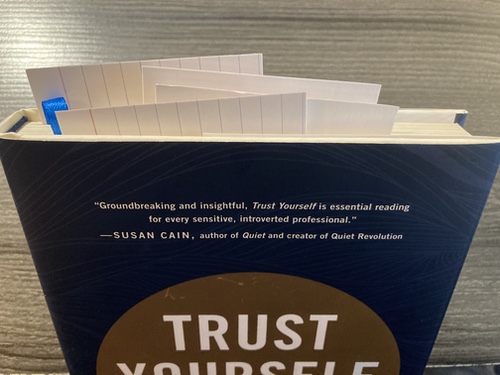
  • I love the physicality of books. The typography, the paper, writing in them, desultory bookmarks, (I add my own ribbon bookmarks,) and numerous sticky-notes poking out the side.
  • I love the peaceful, inertness of books. They literally sit there and do nothing. There are no alerts, and no interaction, (from anyone beyond the author’s original magic spell.)
  • I’ve always wanted to retain more of the knowledge from a book once I’ve read it.
  • I’ve wanted to be free of my self-imposed rule of reading every page.
  • These days I have a slipbox, and I want it to grow.
  • I love to collect quotes.
  • I’ve always wanted a set of crib notes, summary, or something that I could lay hand on after reading a book.

Arrival

Fortunately, books arrive slowly. It took practice, but I learned to do all of the following in a minute or two.

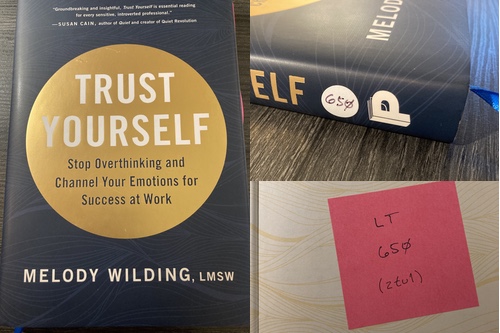
If it’s a new book, I take a few moments to prepare the spine. (Please tell me you know how to do that.) I affix a small, white, circular label on the spine, and I slap a sticky-note on the first face opposite the cover.

I skip over to librarything.com and find the book in “Your Books”—my books, that is. Most arriving books are coming in after already being in my “wishlist” collection; They get moved to the “library” collection. Otherwise they get searched for and added to my collection. Books get tagged as “physical,” (as opposed to those tagged “PDF,” “iBooks”, or “Kindle,” because, yeup, I track those too.) I see what MDS number Library Thing says the librarians of the world have chosen.

On the sticky-note, I write “LT”, (for “this book is entered into Library Thing,) and the MDS number. I write the main, three-digit part of the MDS number on the label on the spine.

Finally, I skip over to bookmooch.com and remove it from my Wishlist over there to ensure I don’t forget about it. (Lest I accidentally “spend” my Book Mooch points requesting a book I now have.) If this is a book that someone sent me because of Book Mooch, I hit the “Received!” button instead.

This book is now “ours.” And some amazing things are now possible just by having spent a couple minutes on each book as it arrives. (Please ignore the entire week I spent bootstrapping ~500 books when I started doing all this. :)

  • Physical bookstores are fun again! What books are on my wishlist? (500+ at the moment) …okay, what wishlist books are tagged, “priority”? (about 250 — yes I have a problem.) Picking up a book… “this looks interesting…” Do I already have it in the house, maybe now is the time to buy it? Did I once have it, and it’s no longer in our collection, (part of my collections in Library Thing is “had but gone now”)?
  • Long-term storage of books doesn’t mean they are lost. A big portion of the books in our house are here because we want to keep them. They sit for years untouched. Those are shelved by MDS number. Ask me for a book, and I can walk directly to it; It’s either laying about somewhere and top of mind, or it’s shelved where it can be found immediately.
  • This is morbid, but if the house burned down I could decide what books to replace.

Books are for reading

Well, technically, one can also build a thing called an anti-library. But eventually, hopefully, or at least this is what I keep telling myself: I start reading the book.

I do tend to read the entire book. But generally I read the table of contents first to see what I’m getting into. If I think the book is going to be a really deep read—something I want to read more than once, refer to, and really ingest—I probably read the Afterword first. The Afterword was written dead-last, after the book was done and the author is a different person at that point. Then maybe the Foreword, or some books have a Summary, or a Preface, whatever.

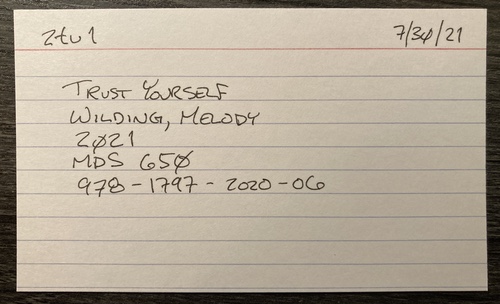
I’ve no qualms about skipping parts. For example, in books like Trust Yourself by M Wilding I skipped all the anecdotes and skipped all the workbook/exercises stuff. I ended up reading only about one-third of all of the pages. (Still, a good book by the way.)

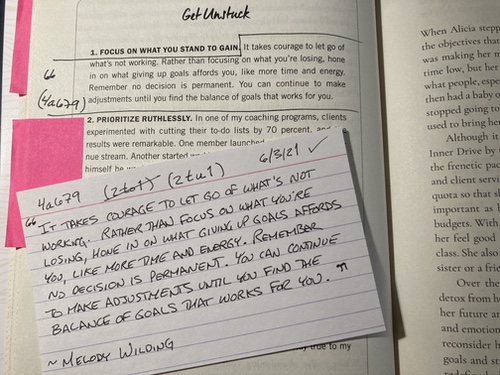
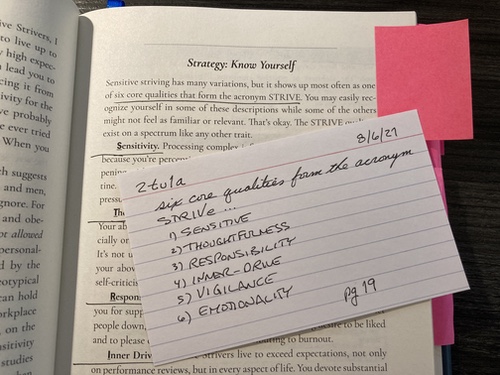
As I’m reading, if anything quotable jumps out, I’ll capture that on the spot. This leads to me making some marks, allocating a slipbox slip address, and I’ll leave a small post-it sticking out the side. I’ve never met a book worth reading that didn’t have at least one quotable bit awaiting me within.

Slipbox

As soon as the first slip gets created from the book, that slip needs to refer to the book. That means the book itself needs to be in the slipbox. Apparently, I always wanted to be a librarian.

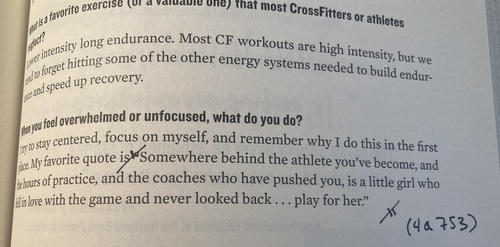
And now I can leave a “(2tu1)” reference on the quote’s slip.

So that’s a bit of detour, but it really only takes me about a minute. You’ll notice—first photo at top—that the sticky-note for this example book has a slipbox reference, “(2tu1)”—the parens mean “this is a reference”. I didn’t put that on the sticky-note when the book arrived. That was added when I put the book into the slipbox by creating slip “2tu1”.

But mostly, I’m just reading the book.

Identify summarizing bits

One day, I’m finished reading.

I find that even if it took me months to finish, the book’s contents remain pretty fresh in my mind. I flip through the book cover-to-cover, just skimming and noticing what I recall from reading. When I see a good, representative bit, I simply stick in a blank card at those spots. This lets me gauge how many slips my “summary” will be; Two is too few, and 20 might be too many.

Each spot has some key point that I want to include in my summary. I don’t write anything at this point. The goal is just to stick the cards into all the places that I want to include in my summary.

(I once tried using a printed template whose layout facilitated taking brief notes and had pre-printed page numbers. Folded, it doubled as a bookmark so I could build some notes as I read. When an idea leapt out, I’d find the page number on the sheet and jot a note. It was a neat idea, but didn’t work out for me.)

Summarization

Finally, I go through all the spots I’ve identified and I do a little underlining. I jot the basics of the idea on a slip and address it. So for this example book, whose slip is addressed “2tu1”, this first of the summary slips goes “below” as “2tu1a.” Next summary slip would be, “2tu1b”, “2tu1c” etc.

ɕ

Aug 14, 2021

Thank you, Miss Merrill

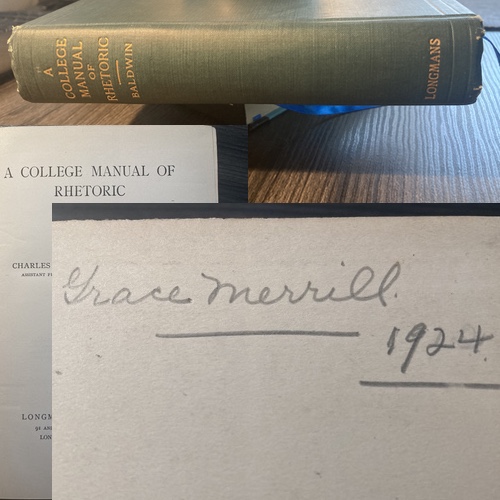
Last weekend, while helping friends pack-house, I found this book:

Wait! Don’t do the math on a book from 1907, and a college student taking Rhetoric in 1924. :)

Instead of packing it, I borrowed the book wondering if this James Sears Baldwin might just be the Baldwin. This is a dry book. But it’s also teaching me a ton about writing. The author hasn’t cracked even the slightest smile in the first 37 pages of this 400+ page tome. But the Baldwin quote I’d love to find within, might just be the sort of pithy thing this author would drop near the end.

Yes, I am willing to read a 400+ page tome on the off chance that I find the quote and get the once-in-a-lifetime thrill of finding an original attribution for a well-known quote. I digress.

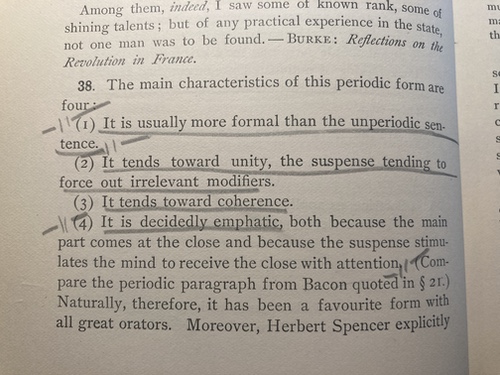
By page 30, I had seen a whole bunch these little diagonal marks, but hadn’t really figured out what she was trying to imply.

Then it hit me. Quotes! It’s a diagonal line with a quote on the diagonal line. She’s delineating quotations. I’m guessing that she must have written a paper—who’d expect that in a Rhetoric class, right?—and I bet she came back through and marked the quotation sections. At the same instant that I figured it out, my up-to-then habit of drawing a full line across the page, (often a long line, then up or down a line, and then finish going across, to “cut” in the middle of a line,) seemed dumb.

Thank you Miss Merrill. This looks just way cooler:

ɕ

Aug 15, 2021

Who. What. When.

An embarrassment of riches swamps me. I have so arranged things that everywhere I turn I find inspiring ideas, growth-catalyzing goals, and outlandish opportunities.

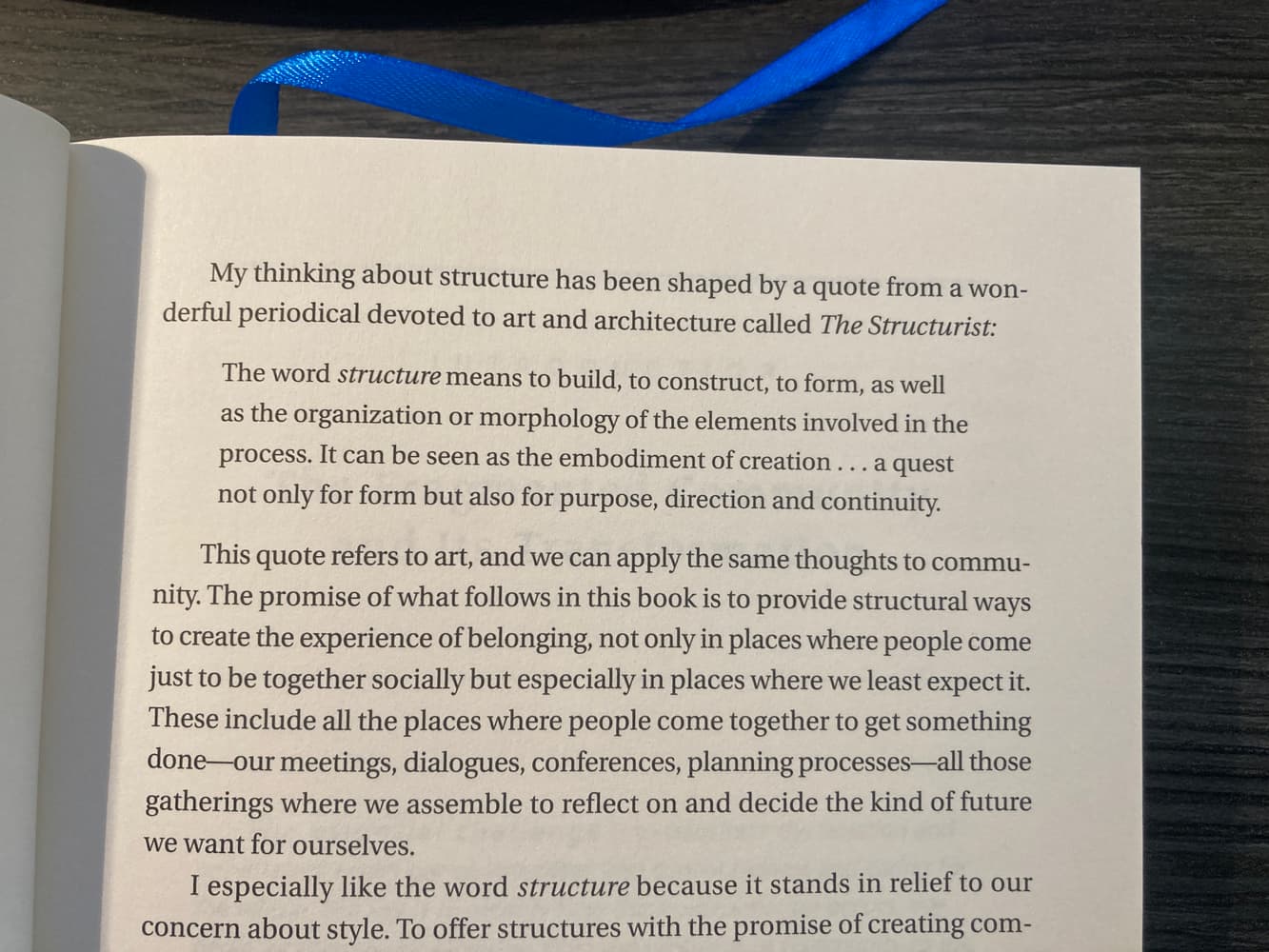
This morning I tenderly cracked open a new-to-me book, (Community: The Structure of Belonging by P Block, 2nd ed., 2018,) and inserted a bright blue, ribbon bookmark. I turned past the first page, then past the second page, and read the dedication:

To Maggie — In appreciation for your commitment, intelligence, love, and integrity that make what I do possible. You are a placeholder for all who give their talents and love in support of others. Your question “Who will do what by when?” changes the world.

~ Peter Block, ibid.

Elsewhere, this is 2co1. — slipbox

I have never had that particular formulation in mind. But I’ve had that sentiment as a driving force for decades. Thank you “Maggie” and Peter Block for making something so long fuzzy for me, perfectly clear.

Yes, indeed! Who will do what by when?

ɕ

Aug 25, 2021

The hive mind

Few working scientists can give a ground-up explanation of the phenomenon they study; they rely on information and techniques borrowed from other scientists. Knowledge and the virtues of the scientific orientation live far more in the community than the individual. When we talk of a “scientific community,” we are pointing to something critical: that advanced science is a social enterprise, characterized by an intricate division of cognitive labor. Individual scientists, no less than the quacks, can be famously bull-headed, overly enamored of pet theories, dismissive of new evidence, and heedless of their fallibility. (Hence Max Planck’s observation that science advances one funeral at a time.) But as a community endeavor, it is beautifully self-correcting.

Beautifully organized, however, it is not. Seen up close, the scientific community—with its muddled peer-review process, badly written journal articles, subtly contemptuous letters to the editor, overtly contemptuous subreddit threads, and pompous pronouncements of the academy— looks like a rickety vehicle for getting to truth. Yet the hive mind swarms ever forward. It now advances knowledge in almost every realm of existence—even the humanities, where neuroscience and computerization are shaping understanding of everything from free will to how art and literature have evolved over time.

~ Atul Gawande from, Atul Gawande and the Mistrust of Science

Elsewhere, this is 4ufoau1. — slipbox

I can’t add to that. I only wanted to be sure that others see it too.

Meanwhile, I never bothered to read Gawande’s hit book, The Checklist Manifesto. (To be candid, bordering on obnoxious: Time is limited, and I don’t need to seek more information about processes. I’ve got that sorted.) But it has hovered in my awareness none the less. Recently, two unrelated sources gave over-the-top praise for Gawande’s newer book, Being Mortal. On those recommendations alone it’s now in my reading queue. I’ve cracked it open, and done the preliminary reading… Have you read it? Do you have any thoughts on it?

ɕ

Sep 11, 2021

If it’s good enough for Faraday

In part, Faraday credits his own “inventing the method of invention” to reading Watts’s books, particularly The Improvement of the Mind — a self improvement guide a few centuries before the internet. Watts recommended keeping a commonplace book to record facts, and Faraday did. Watts recommended he be guided by observed facts, and Faraday was. Watts recommended finding a great teacher, and Faraday starting attending lectures.

~ Shane Parrish from, Isaac Watts and the Improvement of the Mind

Elsewhere, this is 4ufoia1. — slipbox

Yes, that Michael Faraday. And book ordered.

I’m a vigorous agreer with Will Smith’s comments about reading, (and I believe him regarding running but my body is not yet on board.) I hope that reading this book is a wonderful exercise in, “I already knew that. And that. And also that.” However, my current traipsing through, A College Manual of Rhetoric has proven to be a font of—apparently—long forgotten by most everyone, gems. As such, I’m willing to bet my hoped-for reading of, The Improvement of the Mind will turn out similarly.

ɕ

Sep 13, 2021

Just one good idea

I believe the standard how-to book contains too much new stuff for a human brain to take on board once, or at least it does for my brain. Implementing a single habit – flossing before bed, for example – is something most people can do if they’re really focusing on it, but even that is hard. Converting your workday into the full-bore Pomodoro system, or (God help you) the GTD system, represents a dozen or more habits that all have to come online more or less at the same time.

~ David Cain from, How to Get Things Done When You Have Trouble Getting Things Done

Elsewhere, this is 4uraho16. — slipbox

This is an unusual post from Cain. It is very much nuts-and-bolts material—ending in a pitch for a book of his own—rather than his usual philosophical pontifications. To his observation quoted above I’d like to add the following: If I am able to find just one good idea in a book which I can implement, then I get very excited.

For example, one can read many books and come away with new ideas. (Man’s Search for Meaning, or Leaves of Grass, spring to mind as examples.) But the vast majority of books do not contain actionable things that can be implemented to make a difference in your life. An idea like, “be the change you want to see in the world,” is sublime. But how—be specific in your thinking here—do I do that? There are many examples: “Practice gratitude.” How, exactly? And compare that to the same idea, in actionable form: “Begin each day by writing down three things for which you are grateful.”

I’m not trying to denigrate great ideas. I’m trying to explain my sheer delight when I do find a great idea which is readily attemptable. Many of those actionable ideas still fall by the wayside, but a few of them have really stuck and served me well.

ɕ

Sep 15, 2021

Mastery, purpose, and autonomy

A highly influential book for me in designing Automattic was Daniel Pink’s Drive, where he eloquently introduces the three things that really matter in motivating people: mastery, purpose, and autonomy. Mastery is the urge to get better skills. Purpose is the desire to do something that has meaning, that’s bigger than yourself. These first two principles physically co-located companies can be great at. But the third, autonomy, is where even the best in-office company can never match a Level 4 or above distributed company.

~ Matt Mullenweg from, Distributed Work’s Five Levels of Autonomy | Matt Mullenweg

Elsewhere, this is 4umafi2. — slipbox

I’ve read and listened to a bunch of stuff from Mullenweg and he’s consistently someone with his head on straight and his priorities—particularly those related to the many people working for his company—in order. If you just went, “Matt who?” definitely read that little post, and then, perhaps, dip into his podcast, Distributed. (Maybe try the episode, Automattic CEO Matt Mullenweg on building a fully distributed company, to get a good taste.)

Also, yes, more autonomy for everyone.

ɕ

Sep 16, 2021

And sometimes panic sets in

Inspired by a reader’s question to me, I thought I’d ask our followers on Facebook and Twitter for an answer to the question: What books would you recommend someone read to improve their general knowledge of the world.

I must say the number and quality of the responses overwhelmed me. The box Amazon just delivered reminds me that I ordered 9 books off this list.

~ Shane Parrish, from What Books Would You Recommend Someone Read to Improve their General Knowledge of the World?

Elsewhere, this is 4ufobo6. — slipbox

I know there are too many books—old books, new books, red books, blue books … A friend of mine just published a book, Before You Say Anything, and Jiminy Cricket I’d love to read it— I hovered on the add-to-cart button. But I paused, managing to trigger my habit-change “wedge” of repeating: “simplfiy. simplify. simplify.” I digress.

I skimmed that list of books from Parrish and felt I should probably read every one of them. Instead—simplify. simplify. simplify.—I noted I’ve read several, have several more already in my possession, and several others on the wishlist. With a life-is-short shrug, I’m passing it along to you and moving on with my morning.

ɕ

Sep 22, 2021

Fan-boy mode, on

Neither our economy nor the demands of a life well-lived dictate that everyone should aspire to be sitting alone at a desk in rural Narashino, crafting literature to the light of the rising sun. My growing concern, however, is that such real commitment to thought has become too rare.

~ Cal Newport from, Haruki Murakami and the Scarcity of Serious Thought – Cal Newport

Elsewhere, this is 4ucabo34. — slipbox

I’ve read every post on Newport’s blog. I have both Deep Work and So Good They Can’t Ignore You, and Digital Minimalism is in my “priority” subset of my wishlist of books. (Yes, I am aware that I have problems.) But I’ll out myself: I’ve not read either of the two Newport books that I already have, and see no point brining the third into the mix until I do. But whining about my privileged-problem of having too many books, isn’t my theme here. Rather, I want to think about why is it “that such real commitment to thought has become too rare.” Because I totally agree that such is so.

(That’s all. I’m thinking about it, and now so are you.)

ɕ

Oct 8, 2021

The time for action

Books? How, or to what end? For is not reading a kind of preparation for living, but living itself made up of things other than books? It is as if an athlete, when he enters the stadium, should break down and weep because he is not exercising outside. This is what you were exercising for; this is what the jumping-weights, and the sand, and your young partners were all for. So are you now seeking for these, when it is the time for action?

~ Epictetus

Elsewhere, this is 4a376. — slipbox

Oct 21, 2021

The purchase of books

It would be a good thing to buy books if one could also buy the time to read them; But one usually confuses the purchase of books with the acquisition of their contents.

~ Arthur Schopenhauer

Elsewhere, this is 4a618. — slipbox

Oct 23, 2021

Grunt work

It’s important to take time to think about what we’re reading and not merely assume the thoughts of the author. We need to digest, synthesize, and organize the thoughts of others if we are to understand. This is the grunt work of thinking. It’s how we acquire wisdom.

~ Shane Parrish from, A Meditation on Reading

Elsewhere, this is 4ufoso5. — slipbox

That’s a tiny taste from a delightful and sublime collection of thoughts on reading and books. Which will serve perfectly as an on-ramp to Schopenhauer’s actual essay, On Reading and Books. Which, furthermore, is even linked as a modern PDF from that same page. Wonders never cease.

ɕ

Oct 24, 2021

This is click bait

German Philosopher Arthur Schopenhauer (1788–1860) influenced some of the more prominent minds in the world. His writings and lessons traverse time and discipline. Schopenhauer confronted similar problems with media to the ones we face.

~ Shane Parrish from, Master Your Attention: Schopenhauer’s Strategy Against Clickbait

Elsewhere, this is 4ufoso4. — slipbox

The scale of Philosophy—just “western” Philosophy alone, even—is mind boggling. Who thought what, at which point in their career. Who influenced whom. Who’s work is now considered bunk, and which is bunk but still necessary to understand some other piece. What is in which language, and then which translation of that should one choose. If so-and-so had an influence on other-person, in what way? …did they build upon, tear down and correct, or push farther the influencer’s work?

At one point, I had deluded myself into attempting a systematic survey of Philosophy. ahahhahaahhaahahhaahahahahahhahaaa. Silly human.

But this small-ish article from Parrish led me to actually wonder about some of Schopenhauer’s essays. And I’ve ended up with an English translation of his On Reading and Books now sitting on my read-next table.

ɕ

Oct 26, 2021

Tribe of Mentors

Ferriss’s Tribe of Mentors was published in 2017, and arrived in my collection as a gift in 2018. It took me three years—until 2021, March of this year in fact—before I was finally ready to read it. I have a couple, (and “couple” always means two,) of things to say about the book.

Excellence is the next five minutes, improvement is the next five minutes, happiness is the next five minutes. This doesn’t mean you ingore planning. I encourage you to make ambitious plans. Just rememeber that the big-beyond-belief things are accomplished when you deconstruct them into the smallest possible pieces and focus on each “moment of impact,” one step at a time.

~ Tim Ferriss

Elsewhere, this is 4a801. — slipbox

As I was reading, I marked about 50 quotes. I didn’t count the markers I inserted, and some of them are at sections with several quotes. There are quotes from the people in the book, there are quotes that Ferriss included in single-page, “quotes I’m pondering” section breaks, and there are precisely three quotes from Ferriss himself. (All three are here, in this post.)

The first thing I want to share about this book is that it’s not really Ferriss’s book. He didn’t write a book. The vast bulk is other people’s work and writing. Some of those people impressed me, some were “just” solid humans being their best, and some struck me as self-deluded; which makes it a superlative book. Where—let’s be honest—can one get insight on 100 different people and tuck it under your arm? Insight on people you’ve heard of, people you’ve not yet heard of, and even some people you’ll probably never care to hear of. Furthermore, having myself done a bunch of, “you’re just capturing what other people say,” work, I’m qualified to say: He did the deceptively difficult work of asking. He asked and followed up and nudged and organized (and indexed and cross-indexed) and cast light on people he thought were worth giving a platform.

To paraphrase Jim [Loehr]: The power broker in your life is the voice that no one ever hears. How well you revisit the tone and content of your private voice is what determines the quality of your life. It is the master storyteller, and the stories we tell ourselves are our reality. For instance, how do you speak to yourself when you make a mistake that upsets you? Would you speak that way to a dear freind when they’ve made a mistake? If not, you have work to do. Trust me, we all have work to do.

~ Tim Ferriss

Elsewhere, this is 4a806. — slipbox

Which brings me to the second thing: There’s a very slim section hiding at the back. If I noted its existence when I read the Table of Contents, (I always read Tables of Contents,) six months later I’d certinaly forgotten the section existed. I could very easily have put the book down most of the way through and completely missed it. If you read nothing else in the book, this last section is the part you should read. I checked and it’s not published as a blog post by Ferriss, (but it’s small enough it could be.) Borrow or buy the book if just to read the last section.

Based on everything I’ve seen, a simple recipe can work: Focus on what’s in front of you, design great days to create a great life, and try not to make the same mistake twice. That’s it. Stop hitting net balls and try something else, perhaps even the opposite. If you really want extra credit, try not to be a dick, and you’ll be a Voltron-level superstar.

~ Tim Ferriss

Elsewhere, this is 4a811. — slipbox

If you’ve not already guessed, all three of those quotes from Ferriss are from the last section of the book.

ɕ

Elsewhere, this is 2ti1a. — slipbox

Nov 30, 2021

Better figure this part out

Despite having been published in 1910, Arnold Bennett’s book How to Live on 24 Hours a Day remains a valuable resource on living a meaningful life within the constraints of time. In the book, Bennett addresses one of our oldest questions: how can we make the best use of our lives? How can we make the best use of our time?

~ Shane Parrish from, How to Live on 24 Hours a Day

Elsewhere, this is 4ufoao1. — slipbox

I’ve mentioned Arnold Bennett before, and my opinion remains the same: How to Live on 24 Hours a Day, is a delightful little read. Although this post from Parrish isn’t where I first heard of the book, it remains a terrific summary. If you’ve ever thought, “I wish I could find time to…” you should read Bennett’s thoughts.

ɕ

Dec 16, 2021

Another one

Saint-Exupéry extends the invitation to reorient to this particular skyborne machine — and, by a proximate leap of imagination, to technology in general — as something that, rather than alienating us from the rest of nature, could bring us into more intimate and conscientious contact with the world of clouds and creatures.

~ Maria Popova from, Recovering the Wonder of Flight

Elsewhere, this is 4ubasa1. — slipbox

The Little Prince is one of those books that has been on the to-read pile for so long. And now Wind, Sand and Stars seems to be another. One of these days! So many good books, so little time.

ɕ

Dec 27, 2021

How does one take notes…

…when the goal isn’t to end up with a pile of notes?

There are many scenarios where, over time, I do want to end up with a collection of notes. This is straight forward; start taking notes, and keep them somewhere. Bonus points if you review them, or use them as reference, or do anything with them.

But what if I have a scenario where I want to “do a better job” but I don’t care at all about the notes themselves. Suppose you have a regularly scheduled recurring meeting, but you don’t need a historical collection of notes. In fact, suppose you don’t actually need notes, but you think: It would be nice to know what we did last time, so we can follow-up next time.

And so I’m thinking this would be easy. I’ll just have a pile of notes (physical, digital, whatever) and I’ll go through them and … wait, what, actually? Recopy them? gag, that’s tedious. How many do I keep? How long do I keep the old ones? Here’s what I came up with…

I’m working in a single digital document. I have a heading, “Ongoing,” at the top that has the big things we currently have on our radar. The list has some dates with notes; “Oct 2020 — started that big project” and similar things.

Next I have a heading, “Jan 5, 2022” with the date of our next scheduled meeting. When that meeting arrives, I start by doing something very weird: I add “9876543210” on the line below the heading. Then I take simple bullet-point notes under that heading. “We discussed the foo bazzle widget needs defranishizing,” and similar items. Before our meeting ends, I add a heading for the date of the NEXT meeting, ABOVE this meeting’s heading. This pushes the heading and notes down the page a bit.

Then I continue reading. The heading just below this meeting’s, is the date of our last meeting. Just below the heading is “9876543210”, which I put there when we had that meeting. I delete the “9” from the front. I read my notes from the meeting. I may even edit them. Sometimes things that were obvious then, don’t seem so obvious a week later.

Then I continue reading. The next heading is the one from two meetings ago. Just below it is “876543210” — think about that, if it’s not obvious that last week, I read this part and already removed the “9”. So this week, I remove the “8.” Read the notes.

I work my way down each of the historical dates. Snipping a lead number, off the front of the line after each heading. 7. 6. 5. etc.

At the very end of the document, I find a heading that is from 11 meetings ago. Below the heading is “0” — because I’ve looked at these notes 9, 8, 7, 6, etc deleting a digit each time. These notes are now quite old. In fact, they should be irrelevant after 11 meetings. If they are not, I figure out what I have to add to “Ongoing” (the very topmost heading)… or perhaps I put a note under the coming meetings heading (just below “Ongoing”.)

It sounds wonky, but it’s magic. One digital document, you can skim the entire thing right in any of the meetings. You can search in the document. I can be sure I’m not forgetting things, but I can be sure I’m not making a huge collection of crap I’m never going to look at again.

Care to guess where that delete-a-digit each time comes from? It’s an idea from book printing. When they used to set type (physical lead type in trays) they would put “1 2 3 4 5 6 7 8 9 10” (or other orderings of the numbers) in the cover plate. Then print the book. What printing? This one is “1” Next printing? …they’d just chip off the “1” and print “2 3 4 5…” in the book… second printing. They still print those weird sequences of digits in digitally printed books. I believe this one is a second edition, 3rd printing…

ɕ

Mar 29, 2022

Footprints in the sand

When we read, another person thinks for us: we merely repeat his mental process. […] From all this it may be concluded that thoughts put down on paper are nothing more than footprints in the sand: one sees the road the man has taken, but in order to know what he saw on the way, one requires his eyes.

~ Arthur Schopenhauer

Elsewhere, this is 4a820. — slipbox

Apr 3, 2022

Seek to learn

Embracing a growth mindset means to get pleasure out of changing for the better (inward rewarding) instead of getting pleasure
in being praised (outward rewarding.) […] to seek as many opportunities to learn as possible is the most reliable long-term growth strategy.

~ Sönke Ahrens from, How to Take Smart Notes

Ahrens of course discusses, and gives credit where credit is due, to Carol Dweck’s ideas. (See Dweck’s, Mindset: The New Psychology of Success.) Her comment about “reliable long-term growth strategy” struck me as insightful. Her use of, “most reliable,” is an understatement. What other strategy would even be reliable?

If I want to grow, I need to learn. If I want to learn, I need to maximize those opportunities.

ɕ

Elsewhere, this is 4c2se1k. — slipbox

Apr 4, 2022

Time and strength [are] limited

One can never read too little of bad, or too much of good books: bad books are intellectual poison; they destroy the mind. In order to read what is good one must make it a condition never to read what is bad; for life is short, and both time and strength limited.

~ Arthur Schopenhauer

Elsewhere, this is 4a825. — slipbox

Apr 11, 2022

Sapiens

About 70,000 or so years ago, our DNA showed a mutation (Harari claims we don’t know quite why) which allowed us to make a leap that no other species, human or otherwise, was able to make. We began to cooperate flexibly, in large groups, with an extremely complex and versatile language. If there is a secret to our success—and remember, success in nature is survival—It was that our brains developed to communicate.

~ Shane Parrish from, Yuval Noah Harari: Why We Dominate the Earth

Elsewhere, this is 4ufoyu1. — slipbox

Sapiens by Y N Hurari has been on my to-read pile for ages. It’s currently aged its way to the no-seriously-I’m-not-kidding pile of books that are near my desk. The run-of-the-mill to-read pile is several bookcases that live in another room.

And the clock is ticking. The weeks—if one lives to 76, one gets 4,000 weeks—tick by and my collection of to-listen-to podcast episodes (I’ve given up; There are no shows that I subscribe to, pretending I’ll listen to every episode) and my to-read books continues to grow. I need to stop screwing around trying to do things and make a living, and instead get back to listening and reading. Chicken and egg problem, that is.

ɕ

May 26, 2022

The Structurist

Sometimes I have a “thread of interest” that I simply know I will never have the time to do anything with. Instead of simply ̄\_(ツ)_/ ̄ing and letting it go, I’m sharing this here so I can feel like I did something with it.

The what now? Oh, this periodical…

https://artsandscience.usask.ca/structurist/

…but the links on that page itself are broken. More searching did lead me to find at least some issues in U Sask.’s online store. But they are not cheap. (If they were single-dollars-each, I might just buy them all.)

They are available on ABE Books…

https://www.abebooks.com/book-search/title/structurist/

Open questions I had:

Does anyone within the sound of my voice have any issues?
Anyone have any commentary about the periodical at large?
Does anyone’s closest library have any of them?
Is anyone near the University of Saskatchewan?
…have a contact there?
…or any in-real-life means of getting more information?

And also, why aren’t the contents of these online? They seem to be culturally significant.

ɕ

Jun 8, 2022

Eleven ways to really screw yourself up

Most things in life aren’t black and white. Overly dualistic thinking isn’t true to reality. Life is full of nuance. A goal can be worth pursuing even if it doesn’t garner the highest success; there are worthwhile things in both flawed people and flawed philosophies.

~ Brett McKay from, The 11 Cognitive Distortions That Are Making You a Miserable SOB

Elsewhere, this is 4uaoca8. — slipbox

I’m not even sure how to classify this article for you. It’s short enough that you can just go glance at it. You’ll either shrug it off as simplistic (or possibly even offensive), or you’ll find the list of common cognitive mistakes useful. My pull-quote is indicative of the mistake of “splitting” thinking explained, not of the article overall. This mistake was—is still?—my biggest problem.

On the topics of depression and cognitive mistakes, from personal experience I recommend as useful Stoicism in general, and the more modern, (than the one McKay is referencing in the article above,) Cognitive Behavioral Therapy Made Simple. To be fair, David Burns, the author of the book McKay is summarizing, was instrumental in bringing Cognitive Behavioral Therapy into the mainstream.

ɕ

Jul 22, 2022

The price of the ticket

What a journey this life is! Dependent, entirely, on things unseen. If your lover lives in Hong Kong and cannot get to Chicago, it will be necessary for you to go to Hong Kong. Perhaps you will spend your life there, and never see Chicago again. And you will, I assure you, as long as space and time divide you from anyone you love, discover a great deal about shipping routes, airlines, earth quake, famine, disease, and war. And you will always know what time it is in Hong Kong, for you love someone who lives there. And love will simply have no choice but to go into battle with space and time and, furthermore, to win.

~ James Baldwin from, The Light Between Us – The Marginalian

Elsewhere, this is 4uteja1. — slipbox

I’m not sure how many things I’ve linked to over on Popova’s Marginalian project. By now you should be directly following it and reading everything she’s publishing. I’m frozen by indecision; there are so countless many superlative books, and Nothing Personal is yet another one. Drat!

ɕ

Aug 9, 2022

It’s a lot of work

Granted, cultivating a slipbox is a lot of work. This morning, as I regularly do, I was rereading journal entries. A year ago I had made note of a book, Trust Yourself, and how it had spurred some specific thinking. Finding mention of the book in my journal caused me to reflect on what I had written: Was it still accurate? Journaling for the win.

I had also made a little note, “(2tu1)” of the book’s slip in the slipbox. It took only a moment to flip there… and to discover I had written out 9 slips under the book with some take-aways and key learnings from the book. A crash refresher on the book, completely unbidden; A gift from my self-from years past.

ɕ

Sep 1, 2022

Au delà du saut

Nous abordons toutes les dimensions de la pratique depuis l’histoire jusqu’au flow, en passant par les entrainements physiques, la technique, le mental, les valeurs … Tout ce qui vous permettra de mieux comprendre et ressentir le mouvement pour pouvoir aller plus loin.

~ Stany Boulifard Mallet from, L’Art Du Déplacement –

Elsewhere, this is 4uuula1. — slipbox

I’m really excited about this. Two friends of mine, after very much work over several years, have finished a book. It’s in French (there’s discussion of doing an English version next) and available as a digital file if you’re not in France. Two things…

I had a conversation with Stany Boulifard Mallet (one of the authors) back in 2018.

And if you just thought, “lart du depla-what?!” and you’re the curious type, see my Art du Déplacement tag for my blog posts related to this beautiful movement community and its French roots.

ɕ

Sep 14, 2022

The chasm between

Too often there is a chasm between our ideas and knowledge on the one hand and our actual experience on the other. We absorb trivia and information that take up mental space but get us nowhere. We read books that divert us but have little relevance to our daily lives. We have lofty ideas that we do not put into practice. We also have many rich experiences that we do not analyze enough, that do not inspire us with ideas, whose lessons we ignore. Strategy requires a constant contact between the two realms.

~ Robert Greene

Elsewhere, this is 4a1009. — slipbox

Nov 13, 2022

I have a problem

If you find yourself wanting to speed up the reading process on a particular book, you may want to ask yourself, “Is this book any good?”

~ Ryan Holiday from, 13 Strategies That Will Make You A Better Reader (And Person)

Elsewhere, this is 4uryre1. — slipbox

Long-time readers will be well aware of my self-diagnosed problem with books. I’ve spent a lot of time reading about reading about books, but this list by Holiday made me think about a few things in a new light. Yes, of course; It’s a post by Holiday so it’s going to have some ancient Stoic philosophers in it. Schopenhauer had a sublime lament about time for reading. Holiday’s strategies won’t help you there. There’ll preserve some of your reading time for, well, more reading. But I still think the hardest part about reading is making it a priority. (Recall: “I don’t have time to…” is bullshit.)

ɕ

Elsewhere, this is 4a123. — slipbox

Nov 14, 2022

It’s been a while

But it’s also just fun. For me, at least. I enjoy seeing how humans from thousands of years ago tried to get their bearings in the world compared to humans living today. When you read, study, and talk about philosophy, you’re taking part in a conversation that’s been going on for millennia. And conversation is fun. I love a good conversation.

~ Brett McKay from, The Philosophy Textbook Every Man Should Own

Elsewhere, this is 4uaoli1. — slipbox

It’s been a minute since I’ve purchased a textbook. It’s nice to see that they’re no longer stupidly over-priced— oh wait, no sorry. They’re insanely priced. Fortunately, I was able to bop on over to abebooks.com and find a copy of The Great Conversation for about $5 depending on what condition you want; There’s like a hundred copies of that book available.

ɕ

Dec 1, 2022

The best of their thoughts

I was aware that the reading of all good books is indeed like a conversation with the noblest men of past centuries who were the authors of them, nay a carefully studied conversation, in which they reveal to us none but the best of their thoughts.

~ René Descartes

Elsewhere, this is 4a1047. — slipbox

Jan 9, 2023

Ruh-roh… that’s me

The ways in which we are all susceptible to drowning ourselves into drama, and what it takes to float free, is what Iris Murdoch (July 15, 1919–February 8, 1999) explores in her subtle, splendid 1978 novel The Sea, the Sea — the story of a talented but complacent playwright approaching the overlook of life, who is ultimately overcome by his tragic flaw: Despite his obsessive self-reflection (or perhaps precisely because of it), his egotism ultimately eclipses his creative spirit — that brightest and most generous part of us, the part rightly called our gift, the part that extends the outstretched hand of sympathy and wonder we call art and invites, in Iris Murdoch’s lovely phrase, “an occasion for unselfing.”

~ Maria Popova from Iris Murdoch on the Myth of Closure and the Beautiful, Maddening Blind Spots of Our Self-Knowledge

Elsewhere, this is 4uteii1. — slipbox

I’m not a playwright—but the rest of that character seems too like me. “Drowning ourselves in drama…” “…obsessive self-reflection…” “…egotism ultimately eclipses his creative spirit…” Methinks The Sea The Sea would be a good cautionary tale for me to consume forthwith.

ɕ

Feb 16, 2023

Four stories

There are only four stories: A love story between two people, a love story between three people, the struggle for power, and the journey. Every single book that is in the bookstore deals with these four archetypes, these four themes.

~ Paulo Coelho

Elsewhere, this is 4a1082. — slipbox

Mar 15, 2023

Heroism

Heroism is more fun but less reliable than good planning.

~ Seth Godin from, Simple techniques for complex projects

Elsewhere, this is 4usesi2. — slipbox

It’s a good point.

And it took me a long time to realize that heroism isn’t even fun. Long ago I used to rush in, sometimes literally, and save the day. I’ve played the theme song from Mission: Impossible while rushing to fix computers in the middle of the night. One time, although I wasn’t rushing but was en route to fix things, I was nearly killed in a car crash, in the middle of the night, on a highway that was deserted, until I was hit from behind, at extreme speed, by two people who were racing side-by-side. I think I just channeled Proust. I digress. Where was I?

It took me a long time to realize that heroism isn’t even fun. Years later, I was reading M. B. Stanier‘s The Coaching Habit (which I recommend, but I more highly recommend his, The Advice Trap) where I found his mention of the “Karpman Drama Triangle”. I’m not even sure if that’s a real thing; It should be a real thing and I’m not going to spoil it by actually looking. Karpman, apparently, identifies the “Rescuer” as one of the three types of people in his dramatic triangle. (When I first read that I thought, “Oh my gawd, I used to always be that person. I’m so glad I’ve totally outgrown that,” while chuckling nervously.) The Rescuer’s core belief is, “Don’t fight, don’t worry, let me jump in and take it on and fix it.” Crap. I’m pretty sure I still have this problem.

ɕ

Apr 11, 2023

Think more

Read less, study less, but think more. Learn, both from your teachers and from the books which you read, only those things which you really need and which you really want to know.

~ Leo Tolstoy

Elsewhere, this is 4a1105. — slipbox

Apr 15, 2023

Ridiculous

The moral? That there is no greater homage we could pay Proust than to end up passing the same verdict on him as he passed on Ruskin, namely, that for all its qualities, his work must eventually also prove silly, maniacal, constraining, false and ridiculous to those who spend too long on it.

“To make [reading] into a discipline is to give too large a role to what is only an incitement. Reading is on the threshold of the spiritual life; it can introduce us to it: It does not constitute it.”

Even the finest books deserve to be thrown aside.

~ Alain de Botton

Elsewhere, this is 4a1107. — slipbox

May 8, 2023

Then you read

You think your pain and your heartbreak are unprecedented in the history of the world, but then you read. It was reading books that taught me that the things that tormented me most were the very things that connected me with all the people who were alive, or who ever had been alive. An artist is a sort of emotional historian.

~ James Baldwin

Elsewhere, this is 4a1154. — slipbox

Jun 20, 2023

Lazy summer afternoons

If I want to recall peace, serenity, pleasure, I think of myself on those lazy summer afternoons, with my chair tipped back against the wall, the book on my lap, and the pages softly turning. There may have been, at certain times in my life, higher pitches of ecstasy, vast moments of relief and triumph, but for quiet, peaceful happiness, there has never been anything to compare with it.

~ Isaac Asimov

Elsewhere, this is 4a1184. — slipbox

Jul 7, 2023

Listening

I was reading a single post, Waste time, from Mandy Brown’s aworkinglibrary.com. It’s worth reading just to realize there are two, contradictory suggestions for how to live a life depending on how you interpret this deceptively simple sentence:

There is so little time to waste during a life.

And then Brown led me to her reading notes from a book by Mary Rueflé where this left me gobsmacked:

I used to think I wrote because there was something I wanted to say. Then I thought, “I will continue to write because I have not yet said what I wanted to say”; but I know now I continue to write because I have not yet heard what I have been listening to.

~ Mary Rueflé from, Madness, Rack, and Honey

It is indeed unfortunate that there is so little time to waste during a life! I am redoubling my efforts to find more time to waste.

ɕ

Jul 10, 2023

Becoming a Supple Leopard

…is both the title of a book, and a thing I’d very much like to do. What’s stopping me?

It’s not genetics, because that only sets the boundary parameters. Sure, I’ll never literally be a leopard. But the set of genes I’ve been dealt seem pretty choice. Bonus, I can even change my genetic expression. So genetics is not what’s holding me back.

There are two things holding me back: My mindset and knowledge.

Mindset — I like to think of it like this: See this body? This is the body which results from all my choices and my mindset up to this moment. I don’t want a different body so that I can do this or that. (Well, I do but that’s exactly the problem.) Instead, I need to make better decisions. Here are a few ways that I use to steer my life…

  • “I’m not currently able to do that. To do that, I would first need to work on this, strengthen this, and learn this other skill.” (Never simply, “I can’t do that.“)
  • “That isn’t a priority for me now.” (Never simply, “I don’t have time for that.“) Saying, “Sleep isn’t a priority,” or “Healthy eating isn’t a priority,” sorts my mindset out quickly.
  • “I am the sort of person who…” …is barefoot, until I have a reason to add things to my feet. …goes to bed early and regularly. …enjoys spending time preparing healthy meals. …is willing to say that isn’t a priority so that I can have a larger yes for things which are important to me.

Knowledge — There are many things which are a priority for me. Learning everything about each of the fields of human biology, physiology, kinesiology, nutrition, etc. is not a priority. I’ve made great strides in figuring out solutions to many of my problems, but it’s too enormous of a knowledge space for me to learn everything in every field.

Years ago (h/t Jesse!) I first saw a copy of Kelly Starrett’s book Becoming a Supple Leopard. It was an impressive book, and was well recommended. But I was still at a place in my journey where I wanted to carve my own path, and went on my way trying to figure everything out on my own. But no more!

Recently (h/t Andrew!) I was gifted a big, beautiful 2nd edition of the book. Which dovetails nicely with my no longer wanting to figure everything out on my own. So I’ve been diving into Starrett’s Becoming a Supple Leopard.

The third and most notable problem with our current thinking is that it continues to be based on a model that prioritizes task completion above everything else. It’s a sort of one-or-zero, task-done-or-not, weight-lifted-or-not, distance-swum-or-not mentality. This is like saying, “I deadlifted 500 pounds, but I herniated a disc,” or, “I finished a marathon, but I wore a hole in my knee.” Imagine this sort of ethic spilling over into the other aspects of your life: “Hey, I made you some toast! But I burned down the house.”

~ Kelly Starrett from, Becoming a Supple Leopard

I’m still reading the entire book-worth of information in the first part of the book. Plus, the middle parts are an encyclopedic compendium of gargantuan proportions with hundreds of mobility exercises. I skimmed through all of it, and resigned myself to never being able to try, let alone learn, all of them in a systematic fashion. Instead, in the back of the book there is a 14-day system for cherry-picking things to do, and that is the thing I’m digging into. In fact, I expect I’ll simply repeat the 14-day thing (changing what specific activities I’m picking) until I become bored or a supple leopard.

To make that a little easier, I made this PDF so I could print and write directly on it:

ɕ

Jul 26, 2023

Fragmentation

What if I don’t know how to take something apart? One option is to apply excessive force and break the thing open. That works, but obviously sacrifices the thing; this is particularly useless if I wanted to take something apart because I need to fix it, or understand it. Generally, the smash method always works, but is almost never useful.

Yet thought also goes wrong somehow, and produces destruction. This arises from a certain way of thinking, i.e., fragmentation. This is to break things up into bits, as if they were independent. It’s not merely making divisions, but it is breaking things up which are not really spearate. It’s like taking a watch and smashing it into fragments, rather than taking it apart and finding its parts. The parts are parts of a whole, but the fragments are just arbitrarily broken off from each other. Things which really fit, and belong together, are treated as if they do not. That’s one of the features of thought that’s going wrong.

~ David Bohm from, On Dialogue p56

I’m perpetually on a journey of self-awareness. I’m quite often applying my mind to understand things. This idea from Bohm about fragmentation, and in particular fragmentation being bad because it misses out on the relationships and inherent properties of the natural parts (in the sense of disassembled-watch parts versus smashed-watch bits). This idea of fragmentation is a warning against my running with the first way I manage to understand something; just because I’ve found one way to understand (smash) something into understandable pieces, doesn’t mean that’s the best way.

ɕ

Aug 20, 2023

What came before

I have several projects where there’s no end-game. (I’d argue all of my passion projects have no end-game.) The process of doing the creative work is the entire point. Do the thing, because doing the thing is some combination of “I enjoy it”, “I can rationalize the necessary parts I don’t enjoy” and “it’s making the world a better place.”

So you start. You do these trivial first actions, because they’re so stupidly easy, and then you’re working on the task. You’re inside the compound. You’re no longer trying to “get started.” Most of the resistance is gone, it’s clear enough what to do next, and it feels good to continue.

~ David Cain from, The Right Now List

Elsewhere, this is 4urate15. — slipbox

Rest. Reflect. Recalibrate. …was a wonder-filled takeaway from Trust Yourself by Melody Wilding. There was a little diagram of those three in a circle: Rest pointing to Reflect pointing to Recalibrate pointing to Rest. I am forever and ever imagining my projects as some sort of steady-state of affairs. Start the thing and then “just” do the thing. Forever. Forever? No. “What came before?” is, for me, the wrong question. How am I honestly feeling about whatever-it-is right now? That’s right. That just is. That’s how I am today. Okay, what comes next? Do I need to rest, reflect, or recalibrate?

Elsewhere, this is 4c2se1a9. — slipbox

ɕ

Aug 25, 2023

Which spiral?

To this day, if I realize I’m in a downward spiral I bring my attention to my next decision. (“Realize” being the important word there. I am too often actually in a downward spiral without realizing it is so.) Left foot, or right foot next? Take a nap, or continue what I’m doing? What’s the smallest next thing I can do, which would be a positive? Maybe the best thing I can do is to simply cease everything and pause.

Bodies start to hurt when they aren’t moved enough, but also because when they are moved, some parts aren’t moving with ease. This then makes it harder to move enough, and our movements get more diminished, immobility and pain arises, and we think it’s all inevitable.

~ Katy Bowman from, Book Excerpt: Rethink Your Position – Nutritious Movement

Elsewhere, this is 4unuge1. — slipbox

I find it empowering to know that making small, simple decisions about movement can profoundly affect my overall health and mobility. I’m not taking Bowman’s word for it though (she does have lots of great things to say about movement) I’ve simply taken note of what happens. Sometimes (often?) the better, small choice is the slightly more difficult now option. As Jerzy Gregorek put it, “easy choices, hard life. Hard choices, easy life.” Choose wisely.

ɕ

Aug 27, 2023

Calmness is needed

There is a time and place for maximum effort—yes, that’s a Deadpool reference—and there’s a time and place for stillness and calm. I’m fascinated by the relationship and interaction between physicality (as movement versus stillness) and mentality (as agitation versus calmness.) I’ve had transformational experiences at both extremes of physicality, with mental calmness. I do get mentally agitated. But I fear that too many people experience calmness far too rarely, possibly never.

This often means working more thoughtfully, and maybe even more slowly. Slow work is not unproductive work. What we lose in speed we more than make up for in deliberateness—as well as in undistracted attention, a critical factor of productivity.

~ Chris Bailey from, The productivity payoffs of a calm mind – Chris Bailey

Elsewhere, this is 4ucite2. — slipbox

Sometimes people ask me about Stoicism, and I suck at explaining it. Thinking and writing about calmness today, I’m struck that I should probably mention eudaimonia (eu̯-dai̯-mon-ía). Eudaimonia is a key value Stoicism advocates striving for.

[…] is a state of being and consciousness that is consistent with the active, effective activity of ideal agency and in general is characterized by the calm (equanimity; tranquility) that comes from the absence of further moral struggle and the absence of retrospective regret or prospective alarm about things outside one’s control, together with the confidence that comes from the effortless persistence of moral purpose.

~ Lawrence Becker from, A New Stoicism p91

2.5 millenia later… calmness, equanimity, tranquility?

ɕ

Sep 13, 2023

Frustration

Learning to distinguish the map versus the territory is an essential step. It’s critical to learn what a map is, and what maps are good for, in order to proceed with one’s life. Maps enable me to see and do things otherwise impossible; maps reveal unknown unknowns. Maps can also frustrate me endlessly. Sometimes I don’t want to have an opinion; I don’t want to spend the energy to have an opinion. I don’t care how I get from here to there. Just. Tell. Me. how to get there. And of course nothing in this paragraph has to do with literal maps of the world— I’m not talking about cartography nor driving directions.

On closer examination, it turns out there are many things wrong with it. Thousand True Fans is a hollow philosophy. It is Chicken Soup for the Digital Creator’s Soul, ultimately devoid of any real nutritional value.

~ Dave Karpf from, The Hollow Core of Kevin Kelly’s “Thousand True Fans” Theory

Elsewhere, this is 4usupe5. — slipbox

Kevin Kelly’s 1,000 True Fans is a map, before it there was another map, The Cluetrain Manifesto, and there were others. When you find a new-to-you map it opens your mind to new possibilities. I would assume the first children’s books I encountered were astounding, but wouldn’t have the same effect today. (I’m not denigrating either of those works; I’m not suggesting they are “children’s books”.)

But I do get frustrated. I see a terrific map, and then I want to make a terrific next “move”. That’s not how maps work, Craig. You look at the map, then you take the next small step informed by everything you know, including the new perspective from the new map. You write one sentence (for example, on a page soliciting support for your work) and that’s informed by all the maps you’ve previously seen. Big picture. Little steps.

ɕ

Oct 9, 2023

Curated and random

I recall a little sign which was sometimes spotted on desks, back in the before-times when everyone had a desk and papers and ring-binders and books and a telephone that also sat upon that desk. The sign was: “A messy desk is a sign of genius.” (And sometimes it said, “…of a creative mind.” )

I’ve had a lot of desks. In every case, I’ve always swerved repeatedly between messy and organized. I get to a point where—sometimes with a literal scream—I stop working and reorganize everything. For a long time, I hoped that one day I would manage to be just comfortable enough, with just the right amount of clutter and chaos, to be able to reach a steady state.

One detail that drives me bonkers is in the digital realm, computers are perfectly organized. I use a tool (called Reeder) to manage a read-this-later collection. It’s a big collection often reaching 500 different things marked as possibly interesting. (Some are interesting enough to spend a few minutes on, some are interesting enough to spend hours on.) Sometimes I’ll randomly shuffle things in a digital list. But sometimes… the list is just ordered the way you assemble it. And you can look at the list in forward or reverse order. This gets to me. If it’s a big list, neither forwards or backwards is best. So instead, I do both: I read the item off one end (the thing that’s been in the list longest) and then the other (the newest), and I just alternate in a reading session.

Perhaps this seems like a silly or trivial thing to point out. But there’s a bigger lesson: Where do I have some specific structure (organization, ordering, etc.) that I didn’t actually intend? …is that structure holding me back or keeping me from experiencing something I’d prefer?

ɕ

Nov 26, 2023

Bibliofervor

I recently cracked open Listening: Interviews, 1970-1989 by Jonathan Cott. The Introduction alone knocked one of my socks off; I leapt out of my reading chair to search the Internet hoping the Introduction might be published publicly so I could share it. Alas, instead I found this:

There ought to be a word in English that describes the nearly uncontrollable urge to leap out of a reading chair, race to find a friend, and press the book you are reading urgently into their hands. When they politely agree to take a look, you say no, no, you have to read this right now. Let me hold your coffee.

~ W. Scott Olsen from, Review

Elsewhere, this is 4usare1. — slipbox

Which—thank you W. Scott Olsen!—is an altogether different thing, which knocked my other sock off. I took a few moments to noodle it and didn’t have any good ideas. Then I asked Chat-GPT (v3.5 if you’re keeping score)…

Make up a new english word which describes the nearly uncontrollable urge to leap out of a reading chair, race to find a friend, and press the book you are reading urgently into their hands. When they politely agree to take a look, you say no, no, you have to read this right now while I hold your coffee.

How about “bibliofervor”? It combines “biblio,” relating to books or reading, with “fervor,” conveying intense passion or enthusiasm. This word captures the strong, almost irresistible impulse to share a captivating book with a friend, urging them to read it immediately, even going as far as offering to hold their coffee just so they can dive into the story right away. It’s that delightful moment when a book is so enthralling that you can’t help but share it with someone else in real-time.

Oi! That is a superlative answer. NEW WORD: Bibliofervor :)

ɕ

Dec 15, 2023

Communication with Vincent Thibault

Movers MindsetCommunication with Vincent ThibaultDec 15, 2023 · 40:57What are the connections between movement as a language, mindfulness, and personal development? Vincent Thibault joins Craig to discuss the dance between movement and mindfulness, and the balance of effort and ease in training Art du Déplacement.

What are the connections between movement as a language, mindfulness, and personal development?

Vincent Thibault joins Craig to discuss the dance between movement and mindfulness, and the balance of effort and ease in training Art du Déplacement.

You don’t have to pretend that you’re in top shape. If you’re not in top shape that very day you just do what you can. You can be yourself and the whole notion of ease is actually very profound, and that’s where my personal training connects with meditation […] One of the first things we learn with Buddhist Meditation is to be friends with yourself. I don’t want to confuse the whole discussion and mix our metaphors here, but there’s this notion of learning to be friends with your own mind, and that can translate into the way you approach movement and any kind of training.

~ Vincent Thibault 35:55

Vincent, a dedicated Buddhist practitioner, engages with Craig in a dynamic conversation encompassing spiritual insights merged with movement philosophy. They discuss the balance between effort and ease within training, stressing the importance of adapting to personal circumstances over time. They touch on Buddhist teachings in the context of physical discipline, emphasizing mindfulness, authentic connection, and embracing change as core tenets of their practice.

[Connection] also means that you could be connected to the people who have been practicing this before you. Whether you’ve learned from the Yamakasi or somebody else, you can acknowledge that. You can appreciate what you’ve received from them. And there’s also connection with the people who will come after you. Because—sorry to deliver the news—but you won’t be there forever and you won’t be coaching forever if you’re a coach. And you won’t be moving in the same way forever, and you don’t know when you’re going to see it.

~ Vincent Thibault 37:30

Throughout their exchange, Vincent and Craig explore the nuances of effort in training, highlighting the significance of finding ease alongside dedication. They go into the broader concept of ‘connection,’ extending beyond physicality to encompass energy levels, environment, and a respectful acknowledgment of both predecessors and successors in the discipline.

They discuss how cultivating internal ease can transcend into disciplined practices, fostering mindfulness and self-acceptance. Vincent underlines the necessity of adaptation, advocating for working with present circumstances rather than fixating on an idealized version of practice.

Takeaways

Effort and Ease — Emphasizing the balance between effort and ease in training, stressing the importance of finding fulfillment in the process rather than solely fixating on results.

Connection Beyond Physicality — The notion of connection expands to encompass various dimensions, including relationships with training partners, acknowledgment of predecessors, and a connection to one’s own energy levels and environment.

Adaptation as Vital — The conversation underscores the significance of adapting to circumstances, encouraging practitioners to work with their current situation rather than against it.

Integration of Buddhist Philosophy — Buddhist principles blend with movement philosophy, highlighting mindfulness, authenticity, and self-acceptance as integral components of disciplined practice.

Authenticity in Practice — Being authentic with oneself and others in training is emphasized, encouraging individuals to be genuine about their abilities, limitations, and present state of being.

Resources

Parkour & Art du déplacement: Lessons in practical wisdom – Leçons de sagesse pratique — Vincent Thibault’s 2015 book discussed in the podcast. The book contains both the French and English text. Don’t confuse it with the similarly named, but completely different book, “Parkour and the Art du déplacement: Strength, Dignity, Community”, published in 2014.

L’Art du déplacement : Quatre-vingt-dix propositions philosophiques sur le franchissement d’obstacles — The 2020, French-language-only, edition of the book discussed in this podcast.

Vincent Thibault on LinkedIn.

Carrefours Azure (French-language site) — Vincent’s book publishing company founded in 2016. Fiction and nonfiction. A small publishing house with an innovative and ecological model: books are printed on demand, in Quebec or in France depending on the customer’s shipping address (no pulping, minimal transportation). For every book sold directly on Carrefours azur’s website, a percentage is given back to a green initiative or a humanitarian cause.

Vincent Thibault (French-language site) — Vincent’s personal web site.

Study inspired by… — A series of blog posts, circa 2015, written by Craig, mentioned in this podcast.

(Written with help from Chat-GPT.)

ɕ

Mar 13, 2024

Horror and systematic idiocy

Have you ever looked at your own writing and wondered: What author’s work might it resemble? And if you haven’t, I hope I didn’t just break writing for you.

All I can remember of these once indispensable arts is the intense boredom by which the practice of them was accompanied. Even today the sight of Dr. Smith’s Shorter Latin Dictionary, or of Liddell’s and Scott’s Greek Lexicon, has power to recall that ancient ennui. What dreary hours I have spent frantically turning those pages in search of a word for “cow” that could be scanned as a dactyl, or to make sure that my memory of the irregular verbs and the Greek accents was not at fault! I hate to think of all that wasted time. And yet, in view of the fact that most human beings are destined to pass most of their lives at jobs in which it is impossible for them to take the slightest interest, this old-fashioned training with the dictionary may have been extremely salutary. At least it taught one to know and expect the worst of life. Whereas the pupil in a progressive school, where everything is made to seem entertaining and significant, lives in a fool’s paradise. As a preparation for life, not as it ought to be, but as it actually is, the horrors of Greek grammar and the systematic idiocy of Latin verses were perfectly appropriate. On the other hand, it must be admitted that they tended to leave their victims with a quite irrational distaste for poor dear Dr. Smith.

~ Aldous Huxley from his essay, Doodles in a Dictionary from, Tomorrow and Tomorrow and Tomorrow and Other Essays

Lest you think that’s an overly long quote, I’ll point out it’s still only about half of the paragraph. Huxley can really unspool a sentence. Some of the writing in that book—Huxley’s, omg no not Smith’s dictionary—are overwrought. But some of them have a delicious tinkling of structure and grammar with an occasional punctuation of solid snark.

ɕ

Mar 24, 2024

Obliged to respond

I recently heard a conversation between Brian Koppelman and Steven Pressfield (circa 2019 in Koppelman’s podcast, The Moment) where Pressfield mentioned a few great things for creatives to remember: Being a professional has nothing to do with getting paid. Resistance is real, it’s myself, and is waiting for me to invite it to stop me. The Muse is real.

The muse really does reward me for being found working. I’ve learned, no matter the work, the muse approves when finding me ready with pen and paper close. But if the muse taps me and I fail to treat the gift appropriately—if I think, “I’ll remember that. I don’t need to write that down.”—then I hear the muse scoff, “we shall see.” We shall see if I remember. And we shall see if the muse waits a bit longer before checking on me again.

That, of course, was the reason for the pen all along: it’s a physical reminder that you are not reading merely to consume the words of others passively, but that you have an obligation to respond.

~ Mandy Brown from, Ways of writing

Elsewhere, this is 4uaowi6. — slipbox

I’m realizing that books themselves also need room to sprawl. If I keep them shelved upright, or even more simply stacked flat, they still seem to be squished into submission. When I am able to lay a few of them out, with some room for them to wave their invisible tendrils, they seem to taunt me: go ahead, pick me up! If there’s a tablet or some writing scraps at hand, or garish sticky notes for flagging pages, then it begins to feel like its own room with unfolding conversations. In the end, it’s almost a composition just having the books lying about.

ɕ

Apr 22, 2024

The joy of discovery

I have always loved book stores. All types. All sizes. All manner of [dis]organization. When I was young, each store represented a hoard of tomes I could not even dream of possessing. How many books would I have bought? …how much money do you have? Literally. The books I did have then became valuable to me. They were precious because I had chosen them for purchase with various allotments I received; Or they were gifted to me making them both surprising and precious. To this day: Mmmmmmmm, bookstores.

Each store has its own way of embracing you, embracing the reader, and creating a sense of the universe expanding. For anybody curious and interested in printed matter, the more bookstores you go into, the more you’ll realize how many different ways there are to be curious. That helps us set a foundation to be more knowledgeable about the world we inhabit. The practical and the sheer joy of it.

~ Paul Yamazaki from, Paul Yamazaki on the Important, Joyous Work of Running an Independent Bookstore

Elsewhere, this is 4ulipa1. — slipbox

In more recent years, resources have become available. These days, each time I wander into a bookstore I think: Once—just once—I’m going to clear the rest of my day, and spend it all here in this bookstore, and I’m going to buy every single book that i want. Just to see what that feels like.

ɕ

Apr 23, 2024

Books

In the case of good books, the point is not to see how many of them you can get through, but rather how many can get through to you.

~ Mortimer J. Adler

Elsewhere, this is 4a1402. — slipbox

Jun 11, 2024

Books

Books can be dangerous. The best ones should be labeled ‘This could change your life.’

~ Helen Exley

Elsewhere, this is 4a1423. — slipbox

Jun 18, 2024

Vernor Vinge

But what really made Vinge the father of the Singularity was his fiction. His 1981 novella “True Names” created many of the tropes about artificial intelligence and virtual worlds that have now become standard. It’s such a tour de force that top computer scientists felt compelled to write a series of essays exploring its ideas, and it’s often considered the founding work of the entire cyberpunk genre.

~ Noah Smith from, Go read some Vernor Vinge – by Noah Smith – Noahpinion

Elsewhere, this is 4unopo1. — slipbox

Note to self: Go read some Vernor Vinge.

ɕ

Jul 10, 2024

Zen and the brain

During rare, spontaneous moments, experiences of very special quality and great import emerge from the depths of the human brain. To each person, these awakenings seem awesomely new. What they convey is not. It is the simplest, oldest wisdom in the world. The message is that ultimate meaning is to be found in this present moment, infusing our everyday lives, here and now. But one can’t predict such major peaks of enlightenment. Their insight-wisdom is next to impossible to describe. Even so, these fragile events inspired our major religions in ways that still shape our cultural development.

~ James Austin from, Zen and the Brain

Because in reality, none of us actually understands how our minds work. We only know that sometimes, our minds do some pretty amazing things. It would be great (we, I hope, all think) if I could tweak my mind to do that a little more often.

ɕ

Jul 16, 2024

Time well spent

‘Dagon’ has all the elements of a classic Lovecraft tale. Here, as in many of his later works – including ‘The Call of Cthulhu’ (written in 1926), The Dream-Quest of Unknown Kadath (1927), and At the Mountains of Madness (1931) – optimistic endeavours for knowledge, even the simple act of seeing what’s on the other side of a hill, are thwarted by incomprehensible terrors and a horrifyingly arbitrary cosmic order. These revelations shatter the minds of Lovecraft’s truth-seeking characters, including doctors, archaeologists, lost sailors, metaphysicians and scientists of all kinds.

~ Sam Woodward, from Terrifying vistas of reality

Elsewhere, this is 4uaeea6. — slipbox

Some people must think that reading a bunch of Lovecraft’s work was time I wasted. I loved it. I didn’t find it scary (I’m not sure I’ve ever found any book scary. Movies, on the other hand, can scare the hell out of me.) But I deeply enjoyed Lovecraft… and yet I could never quite express why. After reading Woodward’s thoughts I’m thinking I enjoyed the experience—being myself one of those “doctors, archaeologists, lost sailors, metaphysicians and scientists of all kinds”—of seeing people like me get the hell scared out of them.

ɕ

Aug 8, 2024

Reading

The man who doesn’t read good books has no advantage over the man who can’t read them.

~ Mark Twain

Elsewhere, this is 4a1454. — slipbox

Aug 12, 2024

Filed and lost

Taking notes on the books I read was a great start, but it wasn’t enough. It did me no good to leave those notes sitting in a software program like a musty filing cabinet in the basement, never to see the light of day again.

I realized if I wanted to benefit from my reading, I needed to engage with the books I read on a much deeper level. I needed to make something out of them. Otherwise, I would continue to passively consume information with no lasting memory of what I learned.

~ Tiago Forte, from The Ultimate Guide to Summarizing Books

Has anyone noticed that’s what I’m attempting to do with all my blogging and writing? Shirley, that’s obvious. (It’s not obvious, and don’t call me Shirley.)

I’ve always deeply loved movies. I was raised (on hose water and neglect) in the era when going to a movie was special. Remember when you had to use the phone (with a rotary dial, mounted on the wall) to call the theatre and listen to a looooong recording detailing what was playing and when? I could tell you so so so many stories about going to the movies. In more recent issues of 7 for Sunday, I’m feeling less inclined to stomp down the inside-joke movie references. If you find them even half as enjoyable to read, as I do to write them, then we’re both better off. I’m pretty sure that my recalling and retelling of all those stories about and around movies makes the entire movie experience more fun; yes the experience during the movie, but also all the stuff around it too.

No, I’ve not lost my own plot. Forte’s point about how to benefit from what one reads is the same thing. If you want to hold on to whatever it was that you’ve gotten from a book… you have to integrate it with the rest of your ongoing, lived experience. You have to go around telling the story of who gave you the book, what the book means to you in the context of your entire life, and what you think your interlocutor might get from it (like this, this, this, this, this, this or… you get my point.)

And as soon as you realize that’s fun for movies, and great for books, you should wonder if it could be a super-power for self-improvement if you could share the contents of your mind, with yourself, in that same fashion. Two suggestions: Start journaling immediately after reading this issue of 7 for Sunday, so you can then begin in a year, to regularly review your journals.

ɕ

Aug 23, 2024

Everyone else

If you only read the books that everyone else is reading, you can only think what everyone else is thinking.

~ Haruki Murakami

Elsewhere, this is 4a1463. — slipbox

Sep 26, 2024

I know what to do

For me, fully internalizing this one powerful piece of inspiring profanity has been transformative. But I still find that returning regularly to the well makes all this work even better. So I downloaded both of the Goggins’s audiobooks and worked through them in little chunks on my morning walks over the period of a month. Then I moved on to Peter Attia’s Outlive, and Jocko Willink’s Extreme Ownership.

~ Peter Adeney, from The Ultimate Life Coach

I really do know what I should be doing. (I have no idea if you, or anyone else, does too.) But I can tell you that even though I know… it’s still tough to do the soul-crushing work. I’ve not read any of the books above—although Outlive is on my to-read pile.

Elsewhere, this is 4umote3. — slipbox

ɕ

Oct 10, 2024

What is intention?

Friend and fellow podcaster Angie Flynn-McIver published a book, Before You Say Anything, in 2021…

Your intention should be something that really lights you up. You need to feel it in your chest, in your gut. It is the verb that connects you to your audience, the umbilical cord that takes your energy to them and brings theirs back to you. Intention is action.

~ Angie Flynn-McIver

Elsewhere, this is 4a1471. — slipbox

Another quote from the book, was a seed for a recent post to Open + Curious…

Open + CuriousActive, not passiveFlipping the internal to be external Taking action implies taking responsibility. One of the keys to great conversation is to be active, and not passive.…

Little Box of Quotes — For those who don’t know: The quote at the top is now included in my collection, which I call the Little Box of Quotes — number 1,471 to be exact. There’s a daily email available with just exactly one quote, and nothing more. For several years it was also a daily podcast which to more than 1,000 episodes (still available wherever you listen). All free, just because I like to create things that make the world a better place.

ɕ

Oct 12, 2024

The Work

After reading the first “book” in Steven Pressfield’s The War of Art, I’m inspired to define, for me specifically: What is “the work?”

In a specific moment, on a specific day, when I feel that odd uneasiness, I will not try to identify the specific form Resistance is taking. Instead as Pressfield mentions on page 12:

[…] We can use this. We can use it as a compass. We can navigate by Resistance, letting it guide us to that calling or action that we must follow before all others.

Rule of thumb: The more important a call or action is to our soul’s evolution, the more Resistance we will feel toward pursuing it.

As a real example of my own experience, Resistance’s compass guides me towards watching sci-fi entertainment (“a harmless relaxation,” I think after working in my yard for hours). So the opposite would be to… organize and streamline my writing environment and processes so tomorrow I can write more easily! No. My hiding in preparation and perfection is just another form of Resistance.

The best way for me is to look at all the possible things I could do, rather than follow Resistance’s compass. Then boil that down to a list of positive, actionable, directions in which I can sit down and work.

In a specific moment, on a specific day, when I feel that odd uneasiness, I can glance at my list and simply do a bit of The Work.

To defeat Resistance I can simply sit down, and do a little bit of any of the following…

  • do guest outreach for podcasting
  • write the next issue of 7 for Sunday
  • write the next Open + Curious article
  • write new blog posts

ɕ

PS: I’ve listed “do guest outreach” because—for me—once I do that consistently for a few weeks, all the rest of the podcasting process follows automatically.

Oct 18, 2024

A guide to the good life

I wrote this book with the following question in mind: If the ancient Stoics had taken it upon themselves to write a guidebook for twenty-first-century individuals—a book that would tell us how to have a good life—what might that book have looked like? The pages that follow are my answer to this question.

~ William B. Irvine, from A Guide to the Good Life

Elsewhere, this is 4a2gu1a. — slipbox

There are a lot of books and ideas that get put forward when talking about Stoicism. This book is the best place to start. I wish I had found it much closer to when it was written in 2009. I wish it had been written 30 years sooner, and that I’d found it back then.

The Stoics’ interest in logic is a natural consequence of their belief that man’s distinguishing feature is his rationality. Logic is, after all, the study of the proper use of reasoning.

Ibid p33

[…] when the Stoics counsel us to live each day as if it were our last, their goal is not to change our activities but to change our state of mind as we carry out those activities. In particular, they don’t want us to stop thinking about or planning for tomorrow; instead they want us, as we think about and plan for tomorrow, to remember to appreciate today.

Ibid p71

[W]hen Stoics contemplate their own death, it si not because they long for death but because they want to get the most out of life. As we have seen, someone who thinks he will live forever si far more likely to waste his days than someone who fully understands that his days are numbered, and one way to gain this understanding is periodically to contemplate his own death.

Ibid p200

ɕ

Nov 18, 2024

Driveway moments

The driveway moment: When a report or interview really works, you can tell and we can tell. We can, because the story hits the top of the most emailed list at NPR.org. You can tell, because the story keeps you pinned in your car, in a parking lot, in your driveway, or at the side of the road—as you wait to hear how the story will end. In letters and emails, listeners named these occurrences “driveway moments,” and say they look forward to them, even when it means being late for work or dinner. So that’s your goal: make some driveway moments.

~ Jay Kernis, from Sound Reporting, pg xi

I’m finally heading into NPR’s book, Sound Reporting, and this big of context included by Kernis in the Foreword got me thinking…

What are you doing so that you even know when you’ve put out a “driveway moment?”

It doesn’t matter at all if we feel it’s a driveway moment. It matters if our listeners think so. Are you paying attention to your listeners? Do you have multiple ways for them to connect back to you?

I do think about “driveway moments” when creating episodes. It’s difficult however, given the way that I create my work; They have to simply happen. If one wants to create them, that requires planning, work and editing.

For me, when I encounter a listener (virtually or in real life) the only question I ask them is…

Has any episode grabbed you? …any particular moment or image?

And then I shut up and listen.

ɕ

Dec 9, 2024

Really, this book is worth reading

I mentioned this book previously (in, Driveway Moments). As I read more, it became clear this book is stuffed full of useful information for podcasters. At some point, I’ll get around to organizing some sort of “resources” something-or-other over on the Podcaster Community, and Sound Reporting will definitely go in the “must read” books list for podcasters.

Almost nothing in the book is directly usable… but there’s a ton of stuff—far too much for me to quote—that I found made me think.

To be honest, a lot of it felt like, “yes, I agree” and “yes, I learned that the hard way.” But there was also a lot of “that’s a good idea” and “yikes, now I know I don’t want to do that that way.”

These chapters were particularly fertile ground: Writing for Broadcast, Story Editing, Reading on the Air, Hosting, and Booking. They contains tons of information from the professionals.

ɕ

Jan 17, 2025

A small number

[…] a small number [of books] were truly transformative for me. They served as intellectual lighthouses on my journey, helping me understand what was happening to me as I explored my past, my psyche, and my pain.

~ Tiago Forte, from The 10 Most Transformative Books on Personal Development I’ve Read

Elsewhere, this is 4ufobo8. — slipbox

An interesting list. I’ve not read any of these books. I do have one of them in my pile of books at hand. I’m not endorsing the specific books. I do very much endorse the idea of making top-ten lists to share what one has learned.

ɕ

Mar 28, 2025

Out of sight, out of mind

The pile of unread books we have on our bedside tables is often referred to as a graveyard of good intentions. The list of unread books on our Kindles is more of a black hole of fleeting intentions.

~ Ross Andersen, from Stagnant and dull, can digital books ever replace print?

Elsewhere, this is 4uaeea31. — slipbox

Digital is great for consumption, but consumption is not the only reason for having a book.

Having the books physically take up space in my environment is a key feature of books! My anti-library—the collection of books I’ve not yet read—serves the important purpose of reminding what I don’t yet know. Also, when I have a spare moment the books’ proximity draws me to them; This enables me to affect my future self (albeit only slightly) by setting in sight things that would improve me through their reading.

ɕ

Apr 4, 2025

Mirage

They had this idea, just one shot in which three very, very unlikely people were seen as NASCAR drivers. And I think they approached Julian Schnabel, Lou Reed, and me. (Laughs) And we were all supposed to be wearing the uniforms and the helmet, walking in slow motion with the heat haze. That would have been fantastic, but all of us couldn’t do it.

~ Salman Rushdie, from Salman Rushdie – The Talks

Elsewhere, this is 4uteie33. — slipbox

I was a junior in high school when Rushdie’s, Satanic Verses was published in 1988. The book was widely mentioned; It wasn’t really discussed, but rather it was just that everyone knew about its existence, and everyone had an opinion about it. Thinking back, I’m sure my opinion was simply a *hunh* and “that’s interesting.” To this day, I’ve not read the book, not for any particular reason but simply because there are way too many books I have reasons to read. The whole thing (back in the 80s) now feels like some sort of mirage: Real, vivid, and important, but in the end it wasn’t a real thing. The mirage was about a real thing, but it wasn’t real.

ɕ

Apr 6, 2025

Two types of human systems

When looking for similar feedback loops in human interactions, Bateson saw that they didn’t always exist, or operate in the way they should. As a result, he recognized that there were two kinds of systems: ones that relied on feedback to create stability, and others that tended to escalate and create runaway trends.

~ Ted Gioia, from Why Gregory Bateson Matters

Elsewhere, this is 4uhopy1. — slipbox

I will admit this is the first I’ve ever heard of Bateson, and based on Gioia’s article, I seriously considered buying his Steps to an Ecology of Mind. I definitely recommend reading Gioia’s article.

ɕ

Jun 3, 2025

Stoic joy

In a word, Senecan joy comes from within, from a good person’s own character and conduct: it arises from goodness itself and from right actions that one performs. This means that joy will not always be a matter of smiles and laughter, for good actions may be difficult and unpleasant: one may have to accept poverty, endure pain, even die for one’s country. A good person does these things only when they are right, and only for that reason, but the doing is itself a good and a reason to rejoice.

~ Margaret Graver and A. A. Long from Letters on Ethics

I don’t understand how we got to the common definition of “stoic”—the suppression of emotions. It’s a shame, because Stoicism is literally the opposite of suppressing one’s emotions. Emotions and reason have their right place. Stoic joy.

ɕ

Sep 13, 2025

Stop and really look

Stop and really look

On a recent trip I found myself with some spare time one morning. I used it to slowly wander through the little hotel’s sitting area. There I found a collection of board games and a couple dozen coffee-table books scattered about. I took the time to thumb through each of them for just a few moments.

This book still held my interest after a few moments and so I applied my page 88 test. When I realized that page 88 was somewhere within a long series of color plates—all of which were interesting to me—I flipped to the Foreword. And then I took a photo of the cover so that I could later snag a copy.

Today, here I am with a copy of the book (bought for $4.95 from AbeBooks). Beyond all of the above and the contents of the book itself, the book is now also imbued with the ambiance of that little hotel and cues up all the memories of that little trip.

ɕ

Sep 22, 2025

The do-not list

The do-not list

If you’ve not heard of Burkeman’s book (Four Thousand Weeks, I’ve not yet read it) the seed is simple: Your life will be about 4,000 weeks in duration.

In this podcast episode, Burkeman talks about the common advice to prioritize your work and to do the important things first—an echo of Stephen Covey’s metaphor of rocks, pebbles and sand to be put into a jar representing your limited time. Burkeman zooms in on the implication—missed by most people—within Covey’s advice.

You only have finite time. If you have a prioritized list of what’s important to you, it’s the stuff in the middle that will do you in.

Your top 5 items are clearly those big things you should work on. But, your number 6 item—that one feels almost as important as number 5. You need to actively avoid the danger of getting sucked into that number 6 (and the other almost as important items right behind it.)

ɕ

Jan 7, 2026

Undertake a journey

I took [Judith Wright’s] reply to mean that for certain kinds of knowledge you have to undertake a journey. It isn’t like pouring water into a bucket—a process by which neither water nor bucket is much changed—It seemed that if I took this journey I would be utterly changed. And before setting out, I couldn’t predict what that change would be.

~ John Tarrant, from Bring Me the Rhinoceros

Elsewhere, this is 4a1566. — slipbox