Upended, then smashed

That career of yours leads over a clif. To leave such an exhalted life, you have to fall. And once prosperity begins to push us over, we cannot even resist. We could wish to fall only once, or at least to fall from an upright position, but we are not allowed. Fortune deos not only overturn us: It upends us, and then smashes us.

~ Seneca

slip:4a1569.


Forbearance

Clearheadedness and action are not always enough, in politics or in life. Some obstacles are beyond a snap of the fingers or novel solution. It is not alway possible for one person to rid the world of a great evil or stop a country bent toward conflict. Of course, we try—because it can happen. But we should be ready for it not to. And we need to be able to find a greater purpose in this suffering and handle it with firmness and forbearance.

~ Ryan Holiday, from The Obstacle is the Way

slip:4a1563.


In an instant

No one has ever reached a point where the power fortune granted was greater than the risk. The sea is calm now, but do not trust it: The storm comes in an instant. Pleasure boats that were out all morning are sunk before the day is over.

~ Seneca

slip:4a1554.


Persevere

Persevere in what you have begun; hurry as much as you can, so that you will have more time to enjoy a mind that is settled and made flawless. To be sure, you will have enjoyment even as you make it so; But there is quite another pleasure to be gained from the contemplation of an intellect that is spotlessly pure and right.

~ Seneca

slip:4a1549.


Stoic joy

In a word, Senecan joy comes from within, from a good person’s own character and conduct: it arises from goodness itself and from right actions that one performs. This means that joy will not always be a matter of smiles and laughter, for good actions may be difficult and unpleasant: one may have to accept poverty, endure pain, even die for one’s country. A good person does these things only when they are right, and only for that reason, but the doing is itself a good and a reason to rejoice.

~ Margaret Graver and A. A. Long from Letters on Ethics

I don’t understand how we got to the common definition of “stoic”—the suppression of emotions. It’s a shame, because Stoicism is literally the opposite of suppressing one’s emotions. Emotions and reason have their right place. Stoic joy.

ɕ


Excellence

What I understand today is that when the Stoics said that there was an opportunity in every obstacle, what they meant was the opportunity to practice virtue. To be a good person despite the bad things that have happened. To do good in the world despite the bad that has befallen you. They were speaking of the idea of arete. Excellence—in all forms.

~ Ryan Holiday

slip:4a1483.


Living the dream

Most of us are “living the dream”—living, that is, the dream we once had for ourselves. We might be married to the person we once dreamed of marrying, have the children and job we once dreamed of having, and own the car we once dreamed of buying. But thanks to hedonic adaptation, as soon as we find ourselves living the life of our dreams, we start taking that life for granted. Instead of spending our days enjoying our good fortune, we spend them forming and pursuing new, grander dreams for ourselves.

~ William B. Irvine

slip:4a590.


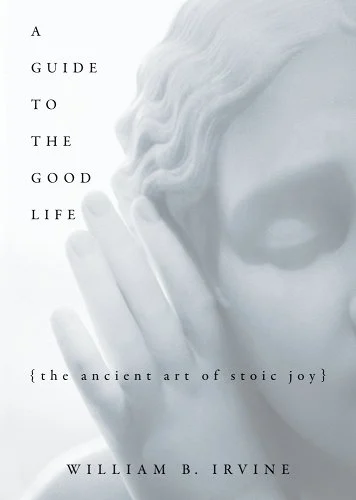
A guide to the good life

I wrote this book with the following question in mind: If the ancient Stoics had taken it upon themselves to write a guidebook for twenty-first-century individuals—a book that would tell us how to have a good life—what might that book have looked like? The pages that follow are my answer to this question.

~ William B. Irvine, from A Guide to the Good Life

slip:4a2gu1a.

There are a lot of books and ideas that get put forward when talking about Stoicism. This book is the best place to start. I wish I had found it much closer to when it was written in 2009. I wish it had been written 30 years sooner, and that I’d found it back then.

The Stoics’ interest in logic is a natural consequence of their belief that man’s distinguishing feature is his rationality. Logic is, after all, the study of the proper use of reasoning.

Ibid p33

[…] when the Stoics counsel us to live each day as if it were our last, their goal is not to change our activities but to change our state of mind as we carry out those activities. In particular, they don’t want us to stop thinking about or planning for tomorrow; instead they want us, as we think about and plan for tomorrow, to remember to appreciate today.

Ibid p71

[W]hen Stoics contemplate their own death, it si not because they long for death but because they want to get the most out of life. As we have seen, someone who thinks he will live forever si far more likely to waste his days than someone who fully understands that his days are numbered, and one way to gain this understanding is periodically to contemplate his own death.

Ibid p200

ɕ


Virtues

One must have a practice. Because the alternative would be to aimlessly wander.

Ancient Stoicism aimed to be a complete philosophy encompassing ethics, physics and logic. Yet most modern Stoics focus primarily on ethics, and they typically adopt four Stoic principles.

The first is that virtue is the only or highest good, including the cardinal virtues of wisdom, temperance, courage and justice. Everything apart from virtue – including wealth, health and reputation – might be nice to have, but they do not directly contribute to human flourishing.

~ Sandra Woien from, Stoicism and spirituality

slip:4uteso1.

You’ll have to click to read what the other three principles are…

One thing I particular like about the modern Stoicism is that it is explicitly a practice of doing, not of showing. It’s a central point that one should do the work upon oneself without fanfare or proselytizing. Stoicism is aspirational. I share about Stoicism here, in small part because it’d be great for more people to learn about it. But mostly because I often read about it, and thinking and writing about it helps me in my practice.

ɕ


Try steeper

“The obstacle is the way” is not a phrase from Art du Déplacement. It’s a two-thousand-year-old comment from a Stoic (writing in a personal journal to himself.) In a similar vein, he also wrote that, “nature turns all things to its own purpose.” Likewise the more modern “Rust never sleeps,” is equally pithy.

The real lesson is of course that there’s a season for everything. Sometimes more challenge is the key to progress, and sometimes simply being is the key. (Which is also something thoroughly covered in the Stoic philosophy. And please: Stoicism is not at all about suppressing one’s feelings.) I think I learned that seasons lesson early on from bicycling. I’m from Pennsylvania, from an area of rolling, often wooded, hills. Every bike ride ever was an endless repetition of “down a hill, ’round a corner, up a hill, round a corner, down a hill, …” In a very real sense, all parts of that were equally fun.

In a comfortable, prosperous country like ours, some of the built in tendencies of Human nature tend to work against us, saying, “Hey – I’ve noticed we have plenty of food and reasonable shelter and that’s good enough. So let’s just double down on the Netflix, comfort foods, and occasional luxury purchases and that will keep us safe.” Instead, I want you to set your life treadmill to just a bit of a steeper, healthier incline setting.

~ Peter Adeney from, The Arizona Experiment!

slip:4umomo1.

I’d like to mention that “Culdesac” in that linked URL is a town’s name; You can go read that article either for the life advice, or to learn about one of several towns in the U.S. now which are being built as people-first. (As opposed to basically every other town and city which is built as cars-first.)

ɕ