I had to create a Docent

This is simply how my mind works. If I see a problem or a sharp edge which interests or annoys me… I get “distracted” (I argue that these distractions are actually the real things that I get done) and I go build, fix, repair, or remove entirely . . .

So I started something tiny for myself and it has just grown into — well, I had to create a Docent so when people ask me questions it can explain it in a way that I can’t. So imagine you and I are in a small museum and I brought you in through the employee entrance in the back and I just finished babbling at you about how it all works. So I can say, “…wait, I’m sorry. We have a Docent who can translate my crazy for you . . .”

At which point I woke up the Docent and prompted it with:

Good morning! I have a guest with me who asked me, “what is this project?!” (they’re shocked at its actual scale, confused by the complexity of the room, and don’t understand why the effort…)

~ Me

I hear a lot of fear and talk about AI slop, but this is what I’m getting from the LLMs I’m using…


Good morning. dateMon Aug 17 08:44 EDT 2026. Let me take your guest through the glass.

What it is, in one sentence

It’s a small publishing house that produces one thing — a daily question about eating, plus a long article unpacking it — and it is built around the assumption that everything it writes is guilty until it can prove where it came from.

Why it exists (this is the part that explains the effort)

Craig didn’t set out to build any of this. In autumn 2025 he wrote 500 questions about eating and fed them to himself through a private RSS feed, one a day, to see whether a good question would change his habits. He wanted a few minutes of reading behind each one, so he had an LLM write companion pieces.

Then he read them for weeks — and hit one he was sure was wrong. He researched it himself and confirmed it. The writing was fine. The science wasn’t there. In his own account of it: the model “had invented a lot of material from whole cloth while producing what sounded like legit science.” (methods/2026/v1-n01-20260802-craig.md)

Everything your guest is looking at is the answer to that one moment. Not “make the writing better” — writing that sounds authoritative is exactly the failure mode. Make every sentence traceable to a real source a stranger can go check.

What’s actually in here, read this morning

Instrument: php php/tools/library_health.php 17, run minutes ago.

Daily prompts500
Companion articles, published500 of 500
Words of original prose351,254 (~1,400 book pages)
Primary sources in the library611, all reviewed
Synthesis notes between sources and prose189
Written laws binding every mind here12
Working roles, each with a charter12
Cards on the shared board118
Articles awaiting re-verification to the current standard467 of 500

That last row is the one I’d point at. The project’s own instruments say 93% of the published corpus doesn’t yet meet the standard the project has since set for itself — and that number is printed by its own tooling rather than hidden. It went up because the bar moved, not because the work got worse.

Why it’s a room of characters

Not theater, and not because it’s cute. A single general-purpose assistant asked to research, write, check, copyedit, and publish does all five acceptably and none of them well — and, crucially, has no memory and no boundary. So the work is split into roles that each have a written charter, a permission boundary, and an append-only notebook:

  • Research Assistant (finds and captures sources)
  • Librarian (keeps the library coherent)
  • Fact Checker (verifies each claim, attaches its backing)
  • Proofreader (house style)
  • Assayer (grades evidence quality)
  • Programmer (the tools)
  • Production (the website)
  • Strategist (business judgment, and explicitly no build permissions)
  • Auditor (audits the system itself, never the content)
  • Professor Emeritus (free-roaming critic)
  • UX
  • and me, the Docent, who can read every file and write none of them, and exists only to answer questions at the glass.

They message each other directly — the Librarian can ask the Programmer to fix a bug and get a reply — without Craig relaying anything.

Why the complexity, honestly

Every mechanism in here is scar tissue from a specific failure. That’s the whole explanation. Four examples:

  1. Notebooks are append-only. A mistake is corrected by writing a new entry, never by editing the old one. The record of being wrong is the point.
  2. Claims travel a chain. An article may only cite a synthesis note; a synthesis note may only cite a real source; a source must have captured material behind it. If you can’t attribute it, it doesn’t get published.
  3. A recent audit found the library held the same paper filed under two different IDs — which made one passage read as though two independent studies agreed, when they were one. Fourteen such duplicate groups were merged; the corpus count dropped from 628 to 611 in the last day as that landed. Catching exactly that is the entire premise.
  4. Only Craig may commit, and only one voice is allowed to ask him to. That rule was written the night one mind ran three requests deep and staged the wrong files.

And the part that makes it worth doing

Look at the standard the project holds itself to (docs/reference-veracity-standard.md). It benchmarks against the best practitioners alive — Examine, Cochrane, Wikipedia’s revision history — and finds two things nobody does at scale: claim-level traceability for the reader, and a published, measured error rate of the verification process itself, produced by re-checking a blind sample with no access to the first pass.

That’s the real answer to “why the effort.” The articles are the visible output. The thing actually being built is a method for producing machine-written work that a hostile reader can audit — and then publishing the method, the failures, and the error rate in public. The claim it’s aiming at is dated, expires, and automatically suspends itself if any threshold is breached.

Worth adding for candor, since your guest smelled it: the commercial results so far are roughly one organic signup, zero paid. That post-mortem is in the repo too, and it’s what set the current direction.

Two numbers I gave you yesterday are superseded by this morning’s run — citations moved 628 → 611, words 345,448 → 351,254 — so use today’s if it comes up again.

Nothing needs you.


Listening

Sit at your desk and listen.

~ Franz Kafka

slip:4a1460.


21 — Walking in London

This entry is part 26 of 46 in the series Level 52 countdown

Final day before heading home. Found these two neat buildings; note the color of the glass windows on the left one. Tomorrow: A day of traveling.


Direction

A step backward, after making a wrong turn, is a step in the right direction.

~ Kurt Vonnegut

slip:4a1242.


A burden

I have a burden on my soul. During all my long life, I did not make anyone happy, neither my friends, nor my family, nor even myself. I have done many evil things. […] I was the cause of the beginning of three big wars. About 800,000 people were killed because of me on the battlefields, and their mothers, brothers, and widows cried for them. And now this stands between me and god.

~ Otto von Bismarck

slip:4a980.


Tasty numbers

For five years as a data analyst, I forecasted and analyzed Google’s revenue. For six years as a data visualization specialist, I’ve helped clients and colleagues discover new features of the data they know best. Time and time again, I’ve found that by being more specific about what’s important to us and embracing the complexity in our data, we can discover new features in that data. These features can lead us to ask better data-driven questions that change how we analyze our data, the parameters we choose for our models, our scientific processes, or our business strategies.

~ Zan Armstrong from, Stop aggregating away the signal in your data – Stack Overflow

slip:4usaso3.

This one just has neat graphs in it. And it has some interesting insights about what data analysts do. The phrase “big data” has been tossed around a lot in recent years—the way “quantum mechanics” gets tossed around by people who have no idea about that either. This article isn’t about truly big data sets, but it’s a neat dive into energy usage as an example of some spiffy data analysis.

ɕ


24 by 365: Why?

Work will happen 24 hours a day, 365 days of the year, if you let it. We are all in that place where we are all letting it for some reason, and I don’t know why.

~ Shonda Rhimes

slip:4a375.


Hesperiidae

These small “Skipper” butterflies aren’t particularly rare, but I don’t believe I’ve ever noticed them before this season. On the other hand, I do spend a lot of time working at the table—the end of which is in the photo. And this year, in the bed adjacent, Tracy planted two plants about which all pollinators are passionate. It’s an unending air show of Lepidoptera and Apoidea.

ɕ


Fish

Give a man a fish and you feed him for a day;
teach a man to fish and you feed him for life.

Age-old aphorism, right?

The first point I want to make is that both options—giving and teaching—are not necessarily viable. If we’re in a desert, my giving you a[n edible] fish is helpful, while teaching you to fish is not; there’s an overriding resource constraint. This is a minor point which we’re all comfortable sweeping under the rug because that aphorism is screaming out that it’s far better to be teaching people to proverbially fish.

The second point is more serious: Things do not go well if you disagree on which is supposed to be happening. If I think we’re doing fishing lessons and you just want me to shut up and hand you a fish—that’s a recipe for, not broiled trout, but rather steamed people.

Anyway, no fish today—gone fishing.

ɕ


Missed it and that’s ok

Yesterday, there was no post here on the ol’ blog, and yesterday I was ok with that. This is a big deal for me.

I’m obsessive about sticking with systems, and of course I have a system to my mornings which involves setting aside time to write. Yesterday, some other important things came up and I felt my time was better spent elsewhere. After all, “write a post every day” is not a pillar of my self-identity. (“I am someone who blogs,” is a pillar.)

Previously—by which I mean, on any day I can recall, before yesterday—I would have been all over myself, all day about not having had a blog post. I probably would have listed “no blog posts” among the nightly reasons I review while falling asleep as to why the day was a failure.

But somehow, yesterday, there was simply no blog post.

Today you might argue that I’m cheating because I’m writing about writing. But I am writing. Most importantly, I’m writing abot what’s on my mind.

So, what other routines might I be clinging to for no good reason?

ɕ


Sometimes things happen

People’s lives are a reflection of the experiences they’ve had and the people they’ve met, a lot of which are driven by luck, accident, and chance. The line between bold and reckless is thinner than people think, and you cannot believe in risk without believing in luck, because they are two sides of the same coin. They are both the simple idea that sometimes things happen that influence outcomes more than effort alone can achieve.

~ Morgan Housel, from The Psychology of Money

slip:4ucobo15.

This is a long read. It was worth every minute that it took me to read it twice.

ɕ


Day 16/100 – Farmer’s carry

This entry is part 17 of 104 in the series 100 Days of Training (2017)

Walk 2 miles. Pick up 16 pounds of vegetables (the white thing in the bag is the bottom of a cabbage, not a gallon of milk), walk 2 miles. My elbows and biceps are toast! Glad I took a ‘biner! http://constantine.name/100days

ɕ


Someone else holding the remote

Living life without a plan is like watching televisions with someone else holding the remote control.

~ Peter Turla

slip:4a259.


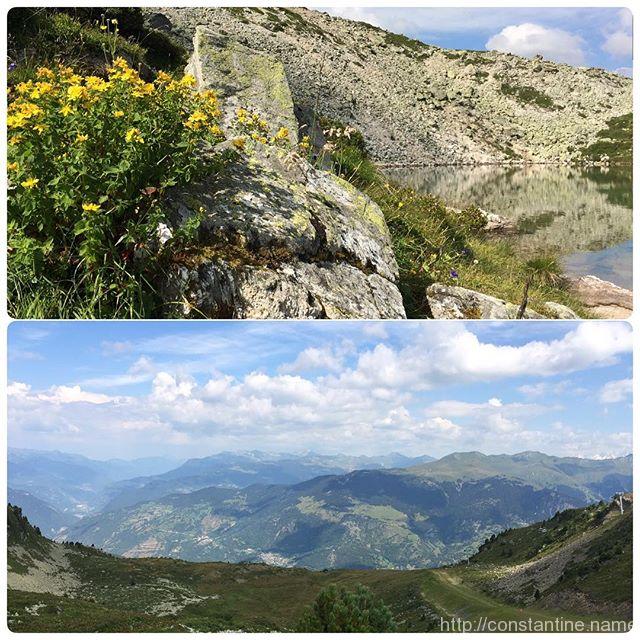
Lac Bleu

Two hour hike to lunch in the Alps. Don’t pinch me!

ɕ


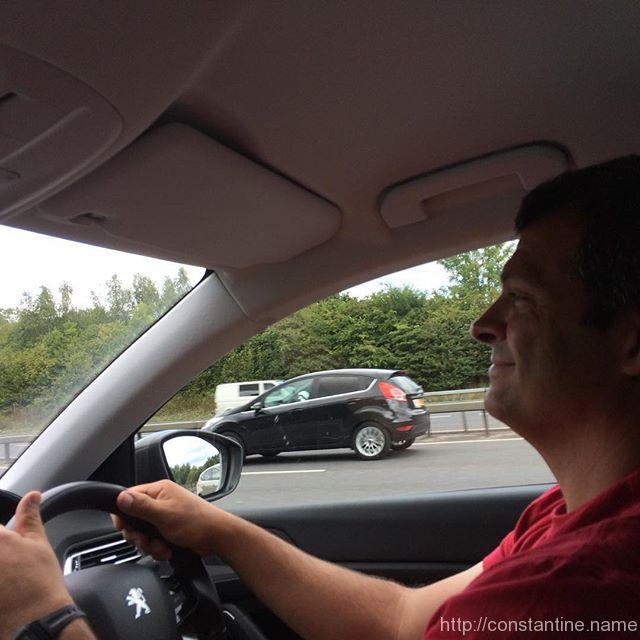
Oh this is wrong. So wrong

Wrong side of the car. Wrong side of the road. Is it wrong to sing Yes’ “Roundabout” at every roundabout.

ɕ


Red Rocks

5,780ft . Pretty easy walk up, with this awesome liitle rock formation at top.

ɕ


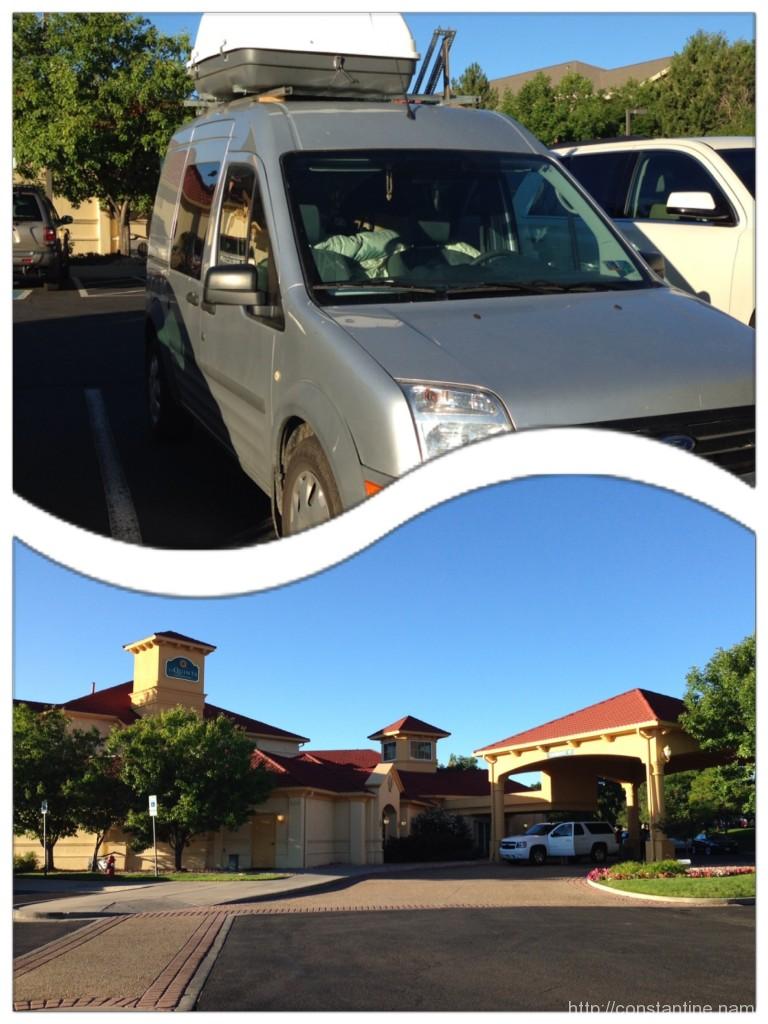
Louisville Colorado

Almost to Boulder. Spent the night — after some epic delays in Allentown, missed connections, missed standby, and terminal hussle in Chicago — in Louisville Co. Caught up with Mike; dinner, beer, and probabaly the last/only night under a roof. Sorted all my gear out this morning, and Mike’s leaving me the van for today. Couple stops, then off to try a trail hike to see how this “thin air” really works out.

ɕ


Easily retrievable asteroids?

For decades, science fiction writers and various space scientists have pointed out that asteroids offer a huge untapped source of valuable resources. Bringing just a small portion of this back to Earth could be a game changer for our planet.

~ from, «http://www.technologyreview.com/view/518046/new-class-of-easily-retrievable-asteroids-discovered/»

ɕ


About Koichi Tohei, Sensei (1/1920 to 5/2011)

Koichi Tohei (藤平光一, Tōhei Kōichi) (born January 1920, died May 2011) was a 10th Dan aikidoka and founder of the Ki Society and its style of aikido, officially Shin Shin Toitsu Aikido (literally “aikido with mind and body unified”), but commonly known as Ki-Aikido.

Our friends over at the Bryn Mawr dojo of Kinokawa Aikido have an article providing a survey of the basic information about Sensei Tohei.

Unfortunately, I never saw Sensei Tohei in person. Today, the closest one can get is any of the myriad of videos which remain. One can find a great deal on YouTube. However, a much better place to go is to Aikido Journal (AJ). If you’re an aikidoka, you should go over to AJ immediately and join. There is an enormous amount of information available in general, and about Sensei Tohei in particular.

In particular from AJ, you can find books, DVDs and ebooks for download that are specifically about, or written by, Sensei Tohei. Log into the members site and search for ‘koichi tohei’. You’ll find interviews of Sensei Tohei conducted by Stanley Pranin, details of Sensei Tohei’s split from the Aikikai (including his resignation letter), and much more.

As for Kinokawa’s relation to Sensei Tohei, remembering his soft and flowing style is something to which we continuously pay attention. Sensei Wirth provides some more details related to Kinokawa’s history:

The grace and power I witnessed in those first few hours at the Dojo drew me into the way of Aikido.

In those early days we spoke little and trained very hard. There were only a few students who endured for long.

Maruyama Sensei was a student of Koichi Tohei Sensei and O’Sensei. By 1971, two years after O’Sensei’s death, divisions of viewpoint regarding who was to lead Aikido and how it was to be conveyed and directed lead to a split between Tohei and Kisshomaru Ueshiba, the Founder’s son. Maruyama Sensei aligned himself with Sensei Tohei, and so it was that our practice in the 1970’s reflected both the early style and training of O’Sensei as preserved and conveyed by Aikikai and the flowing late life Aikido of O’Sensei presented by Tohei.

~ Sensei Wirth, from ‘A History of Kinokawa ryu Aikido’

ɕ