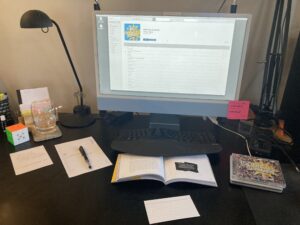
Taking a fresh look at Austin Kleon’s Show Your Work. Book is smashed open to a quote from Russell Brand—with a notecard where I’m about to add this quote to my collection. I’m a bit of an audio nerd—I don’t stream from services, rather stream from the countless CDs that I keep in the ‘ol digital library. I like to start from a movie soundtrack, and then spread out into all the artists. Rubik’s cube, glass of water. Pink postit reminds me: “There are no miracles, there is only discipline“
A few things in view
Hand rolled
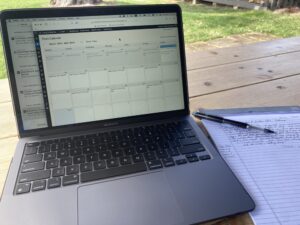
I describe my weekly email, 7 for Sunday, as “Hand-rolled and algorithm-free.” I’m using some custom code in WordPress to assemble separate posts into a single “thing” which then goes out via email. It’s definitely a lot of “hand-rolling”. A lot of hand writing my notes and mind-maps for each post, typing the posts, the quotes, ordering and organizing everything, handling links and images and… zoinks, it’s a lot. I love it.
Building tools
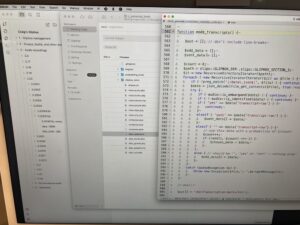
Currently in my personal knowledge system I have notes on ~400 audio recordings. (Raw recordings I’ve done, podcasts of my own I’ve published, other shows I’ve been on, etc.) That can be my episode notes and writing, but also program-readable meta information. Today, I spent time writing some new tooling to help me sort out transcripts (which recordings have them, which have been sent out, etc.)
Pre-flight checklist? Check!
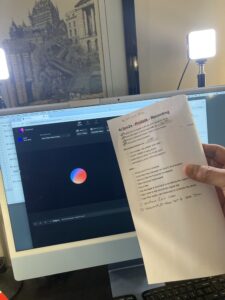
I’m a major process-person. Process is discipline. For me, inspiration always runs out. But process enables me to put one dumb foot in front of the other— and then course correct as I go. Pre-flight checklist here minutes before a guest joins me for a recording.
ɕ
Putting pen to paper
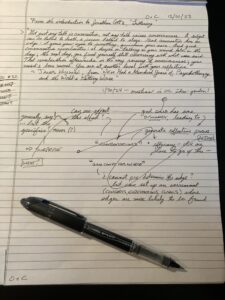
I’ve tried to do digitally the thinking and creative part of writing. It just doesn’t work as well as scribbling on paper. I use these tablets to capture ideas. This seed has been bumping around for 3 months (if you zoom in, it’s interesting that this seed happens to be _about_ reverberations!) Today it gets turned into a new something for Open + Curious.
ɕ
Software power-tools
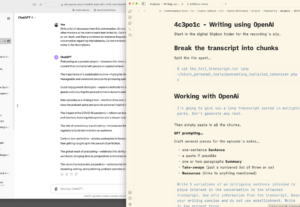
There’s a lot I can say about episode notes for individual podcast episodes. I have trouble writing them from scratch. But I’ve been using OpenAI’s LLM for a while now and tinkering on some prompts that work well. It takes me at least half an hour of writing (me writing and revising) to go from a raw transcript to solidly useful episode notes.
ɕ
Tools at hand
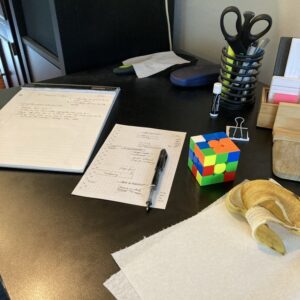
There’s a magnifying glass in the back there too. Extra pair of low-reflection reading glasses. Lip balm; don’t need it until I need it. Rubik’s cube so I can kill a few minutes without spinning off starting something that then turns into a rabbit hole. What do you keep at hand when working?
Brain dump for today’s O+C post
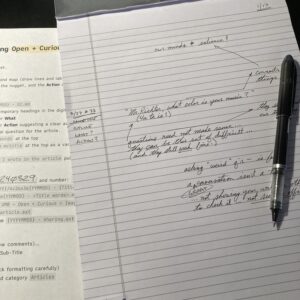
I jot down little conversation-related things I find. Then I work them into being posts on https://openandcurious.org/ This little, weird question caught my eye in January.
Quotations
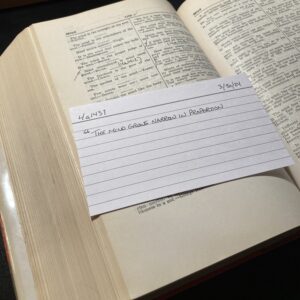
30 years ago, I put a few quotes on my first blog. Then things escalated. I collect quotes from all over the place. But sometimes, I dive (using a random number tool to pick one of the 2,000 pages) into this door-stop of a book, 40,000 Quotations Prose and Poetical. Found a few on this page. This one is becoming number 1,431.
Quotes in audio format
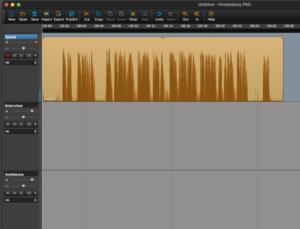
Back in… not sure, 2020? I started a daily podcast of me simply reading quotes from my collection. Last year I decided to slow down to only 3 quotes per week. I record and schedule them in batches. Screenshot of episode 1,399 being recorded. o_O
New show launched
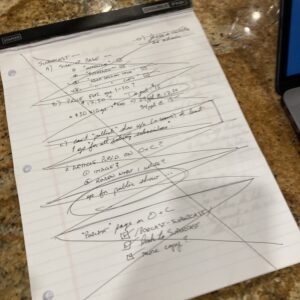
“Show your work” isn’t about showing the finished work. It’s about being open and honest about the work you do. I hope that showing my work inspires others to dig into whatever it is they are passionate about. The photo the final bunch of things, all finished today, after many months of hard work… a new podcast is launched. openAndCurious.org ;)
Feedback on peers’ work
There are few opportunities where I get together with other podcasters to review and improve our work. Just spend time listening to various pieces from some peers in prep for a zoom call this evening.
Writing
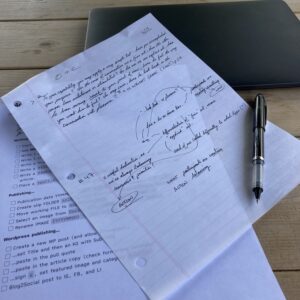
I juggle many things (recent days have been a lot of dirt moving related to garden beds). But I love sitting with a pen and paper. Working on an issue for Open + Curious.
ɕ
Show your work
I return often to Kleon’s matra of “show your work“.
I always fade out from the process. I think the reason is that I’m not necessarily doing something related to podcasting every day. (Which is fine.) Without a strong habit of podcast-specific work (for example, “I do podcast stuff at 9am every day”) I don’t get in the habit of doing the extra little bit of work to capture something showing my work…
I’m convinced, my work would be better—and it would help others too—if I showed my work more. But I can’t seem to crack this nut.
Zooming out, away from podcasting . . .
I keep thinking: I don’t have a clear, single thing that is “my work” — it’s not podcasting, it’s not blog writing, it’s not community building [here], … For example: Here’s some notes I took, over the course of an hour thinking about coaching movement, based on a long conversation I had with a coach I respect. We had a coffee meeting where I wanted to pick his brain…
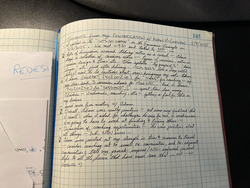
I post all sorts of things here, on the ‘ol blog. In recent years, my posting grew, become a weekly thing which I cleaved off to be the 7 for Sunday weekly email. Here I continue to post new quotes from my collection, copies of all the podcast episodes I do [all shows, anywhere], and a lot of “this is interesting” links that I find.
This morning, I’m thinking: My blog has long been the place where I work with the garage door up. Maybe I should lean into that?
…develop the habit of showing something (anything, from any project I’m working on) there on my blog. 🤔
ɕ
Podcasting ‘process’ videos?
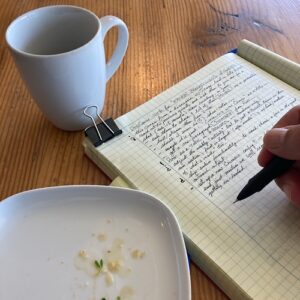
I have tons of ideas. That’s the source of my greatest challenge: trying to decide what not to do. The first step is to fully think through an idea.
This one is about an idea for little bonus videos for the supporting members in the Podcaster Community. It’s been simmering in my head for a few weeks. This morning, walked in the glorious weather, to my fave little cafe. An hour of thinking to paper powered by coffee and a sandwich. :)
Now… should I do it? …or leave it in my notebook? 🤔
ɕ
It’s just lists
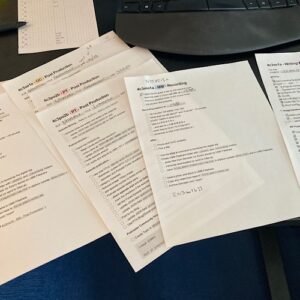
The first 90% of anything is vastly easier than the second 90%. Beginning something (an issue of 7 for Sunday, a new podcast episode for any of my 3 different shows) is so much easier if I know that all I have to do is go through these steps—look, it fits on one sheet, how hard could it be? I can totally do this…
Well, many of those tiny steps are big parts like “write the thing”. But by having all the little paper cuts listed out, I know that I won’t lose the entire kingdom for want of one horseshoe nail at the very end.
ɕ
Take note
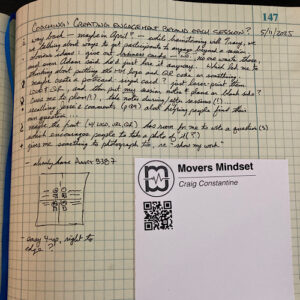
I’ve been thinking about ways to get participants to engage after the session. I talked to a few experienced coaches about this, and there doesn’t seem to be a way that works well. Sure, after any session a few students might ask questions. But cultivating engagement beyond that is a big question—everyone I talked to said to tell them how to do it if I figure it out.
My first thought was to imagine something people could take a picture of. (Giving people things like business cards would be silly and wasteful.) Coaching in the context of Movers Mindset, I imagined a printed card with MM logo/name and QR to MM’s web site and lots of room for me to write. I imagined I could write a question on it; thinking it could be interesting enough to entice people to take a photo of it.
But further thinking led me to create this little card. It’s printed on some 4x postcard stock from Avery, where a full sheet is perforated to tear apart. In the phot you can see a little sketch showing how the printed parts are all arranged in the center of the full sheet, enabling printing very close to the final cards’ edges on the two sides that aren’t the actual printing margins.
My idea is that I’ll use these little cards for my notes as I’m preparing for a session. Then, any changes, problems, questions, etc. that come up are easily captured. This way I can close my personal loop of wanting to reflect afterwards into my more permanent notebooks.
And anyone who notices the card I’m holding, (referring to, writing on, stuffing in my pocket…) may want a photo of it. There we go! There’s no “please take a photo of this” pressure. Instead, if someone is interested, I have the perfect thing for them with some notes and details about the session and a QR to reach me. (The MM site has an email list and a contact form to reach me.)
ɕ
One slip at a time
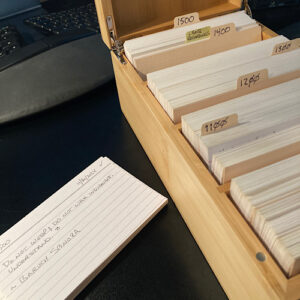
This morning I was working on adding some quotes to the ‘ol collection. I have a little box with the most-recent quotes, blank 3×5 cards and other little office-supply-ish things. Every now and then I pick up a bunch of those new quotes and move them back into these boxes. Today I realized, the second of these boxes is now nearly full—it seems like only yesterday that I moved the first few inches of cards (like ~400) into the first box. Time to order more of these storage boxes!
ɕ
Translating
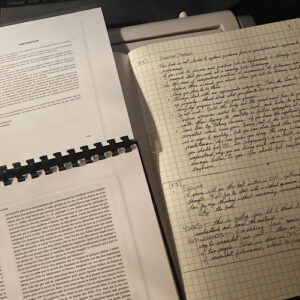
Stany Foucher recently wrote a book, Art du Déplacement: Au delà du saut. I’ve been working on translating it for my own reading. I can read the French language at an “advanced beginner” level. From the epub version of the book (which I printed so I can write on it), I’m working in a notebook… writing things out longhand is part of the learning process. I don’t simply want to read this book, but rather I want to apprehend this book.
ɕ
Which tools you pay for
In the most-recent Podcaster Community campfire we got to talking about what tools and services are we currently paying for as part of podcasting. So today I put up a simple post in a few places to ask just that.
It’s one thing to talk about what we prefer, it’s another for us to have voted with our dollars. Me?
- Hindenburg Pro
- Zencastr (for recording podcasts)
- Zoom (for everything except recording podcasts)
- Vimeo (for hosting streaming video for the Podcaster Community)
- Discourse (for the Podcaster Community forum)
- Calendly (for scheduling, integrated with all the complexity of my personal calendar)
- Otter.ai (for all the various audio I need to transcribe— pod recordings via Zencastr come with a transcript)
- Podmatch.com
ɕ
The view is often the same
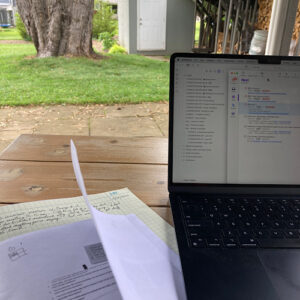
The view, when I’m doing my work is quite often a notebook and a computer. I try to make it be outside as much as I can too. Show-your-work photos are booooooring, I know. But capturing and gestating my thoughts, and then tapping on a keyboard. That’s mostly what I do.
ɕ
Knowledge in
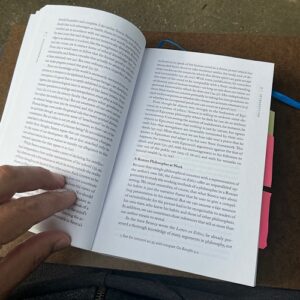
I spend a lot of time reading—frankly, as much time as I can sequester for it. I’ve read several of Seneca’s letters, randomly over the years. A while back I bought this delightful edition from Chicago Press and I’m beginning at the beginning. (There are marks in the book where I’ve already used it for referring to some of the letters.) What knowledge are you putting into your mind?
ɕ
Right. In. My. Face.
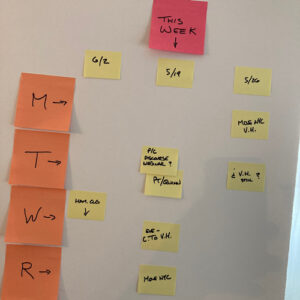
I keep a board with sticky-notes. Right at eye level, right next to my most-common workspace. What’s the simplest thing that could possibly work? In this case it’s rows for day-of-the week, and date at the top. Then I just stick notes for rocks where they need to be. (The metaphor is that of putting rocks and sand into a glass jar… put big rocks in first. Also sometimes phrased as, “Eat the toad first.”)
This really works well for me. Every time I see the board I think: Am I actually doing the right thing?
ɕ
Clear the decks
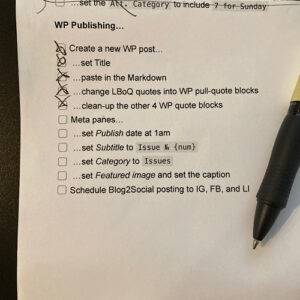
As I’m getting ready for a road trip, I’m finishing up as many things as I can. I always say I want to spend less time at my computer. That will definitely be the case for the next five days. Yes, please.
ɕ
Decisions
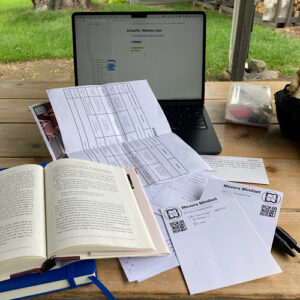
I spend far too much time “working” inside the virtual world. When I get a chance (as I just did) to go do stuff entirely in the real-world, with scarcely a moment to check in online, I end up with piles of backlogged “work.” It’s at this point that I try to pare things down. I’d love to do zero computer work—but that’s not happening while my faculties hold out. Until then, I’ll continue to trim and optimize.
ɕ
I had to create a Docent
This is simply how my mind works. If I see a problem or a sharp edge which interests or annoys me… I get “distracted” (I argue that these distractions are actually the real things that I get done) and I go build, fix, repair, or remove entirely . . .
So I started something tiny for myself and it has just grown into — well, I had to create a Docent so when people ask me questions it can explain it in a way that I can’t. So imagine you and I are in a small museum and I brought you in through the employee entrance in the back and I just finished babbling at you about how it all works. So I can say, “…wait, I’m sorry. We have a Docent who can translate my crazy for you . . .”
At which point I woke up the Docent and prompted it with:
Good morning! I have a guest with me who asked me, “what is this project?!” (they’re shocked at its actual scale, confused by the complexity of the room, and don’t understand why the effort…)
~ Me
I hear a lot of fear and talk about AI slop, but this is what I’m getting from the LLMs I’m using…
Good morning. date → Mon Aug 17 08:44 EDT 2026. Let me take your guest through the glass.
What it is, in one sentence
It’s a small publishing house that produces one thing — a daily question about eating, plus a long article unpacking it — and it is built around the assumption that everything it writes is guilty until it can prove where it came from.
Why it exists (this is the part that explains the effort)
Craig didn’t set out to build any of this. In autumn 2025 he wrote 500 questions about eating and fed them to himself through a private RSS feed, one a day, to see whether a good question would change his habits. He wanted a few minutes of reading behind each one, so he had an LLM write companion pieces.
Then he read them for weeks — and hit one he was sure was wrong. He researched it himself and confirmed it. The writing was fine. The science wasn’t there. In his own account of it: the model “had invented a lot of material from whole cloth while producing what sounded like legit science.” (methods/2026/v1-n01-20260802-craig.md)
Everything your guest is looking at is the answer to that one moment. Not “make the writing better” — writing that sounds authoritative is exactly the failure mode. Make every sentence traceable to a real source a stranger can go check.
What’s actually in here, read this morning
Instrument: php php/tools/library_health.php 17, run minutes ago.
| Daily prompts | 500 |
| Companion articles, published | 500 of 500 |
| Words of original prose | 351,254 (~1,400 book pages) |
| Primary sources in the library | 611, all reviewed |
| Synthesis notes between sources and prose | 189 |
| Written laws binding every mind here | 12 |
| Working roles, each with a charter | 12 |
| Cards on the shared board | 118 |
| Articles awaiting re-verification to the current standard | 467 of 500 |
That last row is the one I’d point at. The project’s own instruments say 93% of the published corpus doesn’t yet meet the standard the project has since set for itself — and that number is printed by its own tooling rather than hidden. It went up because the bar moved, not because the work got worse.
Why it’s a room of characters
Not theater, and not because it’s cute. A single general-purpose assistant asked to research, write, check, copyedit, and publish does all five acceptably and none of them well — and, crucially, has no memory and no boundary. So the work is split into roles that each have a written charter, a permission boundary, and an append-only notebook:
- Research Assistant (finds and captures sources)
- Librarian (keeps the library coherent)
- Fact Checker (verifies each claim, attaches its backing)
- Proofreader (house style)
- Assayer (grades evidence quality)
- Programmer (the tools)
- Production (the website)
- Strategist (business judgment, and explicitly no build permissions)
- Auditor (audits the system itself, never the content)
- Professor Emeritus (free-roaming critic)
- UX
- and me, the Docent, who can read every file and write none of them, and exists only to answer questions at the glass.
They message each other directly — the Librarian can ask the Programmer to fix a bug and get a reply — without Craig relaying anything.
Why the complexity, honestly
Every mechanism in here is scar tissue from a specific failure. That’s the whole explanation. Four examples:
- Notebooks are append-only. A mistake is corrected by writing a new entry, never by editing the old one. The record of being wrong is the point.
- Claims travel a chain. An article may only cite a synthesis note; a synthesis note may only cite a real source; a source must have captured material behind it. If you can’t attribute it, it doesn’t get published.
- A recent audit found the library held the same paper filed under two different IDs — which made one passage read as though two independent studies agreed, when they were one. Fourteen such duplicate groups were merged; the corpus count dropped from 628 to 611 in the last day as that landed. Catching exactly that is the entire premise.
- Only Craig may commit, and only one voice is allowed to ask him to. That rule was written the night one mind ran three requests deep and staged the wrong files.
And the part that makes it worth doing
Look at the standard the project holds itself to (docs/reference-veracity-standard.md). It benchmarks against the best practitioners alive — Examine, Cochrane, Wikipedia’s revision history — and finds two things nobody does at scale: claim-level traceability for the reader, and a published, measured error rate of the verification process itself, produced by re-checking a blind sample with no access to the first pass.
That’s the real answer to “why the effort.” The articles are the visible output. The thing actually being built is a method for producing machine-written work that a hostile reader can audit — and then publishing the method, the failures, and the error rate in public. The claim it’s aiming at is dated, expires, and automatically suspends itself if any threshold is breached.
Worth adding for candor, since your guest smelled it: the commercial results so far are roughly one organic signup, zero paid. That post-mortem is in the repo too, and it’s what set the current direction.
Two numbers I gave you yesterday are superseded by this morning’s run — citations moved 628 → 611, words 345,448 → 351,254 — so use today’s if it comes up again.
Nothing needs you.