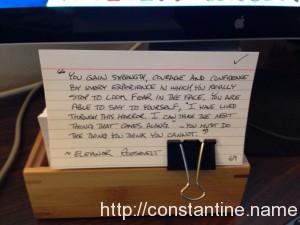
The over justification effect

Self-perception theory says you observe your own behavior and then, after the fact, make up a story to explain it. That story is sometimes close to the truth, and sometimes it is just something nice that makes you feel better about being a person.

~ David McRaney from, The Overjustification Effect – You Are Not So Smart

slip:4uyote1.

ɕ


A most sincere thank you

This entry is part 7 of 72 in the series My Journey

Two years ago today, I showed up at Wescosville Elementary at 4pm and tried parkour. A very big thank you to everyone ( Adam, Josh, Joseph, and Miguel in particular) who has been friendly, happy, and encouraging these last two years. This week I will be attempting the ADAPT 1 certification; I could not have accomplished what I have without all the help from the wonderful men and women of lehigh valley parkour. “allez, allez!”

ɕ


A deep sense of malaise

This entry is part 6 of 72 in the series My Journey

You can harness and channel these needs, but a man completely ignores them at his peril. Modern men are told there’s nothing real about manhood — that it’s all a silly, outdated cultural construct — and they sure work hard to believe it. And yet they cannot shake a deep sense of malaise, and they don’t know why.

~ Brett McKay from, Where Does Manhood Come From? | The Art of Manliness

slip:4uaowe1.

I consider myself very lucky. I’m expressing my mid-life crisis in some pretty healthy and productive ways. Instead of going on a more traditional bender, I’m shaking off shackles and bindings that I in fact put on.

One day I realized that there is no longer anyone left to tell me what to do. Certainly one has responsibilities, but there are precious few of those which are immutable bedrock. You look at your life and think, “Look at all these ideas I’ve accepted.” When you pick idly at some of the threads, the whole thing comes apart, and you find yourself in a row boat on the sea — or on a bicycle on the open road (choose your own metaphor). On the open sea in a good way; You realize you are free, that in fact you have NOT always been free, and that there’s an awful lot of life left to live now that you’re ready to start.

ɕ


First successful Turing Test

First successful Turing Test: First Turing Test success marks milestone in computing history

ɕ


June 6th, 2014

Today is the 70th anniversary of the landings for the Normandy invasion.

A friend asked rhetorically, “Would I have boarded one of those ratty boats and waited for the door to come down?” I can only imagine that the training and “esprit de corps” would carry the day, because otherwise, attempted as individuals, what they accomplished seems inconceivable.

Unfortunately, those two most horrible wars feel as far away now as to be ancient history. I hope that humankind has subsequently climbed far enough up the moral ladder that we no longer need the visceral feeling of the wars to provide us with guidance.

ɕ


Finding meaning in the mundane

Everyone here has done this, of course. But it hasn’t yet been part of you graduates’ actual life routine, day after week after month after year.

But it will be. And many more dreary, annoying, seemingly meaningless routines besides. But that is not the point. The point is that petty, frustrating crap like this is exactly where the work of choosing is gonna come in.

~ David Foster Wallace

slip:4a799.

It occurs to me that I’ve no idea who gave the commencement address at my graduation. After a bit of digging…

Robert W. Galvin, chairman of Motorola, delivered the main address yesterday to the 1,150 graduates at the 125th commencement of Lehigh University in Bethlehem, Pa.

Mr. Galvin received an honorary Doctor of Engineering degree.

~ from the May 31st NYT archives listing several school’s commencement addresses.

ɕ


Take back the Internet

This is not the Internet the world needs, or the Internet its creators envisioned. We need to take it back.

And by we, I mean the engineering community.

Yes, this is primarily a political problem, a policy matter that requires political intervention.

But this is also an engineering problem, and there are several things engineers can — and should — do.

~ Bruce Schneir from, Take Back the Internet

slip:4usebo4.

I’d venture that the vast majority of regular, everyday people working in technology related jobs are not actively trying to do evil. People go to work, make the best decisions they can and then go home. If that’s true, then it’s going to be nigh impossible to change the momentum of how things (e.g., NSA surveillance) are going. Because in order for it to change, we need to start thinking bigger.

ɕ


Oil limits

This model “works” fairly well, as long as the economy is growing fast enough–population continues to grow and resource extraction continues to grow as planned. In a finite world, we know that this model cannot work forever. At some point, we can expect to start reaching limits.

What do these limits look like? I would argue that in the case of resource extraction, these limits look like increasingly high cost of extraction.

Gail Tverberg from, Oil Limits Reduce GDP Growth; Unwinding QE a Problem

slip:4uouoi4.

You should also read “Quantitative Easing (QE)” (the first three, short paragraphs on WikiPedia summarize it neatly.)

My opinion: We need to start seriously talking about a STEADY STATE ECONOMY. What would that look like? How would it work? How do we get to that? Seriously. We simply CANNOT have a growing and expanding economy forever on a finite planet with finite room and finite resources. What part of “finite” don’t you understand?

ɕ


What does “honest” mean in Kinokawa Aikido

When we opened the new dojo in Allentown, I sat down to try to write a short description of what distinguishes Kinokawa Aikido. I wanted to avoid pretentiously explaining “what makes it better,” because starting down that path will instantly close off the minds of certain readers. Instead, I wanted to lay out the hallmarks of Kinokawa so that readers could get a sense of the style at a glance.

There is a bit more at Aikido on the dojo’s web site. But here is the part about honesty:

A second hallmark of Kinokawa Aikido is that is honest — in the sense of being interested in honestly exploring Aikido as a high intensity [physical and mental], combat effective, applicable to your daily life, sort of practice. In fairness, practitioners of hard type martial arts will generally not consider any sort of Aikido as combat effective or workable in a real world scenario. (Obviously, we disagree with such a prejudged assessment.) But setting aside the judgement (does Aikido work, or not, in real application?), it is the goal of honestly exploring those concepts, within the framework of Aikido, which is a critical feature of Kinokawa.

…and here are some similar thoughts from Tom Collings, from Responding to Aggression – Part 2:

… The rule of thumb in military and police training, established through exhaustive battlefield and police critical incident research is: “if it takes long to learn, it probably won’t work under stress.” Yet, as black belt martial artists we take great pride in the techniques that took us many years to master, and it would be unthinkable at the dojo to teach only what is easily learned. Who would that impress? The other rule is: “practice what you will need to perform.” That means our training must very closely match what we will confront.

Do those of us in the aiki arts really believe that assaults commonly occur by someone running up reaching for our wrist, or striking at us from above their head as if holding a sword? I guess we do because we devote most of our valuable training time to these scenarios. If it is obvious that modern day assaults are very different from these classical style attacks why do we not modify our curriculum more in line with what we will actually confront?

ɕ


To be and to last

This entry is part 5 of 72 in the series My Journey
To be and to last

To last? That old lesson about the brightest flame burning the quickest is particularly true in Parkour. What use is a person who lasts five years and has to stop training due to bad knees and a broken ankle? How useful is a body that can’t move pain free due to years of neglect and abuse? The journey of Parkour was never meant to be a brilliant flash of spectacle and show, it was always intended to be a lifelong pursuit of improvement and one that doesn’t need to end once the body begins to show signs of age.

~ Chris “Blane” Rowat from, 50 Ways To Be and To Last in Parkour | Part 1 – Training The Body

slip:4ubowa1.

Ignore the show reels. Ignore the spectacular. Those MAY be inspirational to you, but your journey SHOULD be a long series of small, eminently POSSIBLE steps. Go to your first class and try anything; try SOMETHING. Stop when your body has had enough. Repeat. In a few months, you will have grown so much that you will hardly recognize yourself.

ɕ