[…] a small number [of books] were truly transformative for me. They served as intellectual lighthouses on my journey, helping me understand what was happening to me as I explored my past, my psyche, and my pain.
An interesting list. I’ve not read any of these books. I do have one of them in my pile of books at hand. I’m not endorsing the specific books. I do very much endorse the idea of making top-ten lists to share what one has learned.
Simply sound-related things today: An image of a babbling brook and archeology…
It is possible that some 8,000 years ago, in this acoustically resonant haven, people not only hid from passing coastal thunderstorms, they may have used this place to commune with their dead—using music. That’s a possibility hinted at in the work of archaeologist Joshua Kumbani, of the University of the Witwatersrand in Johannesburg, and his colleagues.
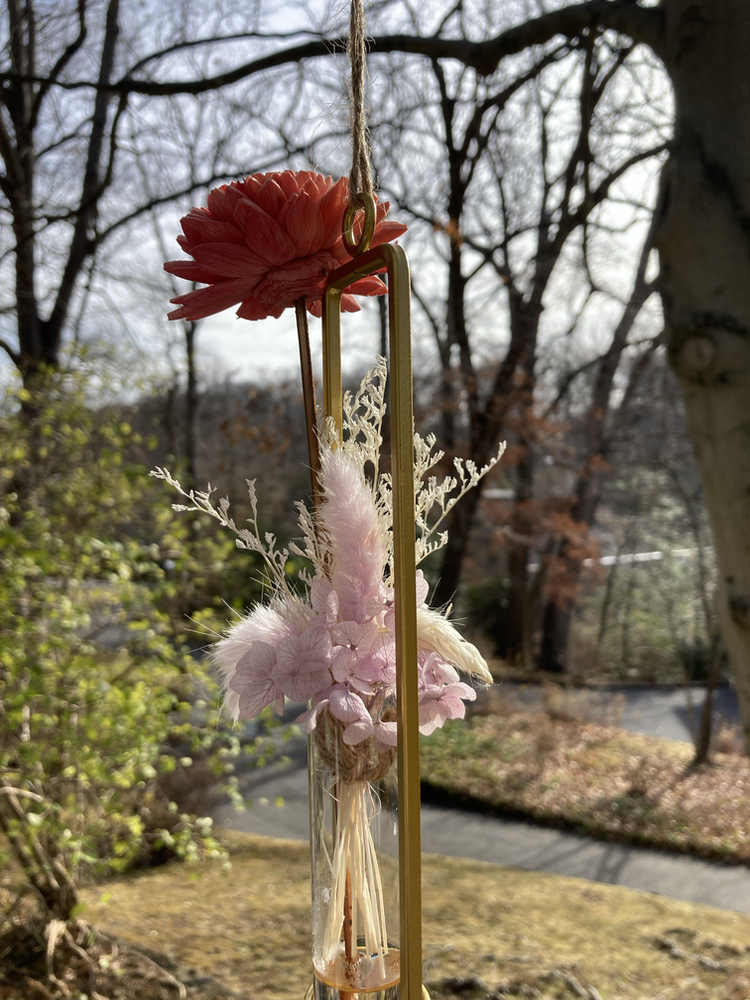
I often stroll around exploring all the little nooks and crannies of places. I found this at Winterthur as part of small display of dried flowers. The display was barely mentioned at the info center, off the normal route (especially if one had taken the minibus ride to avoid walking the slightest distance), and hanging in the back of gazebo mostly out of sight. On the other hand, the sun peeked out just as I was standing there.
Physicist and science communicator Richard Feynman came up with another criterion, one that applies directly to the non-scientist likely to be bamboozled by fancy terminology that sounds scientific. […] Rather than asking lay people to confront scientific-sounding claims on their own terms, Feynman would have us translate them into ordinary language, thereby assuring that what the claim asserts is a logical concept, rather than just a collection of jargon.
Confronting scientific-sounding things on your own terms is actually very difficult. What he’s described is not meant to be a way to decide if something is true—that’s much harder. He’s giving you a tool for quickly spotting scientific-sounding rubbish.
It’s become cliché to talk about finding our ‘why’. That’s a shame because it’s absolutely, still, critically important, to us as podcasters. I was recently reminded of this point…
Ask yourself, why am I podcasting as a host, or as a guest? You must have a clear why, and it should be bigger than just “me.”
~ Alex Sanfilippo
Tell me your ‘why’.
And if you just hesitated— If you don’t immediately have an answer— Then you do not actually know your ‘why’.
You don’t have to post it! But you better know exactly and clearly what it is. Posting it just puts it out there, ensuring it remains real for you.
Whether or not you post it, you absolutely must have a ready-to-mind answer for your ‘why’.
For the longest running of my shows, Movers Mindset, my why is…
Each conversation feeds my insatiable curiosity, but I share them to turn on a light for someone else, to inspire them, or to give them their next question.
When I started that show, I did not have a clear ‘why’. It wasn’t until I took the Akimbo podcasting course in 2019, that I took the time to reimagine a lot of the two-year-old Movers Mindset podcast, and prompting from the course material and the coaches turned me onto asking myself, “uh, yeah, why?!”
Working with the garage door up, means I’m really just thinking out loud. I’m talking mostly to myself. It’s been a long time since I’ve done an episode for one of my own shows. Obviously the break was begun because of health issues in 2024. In the last couple of months though, I again do have the time. And I miss it. So I shall resume.
No one asked me, but if I was asked to summarize Munroe’s work I’d say: He’s mastered the art of finding insight by shifting the scale. Why is that hard? Why is that helpful? Why is that great? Because to do it at the mastery level (as Munroe does) requires one to have integrated a lot of knowledge. A lot.
14+ years ago I started this blog. For many months it was basically my way of posting photos, which were also posted to a particular social platform. After about a year, I started posting more quoted stuff, and including the URL. There’s a little feature in WordPress (which powers this site) that if you drop a bare URL into a post, it will be auto-improved to be a clickable link when the post is displayed. So I took advantage of that and dropped bare URLs into thousands of posts.
Fast forward over a decade and obviously link rot is happening. So I’m changing to use page titles, and linking to the URLs. That way, when the link rots, at least a reader can see the title of where it used to go.
Introductions are not hard— …we’re just not prepared.
Whenever I’m on a podcast, I dread one inevitable question: “I know who you are, but tell everyone listening who you are!”
This is a moment when I feel painfully insecure, first-day-of-sixth-grade only-kid-with-braces level.
The things I like about myself don’t matter in this scenario; my task is to answer, essentially, “What is interesting, valuable, or remarkable about me to strangers?”
This is doubly related to people around here. Mari goes on to talk about David Nebinski and it’s worth a read.
But also, just yesterday I was in a little session presented by Andrea Wojnicki where she gave (among much more) a tidy little framework for introducing yourself. She pointed out that her framework is a place to begin. Once you get comfy introducing yourself you can expand and modify and do what you like.
So, what’s your current self-introduction?
…then read Andrea’s ideas, and then what’s your new, better self-introduction?
ɕ
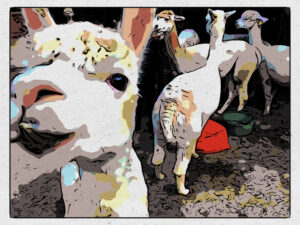
PS: Technically, it’s triply related since that’s a photo of some of Steve Heatherington‘s alpacas ;)
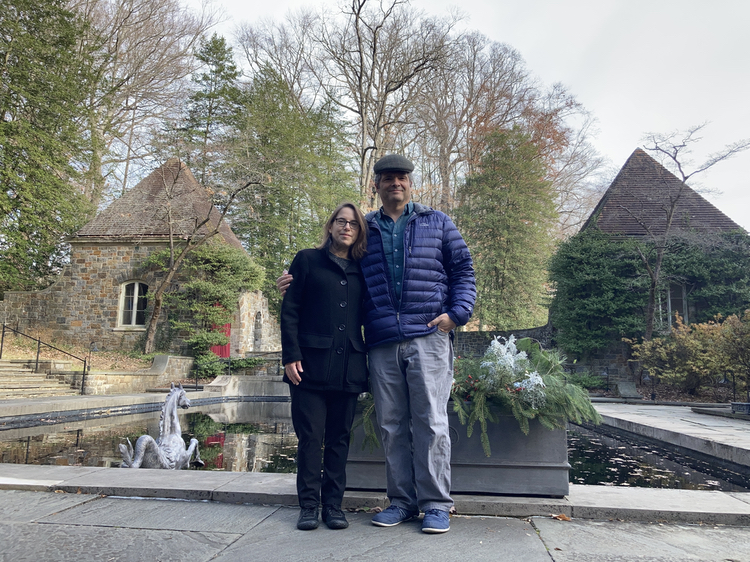
For as long as I can remember, we’ve sent some sort of holiday card to our family and closest friends. Over the years it’s been store-bought cards, then for a while I was custom printing my own cards, but most-recently the professionally printed ones just can’t be beat.
The hardest part is always—of course—getting a photo the two of us can accept. Anyway.
Happy holidays to you and your family, and best wishes for a healthy and joyful 2025.