An agreeable tour

No enjoyment, however inconsiderable, is confined to the present moment. A man is happier for life from having made once an agreeable tour, or lived for any length of time among pleasant people, or enjoyed any considerable interval of innocent pleasure.

~ Sydney Smith

slip:4a1293.


Travel

People say you have to travel to see the world. Sometimes I think that if you just stay in one place and keep your eyes open, you’re going to see just about all that you can handle.

~ Paul Auster

slip:4a1273.


It goes both ways

Still, I try to lean into the benefits of travel. And I, personally, also feel that I’m offering something important while traveling: representation. Black people do travel (and ski and horseback ride and swim and hike)! Some people’s only impressions of Black Americans come from TV shows and media, which are rife with stereotypes. The beauty is, the broadening of horizons go both ways when people travel and cultures collide.

~ Christine Pride from, Race Matters

slip:4ucuta1.

I’ve come to say that I travel so that when I return I can see my home in a new way. I travel to broaden my horizons. I definitely do not travel hoping to broaden other’s horizons. After all, travelers who come bearing gifts rightly raise suspicion.

ɕ


Travel lightly

What if, instead, we could be flexible and travel through life lightly, flowing with changes?

~ David Cain from, Staying Light & Flexible While Traveling

slip:4uzefe3.

You should interpret that sentence both in the physically traveling without too much physical stuff, and in the sense of traveling without too much mental baggage.

Traveling lightly—both without physical stuff and without mental baggage—will serve you well. Over the years, I’ve tried to explain my thinking around these points via blog posts: One series on physical practicalities and tips is, Travel Gear. And, another series about the mindset of traveling is called, Parkour Travel.

ɕ


Chaos and disorder

During my recent road trip my finely-tuned pattern of sleep was annihilated. It’s one thing to have simplicity forced upon you; That has some benefits. But once my sleep was off the rails, everything fell apart. It wasn’t quite Escape-from-New-York-level chaos. It was close though. On one day, I wasted an hour, driving all the way to an entirely wrong address because, the night before I didn’t feel I had 2 minutes to spare to doublecheck.

I’m often viciously critical of myself if I’m still up even a few minutes beyond my desired go-to-bed time, or if I’m still in bed after my get-up time. None the less, for the 10 days of my trip, my sleep times were all over the map. On the one hand, I didn’t die and things got done. On the other hand, it was reminiscent of the old days before I got my sleep sorted out.

Sleep, (when, quantity, and quality,) and daily planning, (what am I doing, when and where,) are related. Back in the day, I cut the Gordian knot by setting a consistent sleep schedule. In a return to Primary School days, I gave myself clear and unchanging go-to-bed and get-up times. Then, arranged around those times I can schedule a specific “plan the day” session. (I’ve tried both “plan for tomorrow” just before bed, and “plan for today” fairly soon after getting up.) With improved sleep and some basic daily planning—which can be literally to simply sit on the beach all day—my life took a serious turn for the better.

But after my recent experience I’ve given this another prolonged bout of thinking and I’ve had a new [to me only, I’m sure] idea: Sleep and planning are not just related, they are circularly dependent on each other.

Here’s a sample pass around the circle: Today’s been busy, and I’ve some things I’d like to finish before sleeping. What time should I go to sleep? What time do I stand up and excuse myself from the current goings on? I need to know how much sleep I’d get if did that at different times. So what time do I have to get up tomorrow? I don’t know. What am I doing tomorrow? I need to spend some time planning for tomorrow, but that’s best done as part of my “alone time” as I’m winding down to sleep… And I cannot simply leave it to luck tomorrow morning. If I have to drive an hour, be some where at a certain time, a shower would be smart too…

ɕ


Nameless joys

That particular experience—abundant warmth and dryness with dampness at the fringes, and a well-earned touch of fatigue—is exactly the same feeling I had as a kid every time I came in from playing in the snow. It still summons images of snowball fights, toboggan rides, and the ribbon of exposed grass you make when you roll up a snowman-ball.

~ David Cain from A Million Nameless Joys Await

slip:4uraai9.

Anybody else feel like looking back at all the ones I can think of seems almost inappropriately decadent? The more I thought about it, the more I came up with, until I started to think, “maybe I should become monastic for at least a short while, since I seem to have been gorging myself on joy.”

haha no

More seriously, his idea of the intersection—a Venn diagram as he put it—of place, time, and culture leading to unique moments of joy, is a succinct description of what I love about traveling; I’m not trying to escape from “here,” but rather I’m trying to see what’s outside my normally tiny Venn diagram.

ɕ


Being a great guest

This entry is part 5 of 5 in the series Parkour Travel

This post is entirely rules, tips, and ideas about how to be an insanely great guest in someone’s home. It’s organized into three sections. The first two sections are meant to get you thinking about how your host, and other guests, perceive you. The third section is focused on the day-to-day details of living in an unusual space. It’s meant to get you thinking about solutions to problems, and ways to make travel more enjoyable.

tl;dr: Empathy.

For my purposes here, empathy is the psychological identification with the feelings, thoughts, or attitudes of another person. I’m not suggesting that you must continuously empathize with everyone. I’m suggesting that empathy is a tool that can be used to inform your plans and behavior. Simply put, artfully using the soft skill of empathy will transform you into a great guest.

(more…)

§4 – Handy Items in a Grab Bag

This entry is part 4 of 5 in the series Travel Gear

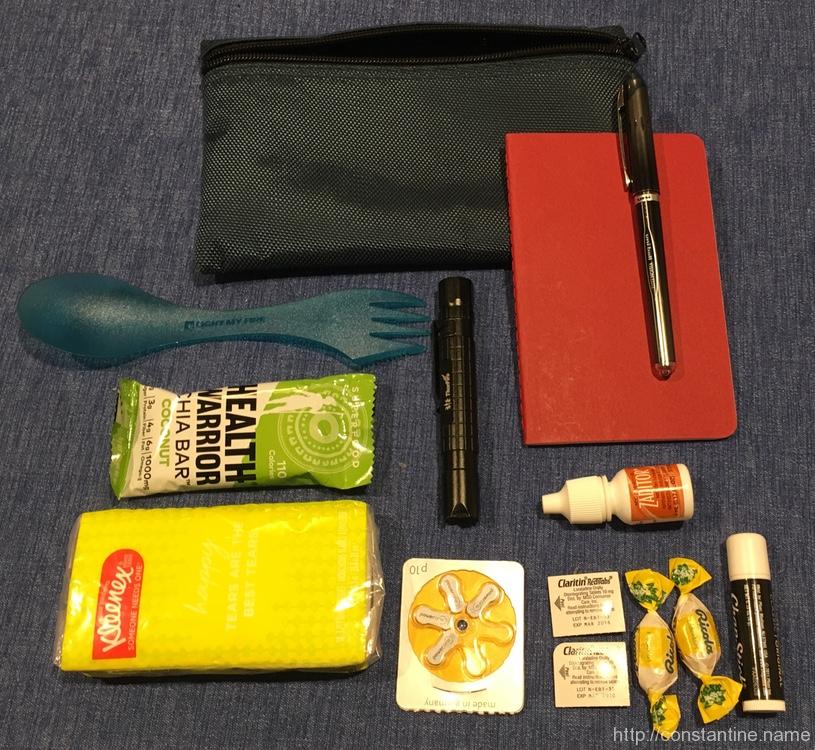
The bag

http://www.cumberlandconcepts.com/shop/medium-zipper-bags-2/

Cumberland Concepts “medium” bag (available in a slew of colors).

This bag is quite small. That’s the point: It’s it’s easy to grab and easy to stuff into whatever it is you’re carrying that day.

What and why

This little bag provides convenience and a bit of insurance. (Its exact purpose depends on what you decide to keep in the bag.) It is easy to prepare this bag, and it requires very little maintenance to keep it ready-to-go. By purposefully setting it up, you will beginning thinking intentionally about packing. You will begin building the habit of thinking about why are you packing, what do you need, what do you want, and balancing the answers against how much you want to carry around.

Following is a list of ideas intended to spur your thinking. I have no idea what you will want to put into this bag. There are surely some items you’ve wished you had, but which would be impossible to individually remember to always bring, and there are some important-in-a-pinch items that could be priceless insurance in rare situations. As you read this list, imagine scenarios where you would smile when you realized, “oh! I have [item] with me!”

  • Small notebook and pen/pencil
  • Epi-pen
  • Pocket knife
  • Medication
  • Micro flashlight
  • Pack of tissues
  • Some spare cash
  • Something to eat
  • Spare identification

ɕ


A Traveler’s Mindset

This entry is part 4 of 5 in the series Parkour Travel

A good traveler has no fixed plans, and is not intent on arriving.

~ Lao Tzu

A traveler’s mindset is the foundation for being a successful traveller and for being a good guest. I didn’t set out to develop any particular mindset when I began traveling. I simply started traveling, and only much later did I realize my mindset had changed.

In my Travel Gear series, I describe my habit of reviewing after each trip. While I began by reviewing the things I had packed for each trip, I soon realized I was spending more time thinking about what had gone well, and not so well. As I examined my mindset, I was drawn to experiment and refine, to try more challenging trips, and to push my comfort zones.

Which brings me to my traveler’s mindset:

Plan
Be flexible
Be positive
Move forward
Slow down

Plan

To be good at planning requires knowledge, but not simply knowledge of my destination. Rather, I discovered it was most important to have knowledge of my own strengths and weaknesses. For the things I am good at, the situations where I’m comfortable, in these areas I can do less planning. But in areas where my skills are weak, or situations where I’m uncomfortable, there I need to focus my planning.

Here’s an example of a strength for me: I’m not a picky eater and I have no dietary restrictions. So I never worry about food, and I hardly ever plan meals; Wherever I travel, people eat and there is food. (I’m happy to fend for myself, help cook, or team up with others.) So in the realm of food, a sufficient level of planning for me, is to carry a plastic spork.

Here’s an example of a weakness: It bothers me when I’m late for scheduled things, or when I miss out on things because of transportation. That it bothers me is my weakness. Until I can overcome that weakness, I try to avoid transportation issues. That means I prefer to be responsible for my own transportation whenever possible. I’ll be the person who coordinates buying the plane tickets, figures out the train schedule, or rents the car.

The next component of good planning is to know my bookends. In any trip, there are firmly scheduled components, such as major transportation legs, or an event being attended. Bookending is the idea of planning out as much of the time and actions leading up to the scheduled item. Once I’ve planned my bookends, I’m free to do any level of planning — including “none” — between the bookends.

After the bookends I search for unknowns. This is basically a litany of questions that I’ve learned to ask myself: Do I have my passport, visa, and host’s address for immigration control? Do I need foreign currency, working credit card, or cell phone data plan? Does my phone even work on the local cellular system? Have I sorted my transportation from the airport? If my phone dies, what must I have on paper (plane ticket, host’s address for immigration, host’s phone number)? Do I speak the local language, or do I have some needed phrases written down that I can point to when searching for help? Do I know the weather? Do I know the laws and customs? Do I have the necessary electrical adapters? The more I travel, the more I think to ask myself, and the more things I might plan for to avoid problems.

At this point I have a skeleton plan. I can convert my bookends into a basic itinerary and pass that to my hosts, and to my family members (who invariable love that they will know where I will be.) I can use my skeleton plan to coordinate with others traveling with me. People with less travel experience, who couldn’t setup a trip of the same complexity level, will be able to join in; They can match transportation (plane tickets, etc.) to my bookends and coordinate with the same (or different) hosts, and so on.

Finally, when talking to my hosts, showing that I’ve done some planning helps them understand I’m not going to show up and expect them to take care of my every need. I can also ask open-ended questions like, “I’ll be in city on date, with some free time. Any suggestions?”, to fill in other parts of my travels.

Be flexible

I should be accepting of change. That’s obvious, right? But I have too often been the stick in the mud, and I have too often seen inflexible people cause friction. The bookends in my plans are the inflexible parts of my travels, and knowing them provides the security that enables me to relax and be flexible the rest of the time.

I try to never be that person who responds negatively to suggestions without having an alternative. My personal rule is to never say, “no,” to a suggestion unless I have an alternative. I had to learn to either get off my lazy butt and go with the flow, or to take the initiative to plan and suggest. Meal planning is the easiest example. When I get hungry, I don’t wait for someone to say, “lets get food, how about X?” and then I’m all, “No. Meh. No,” to each of their ideas. Instead, when I get hungry, I make up a plan for food, and then I say, “I’m getting hungry. What about X?” Maybe there’s another plan they had in mind, and I get to practice being flexible and rolling with their plan.

I think of planning as a sort of currency: If I want to have an opinion on the question at hand, then I have to buy-in with some planning. If I’ve done no planning, then I’m not entitled to an opinion, and I should be maximally flexible to adapt to the plans of others.

At the same time, I had to learn to avoid “false flexibility.” That’s when I used to agree to go with the plans of others, but then quietly — or worse, passive-aggressively, or even openly — dissing the experience once underway. An example of this, which I see too frequently is when people think dinner is going to be an inexpensive, quick meal, but the group’s opinion shifts and everyone suddenly heads to the expensive brew-pub. People then get grumpy about the expense. Too bad! Learn to be flexible. If money is that important, then you had your chance to counter-suggest; “Hey guys, I need to eat on a budget. Can we get food for like $15?” (And really, if you want to have an I-need-to-eat-on-a-budget opinion, you should buy-in by doing some planning to find a possible spot.) But once you’ve agreed to go with the plan, you should spend the money and enjoy it; Or peel off entirely. Never be the passive-aggressive jerk who goes along and drags his feet the entire time.

The easiest way for me to begin learning flexibility was to directly plan to be flexible. I sometimes plan blocks of time intentionally left open. (“Friday, until bookend begins at time, I will wander around the city.”) This taught me to be comfortable with big swaths of unplanned time. It taught me to be aware of my surroundings and helped me learn to adapt to the opportunities that arise.

Planning to be flexible also has a subtle effect on my hosts and others traveling with me. If I say, “I’ve nothing planned today.” This creates an unspoken, subtle suggestion that perhaps I’m hoping my host will fill in some things for me to do. The unwritten sub-text might be, “I’ve nothing planned today, can you entertain me?” But instead, if I say, “I’ve planned to spend the day wandering around the city,” this still leaves open the opportunity for my host to suggest activities, but it also makes it clear that it’s equally fine to simply leave me to my own devices.

Be positive

It took me a long time to develop a positive attitude. The big turning point was when I came to understand the Fundamental Attribution Error. The error is that we tend to attribute the causes for other people’s actions to themselves, (that driver cut me off because he’s an aggressive narcissist,) while tending to attribute the causes for our own actions to external circumstances, (I cut you off because I’m making up time lost to some unavoidable delay I encountered.)

There’s debate in psychology circles wether this attribution error is “fundamental” in the sense of being an inherent trait of how we think, versus just being a very common way of thinking. Regardless, I found it was pervasive in my thinking, and practicing thinking about what I was thinking was a fruitful exercise.

Lessons cautioning against this sort of attribution error appear in many places, including:

Be kind, for everyone you meet is fighting a great battle.

~ Plato

slip:4a116.

And from Epictetus:

Someone bathes in haste; don’t say he bathes badly, but in haste. Someone drinks a lot of wine; don’t say he drinks badly, but a lot. Until you know their reasons, how do you know that their actions are vicious?

As I traveled more frequently, I learned the power of positive thinking. Initially I began by using sugar-coating positive thinking, “I’m going to have fun!” But that is weak medicine. Over time, through intentional and conscious practice, I learned to use positive thinking to dig deep for actionable items: What can I do to solve this problem? What is good about the current situation? What can I say now that would express my appreciation for what this person has done? What can I do with my spare time now, which would create a fun opportunity for all of us later?

Being positive also appears in the way one commits to choices made: not the choices themselves per se, (to go to this event or not, to take on a responsibility or not,) but the way in which I express those choices. Sure, making choices takes time, as I have to consider options, weigh existing responsibilities and allocate free time. But, when it comes time to choose:

Everything in my life should be a, “No,” or a, “Hell yes!”

Simply saying, “Yes,” is not commitment; it is in fact a, “No.” Saying, “Yes,” but not realistically planning, is in fact a, “No.” Unrealistic planning, not allocating money or not allocating time, are more variations of, “No.” On the other hand, “Hell yes!” is the passion and fire that make life worth living. That is what I mean when I say I must be positive with my decisions.

Move forward

I tend to move forward, towards the next scheduled thing. This cultivates an attitude of forward momentum and is closely related to the idea of bookending. Generally, wherever I am, if there’s no specific reason to stay, I’ll move forward, and the closer I get (in time and space) to the next thing, the more I relax and slow down.

For me, 15-minutes-early is, “on time,” and on-time is “late.” Of course, it doesn’t have to be exactly 15 minutes; the longer the journey, the earlier I plan to be. Something like 20% seems to work well — so an hour early on a 5 hour drive. And I don’t mean “the map engine says five hours, so I’ll leave six because I want to stop for lunch.” I mean, five hours on the road, plus an hour for lunch etc, that’s a six hour journey. Then I add 20%, leaving about 7 hours of travel time. When you’re padding in this much time, everything becomes a leisurely journey!

When I travel with others I try (gently) to get them motivated and moving early enough. Only then do we find we have enough time to move at a leisurely pace — to pause for a cup of coffee, to stroll down the side streets — without worrying about wasting too much time.

Once I started thinking about momentum, and moving forward, I found I was visualizing my next actions. “I should do laundry. I should get up early tomorrow and do my laundry. I should shower now and go to bed, so I can get up early and do my laundry.” Invariably, the more I think ahead, and move forward — physically move towards the next thing, or just pick off tasks I can do now, rather than later — the more I find myself with free time and flexibility.

Slow down

Which brings me finally to the best part: Slow down, leave space and enjoy life.

I find I have a certain pace to my normal life, I know how much I can pack into a day, and how long I need to get from one place to another. But when I’m traveling, I purposely plan a slower pace. First of all, things often take longer than I expected, so things work out better when I’ve expected that by leaving extra space and time in my schedule. When things go as planned, or take less time then expected, I suddenly have time to notice things, or go on little adventures.

My entire traveler’s mindset leads to this, “slow down, leave space and enjoy life” end-goal. Unexpected conversations with new friends, a 10 minute walking tour of a neighborhood that’d I’d never have known to plan for, a spontaneous meal, a suggestion by someone that I’d have missed if I hadn’t been relaxing with free time.

In short, without my mindset, I’d miss all the good stuff, and end up simply travelling.

ɕ

§2 – Unpacking

This entry is part 2 of 5 in the series Travel Gear

Every time someone was looking for something my grandfather would bark out:

Put it where you got it! It’ll be there when you go for it!

When I was little, I thought that was pretty cool. Turns out it’s a variation of the old adage:

A place for everything, and everything in its place.

Unpacking begins with things having a place

In certain productivity and self-improvement circles there is an idea called Clearing to Neutral. Simply put, when ceasing work on something think ahead to the next time a task will be worked on, and eliminate as much start-up friction as possible.

Having all your travel and packing items in their place means packing for a trip is simply taking things out and putting them into your bag. (And perhaps some things should simply be kept in your bag.) That’s as close to zero-friction as possible. So clearing to neutral suggests I prepare for the next trip by immediately putting everything away.

So where to keep the stuff? The first iteration is to simply have a pile of things on a shelf, or in a drawer, where you know you keep “the travel stuff.” The next iteration might be a dedicated bag, or large box. But the best solution I’ve found is to use translucent plastic filing tubs. (For example, these filing tubs.)

These tubs are perfect; you can see what is in them and they are easy to handle. I have one which holds things I grab most frequently; for example, my micro-flashlight and M’Urgency kit. I have another tub which holds the less-used random stuff; for example, the replacement o-rings for my flashlight, those little toothpaste tubes the dentist gives me, refills for my cartridge razor, and my rarely used, travel laundry kit. When packing, I just pull the tubs out and grab what I need.

The tubs can be stored on a high shelf, on the floor in the back of a closet, or in the garage. Regardless how exactly you store your travel gear, it should have a dedicated home where things don’t get dirty, lost, or eaten by your cat.

Exploding

So now everything has its place, and I’m mentally prepared to spend time putting things away when I return. But I have a problem: When I return, some — often most — of my stuff is not ready to be stored.

I gave out a bandaid from my M’Urgency kit which needs to be replaced. The sheet from my sleep system needs to be washed. I lost a zipper-pull on my backpack that needs to be replaced. My flashlight needs a new battery. My razor needs a new cartridge. I need a new bar of soap. …and on and on.

Each of these issues is a very small thing to take care of, and it is tempting to leave these small tasks for later. But this is exactly the moment where a little work now leads to zero-friction later. This is where the magic of clearing to neutral shines. All of those little issues would slow me down — or worse, leave me in the lurch during a trip — when next I pack to travel. By taking care of them when I return, I eliminate all the friction and make packing a breeze when the next opportunity arises.

If I’m exhausted, I may simply set my bag down and go to sleep. But when I’m ready to unpack I explode everything in one place. I pull everything out and if it’s ready to store, (that is to say, it is ready to use again when I next travel,) I put it away immediately. If it needs something, I leave it in the exploded area. Normally, this is right in the middle of the floor, in the middle of a room. So the goal is to clean up the entire pile. Laundry into the laundry basket, or better yet, right into the washing machine. Get a fresh battery, change it and put the flashlight away. Grab a spare zipper pull and fix the backpack. Grab a bandaid and razor cartridges from the spares tub and fill up the M’Urgency and bathroom kits; then put them away. Zip, zap, done.

Aside: I clear everything to neutral. Years ago, my Hueco backpack came with spare zipper-pulls. I put them in a ziplock bag, with a 3×5 card that says “spare zipper pulls for Hueco” in the tub of less-used items. By the time I lost a zipper-pull, I had completely forgotten it had come with spares. But I knew that _if_ I had spare zipper-pulls, they’d be in the less-used tub. And there they were!

Using processes like this will expand outward into the rest of your life. I just used the last of the spare razor catridges from the storage tub to refill my bathroom kit? Add “razor cartridges” to the shopping list that we keep in its assigned place, so everything is on the list when someone goes to the market. Go to the market, buy what is on the list.

As you’re unpacking, sorting, cleaning, repairing, etc all your stuff, you’ll find you’re automatically reviewing; Which is the next part of this series.

ɕ