Apr 12, 2013

The Cat’s Out of the Bag

If you want to repeat that little jump at an angle to a moss covered wall all day until you can do it with your eyes closed… well my friend, you are not alone. I want to repeat that jump with you. But let’s do 50, just to be sure. And one more for the others who can’t join us. That’ll do us both more good than that big roof gap whilst you hold the camera.

~ Chris ‘Blane’ Rowat from, «http://www.parkourgenerations.com/article/call-arms»

By now, all of my friends know I practice parkour with Lehigh Valley Parkour. I’m pushing 42, with graying hair and the BMI calculator says 34.9, (which is “obesity.”) So when people first find out, they raise an eyebrow and say, “You’re a brave soul!” or “Huh? The jumping from roof-top to roof-top thing?!”. …my answer is ‘no’ to both of those.

Please do not go to TouYube and look up parkour; Total waste of your time. This is one of those Catch-22 things where the people who believe — quietly, to themselves — that they “get it”… well, those people aren’t posting spectacular videos on TouYube. So you don’t notice their point of view on the whole thing.

I am not saying, “those people over there have it wrong.” I am not saying, “parkour is the One True Path(tm)”. I am not saying, “these ideas are to be found only through parkour.”

I am saying parkour is…

…a journey composed of tiny steps so easy that failure is impossible.

…the grueling, deconstructing, work of self-improvement.

…that well-earned sense of accomplishment.

…the joie-de-vivre that I hadn’t noticed I let slip away.

Playfulness.

Freedom.

…and one more for the others who can’t join us. :*)

ɕ

Jun 15, 2013

It is done fast enough when it is done well.

Getting done right does not mean getting done slow. Getting done right means getting done fast. You will go faster if you do things right. You will go faster if you come down off the “high” generated by the illusion that effort is speed. You will go faster if you calm down, follow your disciplines, and refuse to rush.

~ Bob Martin from, «http://blog.8thlight.com/uncle-bob/2013/03/11/TheFrenziedPanicOfRushing.html»

While he’s talking about software development in general, and test-driven development specifically, this is true for – I think – everything. My experience is that this is true for software development, and other technical work. But it is also true of martial arts practice, parkour, games, building model airplanes… you name it.

The pervasive admonishment should be “do it well,” rather than, “slow down.” Do it well and you’ve – by definition – done it as fast as possible. What’s the point of doing it poorly? What’s the point of rushing to completion; If you didn’t do it well, then it’s not done.

ɕ

Jul 7, 2013

Make the most of this life

I would love to believe that when I die I will live again, that some thinking, feeling, remembering part of me will continue. But much as I want to believe that, and despite the ancient and worldwide cultural traditions that assert an afterlife, I know of nothing to suggest that it is more than wishful thinking.

The world is so exquisite with so much love and moral depth, that there is no reason to deceive ourselves with pretty stories for which there’s little good evidence. Far better it seems to me, in our vulnerability, is to look death in the eye and to be grateful every day for the brief but magnificent opportunity that life provides.

~ Carl Sagan

Elsewhere, this is 4a791. — slipbox

Jul 14, 2013

Start now

Maxim:

Dead last finish is greater than did not finish, which trumps did not start.

~ unknown

Elsewhere, this is 4a136. — slipbox

Corollaries:

Be kind, for everyone you meet is fighting a hard battle.

~ Plato

Elsewhere, this is 4a116. — slipbox

Never throw in the towel. Use it to wipe the sweat from your brow. Then keep going.

~ unknown

Elsewhere, this is 4a69. — slipbox

The hardest part of any journey is believing you are able to begin it.

~ unknown

Elsewhere, this is 4a203. — slipbox

Jul 19, 2013

Be mindful of your negative thoughts

When we are unaware of our thoughts and urges, which arise in the back of our mind mostly unnoticed, they have a power over us. We are unable to change if these unbidden thoughts control us. But when we learn to observe them, we can then release their power over us.

Meditation is practice for observing those thoughts, for being more mindful of them throughout the day.

~ Leo Babauta from, Meditation: The Most Fundamental Habit – Zen Habits Website

Elsewhere, this is 4uzefu1. — slipbox

Meditation is literally the easiest thing you can add to your life — 5 minutes, 2 minutes, even 60 seconds will do you good. As I wrote elsewhere:

 If you were handed a large bucket of sloshing and disturbed water and told to calm the water, you should simply set the bucket down and wait for the water to calm. You would definitely NOT shake the bucket in an attempt to convince the water to calm down.

Driving, texting, walking, rushing, typing, watching TV, playing games, talking, frenzied eating. Set the bucket down for a few minutes.

ɕ

May 3, 2014

To be and to last

To be and to last

To last? That old lesson about the brightest flame burning the quickest is particularly true in Parkour. What use is a person who lasts five years and has to stop training due to bad knees and a broken ankle? How useful is a body that can’t move pain free due to years of neglect and abuse? The journey of Parkour was never meant to be a brilliant flash of spectacle and show, it was always intended to be a lifelong pursuit of improvement and one that doesn’t need to end once the body begins to show signs of age.

~ Chris “Blane” Rowat from, 50 Ways To Be and To Last in Parkour | Part 1 – Training The Body

Elsewhere, this is 4ubowa1. — slipbox

Ignore the show reels. Ignore the spectacular. Those MAY be inspirational to you, but your journey SHOULD be a long series of small, eminently POSSIBLE steps. Go to your first class and try anything; try SOMETHING. Stop when your body has had enough. Repeat. In a few months, you will have grown so much that you will hardly recognize yourself.

ɕ

Jun 14, 2014

A deep sense of malaise

You can harness and channel these needs, but a man completely ignores them at his peril. Modern men are told there’s nothing real about manhood — that it’s all a silly, outdated cultural construct — and they sure work hard to believe it. And yet they cannot shake a deep sense of malaise, and they don’t know why.

~ Brett McKay from, Where Does Manhood Come From? | The Art of Manliness

Elsewhere, this is 4uaowe1. — slipbox

I consider myself very lucky. I’m expressing my mid-life crisis in some pretty healthy and productive ways. Instead of going on a more traditional bender, I’m shaking off shackles and bindings that I in fact put on.

One day I realized that there is no longer anyone left to tell me what to do. Certainly one has responsibilities, but there are precious few of those which are immutable bedrock. You look at your life and think, “Look at all these ideas I’ve accepted.” When you pick idly at some of the threads, the whole thing comes apart, and you find yourself in a row boat on the sea — or on a bicycle on the open road (choose your own metaphor). On the open sea in a good way; You realize you are free, that in fact you have NOT always been free, and that there’s an awful lot of life left to live now that you’re ready to start.

ɕ

Jun 17, 2014

A most sincere thank you

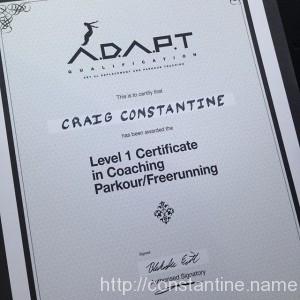
Two years ago today, I showed up at Wescosville Elementary at 4pm and tried parkour. A very big thank you to everyone ( Adam, Josh, Joseph, and Miguel in particular) who has been friendly, happy, and encouraging these last two years. This week I will be attempting the ADAPT 1 certification; I could not have accomplished what I have without all the help from the wonderful men and women of lehigh valley parkour. “allez, allez!”

ɕ

Jul 8, 2014

Visceral

My suspicion is that, in our convenient society, we don’t need to be acutely aware of our balance and body positions vis a vis the ground because many of us don’t do much physical labor anymore, or play freely as kids outdoors now that we have so many enticing computer games to entertain us.

~ Wayne Muromoto from, 90. The base: close to the ground – The Classic Budoka

Elsewhere, this is 4uwote2. — slipbox

More than a year ago, I wrote that parkour is about freedom (and much more.) There is also a visceral component that I’m finding is playing a greater and greater role.

Visceral, adj. characterized by, or proceeding from, instinct rather than intellect: a visceral reaction;  characterized by, or dealing with, coarse or base emotions.

When you treat your body like a Cadillac meat vehicle – that is, when it’s just a mode of conveyance from one creature-comfort to the next – you soon cease to be intimately aware of what your body is feeling. A large part of the allure of parkour is the immediate and clear, honesty and reality of the experience of training. It’s obvious that your body and mind are not readily separable, but in normal daily life, one mostly ignores the body. In parkour, the body and mind have to work in harmony.

I have a lot more to say about this harmony (my personal interpretation, and explanation, thereof.) But for the moment, I’m just going to start with the above.

ɕ

Dec 11, 2014

How To Live on 24 Hours a Day

As you look back on the year that has just past, do you feel as though you spent another 12 months merely existing instead of truly living? Do you often go to bed at night with an anxious, sinking feeling that you wasted away another precious day of your limited time here on earth? One of my all-time favorite old books addressed this very concern better than anything else I’ve ever read.

~ Brett McKay from, How to Live on 24 Hours a Day

Elsewhere, this is 4uaoho3. — slipbox

104 years old, still readable, and totally apropos of our lives today.

ɕ

Jan 13, 2015

What’s the constant?

This change really seperates people. It’s not going to be like it used to be. You can’t ‘go back to training’ as you once did. That one Jam that you remember is a small part of your whole experience that you remember fondly. It’s one highlight in a long journey, which isn’t just highlights. What’s the constant in these memories?

It’s Parkour.

~ Chris Grant, from Change

Elsewhere, this is 4uwoca1. — slipbox

ɕ

Jan 28, 2015

A person should be strong

It suggests that a person should aim to be strong, but not just in a physical sense. They should aim to be resilient, free thinking, confident and yet remain humble. They should learn to be self-sufficient and useful to their loved ones and they should be aiming to always progress in some way.

~ Chris Rowat, from «http://www.parkourgenerations.com/node/9399»

Written to have 5 parts, plus the introduction, he’s only completed two parts so far. But if parkour/art d’déplacement/free running you love, read this you must.

ɕ

Feb 25, 2015

If you win the rat race, you’re still a rat

Don’t ever confuse the two, your life and your work. That’s what I have to say. The second is only a part of the first. Don’t ever forget what a friend once wrote to Senator Paul Tsongas when the senator had decided not to run for reelection because he’d been diagnosed with cancer: “No man ever said on his deathbed I wish I had spent more time at the office.”

Don’t ever forget the words on a postcard that my father sent me last year: “If you win the rat race, you’re still a rat.”

~ Anna Quindlen from, A Short Guide to a Happy Life

Elsewhere, this is 4ubaie4. — slipbox

From Maria Popova’s A Short Guide to a Happy Life: Anna Quindlen on Work, Joy, and How to Live Rather Than Exist.

ɕ

Feb 26, 2015

Today is not that day

There will come a day when I can no longer do this.
Today is not that day.

…a wonderfully inspirational thought for us oldsters!

This photo of me at the crux of The Edge of Time (5.9R) in Estes Park Colorado was taken by Mike Bowyer in August 2014. I saw this caption on an image of a bicyclist posted by a cyclist friend of mine and wanted to make one that would hit closer to home.

ɕ

Mar 21, 2015

My oath

I’ve been slowly collecting small thoughts so that I could begin writing something about my journey. Over a year ago, I found an oath on Nerd Fitness, but hesitated committing; There are bits in this oath that will demand 40+-years-big-ship-small-rudder sorts of changes of me. I’ve been revisiting it periodically to see how it felt each time I tried it on.

I love it. I’m committing to it.

My oath:

Today is the first day of the rest of my life. I shall make no excuses and hold no grudges.

I care not where I came from, only where I am going.

I don’t compare myself to others, only to myself from yesterday.

I shall not brag about successes nor complain about my struggles, but share my experiences and help my fellows. I know I impact those around me with my actions, and so I must move forward, every day.

I acknowledge fear, doubt, and despair, but I do not let them defeat me.

ɕ

Elsewhere, this is 4b24. — slipbox

Apr 23, 2015

New toys

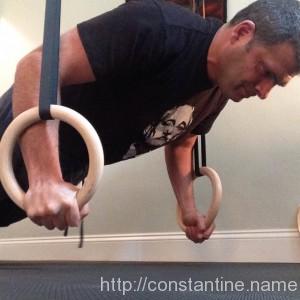
So many people have been talking about rings recently… we are upping our push-up game with new toys! Yet another great use for a pullup bar. Also. wow, this is tough…

ɕ

Apr 29, 2015

FitBit Charge HR

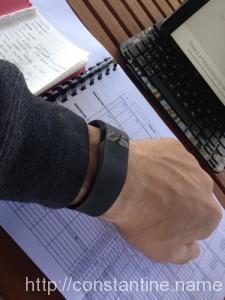
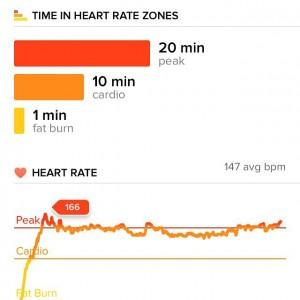
I’m working with a friend of mine — Mike Bowyer — on a designed, intentional, training program. One of the critical components is working for specific times in very particular heart rate zones. So I’ve bitten the bullet, and am trying a FitBit. Online commentary seems to be that it’s not super-accurate, but I’m hoping it will do at least an ‘ok’ job of thoroughly recording heart rate during — saw this coming didn’t you? — parkour activities.

…until I smash it on a brick.

ɕ

May 9, 2015

Boston Gauntlet 2015

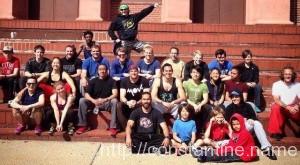
Group photo from the end of the “Gauntlet” event in Somerville.

I think my biggest accomplishment was the “didn’t hurt myself.” I certainly did a lot of physical things that were impressive (for me, and my ability.) But just being able to continue to ‘dig deep’ for hours on end — that was great.

As usual, I want to avoid name-dropping. But we did this one neat turn-vault landing on one foot and continuing on to step down and off the wall… that was something very different! Also, one of the first times I’ve EVER just “done” something and actually felt like I was really moving simply.

ɕ

May 9, 2015

Videos from BKB

Some videos I took in April 2015 when I was last up in Somerville. This certainly isn’t a great answer to “what is parkour” in the global sense. But it will give you an idea of what I was working on when I had several hours to play on some scaffolding when I had unstructured time to just train.


ɕ

May 13, 2015

Sorry, no actually I’m not

So this happened in Cartegena.

This is funny, but that’s not why I posted this. See the bottom.

Imagine if you will, a bus load of 45 tourists — a perfect stereotype bus tour from a cruise ship. We all walk up a hill/road to see the Castillo overlooking Cartegena. (Very nice by the way! Photos coming soon.) Then we walk all the way back down. We reach an intersection, near our bus in the home stretch, and across the street is a small park with one of those long railings meant to keep people from J-walking.

The cross-walk says “go”, so there’s no traffic. Without thinking, I J-walked straight across and vaulted the rail.

…and I hear 44 people do a group groan. They had all followed me across the intersection and everyone had to walk all the way around the railing. (My mom shouted out, “Brat!”)

SO? Well, I did it without thinking, but FORGET ME.

Imagine what YOUR LIFE would be like if you vaulted a little railing after a long walk AND THOUGHT IT WAS FUN. What, really, is your excuse?

(…and if you’re in shape, or under 20, or can already vault a rail. Kudos to you! …but I’m not talking to you.)

ɕ

May 25, 2015

Is motivation useless

Instead of berating yourself when you’re not motivated to exercise, or getting mad at yourself when you struggle with eating unhealthy food, take a step back and look at it from a different angle:

“How can you build the habit of success and put your focus there, instead of chasing the motivation to make it happen?

It’s easy to become ensnared – to chase motivation and fail – or rationalize inaction and never try. Every single one of us has fallen into this trap. I’d love to hear about your experience with this, and how you plan to (or already have) overcome it.

~ Steve Kamb from, Is Motivation Useless?

Elsewhere, this is 4unebo8. — slipbox

In a vague sort of way, I found this idea in my own training. As usual, Steve Kamb brings clarity to the party. This idea of incremental actions, of habits, and little processes that make success a foregone conclusion is at the core of my Parkour training.

ɕ

May 26, 2015

GORP snack to the rescue

I’ve been slowly making steady progress on a number of healthy goals. One of them is good ‘ol weight loss.

It is important that I avoid going crazy with snack food. But sometimes I simply get hungry between meals. And most importantly, because I’ve been doing intermittent fasting, it is very important that I have something ready to eat at Noon in cases where a full meal isn’t easy to get. So if I’m driving, or out doing something with friends or family, and Noon rolls around… what are you going to do? I don’t want to be a stick-in-the-mud and demand we stop what we’re doing to have lunch promptly at Noon.

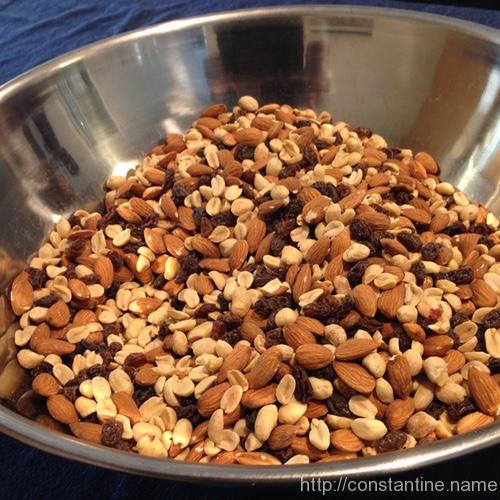
GORP to the rescue!

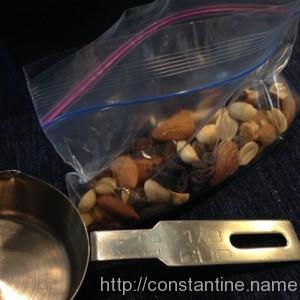
GORP is simply Good Old Raisins and Peanuts. But I particularly like mixing in raw almonds to get the micronutrients, and fat — fat is GOOD for you! Peanuts are not a true nut by the way. So this recipe is just roughly equal part mixture of raisins, peanuts and almonds. (Note, dry roasted unsalted peanuts, raw unsalted almonds.)

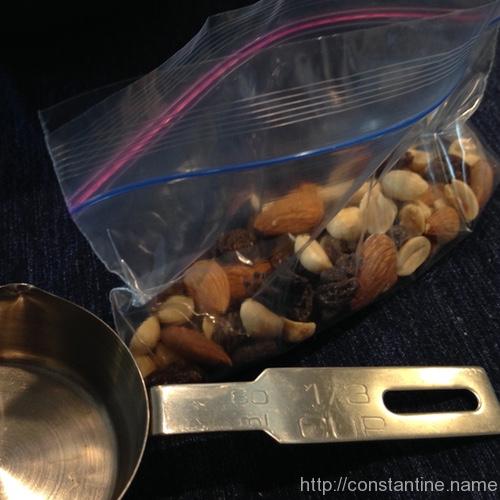
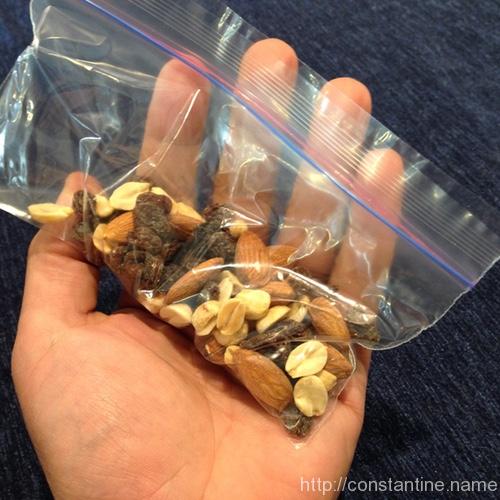
I mix this up in bulk, and measure it out in 1/3 cup servings in small snack size plastic bags. You get about 45 servings out of this batch. The serving size is deliberate: It is about 240 calories; about 22g fat, 19g carbs and 11g protein. So I know I can have one of these with ZERO guilt. They are small enough to fit/carry anywhere, and small enough in calories to have little effect on whatever dieting you may be doing. On the other hand, they are large enough in calories and nutrition that I can easily go a couple hours before getting hungry again for a meal.

Update May 2016

There are two things to notice.

The nutrition info I’ve given comes NOT from the “serving size” info on the containers. Instead, I extrapolated to get the nutritional data for the entire container and then divided by the number of 1/3-cup servings I make out of the entire mix.

240 calories is a surprisingly small handful of this stuff. Every time I eat one of these, I think, “I’m hungrier than this size… but ok I’ll start with this.” Then, an hour later I’m like, “I fell for it again… 240 calories was enough.”

ɕ

Jun 3, 2015

A student of Art du Déplacement

Art du Déplacement, (a French phrase meaning ‘art of movement’,) is a method of improving oneself through challenge. The founders say that to practice the art means to work toward: Being mentally and physically strong; being useful; being a positive contribution to your community; being better than you were yesterday.

But what about competition, flips, stunts, jumping roof gaps and gymnastics tumbling? …are those things part of it? Certainly, some people do those things as part of their practice. Competition can make you physically stronger. Jumping roof gaps can make you mentally tougher. So these things can be part of your practice, but your practice does not have to be these things.

For me, swallowing my pride and starting over in physical fitness with a group of people about half my age… That was a challenge. For me, pull-ups are a challenge. But that’s the whole point. It’s is about me improving me, and you improving you.

But I didn’t know that when I first tried Parkour, (before I understood the Art du Déplacement roots of what I was learning,) in the spring of 2012. I had met Adam McClellan during a martial arts demonstration and he talked me into coming out to play with the growing Lehigh Valley Parkour community. I am continuously delighted to be the big, old, slow, lumbering gorilla in a community of enthusiastic, supportive and happy people. After two years of serious training, at the age of 42, I passed the ADAPT Level 1 certification through Parkour Generations. Art du Déplacement, Parkour, and this unique community, have changed my life.

ɕ

Jun 7, 2015

Art du Deplacement

LVPK representing! So happy we got this trip in!

ɕ

Jun 18, 2015

Kee Klamps!

Yeeee-Haw! The UPS driver, (aka ‘our brown Santa’,) just surprised me with this…. didn’t even know it had shipped! Off to Home Depot for steel pipe . . . *squeeeeeeeee*

ɕ

Jun 18, 2015

Turn vaults

Tracy said, “I wanna’ work turn vaults…” BAM!

ɕ

Jun 24, 2015

Targeted-heart-rate workouts

A while back I mentioned I’ve been experimenting with a FitBit HR and an intentional, designed, fitness program. I’ve been playing with this more. I originally didn’t like that I couldn’t just redefine all the zones to the HRs that we’re targeting.

Most, tradition/common workout programs I’ve seen have just 3 heart rate (HR) zones based on a maximum HR which is simply computed based on your age. The plan I’m working with from Mike, is significantly more complex. (Details for another post I suppose.) Anyway, the plan calls for very specific workouts, for example: “17 minutes in Z1”.

I noticed on day one, that the FitBit only has one “custom zone” that you can configure. So, I’ve begun manually setting the “custom zone” to the goal HR before some of the workouts. Once I plug in the specific Z1 lower/upper numbers, I can then set off on the workout.

On the device, there is an icon-based display that shows you quickly if you’re below/in/above the target zone. Normally, the icons refer to one of the FitBit’s built-in zones. But it turns out that if you set a custom zone, then the icon status is for your custom zone. Ok, now THAT’S useful!

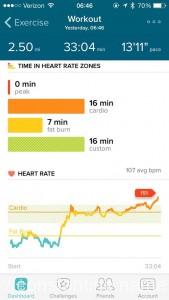
The above screen grab is from a morning run where I had the custom zone set to my specific Z1 values. The graph shows the FitBit’s default zones (blue/”under”, yellow/”fat burn”, orange/”cardio”) and it overlays my custom zone as the hatched band. The bar graph even adds a value for the time in the custom zone.

In this example I set out to perform, after warming up, for 17 minutes in Z1. …and BAM! 16 minutes in Z1 by it’s measure. Now that’s a targeted workout.

Aside: The tail end of the graph was a strong-run-out, 1/4 mile. My opinion is that the FitBit sucks at picking up highend HR. Either that, or I’m a machine, and can run an 8 minute mile pace at a 151HR. …and it’s not the latter of those two.

ɕ

Jul 16, 2015

Max heart rate 189

New personal best out running with Tracy this morning. The traditional “220-age” formula for me is 177. The newer “217-(0.85*age)” model yields 180.

ɕ

Jul 26, 2015

Yeeeeeeeeeeeeeees!

In. The. Bag! …aaaand back to training.

ɕ

Aug 3, 2015

Shut up and train: Self-directed advice

Nature has given us two ears, two eyes, and but one tongue – to the end that we should hear and see more than we speak.

~ Socrates

Elsewhere, this is 4a100. — slipbox

I think that “shutting up” has been the most difficult aspect of my Parkour journey.

In my youngling days — let’s define that as sub-30-years-old — I was always the clown: obnoxious; rude, crude and ill-mannered; smart ass. When you have a big ego and low self-esteem, you seek attention to try to make those ends meet. That’s probably a good benchmark definition of dysfunctional. Worse, I had no idea such was the case. Over the next ten years, (or so,) I started to realize that such behavior was dysfunctional and pathetic. That decade was finally followed by my beginning to try to change about 40 years of ingrained behavior.

It was at this point — just as I was trying to change the course of a very large ship with a very small rudder — that I started Parkour. At the time, I simply jumped into Parkour being my usual self. But two pushups into my first class I was stripped of my delusions of grandeur. Two minutes in, and I figured out that I was an out-of-shape pile of bacon. After two hours of trying to do something, anything, and failing and sweating and flailing and sweating more… Well, shit got real.

That first class was followed by a solid year of me having an argument with myself, in real-time, at every class. Every time I’d exhibit some variation of my dysfunctional behavior I’d mentally berate myself; Shut up. Train. After each class, I’d think back on all the cringe-worthy moments and think: Next time, shut up more. Train more.

Somewhere around two years in, my ship’s course had shifted far enough that the dysfunctional behavior was noticeably tailing off. Certainly, the behaviors I disliked were still frequent enough to bother me, but they WERE tailing off.

Now, three years in and going stronger than ever, I’ve made a lot of progress in terms of fixing myself mentally and physically. I can now say, with an air of experience: Everything has changed. And nothing has changed.

Shut up more. Train more.

ɕ

Sep 8, 2015

I have awesome friends

Eric and Anabella left me a bday gift bag on my desk… this is several levels of awesome: A *large* shirt. The meme is perfect. It’s really good rum. And, inconceivably, it’s the same rum I selected from a huge Rum list at the Jerk Chicken place where everyone had dinner in Toronto after the event.

ɕ

Sep 13, 2015

Indescribable

I spent Saturday in Philadelphia training with a relatively small group of people.

Honestly, I was pretty beaten up, broken down, and tired before we even started. Brutally honestly, I need a break; I have simply been doing way too much for way too many weeks in a row for these old bones. So right out of the gate on Saturday, I could tell I was going to be dragging my a** all day.

And then the entire day unfolded in so many ways I could never have imagined.

I’d have to write a small book to tell all the stories; The people, the names, beautiful smiles, sketchy Philadelphia parks, smiling strangers, wall runs, jumps, cats-to-climb-ups, people who have grown and changed so TREMENDOUSLY since I’ve last seen them, old friends, new friends, people with broken hearts who are an inspiration in the way they continue to crush challenges, people ahead of me laughing and playing and urging me on by simply “being”, people behind me yelping approval that I can’t comprehend, and dinner and milkshakes and conversations and shared thoughts with people I expect I will never forget.

ɕ

Sep 27, 2015

Resilience?

Resilience also requires downtime for recovery. Changing up my scaf routine today to take advantage of the lingering awesome weather.

ɕ

Sep 29, 2015

Long was I Marcellinus!

Nevertheless I shall brave this danger and be bold enough to show [Marcellinus] his faults. He will act in his usual way; he will have recourse to his wit, – the wit that can call forth smiles even from mourners. He will turn the jest, first against himself, and then against me. He will forestall every word which I am about to utter.

~ Seneca, from Letters From A Stoic: Letter 29

Elsewhere, this is 4ulele2. — slipbox

Many of Seneca’s letters are pretty obtuse after all this time. But this one… this one jumped out at me as being really apropos of modern life. And, uh, painfully on point for myself.

ɕ

Oct 17, 2015

Bam

5k like a machine! 31:20-ish for total… GREAT for me :D

ɕ

Oct 18, 2015

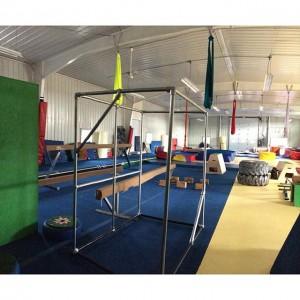
Innate Movement

Gee, what could we do in here??

ɕ

Nov 1, 2015

30/30 squat challenge

I already have several health and fitness “projects” going on. But for November, I’m taking on another relatively easy one as an experiment:

Ido Portal’s “30/30 squat challenge”

It’s simple: For thirty days, spend 30 minutes in a squatting position. (It’s 30 total minutes via many short duration sitting positions; it’s not a 30 minute endurance sit challenge.)

ɕ

Nov 21, 2015

A thought on health

Of this I am certain: Unless you take the time to study how your body’s biology and chemistry work, you will never figure out what you should actually be eating. Your health is your number one priority — your children, your parents, your spouse/significant-other… you cannot help them if you don’t have your own health.

Take just a bit of time to start reading about metabolism, diet (the general idea of what you should consume, not a specific set of instructions to lose weight), biology, and chemistry. Just spend a little bit of time reading to investigate the things you believe are true, and to verify the things you believe are false.

ɕ

Dec 4, 2015

30/30 squat challenge redux

Back at the end of October, I decided I was going to try Ido Portal’s 30/30 Squat Challenge. Basically, attempting to sit (a rest position) in a deep squat for a total of 30 minutes, every day for the month of November.

How did I do? Actually, not so well. I only racked up an average of 11 minutes per day. A few days had only a few minutes, and only on TWO days did I get the full 30 minutes in. It turns out, that making time to sit (squat) down isn’t easy. Most of the time, I just plain forgot. I did best when I set a timer while working at my desk. Every 10 or 15 minutes, the timer would go off and I’d do a one-minute squat.

But, I can see/feel the improvement in ankle and hip flexibility. Initially, I could only manage to squat on the balls of my feet, or rest flat footed if I held onto something VERY sturdy to keep from falling over backwards. Now, it only takes a gentle assistance to sit flat footed. So I think with another, more serious, go at this challenge in December — I’ve gotten all 30 minutes in for the first three days of December —  I can finally reach a flat footed, deep squat.

ɕ

Dec 7, 2015

Pullups pay off

I clearly remember thinking this seemed inconceivable less than a year ago. Pullups and hard work for the win!

ɕ

Dec 17, 2015

Brooklyn Zoo

Pushing the old comfort zone tonight in Brooklyn!

ɕ

Jan 21, 2016

What’s up for 2016?

I’ve recently started thinking about 2016 goals. These aren’t “New Year’s Resolutions”; When I pick up a goal, it’s only after a lot of thinking and planning. Most importantly, I only commit if I believe the result of reaching the goal is worth it.

I’m considering things like the following:

  • Hip/ankle flexibility: Achieve being able to sit, relaxed in a full squat. (I’ve been working on this for 3 months already.)
  • Reach a lower weight; I’m thinking 210 is probably a good goal for about 6 months out. (Currently about 223.)
  • Run 10 minute miles; Maybe run a 5K in 30 minutes in October. (I think this would be pretty easy if I was 210.)

…and then a bunch of non-physical training things:

  • Become fluent in French. (A big challenge!)
  • Develop a solid writing habit.
  • Develop a solid reading habit. (I already read a lot; It’s consistently finding/making the time.)

Allez! Allez!

ɕ

Feb 12, 2016

Not quite?

Maybe some day… soon. 45 pounds lighter than when I started Parkour; just a wee bit stronger too.

ɕ

Feb 19, 2016

Scaf set

I’ve been working on coming up with a fewest-parts/lowest-cost set of scaf. (Which turned into an entire series of posts on getting started with scaf.) So far, this is the best set. Saturday I’m going to assemble all the different things you can make from this [relatively] small pile of parts.

ɕ

Mar 5, 2016

Working on controlled precisions

Fun with controlled precisions: I finally got around letting the camera run while repeating a jump. Here’s two that I was working on yesterday. These were just a wee bit odd for me to sort out. This is the aspect of indoor gyms that I love; being able to set up something very specific. This was taken at Innate Movement Parkour -Kingston, NY.

ɕ

Mar 12, 2016

More things!

Several gap challenges here and today I’ve been playing with manuevering through bars hands down using feet/legs to brachiate. #mindblown

ɕ

Mar 17, 2016

It’s not a priority

Starting today, you are no longer allowed to utter the words: “I don’t have time.” Instead, you will say, “It’s not a priority.”

~ Steve Kamb from, Why “I Don’t Have Time” Is A Big Fat Lie

Elsewhere, this is 4unebo12. — slipbox

Years ago, when I discovered the Lehigh Valley Parkour community’s inside jokes, I started avoiding the word “can’t” — if another LVPK member hears you, there’s an immediate 5 pushups penalty. (Very annoying in markets, subways, when driving, you get the idea.) Instead of saying “I can’t do that…” you start to say “I can do that when I am able to [insert something I need to work on].” Changing your words, changes your thoughts, changes your actions, changes your life.

Well, this one is my newest addition. No more “I don’t have time”; It’s all going to be, “It’s not a priority.” Go ahead, try a few of these out loud:

I don’t have time to eat healthy, becomes… Eating healthy isn’t a priority.

I don’t have time to exercise, becomes… Exercise isn’t a priority.

I don’t have time to sleep, becomes… Sleep isn’t a priority.

Oh, well brain, if you’re going to think about it that way… our whole life is going to change.

ɕ

Mar 18, 2016

That which gets measured

I’ve often heard, “that which gets measured, gets improved.” (…and you have to actually plan and work to realize improvements.)

Ten years ago, I saw 270 pounds on the scale and decided to start tracking. The first step was to work on getting proper sleep (followed by many more steps – but that’s another story.) I’ve been tracking health related things – weight, hours of sleep, dietary supplements, habits like stretching (whatever little projects I’ve had going on) for almost 10 years. This enables me to trot out amazing things like this when I’m looking for some inspiration…

Highest weight from memory: 270
Dec 2006, earliest recorded weight: 265
Jun 2012, started Parkour: 254
Jun 2014, ADAPT 1: 240
Aug 2014, rock climbing in Colorado: 232
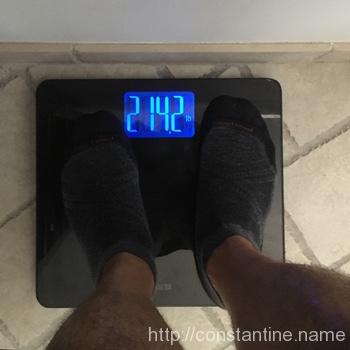
Mar 2016: 221

Me, excited? You betcha!!

I’ve said it before: Find the smallest first step you can make towards your goal. Take that step. Tomorrow, look back and say, “well… I’ve come this far, may as well take the next step!” The hardest part of any journey is believing the journey is possible.

ɕ

Mar 20, 2016

Working on bar precisions

I’ve been doing a lot of rail precisions (approaching 5,000) as part of my “10k reps” project. The goal is simply to do 10,000 rail precisions — not at any particular height or distance, but to simply get comfortable landing on rails.

But on Saturday, i spent a couple hours pushing the distance out…

ɕ

Mar 22, 2016

Damaging my hands is not a good thing

I used to think blisters, busted skin, and crusty scabs were badges of accomplishment. But now, I think that if my hands are wounded I have done something wrong.

If I have a bashed shin, a bleeding elbow, or a bruised rib then clearly I’ve done something wrong to damage those body parts. So why did I think that injuries to my hands were cool or something of which to be proud?

tl;dr: Hubris.

Almost everyone I know has soft hands. I know a very few people who work in trades who have tough hands, and I know some Parkour people with seasoned hands. So I thought it was cool that I could sometimes show off my “I worked hard hands.” Turns out that was just a way for me to brag. (Boo! Bad, old me! Time for me to re-read My Oath.)

Even worse, there were times where I’ve left parts of my hands, or even blood, on walls, obstacles, etc.. That’s actually pretty gross, and is the exact opposite of the leave-no-trace mentality that I want to cultivate in myself.

The light-bulb moment for me was the last time I went indoor bouldering. I climbed for several hours (at a leisurely pace and without damaging ANY body parts). When I was done I found myself thinking, “AWESOME! Look at my hands! All these pull-ups and scaf work are paying off!”

Lest I get pushed under the bus by hardcore people, I want to be clear: I train hard. I love “MDK”, “gauntlets” and mental/physical challenges. I do push parts of my body to their limits. Usually, I discover those limits were farther out than I expected. But, just as I do with the rest of my body, I am now going to do my best to take good care of my hands.

I’m happy with progressions for everything I do; Now I’ll try to also be happy with progressions for my hands. If it turns out that I have to stop doing something (or tape my hands, or *gasp* put gloves on) because my hands are going to give out, that tells me what I have to work on next: Toughening up my hands.

ɕ

Apr 4, 2016

Reality check from 2008

My mom dug this photo up from somewhere. It was taken in 2008, and there may have been a few changes since then.

I think this is now my favorite inspirational photo.

Why inspirational? Most of the changes I’ve accomplished have been in the past four years. If I can accomplish what I did, without killing myself (literally or figuratively), while having a tremendous amount of fun… then I cannot wait to see what comes next!

ɕ

May 14, 2016

Moving forward

I really struggle with believing that small, daily efforts lead to long-term changes. On the treadmill of life, I always seem to want to start sprinting to get ahead, especially when the treadmill picks up speed working against me. I find little injuries or other setbacks are really demoralizing. Curiously, I don’t seem to be demoralized by the things I’m not yet able to do. (“Scale that wall? meh. Some day, maybe, not really a major concern though.”)

So any time I manage to go to a class, or an event, or a simple workout, or a run, or whatever… and I put in solid effort without injurying myself or pushing anything too far (pushing “too far” is for special occasions ;) …well, after those workouts, then I really feel vindicated and motivated to continue my journey.

This morning I managed to get up, get out the door, run and do my QM work alone. It was nothing major; Just a half hour of easy running and a half hour of “easy” QM.

It ain’t about how hard you hit. It’s about how hard you can get hit and keep moving forward.

~ Rocky Balboa

ɕ

Jun 10, 2016

When the ‘me’ is obliterated

When the ‘me’ is obliterated by fear or the demands of immediate survival, action is no longer constrained by social forces, and the individual is left with a sense of self-determination. […] Behavior in edgework appears to the individual as an innate response arising from sources deep within the individual, untouched by socializing influences”

~ Stephen Lyng from, Edgework, 2004

A couple years ago I tried to write something explaining what exactly it is about practicing parkour that I like so much. It turns out others are way WAY ahead of me. Julie Angel (you have read Cinè Parkour, right?) talks a bit about “edgework”; The idea of negotiating the “edges” between things like consciousness/unconsciousness, sanity/insanity, and life/death. Others (H.S. Thompson and Lyng) have talked about “edgework” in depth.

And I agree. My experience is that being in the parkour practice — even just the visceral edges where I’m pushing my physical limits while exposing myself to only manageable levels of risk — just totally strips away all the context of my work-a-day life. Everything — all the way down to my thoughts — everything falls away.

My martial arts teacher has a great phrase related to edgework: No this. No that. No delay.

ɕ

Jun 15, 2016

The little box on my desk

A long long time ago I began collecting inspirational quotes and aphorisms. I kept them on the first version of my web site, where they were displayed randomly. But as time went on, I realized I wanted them where I would see them. Eventually I copied the fledgeling collection onto 3×5 cards and put them in a small box. As I find new ones, I add cards.

I keep the box on my desk with one card showing — just wedged in so it stands up readable. I change the card randomly, whenever the urge strikes.

Countless times I’ve pulled another card and found it eerily appropriate to the challenges of the day.

Countless times I’ve returned to my desk and felt inspired upon rediscovering an old card’s whispered counsel.

Countless times, just as I was about to throw in the towel, I was saved by an echo from the little box on my desk.

ɕ

Jun 21, 2016

Why is everyone so darned happy!?!

I think it may be the sun exposure.

When I started Parkour, I wasn’t even aware that I was generally UNhappy. But I sure did notice that everyone I met WAS happy. At first I just marked this down to “everyone is young”, and I set about simply enjoying training and playing with a mob of fun people.

Then, slowly, I realized I was becoming happy.

Now sure, some of this has to be due to my changing — some life-style changes, some dietary, some weight, some exercise, etc. But the more I’ve been reading, the more I’m inclined to blame some of it on the sun.

You see, it’s been shown that Vitamin D supplementation works wonders, and I’d bet that getting my Vitamin D the natural way is even better.

«http://www.proteinpower.com/drmike/supplements/sunshine-superman/»
«http://www.drbriffa.com/2007/09/12/vitamin-d-supplementation-appears-to-save-lives/»
«http://www.drbriffa.com/2010/04/29/can-sunlight-and-vitamin-d-help-to-preserve-physical-function-and-independence-as-we-age/»
Male Depression: How to Deal With It | The Art of Manliness

ɕ

Jun 27, 2016

I work like a gardener

I work like a gardener… Things come slowly… Things follow their natural course. They grow, they ripen. I must graft. I must water… Ripening goes on in my mind. So I’m always working at a great many things at the same time.

~ Joan Miro from, I Work Like a Gardener: Joan Miró on Art, Motionless Movement, and the Proper Pace of Creative Labor – The Marginalian

Elsewhere, this is 4ubaio1. — slipbox

In the beginning, my Parkour practice was simply “push. push! PUSH!” with the only moderating factor being to avoid serious injury.

Fortunately, I soon found my own way to the concept of auto-regulation (although I didn’t know the word at the time). Now, at each practice session, I simply start moving and practicing. Then depending on how I am actually performing (physically, mentally) I dial up or down the intensity, and level of challenge, to correspond to the moment/hour/day. The critical point being that I assess how I am actually performing. It’s not, “I roll out of bed, decide I feel sore (or lazy) and then skip the workout/class.”

Lately, I’m noticing there’s a seasonal component. (It’s one thing to say that. It’s another thing to really experience it over a few years.) In the Spring I charge ahead on new plans and goals, and by Summer I find I’m making progress by leaps and bounds. (See what I did there? #sorrynonotsorry.) Then Fall rolls around and I’m starting to chillax and really enjoy things; Meals with friends, vistas, the moments between gonzo training sessions, etc. By the time winter descends, I’m ready to burrow into reading and cooking up new schemes for the coming year.

Obviously, part of that is just the natural rhythm of life in an area that has four clear seasons.

…but part of it is exactly what Joan said about working like a gardener.

ɕ

Jul 3, 2016

Yes you can

Hello there! Welcome!

This post is where I’ve dumped a bunch of things intended to convince YOU that you really can do Parkour.

Why do I think you can do Parkour? Because, basically, everything the general public has heard about Parkour is wrong. You could totally do Parkour because…

I’m too old, over-weight, out of shape…

I did it, so can you.

I simply mean that when I started, I was very over-weight (BMI well over 30, definitely “obese”), very out of shape, and I was just over 40 years old. That combination is probably “worse off” than most people who end up reading this.

However, if you are older, in worse shape, or fatter than that, I do still think you can do it . . .

Do you think you can improve yourself?

Parkour is about improving yourself through challenge. So whatever is challenging for you, that’s going to be your practice. Maybe for you, it’s a warmup and then start working on some shoulder strength, but you spend a majority of the time watching class so you’re not over-exherting yourself. Maybe it’s a long talk about nutrition and diet (generally what you eat, not a specific diet fad) combined with your initial Parkour efforts.

What about that crazy stuff on TouYube?

It is NOT about big jumps! Why does everyone see the EXTREME movements, and then assume ALL Parkour has to be like that?

You can drive a car without getting into auto racing. You can do a cart wheel without being an Olympic gymnast. You can go for a jog without running a marathon. You can practice Parkour without jumping between roof-tops across an alley!

There’s nothing wrong with the extremes (in the “ultimate level of performance” sense) in any of those activities, but those extremes are NOT representative of the average activity of “driving”, “cart wheeling”, “running” or “Parkour”.

And anyway, here’s a link to my all-time favorite video of some Parkour. I think it’s spectacular, but not in the “huge jumps”, “extreme movement” sense: Julie Angel’s, Movement of Three (2’33”) Movement of Three – YouTube

But I’m a woman…

The answer is still: Yes. Yes you can.

I do understand that there are issues (not just in Parkour) that only women face. But those issues are either societal norms, or other bullshit caused by men. That has nothing to do with Parkour per se. (It’s about men. Actually it’s about boys. Real men don’t pull misogynistic crap.)

HOWEVER, do not take my word about anything regarding the woman’s point of view. Instead, go read this:

«http://www.risingtraceuse.com/2015/03/5-thoughts-that-keep-women-from-trying.html»

And the question almost no one asks…

How do I figure out where and with whom to train?

This is ACTUALLY the hard part. It’s always the same: finding the right coach is mission critical. And you have to perfom this most-important step BEFORE you know much about the thing you want to learn.

So here’s how you do it: You find the nearest place/people/group that purports to teach the thing. You go there. You put your “vibe radar” on and you don’t go back if anything weirds you out. If anything is high pressure (“Jump this! NOW!”, “Sign up for a year! NOW!”) then you back away slowly, and never return. They should be welcoming, intelligent and you should feel supported by most (if not literally) everyone in the class.

ɕ

Jul 9, 2016

Patience is the master key

Patience is the master key to every situation. One must have sympathy for everything, surrender to everything, but at the same time remain patient and forbearing… There is no such thing as bending or breaking. It’s a question only of overcoming, which begins with overcoming oneself. That cannot be avoided. To abandon that path is always to break in pieces. One must patiently accept everything and let it grow within oneself. The barriers of the fear-ridden I can only be broken by love. One must, in the dead leaves that rustle around one, already see the young fresh green of spring, compose oneself in patience, and wait. Patience is the only true foundation on which to make one’s dreams come true.

~ Franz Kafka from, Kafka on Love and Patience – The Marginalian

Elsewhere, this is 4ubaco1. — slipbox

Patience with myself is a huge hurdle. I’m my own worst critic. One critical comment from me, and I crumble. I regularly beat myself down and out with negativity, self-doubt and unreasonable expectations.

New mantra: Patience is the master key. Patience.

ɕ

Oct 7, 2016

Keep on keepin’ on!


Keep on keepin’ on!: I’ve filled in the rest of the bars and this thing now needs a name. Until you’ve tried moving in a complex space, you won’t know how supremely capable the human body is; shoulders, grip, torso, knees, feet, vision, proprioception, spacial mapping… that meat-frame your mind lives in is meant to M. O. V. E.

ɕ

Oct 20, 2016

Life Return On Exercise Invested

Life Return On Exercise Invested – LROEI

Exercise has been show to correlate (caution, https://en.wikipedia.org/wiki/Correlation_does_not_imply_causation) with longevity; The people who exercise more are also the people who live longer:

«http://www.drbriffa.com/2009/03/06/taking-up-exercise-in-middle-age-appears-to-give-a-handsome-return-on-investment/»

Elsewhere, this is 4udita1. — slipbox

I had never thought about exercise in quite this way: If I’m going to exercise, and if the exact details of the exercise aren’t so important, WHICH exercise would I prefer to do?

Would I rather spend time indoors or outdoors?
…in a gym, or at a playground?
…alone, or with my friends?
…in a familiar place, or some place new?

There are many types of exercise. The way I’m pursuing exercise through Parkour ALSO happens to generate a greater LROEI.

ɕ

Dec 22, 2016

Parkour as a technology of the self

I’m working on a crazy idea as a side project. Totally unrelated, I’m reading Julie’s CinéParkour. I’m just reading along this evening, and I get to this paragraph. This is so apropos of my train of thought these past few weeks.

Mind.
Blown.

Traceurs are active subjects within dominant power relations who use parkour as a technology of the self; an active transformative tool, to create and understand themselves and move away from fixed notions of identity and behaviour. Through a process of critical thinking and self-awereness traceurs problemitise and set ethics by which they adhere to. Parkour becomes a ‘practice of libery’, where traceurs practice freedom as a lifestyle, based on inventions and styles, that create ethics centered around creative environmental interactions and connections, to reclaim the body as an autonomous vehicle, away from the dominant notion of ‘bio-power’ and other dominant discourses.

~ Julie Angel, from CinéParkour, pg 152

‘technology of the self’
‘freedom as a lifestyle’
‘ethics centered around creative environmental interactions and connections’
‘reclaim the body as an autonomous vehicle’

ɕ

Mar 11, 2017

How do I stay motivated?

My level of motivation varies tremendously, and it took me far too long to learn that it was cyclical. I used to think I had these huge swaths of motivated productivity with an occasional, unexplained crash. I used to think I just needed to figure out how to avoid those anomalous crashes, and I spent too much precious time fighting with myself in the down-turns. I now see that I was wrong; My motivation is inherently cyclical.

When I am highly motivated, it’s alluring to believe that I should spend my time working only on focused and directed things. I used to fall into the trap of trying to focus all of my time and energy on moving forward. I felt that if I wasn’t on-task, then I was wasting time, and that feeling fed into my sense of guilt.

Because I now expect the inevitable down-turns, I feel justified spending time on things which support my motivation in the long run. I work intermittently in two directions: I spend some of my time working on-task towards achieving my goals, and some time goofing-off cultivating my motivation and inspiration. In effect, I’m prolonging the motivational peaks by spreading them out wider. At the highest points, I may not be as motivated as I once was, but I maintain a productive level of motivation for a much longer time.

(To be fair, I have a pretty organized way of goofing-off. I read from a wide range of online sources and books, from health, wellness and exercise blogs to physiology text books. I constantly fiddle with new exercises to try, places to go, health tweaks, and habits. I make plans to travel near and far, where I can meet new people, and visit old friends. I even have no-thinking-required things — music playlists, and monotonous chores — which I can draw on when I need to be off-task.)

But eventually, I head into a down-turn. They vary from mild bouts of, “meh,” where I simply feel unmotivated to do any of the things I’ve set out for myself, to dark moods of depression. Regardless of the depth, when I’m heading into a motivational down-turn, my best tactic is to stop doing — to stop trying — and to simply be. It’s as if I’m at the crest of the first hill on a roller-coaster; I see what’s coming, and prepare for the inevitable ride.

At the bottom of that huge, thrill-less, depressing hill it is agonizing to lay in a puddle of “meh” and believe that this is exactly what I need to be doing right now. But that is the truth. After countless cycles of ebb and flow, I’ve learned to think: “Right now, laying in this puddle is exactly what I need.”

…and that is the key to my success.

I remind myself to roll with this down-turn, guilt-free. I try to avoid “should’ing” on myself. (I should stop this. I should do that.) I remind myself this down-turn is only one phase of a healthy cycle.

I rest.

I mope.

Maybe I watch a movie and have some popcorn. Maybe I nap. Maybe I nap in the hammock if it’s warm outside. Maybe I bask before the fire, or lay in the sun. I do whatever it is I feel like doing, which may well be absolutely nothing at all. I throw down the reigns which my executive-level mind normally holds with an iron grip. I set my thoughts and body free. They weren’t listening anyway.

And then I could write a long diatribe where I try to explain how it feels as if there’s this big, gloomy, moping, dog that sits around keeping me stuck in the down-turn. And eventually that dog gets bored and I can convince it to go away. And, honestly, it’s a stupid metaphor. Except for the fact that here I am, stuck writing some lousy metaphor, making me hate writing this, which — it turns out — is exactly the sort of perfect metaphor for feeling lousy when I’m stuck in a down-turn…

I’m going for a walk.

Just the tiniest little stroll.

But…

Walking invariably loosens up my mind. Sometimes it takes days of doing nothing interspersed with some walking before I see the light at the end of the tunnel. Soon, I find I have at least a few things on my mind that need to be unloaded. When I hear that quiet calling, I write whatever-it-is into my journal. Writing things down — moods, worries, plans, ideas — unjumbles my mind. So I record my thoughts as inspiration for future projects, and as reminders to expect future down-turns.

Eventually, I simply find the thought of working on something might actually be fun. At which point I realize I’m headed back towards the next up-turn.

When things go badly, relax; It will not last.
When things go well, relax; It will not last.

ɕ

May 25, 2017

Bookending

For as long as I can remember, I’ve had an idea I call “bookending.”

While most of life is reasonably flexible, there are certain important events which are scheduled at firmly fixed times. Bookending is planning, starting with the fixed event and working backwards. From the fixed event, I can imagine in reverse all the preceding steps, and how much time each requires. I can then determine the time at which I must begin the first step in the chain. From the beginning of that first step, through to the fixed event, defines a wide bookend during which all my actions are more or less known.

As I was writing my series on Parkour Travel, it became clear that bookending is critical to my success with traveling. A Parkour trip tends to be very random and unorganized (those are good things,) but that means it’s even easier to get surprised by firmly scheduled things sneaking up.

Bookending is simply a visualization practice. Various professions use visualization to minimize mistakes. They visualize each step happening successfully, as a complete chain of events, which leads to the desired outcome. When they face time constraints, visualizing the important details of each action they will take reduces errors and increases the likelihood of success.

Here’s an example from traveling:

My flight leaves at 11:00. I don’t have any checked luggage, so I’ll plan to arrive an hour and a half before my flight departs. I’m now thinking, “9:30.” There’s a bus which leaves at 8:00 and arrives at the airport at 9:27. That’s too close for my personal preference. I’ve already bookended the time before the flight: It’s not, “flight at 11:00”, the fixed event is now “be at airport at 9:30.” The previous bus leaves at 7:00, I’ll plan on that one. Now I’m thinking, “bus leaves at 7:00.” I need 15 minutes to drive to the bus terminal, and let’s aim to be 15 minutes early for the bus. That’s now 6:30. I need to park, buy a bus ticket, probably stop at the bathroom, and I need a cup of coffee somewhere along the way, so I’ll throw in another half an hour. I’m now thinking, “6:00.” My bookend is from 6:00 through 11:00. When I begin at 6:00, everything falls into place, bumps in the road don’t cause significant problems and I’ve plenty of time at each step of the way.

Before I learned to bookend, I used to remember the time of the firmly scheduled event (“my flight departs at 11:00”), and then I’d have in mind how long I needed before that (“I need five hours to get there.”) People would ask me, “What are you doing tomorrow?” and my train of thought each time was always, “Flight at 11, I need 5 hours… Five hours? Really?! Yes, I’ve already thought about this. I should leave at 6:00. Ouch. That’s pretty early.” And then I would finally say, “I have a flight at 11:00 and I want to leave about 6:00.”

With my old “method” is was, “Flight at 11:00 and then here are more details that aren’t important, but actually 6:00.” In my mind, and everyone else’s, it’s 11-and-then-all-these-other-details. In my mind, and everyone else’s, we’re always second-guessing why I seem to want to start so early. How did a flight at 11:00 lead to wanting to leave at 6:00?

A large part of what makes bookending useful is that it flips the thinking to, “I would like to leave at 6.” I’m thinking 6:00. I’m saying 6:00. 6:00 is what’s bouncing around in my head. 6:00 comes around and the entire planned sequence of events for the bookend is cued. Off I go, and on time I am.

As I got used to this process, I discovered other benefits: People who host or who are helping you when you travel, understand when you do NOT need their help. If I say “I have a flight at 11:00,” does that imply I’d like a ride to the airport? Perhaps. But if I say, “I’m leaving at 6:00,” that implies I have a plan to get wherever it is that I’m going.

There’s another huge benefit that sneaks in. Having extra time padded in, leads to little chunks of time for me to read. I keep a collection of read-this-later items in my phone (via services like Pocket or Read It Later.) As I find pockets of spare time I always have things to read rather than wasting time in social media or bookface.

ɕ

Sep 25, 2017

Back pain

Somewhere in my 30’s, slowly, year by year, the frequency of my back problems increased. I’m not talking about, I helped a friend move over the weekend, or, I did climb-ups for an hour at Parkour class, and now my back is “out.” I’m talking about,

I sat down to put socks on — because I cannot hold my foot up to reach it standing — and my lower back “just” gave out.

or,

I was just standing at the sink washing dishes.

For me, these incidents where I was clearly not doing anything amazing and was still somehow injured, became a clear sign that I needed to change something. In hindsight, this is the article I wish I had found first and so I hope it helps someone.

Elsewhere, in my Changes and Results series, I’m laying out all the big things I’ve changed, project by project. But there was never any one thing that I worked on specifically to fix my back. It simply turned out that many of the things I did contributed to — knock on wood — resolving my back problems. Of course my back still gives me trouble when I deserve it. But these days, I know when it’s going to be a problem. I can feel when my back is getting tired, and if I listen to that quiet signal I can avoid the worst of the problems.

My spine and me

Although I had been doing some intentional, general improvement efforts, such as losing weight and getting better sleep, my back-focused improvement journey really began when I heard Ido Portal say something to the effect of:

Your legs are for moving you through your environment. Your arms are for manipulating your environment. Your spine is for orienting yourself within the environment. So your spine should be this incredibly mobile and powerful system with a huge range of dynamic movement.

(That’s not an exact quote because I don’t feel like going through the entire “Rewild Yourself Podcast” episode where Daniel Vitalis interviewed Ido Portal. It’s episode number 8: Ido Portal on the Movement Diet which you should probably go listen to.)

When I heard that, I realized that my spine was nothing at all like Ido’s vision of a human spine. Mine barely moved at all, and when it did, I often felt nervous about impending disaster. After hearing Ido’s way of describing the spine, I had this new perspective where each time I’d do some movement, I could see how much my spine was right at its limit of ability. I realized that my spine should be an incredibly varied mover, and that my spine’s flexibility (the total movement possible) and range of motion (the smaller space of movement where my back is usable, comfortable and strong) are critical, foundational elements to all of my health and movement.

I realized that for years I had tried to “stabilize” and strengthen my spine as a defense against movement causing injury to my back. But I now see that this is an erroneous reaction to weakness. If instead of being immobilized as a defense, my spine is strong, then it can be mobile, able to make all the movements I need, and not be injured.

Awareness and honesty

The first step was to learn to avoid injury. This sounds trivial, but it was not at all obvious to me at the time. When I was so fat and inflexible that putting my socks on regularly endangered my back, it was a terrible, humbling experience to admit that I had to change how I put my on socks.

I had to identify all the landmines, and own up to them. I had to learn that stretching — really just moving around — was mandatory each morning. I had to stop automatically rushing to help everyone move heavy objects. I had to stop trying to be “the strong guy,” and generally dial down all my activities to a level my back could handle. I had to acknowledge those random days when my back felt “off”, and learn to take a rest day for recovery.

All of which forced me to face that I was no longer indestructible and to own up to the deteriorated state of my body. Awareness and honesty were the only way that I could stop taking frequent steps backwards. They were the only way that I could begin to make glacial forward progress.

(I’ve written more about the Philosophy of the changes I’ve made in my Changes and Results series.)

Weight loss

Losing weight is obviously not easy. But every pound that I peeled off paid dividends to my back. It turns out that weight around your middle drastically increases the load on your lower back. “Lost weight” is a woefully inadequate summary for this element of fixing my back, but hopefully I’ll get around to writing out everything I did to lose weight.

Recovery work

What began as endless massage work by my spouse, slowly morphed into self-massage and then into mobility work; Basically, I learned to lay on the floor moving in all the ways my spine was meant to move. I mastered the use of a foam roller and Lacrosse ball for myofascial release and self-massage. As my back got stronger, I was able expand this recovery practice to a more general, whole-body movement, stretching and — much later — general strengthening.

(I’m writing a separate post on my “20 minutes of morning stretching” which is one of the cornerstones upon which I have built the whole new me. It’s not yet published, but will eventually be part of my Changes and Results.)

Finally, chiropractic has saved me countless times. I know many people who believe chiropractic is quackery. But for me, it doesn’t matter how or why, it simply yields results.

Posture

Years of sitting, and progressive weakening of my back, took their toll. Worse, the hunched back, rolled shoulders posture was so common in my environment, that it seemed normal. So I didn’t even realize what was happening to me.

The first baby step to improving my posture was when I learned how to understand, and control, the orientation of my pelvis through learning to sit as part of martial arts training. The traditional Japanese seated posture, seiza where you sit with folded-under knees and pointed toes is great for learning posture. Of course, this type of sitting initially rewards you with agony from the knees and ankles. But once your legs adapt, there is a delightful feeling of peace and centralized weight when you learn to center your pelvis and to balance and align your entire spine. But maintaining this alignment, even in a statically balanced seated position, required a certain muscle tone. A tone which I had lost through endless sitting in a poor posture.

I soon realized that the orientation of the hands as they hang at your sides is indicative of your upper back posture. Palms turned to the back, (the shoulders being in interior rotation,) with that “knuckle-dragger” appearance is a sign of a week upper back and poor scapular position. I began incorporating various exercises, (the ‘Sphinx’ pose from yoga, ‘shoulder dislocations’, and thoracic extension in supine position, etc.) into my daily recovery work. (For a great introduction, read De-Quasimodo Yourself.)

As I’d gained weight, I hadn’t realized that I had also, slowly transitioned to a “dumped” lower abdomen: guts hanging out the front, pelvis tipped forward, and lumbar spine pulled forward into a maximum arch. This led me to lower back agony whenever I spent time on my feet, especially if I over-worked my lower back by strolling and slowly shift my weight from one leg to the other. But as I’ve lost fat from my typical abdominal male pattern, and as running and jumping in the context of parkour have strengthened my glutes, it has become easier to maintain a neutral pelvic position and a neutral curve of my lumbar spine.

Walking

Solvitur Ambulando ~ It is solved by walking

Today, I have a ton of stuff here on my site about walking.

But it all started, long ago, when I read a blog post by Steve Kamb, about Walking to Mordor. “One does not simply walk into Mordor!” Except, that is exactly what Sam and Frodo did. Elsewhere I’m writing an entire post about my efforts and progress related solely to walking; But all of my walking was kick-started by Steve’s Nerd Fitness blog post.

Shoes

This was the least obvious thing which improved my back: The closer I get to living barefoot, the better my back feels.

Long ago, I was wearing “normal” shoes, and then I started taking some parkour classes. Turns out that I want to wear the lightest weight, and thinnest soled, shoes I can; because I want to use my feet and toes. Anyway, roll with me here when I say: I wanted to wear minimal footwear for parkour. So, I started wearing Feiyue shoes to class — not the fancy French brand of shoes, but the el’cheapo, crépe sole, martial arts shoe. They have no structure, no arch, and just some padding and protection from most (not all) things you might step on.

I started to run in Feiyue. I ran 10 feet and my calves cramped up. I kept at it. For years. I relearned how to run. Then I relearned how to walk. Then I relearned how to use my knees. Then I realized that to get things working again, I needed to stop wearing “normal” shoes entirely. So I started wearing Feiyue everywhere.

I went on reading about feet. …and about minimal shoes. …and about barefoot training. Then I learned about the amount of nerves in our feet, (the same as in your hands,) and I had some discussions about sensory input through your feet. …and balance. …and acupressure points.

It is not an exaggeration to say that learning about my feet has changed my life.

Today, I exclusively wear an old-school track running shoe called Bullets, made by Saucony. I remove the insoles, so that from the midsole to the toes there is ZERO padding; just a few millimeters of hard rubber sole between my foot and the world. I wear these same shoes for everything. All surfaces, all activities — everything.

The ah-ha moment

It was at this point — after all of the above changes, and after I had spent about two years full-time in minimalist shoes — that I realized my back was fundamentally different.

Then I set out to write this, over the course of 18 months. :)

Recommended reading

Despite all that I’ve written here, this is still only scratching the surface of information about the back and spine. Take a look at the Human Back and Spine topic over on Hilbert’s Library.

ɕ

Jan 20, 2018

A lifetime of successful training

I had to change my expectations of how much I trained because I was in that mindset, the more training, the better. You can’t do more intense training, so now I probably train, if you look at it, still, I train maybe four or five hours per day, but three of those hours or four of those hours are watching video, or reading books, and researching because I can do that without damaging my body or going too far. For me, it’s not saying, “Well, I guess I’ll never be this good. Well, I’m just not going to have the expectation that I can get on the mat and grind it out with the 20-year-olds for five hours a day.” That’s not going to happen.

~ Burton Richardson, from Show Notes

Elsewhere, this is 4ugiei1. — slipbox

If you don’t know who Burton Richardson is… uh, think: Direct student of Bruce Lee, and 30 years of training with many of the greatest martial artists in history. Also, zero ego.

This interview with the legendary Burton Richardson is life-changing. My pull-quote does not do this interview justice. This 45-minute interview contains an insane amount of insight into training and practice for the long-haul.

…yeah, how many hours a day do I train?

ɕ

Mar 7, 2018

Ever-present mental stress

Most people have been in some version of this mental stress state so consistently, for so long, that they don’t even know they’re in it. Like gravity, it’s ever present — so much so that those who experience it usually aren’t even aware of the pressure. The only time most of them will realize how much tension they’ve been under is when they get rid of it and notice how different they feel. It’s like the constant buzzing noise in a room you didn’t know was there until it stops.

~ David Allen from, Getting Things Done

Elsewhere, this is 4uliwo2. — slipbox

The key insight for me was once I realized there are two “directions” to thinking: I was always good at vertical thinking, going down thru a project (big or small), planning, organizing and doing. This was simply “thinking”, and how could there be more than one “direction” in which to think?

Unfortunately, I often got stuck when my brain started doing this other direction of thinking for which I had no name; no concept to attach: The horizontal thinking. The hopping from project to project — and I use “project” in the most broad sense of ANY thing involving a goal (“remodel house”, “send holiday cards”), any size (“seven years of projet management and contractors”, “buy stamps, buy cards, stuff, mail” ), and any number of steps. My mind hopped uncontrollably from thing to thing, around and around, across all the open loops, as the same things came up over and over and over.

These days, having a solid capture and review system enables me to close those mental loops. I can often read for a half an hour without my mind once interrupting me with some random, “I need to do this,” or “I need to remember that,” thought. (And if it does interupt me, I simple capture that thought once. Done. Freedom.) In the beginning I used paper notecards, then notebooks, software, and on and on. The exact system does not matter. It only matters that you trust your system. Only when you truly trust your system will your subconscious close all those open loops.

ɕ

Jul 11, 2018

Status update July 2018

I’m not quite ready to publish scantily-clad selfies… so I left my socks on. I’ve a target weight in mind which corresponds to 20-year-old-me and a good photo from 1991.

Meanwhile…

This is the least I have weighed in 20 years. About 55 pounds (25kg!) lighter than 2008.

A visiting Finn mowed my lawn for me yesterday, and so I had time for one last run on this continent before I leave for a triple-stop Parkour trip in about twelve hours.

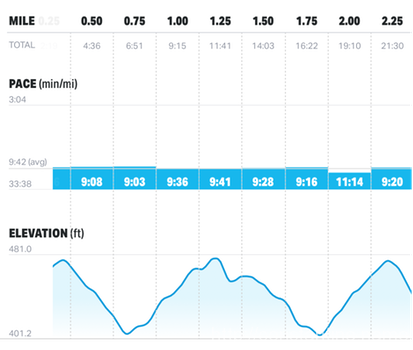
The graph is a little odd because I didn’t stop the tracking immediately, so there’s a huge bar for the last split (not shown.) It’s a lollipop route, so the 11-minute split is up the slight hill which I ran down at ~9-minute pace. The whole run came in about 9:33, which is right on the fastest I’ve ever run this. This time was much more uniform in pace than the last time I ran this.

Why do I post this stuff? Because whomever you are, whereever you are in your physical fitness (or complete lack thereof), you can simply do what I did: Start where you are.

ɕ

Oct 9, 2018

The over-40 crew from ARDV18

Nov 18, 2018

There’s nothing small about the world

Now I realize I was not giving up anything of any use to anyone. The news never really added to my knowledge in any meaningful way. It just added a steady stream of limited and unsubstantiated viewpoints on select issues to my head, which is already full of limited and unsubstantiated viewpoints. The news doesn’t inform you about what’s happening in the world. The news only informs you of what’s on the news.

~ David Cain from, There’s Nothing Small About the World

Elsewhere, this is 4urate6. — slipbox

One of the first steps I ever took in turning my life around was to get a handle on my information “diet.” In the beginning, there was TV. I was horribly mistaken in thinking that it was possible to obtain any useful news from TV. (There’s plenty of entertainment on TV if you’re willing to guzzle advertising with it.) Early on, perhaps around ~1993, I realized you could use RSS (and it’s many descendent flavors) to watch [as in, “notice when things are published”, not “mindlessly stare at”] information sources of my choosing.

ɕ

Dec 25, 2018

Insecurity

The problem comes from how we deal with the feeling of insecurity. We might curl up and hide, lash out at someone in a hurtful way, harden our rigid views of the world so that everyone else is wrong and we’re continually angry. We might procrastinate and run to distraction, use social media to avoid feeling insecurity, try to control others or the world around us to end the feeling of insecurity.

~ Leo Babauta from, The Guide to Insecurities You’ve Been Waiting For

Elsewhere, this is 4uzeie3. — slipbox

I have been lucky—repeatedly over the course of several years—to have had Leo Babauta’s writing available to me. One theme that he repeats is the idea of being kind to one’s self.

The insecurity that I’m not good enough, in my own judgement, is deeply held. I regularly and often flee to easy comforts; it’s been many things over the years, but in the most recent years, it is food.

Not often enough, but sometimes, I find a way to practice being kind to myself. One that works well is: “Spend 30 minutes balancing on a rail. If you fall, simply get back on. Take your time. Be kind to yourself.” Each time I do this I know I will reach a barter-stage where I’m ready to be done. Each time I do this I know I will fall off often—it’s hard for me to even leave out the word “too,” from the phrase, “fall off too often.” Each time I do this it makes me sweat from the physical effort not from, (for example,) the fear. I do fear that some day this exercise will no longer work for me.

ɕ

Jan 17, 2019

Ten-years and About that “diet”…

That photo? In the “before” photo (the left half) I am the unrecognizable person on the right. :)

Recently a friend of mine emailed me and asked, “Hey Craig, tell me about that diet you went on a few years ago.” He was referring to what I did from ~2008 to ~2016—the photos above were taken in 2008 and 2016. Below is my response and this just happens to all coincide with the “ten year challenge” currently all over social media.

I did a few things. Each of these took a few months of trying/fiddling until they felt comfortable.

I tried to avoid refined carbs like the plague; I tried to eliminate all added sugar, all refined grain (bread, pasta, etc), and even eliminated granola which was a go-to breakfast staple (with plain yogurt). What really happened was that it forced me to become aware of the carbohydrates I was eating. I still ate pasta and bread and even sweets, but by focusing on, “I am the type of person who eats fish, meat and veggies,” I was able to shift my diet significantly. I started to make choices such as, “if I’m going to eat pasta, I’m not eating shitty pasta, I’m going to my favorite Italian restaurant so I really enjoy it.” I did not count calories. This was not fun as I [in my opinion] was addicted to the blood sugar spikes from eating a lot of carbohydrates. Shifting my dietary balance had the effect of changing my energy metabolism; it caused changes in my liver function and cellular mitochondria performance.

After many months of that, I next worked on my addiction to eating. I started intermittent fasting. (Without consulting my doctor I just jumped all in.) I did (and still do, many years later) “16/8” intermittent fasting; meaning I’m fasting 16 hours-a-day, and permit myself an 8-hour “feeding window.” (Aside: What I now call ‘normal human eating.’) The way I like to do this is to aim for consuming no food after about 7:30pm. That makes it easy to have a normal dinner, including social eating which is super important to me. Then I basically don’t eat breakfast. Around 11:30, (16 hours after 7:30 the previous day,) I have my break-fast while everyone else is calling it “lunch.” Most people never notice I’m doing this. I could talk for hours about intermittent fasting. BE CAREFUL with this; you can faint, or have low-blood sugar problems depending on how wacked your metabolism is.

It’s important to note that I did the above things separately, one after the other. My reading indicated that reducing carbohydrate intake would force my cells to up-regulate all the cellular processes for burning fat—my own pre-installed fat. So my “lower carbohydrates” work was in preparation for the intermittent fasting work. If I was planning to not eat for 16 hours, my body will have to switch to mobilizing the fat from fat cells; the liver has to be able to put glucose into my blood stream from stored-like-a-battery glycogen in the liver, and from glucose created chemically from other substrates. Those in particular were cellular processes that I was hardly using for decades, when I was always-eating and eating lots of carbohydrates.

So the big picture for me was to change my energy metabolism—to recover my [natural, normal, hey humans are awesome] ability to run on various fuels, (be that carbohydrates, protein, or fat I put in my face, or the pre-installed fat.) I did that by first reducing carbohydrates, and then starting to fast.

I’ve written some of my thoughts up on my web site, but it’s all scattered about. Let me know if you want more information on any of the above and I can give you more and point you to specific resources. If you want to learn more, start with my health or self-improvement tags.

All that said…

I’M INSANELY HAPPY I DID ALL THE ABOVE.

I can train like a machine all morning, not having eaten—in fact, if I eat I feel worse when I try to work hard. I’m considering using longer fasts (days, even up to a week) because there are long-term benefits seen in some studies; fast for a week, have improved blood markers for months. But this is definitely out in the land of, “I’m experimenting on myself.” (If you want to learn about long-term fasts, check out Peter Atia’s podcast, The Nothing Burger, it’s a long discussion of a one-week long fast he did with insane amounts of medical science.)

Finally—this is subtle but important—I did not intentionally increase my physical activity. It was not, “I’m exercising to get in shape.” My activity level spontaneously went up in response to feeling better. “I feel like running 2 miles,” is a thought I now have [sometimes] and now I can go run just for fun. It’s a virtuous cycle though; I feel better, I feel like more activity, I feel more better, I feel like more activity, …

ɕ

Jan 29, 2019

Parkour floor

We forget that what we have is more than what we need. Obscenely more. I know it may sound perverse, but here in the future people often feel like they need more than they have.

~ David Cain, from A Day in the Future

There’s a sense of accomplishment in being prepared to sleep on the floor when traveling. There’s a sense of freedom in being able to carry a small backpack and live comfortably. I always knew this was at least partly due to knowing that I was prepared enough for important contingencies and free enough to roll with whatever comes up during the day.

But now I see that there’s a second dimension to why I enjoy it: The self-imposed hardship. Sometimes the floor is cold and drafty, sometimes there’s a cat (I’m allergic to cats), sometimes everyone stays up very late (I usually turn in around 9:30), sometimes I miss a meal, sometimes I don’t sleep much if there’s too much light, sometimes it’s noisy, … and so on. Still, I am invariably in a better mood than usual the morning after each of these choose-your-own-adventures-gone-bad. Cold, stiff, sneezy, tired … sure. But in a good mood. Well, that’s very interesting, now isn’t it?

I’m not making a call for you to take up Parkour-flooring. I’m only pointing out that when I occassionally reset my callibration by intentionally taking on some suffering, I’m invariably happier after.

ɕ

Mar 2, 2019

Keeping a notebook

I think we are well advised to keep on nodding terms with the people we used to be, whether we find them attractive company or not. Otherwise they turn up unannounced and surprise us, come hammering on the mind’s door at 4 a.m. of a bad night and demand to know who deserted them, who betrayed them, who is going to make amends. We forget all too soon the things we thought we could never forget. We forget the loves and the betrayals alike, forget what we whispered and what we screamed, forget who we were.

~ Joan Didion

Elsewhere, this is 4a959. — slipbox

I have no idea who my 16-or-so-year-old self was. I recently found myself telling a long sequence of stories from that era. Who was that person? What were they thinking? …I have no idea.

And I don’t mean that looking at the facts, things don’t make sense. As in, “why would someone do that, in that situation.”

I mean: I have no recollection of what it felt like to be that person. That person—those experiences—don’t even feel real. It’s like there’s not even the least certainty that those memories aren’t just something loaded into my brain before it was booted up a few years ago.

Going back ten years—maaaybe 15 at most—I feel like that is still me. It’s like there’s a horizon and once an experience disappears over the horizon, all that’s left is a story.

ɕ

May 2, 2019

Quadrupedal Movement

Quadrupedal Movement (QM) is a diverse collection of movements using both hands and feet on the ground to support one’s weight.

QM is almost always done using just the feet, and not the knees, since our knees are not capable of taking prolonged usage or impact. That said, there are some small-size, low-impact, movements using various surfaces of the knees, lower legs, buttocks, and thighs which integrate well with the usual hands-and-feet-only QM.

There are countless variations of QM. Many variations are physically demanding, but many are drastically easier than the more usual bipedal movements: Using a railing with your hands for balance and support as you ascend stairs, using walking sticks and canes, and “scrambling” on hands and feet up steep slopes, are all common variations of QM.

Start here https://gmb.io/locomotion/

Elsewhere, this is 4ugilo1. — slipbox

…and then take a look at some advanced options, Two Hours and a Slab of Concrete.

ɕ

Meta: I’m retiring this series, “My Journey.” Over the years, my blog has changed a lot. In the beginning I had a lot of more random things here and I used this series as a way to highlight this aspect of my blog writing. Today, the blog itself is basically a record of my journey.

Jun 25, 2021

Side quests

I [generally] hate the Internet. I wanted to start this post with a reference to a little children’s TV skit I saw many (many) moons ago, on Sesame Street or maybe it was the Muppets… about a guy named Henry with a bucket with a hole who tried to fix it based on another character’s—named Liza—ministrations, but which eventually lead him to need the hole-y, original bucket to haul water to complete the bucket-repair process. If you’re not yet grabbing your head, try reading: “There a hole in my bucket. Dear Liza. Dear Liza.” Fortunately, Wikipedia, and a pile of YouTube clips I managed to not watch, have me covered. Long live the Internet!

“Holey-bucket-fixing” is a long chain of tasks which turn out to be circularly dependent. Obviously, I don’t realize it’s holey-bucket-fixing at the start of the side quest. I start off on some simple problem. To do A, I need B. To do B, I need C. To do C, I need… A? Where’s the Tylenol?!

But sometimes, I start off on some simple problem and it goes very well. As in . . .

Your merry band enters the dimly lit inn, glad to find shelter from the stormy night. The rogue among you sticks to the shadows to the left, the dwarf angles right, (in both senses of the word,) towards the bar, and the elf-archer, with the balance of the band in tow, strides for a long table against the doorless, far wall. The dwarf orders the first round of whatever-it-is-they-serve-around-these-parts, and the bartender strikes up a conversation. “Haven’t seen you folks around before. You look like you might be up for an adventure.” If you want to go on an adventure, turn to page 42. If you just want this idiot to shut up so you can drink your whatever-it-is-they-serve-around-these-parts in peace, continue reading.

And so, with a hole in my bucket, or a simple question in mind, or—challenge-loving dwarf-at-the-bar that I play so well—just too curious for my own good… I almost always turn to page 42.

ɕ

Jun 29, 2021

Final step

For many, the first step on a spiritual journey is to become lost. The final step is losing one’s self.

~ Wu Hsin

Elsewhere, this is 4a327. — slipbox

Oct 10, 2021

It’s the journey

Tippet resurfaces questions many have explored before us. “What does it mean to be human? What matters in life? What matters in death? How to be of service to each other and the world?”

~ Shane Parrish from, Becoming Wise: An Inquiry Into the Art of Living

Elsewhere, this is 4ufoki2. — slipbox

Confirmation bias never ceases to amaze me. One minute, I’ve never noticed Tippett wrote a book. The suddenly I’m tripping over references and suggestions for it; Here’s a blog post from 2017 which I’m just reading 4 years later. And over here is a mention from another blogger. And then this podcaster. And so on.

Finding people, their work, their books, etc. feels like wandering through an ancient stand of Redwoods, (which is something I’ve actually done, just to be clear.) This stuff was here long before me, and will be here long after me. Sure, I’ve “hiked”—it’s just walking on a trail—far beyond the usual little loop which most tourists opt to explore. But way farther along, behold! Here is a bench, with a dedication. And even here people have been walking for, I dunno… 100 years now? I don’t even know exactly where this trail goes, but I can see up to the next bend, and the part I’ve already traveled has been purty durn neato. This other person exploring conversation and the human condition has, probably, already done more than I ever will. But that doesn’t take away from what I get from strolling the trail.

Because—as I hope you too have already discovered—it’s the journey that counts.

ɕ

May 9, 2022

How you play

If life is a game, how do you play it? The answer will have a huge impact on your choices, your satisfaction, and how you achieve success.

~ Shane Parrish from, Finite and Infinite Games: Two Ways to Play the Game of Life

There are of course some games simply not worth playing. (For example, Global Thermonucler War, which is, “[a] strange game. The only winning move is not to play.“) For most of my life I’ve thought of games as something I first decided to do—”let’s play a game!”—and then sorted out what sort of game—board games, tag, charades, etc.. Even sports games worked this way; “I feel like playing baseball…” and then round up my friends, or “I feel like getting good at baseball and playing a lot…” and then join a league. In all the cases, the game itself was the point.

Then, back around 40 when I was busy rediscovering movement, I realized that one could start by having a goal, or an idea one wanted to explore, and then one could deploy games as the vehicle for accomplishing that. On the one hand, it’s still fun to simply play for play’s sake, but it’s empowering to have fun playing while intentionally accomplishing something of your own choosing.

ɕ

May 24, 2022

A tiny commitment

To suddenly “go mindful” and try to be present all the time is about as easy as running a marathon when you’ve never even run around the block. Since most of us are not present the vast majority of the time, occasional stabs at “being in the moment” are quickly overrun by the colossal momentum of a lifetime of being lost in thought.

~ David Cain from, How to Make Mindfulness a Habit With Only a Tiny Commitment

There’s much worth reading on David Cain’s Raptitude website. For example, his How to walk across a parking lot, is one of the greatest things I’ve ever read. But the piece I’ve quoted from above stands out as a terrific “how to…” for working on mindfulness.

I’ve been actively working on first self-awareness, then self-assesment and finally mindfulness, for many years. (And writing about my journey as I’ve done so.) But mindfulness is still something that comes and goes for me.

ɕ

Jul 11, 2022

Grit

Don’t let ease tempt you. Don’t fall for its false promises. What you gain in ease, you lose in meaning. What you gain in ease, you lose in excellence.

~ Hugh MacLeod from, «https://www.gapingvoid.com/blog/2022/07/08/follow-the-yellowbri-road-to-greatness/»

Elsewhere, this is 4ugabo3. — slipbox

This topic came up today in an outdoor Parkour class. Being outside, training, sweating, and overcoming challenges with friends old and new is always a treat. (“If this isn’t nice…“)

ɕ