Post-training cafe play at Manny’s in Brooklyn. The Lancaster Parkour post-training chocolate milk tradition continues!
ɕ
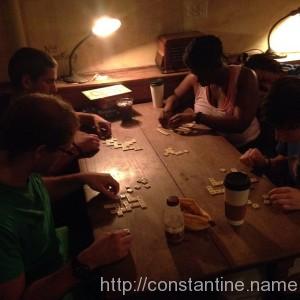
Post-training cafe play at Manny’s in Brooklyn. The Lancaster Parkour post-training chocolate milk tradition continues!
ɕ

Creme Brulee doughnut… waaaaaaaaaaaaaaat. yummy.
ɕ
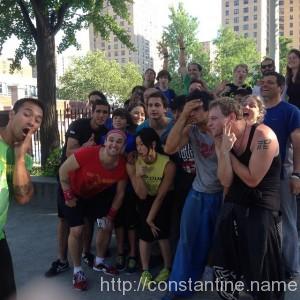
In the bag. What an awesome group of people. Spirit all around…. what heart!!
ɕ
When I left, the search for my replacement took a long time. Much longer than I’d have preferred, and to an eventually unsatisfactory conclusion for everyone involved, I believe. I contented myself with the knowledge that my skill set was sufficiently wide in breadth and complex in nature that I was hard to replace. I used this to buoy my ego. ALthough I had sympathy for the people I was leaving, and the one I left in my stead, it felt good to be needed and wanted, and I was proud that I could fill that role like no one else we’d found.
Such is the folly of the unwise, I’m afraid.
~ Matt Simmons from, «http://www.standalone-sysadmin.com/blog/2013/02/and-when-you-gaze-long-into-an-infrastructure-the-infrastructure-will-gaze-back-into-you/»
Note to self: Hang out with Matt more and listen to what he has to say.
ɕ

NO. SLEEP. ‘TIL BROOKLYN!!!!!!!
ɕ
Growing old sucks.
~ unknown
But it is much better than the alternative.
Elsewhere, this is 4a573. — slipbox
http://www.quietrev.com/manifesto/
Elsewhere, this is 4uquma1. — slipbox
The Quiet Revolution: Have you ever read the book Quiet by Susan Cain? Here’s . . . well, her next project? a companion project? you decide.
ɕ
In each of the situations above, I had sorted myself into a category, or felt like I had been sorted…and then panicked when I didn’t fit or wanted to get out. It turns out, I was the one doing the sorting, not my family or friends. It was pressure I had been putting on myself: I struggled with losing my identity that I THOUGHT I needed to have, that I thought others had of me.
~ Steve Kamb from, Ditch The Sorting Hat. Choose Your Own Adventure!
Elsewhere, this is 4unebo6. — slipbox
ɕ
Art du Déplacement, (a French phrase meaning ‘art of movement’,) is a method of improving oneself through challenge. The founders say that to practice the art means to work toward: Being mentally and physically strong; being useful; being a positive contribution to your community; being better than you were yesterday.
But what about competition, flips, stunts, jumping roof gaps and gymnastics tumbling? …are those things part of it? Certainly, some people do those things as part of their practice. Competition can make you physically stronger. Jumping roof gaps can make you mentally tougher. So these things can be part of your practice, but your practice does not have to be these things.
For me, swallowing my pride and starting over in physical fitness with a group of people about half my age… That was a challenge. For me, pull-ups are a challenge. But that’s the whole point. It’s is about me improving me, and you improving you.
But I didn’t know that when I first tried Parkour, (before I understood the Art du Déplacement roots of what I was learning,) in the spring of 2012. I had met Adam McClellan during a martial arts demonstration and he talked me into coming out to play with the growing Lehigh Valley Parkour community. I am continuously delighted to be the big, old, slow, lumbering gorilla in a community of enthusiastic, supportive and happy people. After two years of serious training, at the age of 42, I passed the ADAPT Level 1 certification through Parkour Generations. Art du Déplacement, Parkour, and this unique community, have changed my life.
ɕ
In college, I briefly practiced Taekwondo, and I spent 5 years practicing, and informally teaching, modern fencing. (Epée!) But I didn’t begin martial arts training in earnest until 1998, at age 26, when I began practicing Aikido under the direction of Sensei Michael Wirth. I practiced non-stop, reaching shodan (1st-degree black belt) in 2003 and godan (5th-degree) in 2013.
Sensei Wirth’s Aikido is an unaffiliated, no-nonsense, art; It is built on the bedrock principles of a soft and flowing Aikido, while honestly seeking to be physically functional and practical. On the mat, his Aikido is soft and flowing; It can vary very quickly from a light touch to vigorous atemi. In more recent years, I’ve repeated catch-phrases such as “No this. No that. No delay.” and “Relax beyond any indication of every injury you’ve ever received.” to convey the idea that you can be your most powerful only when you relax and eliminate all the unnecessary thinking and movements.
In the beginning, I had no clue how unique the Aikido group was that I’d stumbled into. It wasn’t until ten years or so into my journey that I realized the incredible luck of my timing: I started training just young enough to survive the tail-end of what I call Sensei Wirth’s “Does this work?” epoch, and was just old enough to thoroughly appreciate the subsequent, “Yes, it works. What can we do with it?” epoch. Those who experienced the former epoch nod knowingly with a serious expression. Those who experience the later epoch have the luxury of following the now more direct path that Sensei Wirth has arrived upon. The later epoch is certainly better, but the few of us who experienced both are indeed, very lucky.
Along the way, as I’ve wandered (physically and mentally), I’ve taken the opportunities to experience a wide range of Aikido styles, groups and teachers. I’ve gone to fundamentally different Aikido groups’ seminars just to honestly try the “when in Rome…” thing. I also made an honest effort of a couple years in Tai Chi. I expanded my practice by reading from a wide range of topics directly, and indirectly, related to Aikido including philosophy, physiology and spirituality. In fact, I would go so far as to say that I did my best to deconstruct and reassemble everything I’ve learned.
On the other hand, I make no claim to the quality of my reassembled puzzle since some pieces are missing, several are chewed on, and many which don’t fit remain to the side. All things considered? I’m delighted to still feel I am a beginner.
ɕ