This entry is part 22 of 25 in the series M. Eades' Blog
Then I asked myself the big question: If I have too much insulin (and I was guessing I did – it wasn’t something you measured in those days unless you were in a scientific lab), how do I get it down? There were only two conclusions. Don’t eat. Or don’t eat carbohydrates. The latter seemed to make a lot more sense over the long run.
I really hope everyone else finds this totally obvious.
…because I didn’t, and I wasted a lot of my life “should’ing” on myself. I should do this. I should do that. I should be working. I should take time off. blah blah blah. I started saying “No” to little things first… really silly dumb stuff that I did all the time. Like check my email FIRST thing after opening my eyes. Saved myself, maybe, 5 seconds every day right there. Maybe instead now I glance out the window first. Then I moved on to bigger and bigger things; Do I really want to try to start this professional meetup group? Do I really want to continue studying tai chi? Do I want to keep writing in my journal? (Yes, but I can change my expectations for what gets into the journal from, “a good long journal entry for each day,” to “just write a couple of thoughts — literally, two. If more flows, great.”
I’m not trying to soap-box preach, I’m trying to say: Hear! Hear! Go read what Leo has to say.
Old friends pass away, new friends appear. It is just like the days. An old day passes, a new day arrives. The important thing is to make it meaningful: A meaningful friend — or a meaningful day.
This entry is part 21 of 25 in the series M. Eades' Blog
Meat eating made us human. The anthropological evidence strongly supports the idea that the addition of increasingly larger amounts of meat in the diet of our predecessors was essential in the evolution of the large human brain. Our large brains came at the metabolic expense of our guts, which shrank as our brains grew.
This entry is part 21 of 72 in the series My Journey
I’ve been slowly making steady progress on a number of healthy goals. One of them is good ‘ol weight loss.
It is important that I avoid going crazy with snack food. But sometimes I simply get hungry between meals. And most importantly, because I’ve been doing intermittent fasting, it is very important that I have something ready to eat at Noon in cases where a full meal isn’t easy to get. So if I’m driving, or out doing something with friends or family, and Noon rolls around… what are you going to do? I don’t want to be a stick-in-the-mud and demand we stop what we’re doing to have lunch promptly at Noon.
GORP to the rescue!
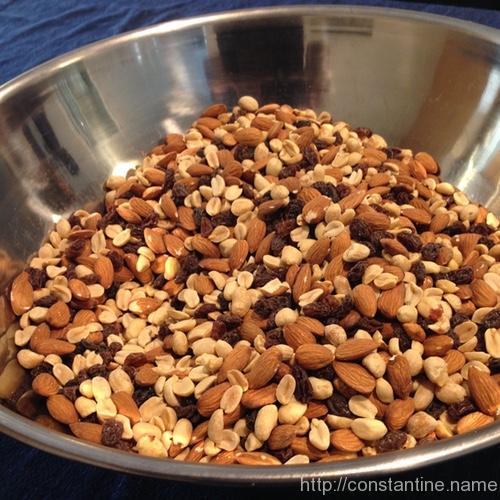
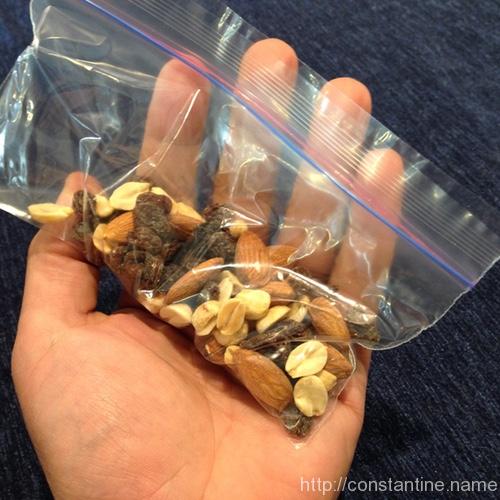
GORP is simply Good Old Raisins and Peanuts. But I particularly like mixing in raw almonds to get the micronutrients, and fat — fat is GOOD for you! Peanuts are not a true nut by the way. So this recipe is just roughly equal part mixture of raisins, peanuts and almonds. (Note, dry roasted unsalted peanuts, raw unsalted almonds.)
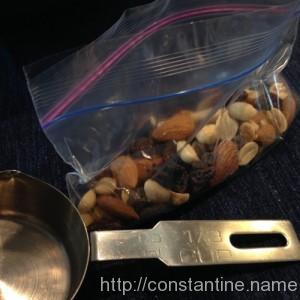
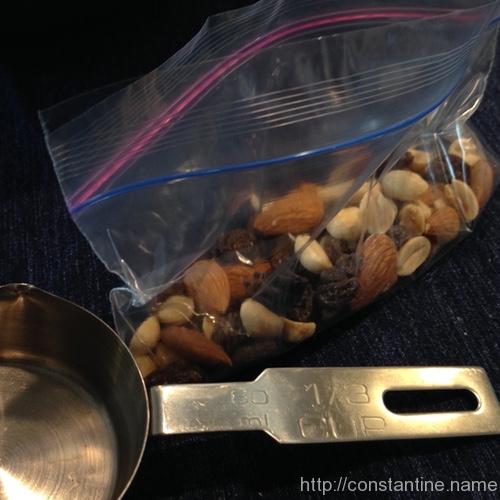
I mix this up in bulk, and measure it out in 1/3 cup servings in small snack size plastic bags. You get about 45 servings out of this batch. The serving size is deliberate: It is about 240 calories; about 22g fat, 19g carbs and 11g protein. So I know I can have one of these with ZERO guilt. They are small enough to fit/carry anywhere, and small enough in calories to have little effect on whatever dieting you may be doing. On the other hand, they are large enough in calories and nutrition that I can easily go a couple hours before getting hungry again for a meal.
Update May 2016
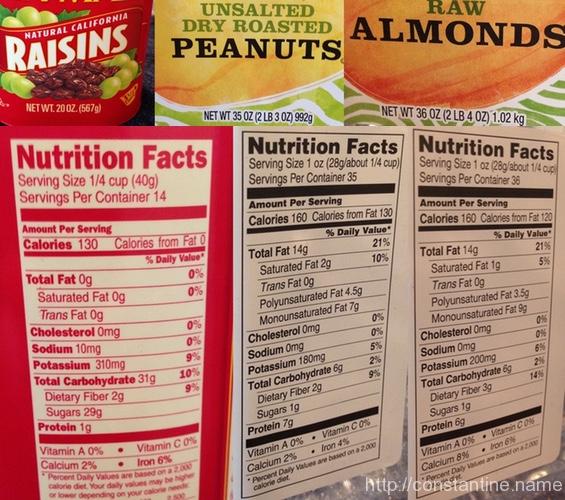
There are two things to notice.
The nutrition info I’ve given comes NOT from the “serving size” info on the containers. Instead, I extrapolated to get the nutritional data for the entire container and then divided by the number of 1/3-cup servings I make out of the entire mix.
240 calories is a surprisingly small handful of this stuff. Every time I eat one of these, I think, “I’m hungrier than this size… but ok I’ll start with this.” Then, an hour later I’m like, “I fell for it again… 240 calories was enough.”
This entry is part 20 of 72 in the series My Journey
Instead of berating yourself when you’re not motivated to exercise, or getting mad at yourself when you struggle with eating unhealthy food, take a step back and look at it from a different angle:
“How can you build the habit of success and put your focus there, instead of chasing the motivation to make it happen?
It’s easy to become ensnared – to chase motivation and fail – or rationalize inaction and never try. Every single one of us has fallen into this trap. I’d love to hear about your experience with this, and how you plan to (or already have) overcome it.
In a vague sort of way, I found this idea in my own training. As usual, Steve Kamb brings clarity to the party. This idea of incremental actions, of habits, and little processes that make success a foregone conclusion is at the core of my Parkour training.
… demand doesn’t pick up quickly as prices drop. We are dealing with a world that has a huge amount of debt. China in particular has been on a debt binge that cannot continue at the same pace. A reduction in China’s debt, or even slower growth in its debt, reduces growth in the demand for oil, and thus its price. The same situation holds for other countries that are now saturated with debt, and trying to come closer to balancing their budgets.
I have now discussed this a few times, and a common objection raised is that she is over-complicating a simple case of supply-and-demand. To which I say: What part of our enormous, intertwined, legacy, critical to everything from food to medicine to transportation to energy production, global dependency on petroleum is simple?