Photos from a visit to a Butterfly Conservatory near Niagara Falls, Canada.


ɕ

Within the team that creates the Movers Mindset podcast, we assign numbers to our projects. We use “R42” for our 42nd recording project, then R43, and so on. This enables us to start naming things from day one, in a way that we don’t have to change later. If you’re putting your files in a folder, what would you name it, that you could be sure wouldn’t change?
We also use our podcast’s initials on file names, “MM.” When we see files whose name contains, MM-R42… we know what it belongs too. It’s part of the Recording-42 project for Movers Mindset.
We also exclusively use people’s family names on files. So a raw WAV file from an interview is 20200423-MM-SMITH-TR1.wav … April 23, 2020 recording for Movers Mindset, of someone named “Smith”, and this is track one [a recording from one microphone.] 20200423-MM-SMITH-TR2.wav is track two, and so on. No matter where you toss that file, it’s going to make sense.
Eventually, a recording project might lead to one (or more!) episodes of our podcast. They get assigned episode numbers, EP56, EP57, etc. Then we have filenames like MM-EP57… and it’s always clear what that is.
Sometimes we have a dozen files to keep track of in a podcast episode and we end up with20200423-MM-SMITH-TR1.wav20200423-MM-SMITH-TR2.wavMM-EP56-INTRO.wav (introduction recorded after interview)MM-EP56-OUTRO.wav (outro recorded in post production)MM-GCORD.wav (a little music ‘button’ used when joining bits of interview)
…the final episode is then MM-EP56-SMITH.mp3
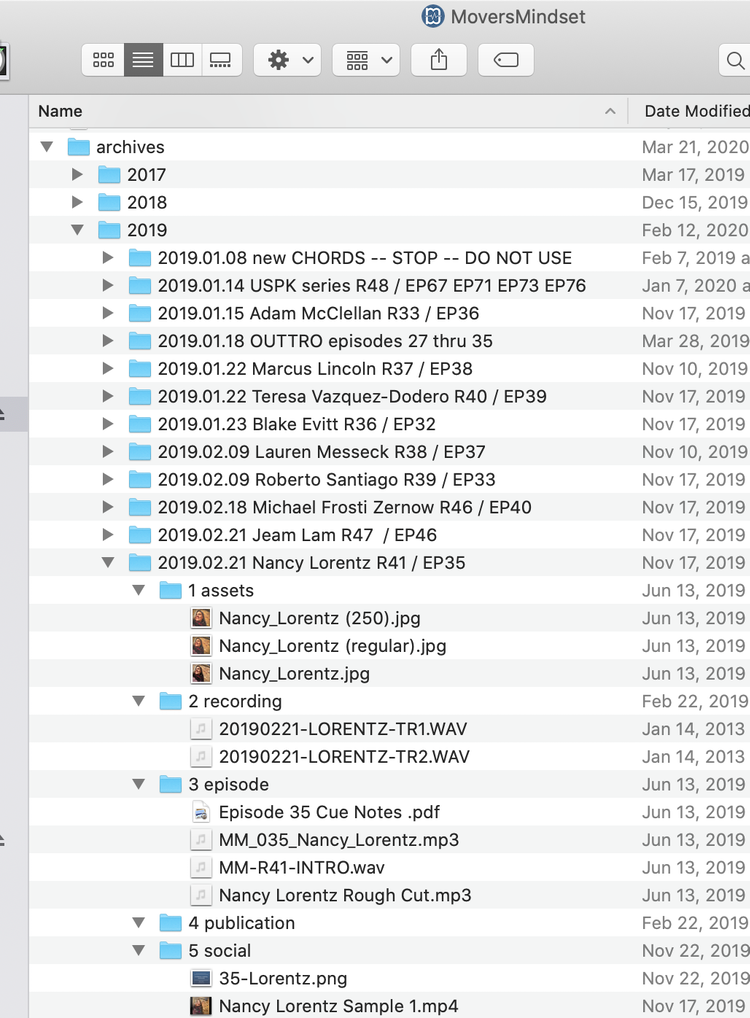
Since I’ve typed this much, here’s another thing we do: We use consistently numbered folders to store the files. Every project has a folder, 2020.04.23 Bob Smith R42/EP56 — we create 2020.04.23 Bob Smith R42 in our archives when we do the raw recording, and at the very end we add the /EP56 to make it easier to find things. In side each project we create five folders 1 assets, 2 recording, 3 episode, 4 publication, and 5 social — the leading number ensure they sort in nice order in various displays. 1 contains anything the guest gives us (photos, writing) or any photos we take during recording. 2 is the raw original recordings, 3 is everything to make a podcast episode (intro, outro, whatever we have to assemble, AND the finished MP3), 4 is anything we create as part of publishing the episode (transcript, articles, highlights ) and 5 is anything that’s ok for social media and sharing. And then we have a multi-terabyte file server with a “few” files on it:
ɕ
It is not so much what you are doing as how you are doing it. When we properly understand and live by this principle, while difficulties will arise—for they are part of the divine order too—inner peace will still be possible.
~ Epictetus
slip:4a167.
Ever since I first read these words, they stuck with me as useful for understanding the working world in particular. The whole edifice that we now call “productivity advice” distills, I realized, to instructions for cajoling the elephant. If you’re not firm, it’ll do what it wants to do.
~ Cal Newport from, Deep Habits: Never Plan to “Get Some Work Done” – Cal Newport
slip:4ucabo3.
Plan? Do? Chaos? I get so swept up in systems that sometimes I just bridle and rebel. I think the problem comes up when I have too many systems that don’t have an end goal. My systems are supposed to make the space for me to get real things done. But if all I have is ongoing systems of the busy-work that’s supposed to make space, then I rebel. Because I also need real projects. I want to spend as much of my time as possible getting real things done. Real things for which I have real reasons for wanting to do them. And those real things require real planning.
Generally, I don’t have a problem with over-planning; I can do a tremendous amount of planning, but experience shows that I always do better if I resist the urge to begin… start now! Take action! It’s always better if I resist action, instead doing a brain-dump session and then setting the whole thing aside. When I return later, more ideas flow and more planning ensues. Maybe a third session. Maybe even a fourth.
Meanwhile, the elephant dozes as I plan surreptitiously.
Ever notice that the “doze” in bulldozer is the exact opposite of the elephant’s? Eventually, the planning reveals a beautiful domino setup, and it’s time to awaken the elephant who easily bulldozes them one by one.
ɕ
On Castbox.fm — Adam McClellan | Know Your Numbers
How can Parkour business owners use financial data to better understand and grow their businesses?
Many business owners are unaware of their financial health until they see the gaps in their numbers.
Businesses want to be successful, but you don’t know what success is, if you didn’t set some kind of goal in the first place.
~ Adam McClellan (7:31)
The conversation focuses on the importance of understanding and tracking financial data for running and growing a Parkour business. It emphasizes that many business owners overlook key financial indicators, which leads to uncertainty and poor decision-making. A major theme is that budgeting, like the rules of a game, provides structure and clarity, enabling better goal-setting and resource allocation.
The discussion explores practical steps such as tracking income and expenses, creating performance indicators, and comparing data year-over-year to identify trends. The value of making assumptions, trusting them, and consistently testing them against actual data is highlighted as essential for success. The conversation also underscores the psychological benefit of financial clarity, helping owners make confident decisions about hiring, marketing, and expanding.
Takeaways
Budgeting as structure — A budget is necessary to define goals and measure progress in business.
Tracking key indicators — Key performance indicators help measure and improve critical business processes.
Assumptions in decision-making — Assumptions, when tracked and adjusted regularly, are essential for planning.
Growth as a challenge — Businesses should set achievable but slightly challenging growth goals to stay competitive.
Confidence through clarity — Knowing financial numbers provides confidence when making hiring and expansion decisions.
Empty space for growth — Unstructured time at events can lead to organic, valuable connections and ideas.
Resources
Lehigh Valley Parkour — Adam McClellan’s Parkour business website.
Parkour Generations Americas — Organization involved in Parkour education and leadership.
Art of Retreat — Event for Parkour professionals focused on leadership and education.
(Written with help from Chat-GPT.)
ɕ
The full definition of leadership that Badaracco gradually unfolds through literature in the course is: “Leadership is a struggle by flawed human beings to make some important human values real and effective in the world as it is.”
~ Martha Lagace from, Machiavelli, Morals, and You | Working Knowledge
slip:4uheie1.
I’ve mentioned bias to action previously, but I don’t recall having every connected it to one of Machiavelli’s best-known quotes, that fortune favors the bold. (Click through for more context.) Here I’m struck by Badaracco’s choice of, “effective,” as a critical feature of leadership. Certainly without action, there can be no efficacy. (And, yes, using my words totally counts as action, thank you.) Leaders are by definition out in front. That means acting first, and that presumes being capable of acting. If my bias is towards inaction, (gather more data, think about it more, however you want to mince those words,) I cannot be a good leader.
ɕ
How can diverse physical practices and creative disciplines inform and enhance each other to foster personal growth and adaptability?
Any mind hell-bent on problem solving inevitably seeks challenge. Thea Rae discusses many things, including her movement background, coding, and stunt work. She unpacks the connections between her art, movement, aerial circus, and programming. Thea explains her varied interests: stunts, circus, cycling, climbing, and ice skating, and why cross training is so important to her practice.
Movement is also a language to me. Just as much as we can communicate with words, we can also communicate with our bodies and we can say so much.
~ Thea Rae
Thea Rae discusses her multifaceted journey through movement arts, creative technology, and life, emphasizing the significance of cross-training in her personal and professional development. She reflects on how disciplines like gymnastics, aerial arts, and ice skating have shaped her understanding of physicality and creativity. Her experience with rock climbing has also been pivotal in teaching her how to remain calm and adapt to challenging situations.
In addition to physical movement, Thea digs into her artistic pursuits, including kinetic sculpture and interactive installations. She explains the parallels between her programming and movement practices, highlighting the problem-solving mindset that underpins both. Throughout, she underscores the value of viewing movement as a language and a means of communication, shaping her approach to teaching, performing, and everyday life.
Takeaways
Movement as a language — Physical movement can communicate as much as words, offering nuanced expressions of thought and emotion.
Cross-training benefits — Engaging in varied physical practices enriches skills across disciplines and fosters adaptability.
The interplay of art and movement — Artistic and physical pursuits inform and enhance each other, creating a holistic creative process.
Resilience through rock climbing — Climbing teaches problem-solving, calmness, and persistence in the face of physical challenges.
Ice skating’s impact — Ice skating has improved Thea’s balance, core stability, and understanding of subtle movements.
Rehab and pre-hab importance — Maintaining physical health requires intentional rehabilitation and preventative exercises to stay active.
Creative problem-solving — Both programming and movement rely on structured thinking and the ability to adapt to complex situations.
Resources
New England Center for Circus Arts — A school where Thea studied aerial silks and acrobatics.
Brooklyn Zoo — A parkour gym where Thea began exploring movement in New York City.
Motiv NY — A physical therapy center that has assisted Thea with movement optimization and injury recovery.
Wonderfruit Festival — A music festival in Thailand where Thea built interactive installations.
(Written with help from Chat-GPT.)
ɕ
It’s important to be aware of our own crystallizing experiences and how they affected us. I’m curious about what crystalizing experiences you’ve had, and I’m thinking beyond just moments, to books, people, videos, discussions, whatever left an impact. What stuck with you and changed the way you thought about things? This could be in any area of your life: work, learning, movement, writing, any hobby. What was the experience, and how did it change your practice?
~ Melissa Way
The Movers Mindset team has an internal project management system. (Basecamp.com in case you’re still mysteriously using something dysfunctional, like Slack, to run your team.) Each week, in a sort of loose rotation, we take turns kicking off some discussion by posting something—anything, whatever interests us when it’s our turn.
I’ve been coming back to this post from Melissa for nearly two weeks, trying to figure out where to start on a reply. Each time I start thinking, my mind wanders down a seemingly endless sequence of formative experiences; I can’t even begin to list them as they’d sound like an intolerable bragging-list. There are some unbelievable experiences ranging from, “been there,” to “done that,” and careening between, “literally cheated death,” and “hfsyesagainplease.”
Instead of trying to pick just one, tell the story, and pull out how the experience changed me, I’m going to ask, and attempt to answer, a meta question: Is life a journey of becoming, or simply a journey?
If it’s the former, then I should be paying attention for—perhaps even actively seeking—crystallizing experiences my entire life. I should be continuously repeating the process of asking myself what I should change or improve next, and then seeking out the experiences or knowledge to achieve that change. But having bashed myself on that cold anvil, incessantly seeking change and improvement, I’m now convinced that it’s the later.
Life is simply a journey.
ɕ
There is a Clock ringing deep inside a mountain. It is a huge Clock, hundreds of feet tall, designed to tick for 10,000 years. Every once in a while the bells of this buried Clock play a melody. Each time the chimes ring, it’s a melody the Clock has never played before. The Clock’s chimes have been programmed to not repeat themselves for 10,000 years.
~ Kevin Kelly from, The Clock of the Long Now – Long Now
slip:4uloco1.
The Long Now Foundation was started in 01996. They always include the leading zero in years as just another subtle way to get one to think long-term. I can’t say for sure that I’ve been following them since they started, but it’s got to be darn close. I will be going to Texas, (and to Nevada if I live long enough to see the second clock built,) to visit.
The 10,000-year clock is just one project. Grab your favorite beverage, put your phone on do-not-disturb and go spend an hour or so reading what the Long Now Foundation is up to.
ɕ
There is no question that apps are here to stay, and are a superior interaction model for some uses. But the web is like water: it fills in all the gaps between things like gaming and social with exactly what any one particular user wants. And while we all might have a use for Facebook – simply because everyone is there – we all have different things that interest us when it comes to reading.
~ Ben Thompson from, Why the Web Still Matters – Stratechery by Ben Thompson
slip:4usawe1.
That’s from 2014, and holds up pretty well I think. That the web, “fills in all the gaps,” is insightful. Sure, the technology that defines “the Web” drives an enormous amount of stuff other than written content. But even just the smaller portion that is the written word is a huge swath of time and attention. That speaks well for us in the aggregate.
I still believe that the problem, currently, is simply that people rarely bother to figure out how things actually work. People don’t tinker and change things. Once someone gets the bug of curiosity, it’s a slippery slope from poking and prodding, to tinkering and experimenting, to building and creating; It’s a slippery slope lined entirely with reading.
ɕ