Open Graph and oneboxing

This is a standardized way to present a preview of a URL. Instead of just showing a URL, like this:

https://en.wikipedia.org/wiki/Dwight_D._Eisenhower

It can be presented as a “onebox,” like this:
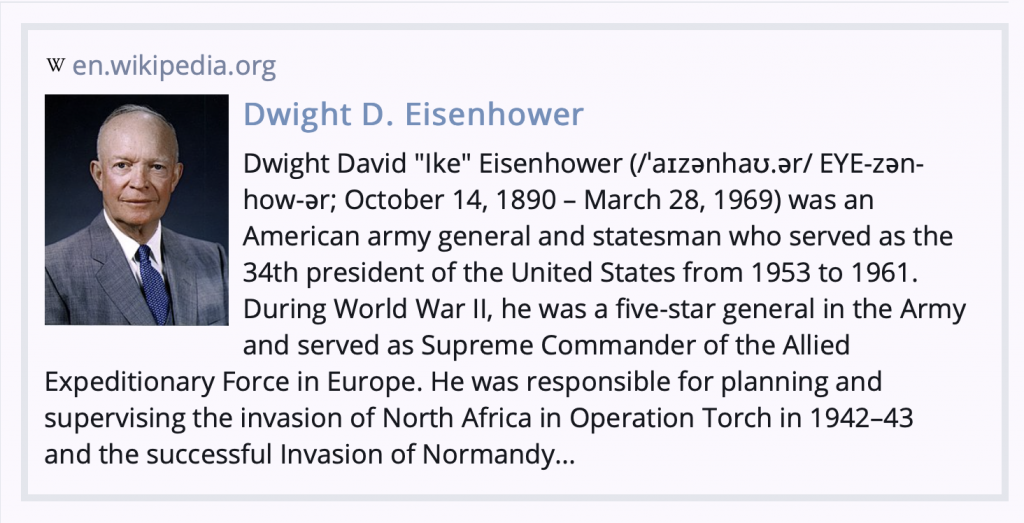
That’s just a screenshot from a system which is able to do oneboxing. The magic is that when editing, (wherever you are editing,) you simply paste in a raw URL and the oneboxing is done automatically by the system.

What wizardry is this?

It’s based on the Open Graph Protocol (OG). Facebook started this as a way to get sites on the open web to provide software-understandable, summary information. It took off everywhere because it’s just downright awesome.

A web site includes information stuffed out of sight, in the source HTML of the page. Software can fetch the URL, notice the OG information and craft a meaningful summary. This grew into the idea of presenting a single box summary—”one boxing”—of a URL if it has OG information.

Testing it

When something doesn’t onebox as you expect, how would you figure out which end has the problem? (Was it the end serving the URL content that doesn’t have OG data? Or is the end fetching the URL that couldn’t parse the OG data?) So someone wrote a handy tool that lets you see what (if any) OG data there is at any URL you want to type in:

http://debug.iframely.com/

ɕ


You don’t deserve happiness

Happiness isn’t something that is deserved or earned from something outside yourself. Happiness is created within yourself. And it’s created by the simple and constant choice to accept what is. To look at the pain in the face and not blink. To confront one’s fears and struggles and embrace them rather than fight them.

~ Mark Manson from, 5 Simple Ideas That Can Change Your Life

slip:4umava1.

Manson has written a number of articles that feel like the fist from the adage: “Everyone has a plan until they get punched in the face.” (~ Mike Tyson)

ɕ


The way we communicate

So, don’t feel bad about procrastinating when you need to write—humanity put the whole thing off for a couple hundred thousand years! By a conservative estimate, we’ve had writing for about 4% of the time we’ve been human. Chatting is easy; writing is an arduous chore.

~ Erika Hall from, Conversational Design – A List Apart

slip:4uaiai1.

The more time I spend texting—in all its various forms—the more I’m growing to understand the allure of the mode of communication. I’m a digital immigrant, born far enough before cellular, wifi and the Internet in general… or at least the publicly accessible one. Anyway. As an immigrant, I’ve always found the written form—email, forum, message boards, etc.—the easy form of communication, and the ephemeral “texting” the more challenging. Like anything else I suppose, the more you use it, the more you become accustomed to it. I’d say I’m a solid C+ at texting these days. The digital natives can spot me in 10 seconds. But I’ve learned to appreciate the medium.

After reading this piece from Hall, I’m shifting my opinion: I used to think it was, in descending utility, spoken word, written word, and then texting. But now I’m thinking texting slots in as better than the static written word precisely because it’s a form of two-way communication. When I write… *ahem* I get to spend all the time I want, preparing this salvo of characters to be launched at you. *tap* *tap* Hello? Is this on? …yes? Okay, now I can broadcast at you on and on and on and on and on until your eyes glass over and you stop reading. On the other hand, texting requires me to interact with you, not quite in real time, but it’s an interactive conversation.

Hey there! havent talked in ages!!! :D Wats up??

ɕ


Grape Vine Beetle

When insects are big enough that they have facial expressions…

ɕ


Success

To win the lotto, you need a miracle. To be successful, you need hard work. More people are playin’ the lotto than working hard.

~ Eric Thomas

slip:4a117.


Bad taste

Saying that taste is just personal preference is a good way to prevent disputes. The trouble is, it’s not true. You feel this when you start to design things.

~ Paul Graham from, Taste for Makers

slip:4upata1.

I’m not certain about “good” taste. I’m not convinced that there’s an objectively good measure of, well, good taste. I think too much of what some would say is “good,” is actually rooted in the current culture.

But I feel comfortable saying that there is such a thing as bad taste. There are clear reasons, for which one can present a clear case, why things are gauche. There’re clear situations and choices that are in bad taste. Mind you, I can readily imagine art which is intentionally in bad taste; that’s a good thing because art’s purpose is (sometimes) to push the envelope or to change society and culture. But in general, bad taste exists.

ɕ


Justin Taylor | How to Find, Hire, Train, Retain, and Fire Coaches and Staff

On Castbox.fm — Justin Taylor | How to Find, Hire, Train, Retain, and Fire Coaches and Staff

How can a growing gym effectively hire, train, retain, and manage staff to sustain long-term success and positive culture?

Developing a team culture strong enough to survive rapid growth requires meticulous planning and personal leadership.

[L]ead by example. Right? So that’s number one. I cannot ask somebody on my staff to do something that I’m not willing to do.

~ Justin Taylor (8:18)

The conversation covers the journey of expanding a gym business from a small operation into multiple locations with large staff. Topics include managing rapid growth, hiring processes, and establishing standard operating procedures to ensure consistency.

Cultural development is emphasized as key to long-term staff retention and gym atmosphere. The importance of leading by example and fostering a sense of community within the staff is highlighted. Personal experiences with hiring missteps and lessons from managing team dynamics illustrate the complexities of gym leadership.

Takeaways

Hiring process — A structured hiring process with standardized steps is essential to avoid legal issues and ensure consistent results.

Staff retention — Retaining staff requires creating a positive culture and treating employees as part of a community or family.

Cultural leadership — Leaders must lead by example, modeling the behavior they expect from their staff.

Scaling challenges — Rapid expansion introduces difficulties in maintaining organizational culture, requiring careful management and strategic onboarding.

Training systems — Developing standard operating procedures helps ensure new staff are trained consistently and effectively.

Personal responsibility — Business owners are ultimately responsible for the livelihood and well-being of their staff, reinforcing the need for careful leadership decisions.

Resources

Parkour Professor — A resource created by Justin Taylor offering mentorship and resources for gym owners.

Firestorm Freerunning — Justin Taylor’s gym brand encompassing multiple locations.

Movement United Gym — A gym in Michigan partnered with Justin Taylor for mentorship and operational support.

(Written with help from Chat-GPT.)

ɕ


Rabbit holes

Draw Antonio, draw Antonio, draw and don’t waste time.

~ Michelangelo

Yes, I do spend a lot of time chasing white rabbits down rabbit holes.

I cannot tell if that’s because diversity of experience and exploration is central to what it means to flourish as a human being, or if I’m simply the type of person for which that is true. Which case it is doesn’t really matter since I can only deeply relate to my personal experience of being. (Recall, I’m not trying to accomplish ‘change the world’ with this blog; Rather, I’m working on self-reflection here.)

Today, an example of a rabbit hole: I have a way of reading entire web sites, one page at a time—software that keeps track of an entire web site and feeds me “the next thing” to read each day. (Aside: If you want to pay to make this a commercial product, let me know.) Today a post from some author (I’m ommiting names) came up that referenced another author’s book which quotes Michelangelo… and it only took me a few minutes to dig around the internet to figure out the quote is correct (albeit translated from Italian) and the original source is in the British Museum. Note to self: See if I can find it next time I’m there. Along the way I found a few interesting things which I shared with some friends. Along the way I learned several new things.

Along the way.

ɕ


All of humanity’s accrued knowledge

As I elaborated in last week’s episode of my podcast, Neil Postman argues that it was the introduction of mass-produced longform writing that really unleashed human potential — ushering in the modes of critical, analytical understanding that birthed both the enlightenment and the scientific revolution, the foundations of modernity. It allowed us to efficiently capture complex thought in all its nuance, then build on it, layer after layer, nudging forward human intellectual endeavor.

~ Cal Newport from, On the Exceptionalism of Books in an Age of Tweets – Cal Newport

slip:4ucabo2.

I’ve often ranted against lack of attention-span, and wasted time. But Newport, and in particular some things he’s quoting and talking about from another article, make the point that all of human history is encoded in written form. Why is that so? Because it works, and it works really well.

There is a place for visual and auditory information, of course. Those tools of communication are power tools compared to writing—well, almost all writing. As I’ve said many times here though: One can have the power tools after demonstrating mastery with the manual hand-tools.

ɕ


Anti-productive

These distractions aren’t just unproductive, they’re anti-productive. They create more work than they replace.

~ Mark Manson from, The Attention Diet

slip:4umaae1.

I wish I had learned much sooner the idea that distractions aren’t just wasting the time spent on the distraction, but are in fact decreasing the value of the time I do try to spend on anything focused and productive. Alas, it took me decades of experimenting to deeply understand it for myself before I could truly learn the lesson. Manson’s article is, as usual, irreverent and explicit—but it has some terrific points in it about how to go about crafting an attention “diet” to take back your mind.

My mind does need a lot of down-time and relaxation. But none of that looks like distraction. I deeply love sitting down to some great science-fiction movie with popcorn. I also deeply love me some burly physical work where my mind can press the “body: do things” button and then wander out of the control room for a snooze on the terrace. (I imagine Homer Simpson’s sipping-bird left in the control room; but mine’s pressing the, “continue hard labor,” button rather than his nuclear reactor alarm reset.)

ɕ