Solitude is not a condition of the body. Instead, it is a condition of the mind. Solitude may be found in the busy market, or may be elusive in the forest.
~ Wu Hsin
slip:4a319.
Solitude is not a condition of the body. Instead, it is a condition of the mind. Solitude may be found in the busy market, or may be elusive in the forest.
~ Wu Hsin
slip:4a319.
In the most general sense, productivity is about navigating from a large constellation of possible things you could be doing to the actual execution of a much smaller number of things each day.
~ Cal Newport from, The Productivity Funnel – Cal Newport
slip:4ucabo1.
A decade ago, I was swamped by the sheer number things I could possibly do each day. In one sense, that’s a good problem to have. But good or bad problem, “swamped” and “drowning” are adjacent. I’d committed myself to far too many things. Large swaths of those “possible things” every day came with emotional baggage, and often with the self-imposed weight of “should.” And so I worked on that and eliminated all the negative things.
Unfortunately, selecting what to tackle each day remains just as challenging. I’ve a habit of creating a “page for today” that I scribble on early in the morning. As the day progresses, I cross things off, jot down notes, scribble things which I need to add to my other systems, etc.. Over the years, I’ve used various bits of random paper; for a time, I was using the back-side of all the printer paper from the recycle bin. I’ve used spiral notebooks, tablets, and even a custom spreadsheet, (which I printed on 8.5×11 paper and cut in half to make my own table of half-sheet daily schedule/grid.)
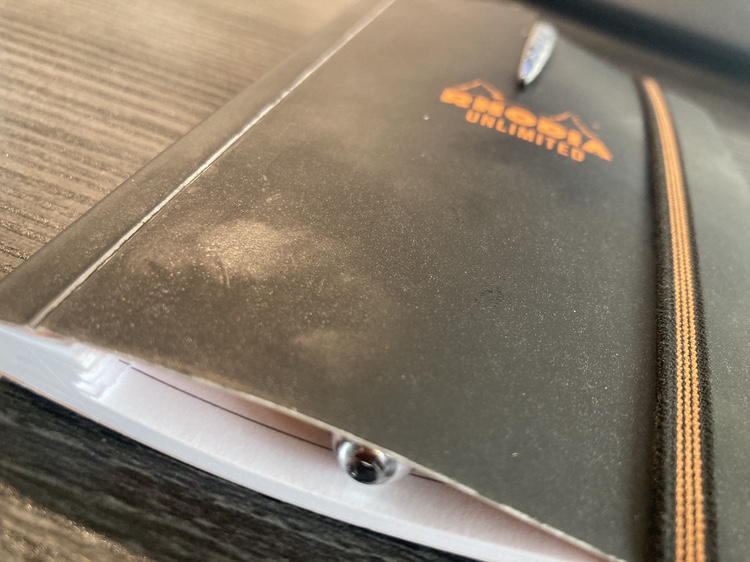
Recently, I realized that the size of the paper I was using was getting progressively smaller. I’m currently using a 3×5-size of Rhodia notebook. (These, if you’re interested. Durable, great paper, and, critically, every page is micro-perforated so I can tear out each day to start fresh the next day.) The sublime recipe of page size, line space, handwriting style and hours in the day goes a long way to keep my selection of what to do tending towards the possible. Whether the sheet for today feels cramped or airy is a good indication of what I’m setting myself up for.
And to be clear, I don’t plan every day into this little book early each morning. On the days when I’ve something big planned—a day trip to the beach, a long weekend away—I throw all structure to the wind. But most days I do.
ɕ
What role does movement, particularly parkour, play in fostering personal growth, connection, and creativity?
Playing tag on national television was never something Mike Araujo imagined when he started training parkour. He discusses his path in parkour and the opportunities he’s gained from it. Mike shares his experiences with World Chase Tag, and his thoughts on competition. He explains his personal definition of parkour, sharing it with others, and his thoughts on how the community has changed.
Everyone needs to find the thing that moves them to move. Whether that be parkour or whatever other sport. I think as long as you’re moving and connecting with people and your environment then you’re on the right path.
~ Mike Araujo (7:07)
Mike Araujo is an athlete and head coach with the Movement Creative. He has trained parkour in NYC for over a decade, and coached nearly as long. Mike often travels for parkour, and recently competed in World Chase Tag’s first USA based event.
The conversation explores the transformative power of parkour as a practice that transcends physical movement. Parkour serves as a medium for personal growth, offering opportunities to connect with one’s body and environment intentionally. The practice is presented as adaptable, requiring no specific equipment or space, which makes it accessible to anyone seeking a meaningful connection with movement.
The discussion also examines parkour’s evolving culture, from intimate, small gatherings to large-scale global events. Topics include the impact of structured competitions like World Chase Tag, the community’s adaptation during the pandemic, and the balance between maintaining the sport’s original spirit while embracing its growth. Reflections on coaching and transitions in life highlight the importance of aligning passion with action, even when faced with uncertainty.
Takeaways
Movement as nourishment — Physical activity is essential for mental and physical well-being.
The intention behind practice — The focus should be on personal growth and meaningful connection, not just the movements themselves.
Accessibility of parkour — As a discipline, it requires minimal resources and emphasizes adaptability.
Coaching philosophies — Evolving as a coach means shifting from making others love the discipline to helping them find their own path.
Parkour and community — The growth of events and gatherings showcases how parkour fosters connections among practitioners worldwide.
Competitions and novelty — Events like World Chase Tag add new dimensions to training, blending creativity and structured athleticism.
Resources
The Movement Creative — Parkour coaching and event organization company.
World Chase Tag — Competitive tag event blending parkour with high-speed athleticism.
Jump London — A documentary showcasing the origins of parkour.
Max Henry @maxhenryparkour — Parkour athlete and author known for his innovative approach to movement.
(Written with help from Chat-GPT.)
ɕ
How does the concept of offering a platform influence the selection of guests and the dynamics of conversations in podcasting?
The process of creating meaningful conversations involves balancing guest selection with the organic nature of dialogue.
I feel there’s a responsibility to seek out people who don’t have so much of a platform, and who have good things to say, and give them a space to say it and get that out in the world.
~ Melissa Way (3:05)
The conversation explores the intricacies of offering a platform through podcasting, particularly focusing on the responsibility and power it entails. The discussion examines how guest selection is guided by values and ethos, such as avoiding topics like diet culture while amplifying insightful voices. Emphasis is placed on providing a space for lesser-known individuals who possess valuable perspectives to share.
Another central theme revolves around the organic nature of conversations and how they often reveal unexpected insights. Guests frequently surprise themselves with the depth and relevance of their contributions. The dialogue also touches on the balance between preparation and spontaneity, highlighting how meaningful connections emerge through a combination of intentionality and adaptability.
Takeaways
A platform’s power — It amplifies voices and carries the responsibility to ensure content aligns with ethical standards.
Guest selection — It reflects the host’s ethos and values, influencing the broader impact of the podcast.
Creating space — Fostering an environment where guests feel comfortable leads to deeper, more meaningful conversations.
Balancing structure and spontaneity — Preparation aids in focus, while adaptability ensures authenticity in interactions.
Highlighting unheard voices — Offering a platform to those with limited exposure brings fresh, valuable perspectives to light.
Resources
Melissa Way — Artist. Mover. Explorer.
Movers Mindset Podcast — A podcast focusing on the interplay between movement and personal growth.
Open + Curious — A related project exploring themes of curiosity and reflection.
(Written with help from Chat-GPT.)
ɕ
How can skills and tools from podcasting be applied innovatively in professional practices, such as orthodontics, to improve outcomes and creativity?
Exploring the intersection of dental innovation and audio technology for patient care.
There are these occasional little sort of strands that bring them together. But in a way, what I quite like with the podcasting is to keep it separate, because what it is for me is, it’s this regular creative thing that I’m under pressure to produce.
~ Rob Slater (18:44)
The conversation explores the intersection of creative podcasting practices and professional orthodontic work, specifically how Rob applies podcasting tools and techniques to benefit his patients. He discusses using audio analysis software like Audacity to monitor the impact of orthodontic treatments on musicians, particularly those who play brass instruments. He describes innovative approaches, such as using aligner systems that allow for reversible adjustments, accommodating the unique needs of musicians and minimizing risks.
The discussion also highlights the broader influence of creative endeavors like podcasting on professional work. Rob notes how the regular creative demands of podcasting stimulate his imagination, even shaping how he approaches professional challenges. The dialogue touches on balancing innovation with safety in a medical context and the potential of niche specializations to enrich professional practices.
Takeaways
Using aligner systems — Allows for reversible orthodontic adjustments tailored to patient needs.
Leveraging audio software — Employing tools like Audacity to analyze the impact of dental treatments on musicians.
Balancing innovation and safety — Ensuring medical creativity aligns with professional standards and patient safety.
Interdisciplinary inspiration — How podcasting influences problem-solving and creativity in professional contexts.
Niche specialization opportunities — Developing expertise in addressing specific challenges for musicians.
Resources
Dad Sofa — Rob’s podcast where he talks about the stuff of life, what makes us curious, what connects us.
Audacity — Audio software used to visualize and analyze sound quality during orthodontic treatments.
(Written with help from Chat-GPT.)
ɕ
While the software has been an essential tool for productivity, learning, and social interaction, something about being on videoconference all day seems particularly exhausting, and the term “Zoom Fatigue” caught on quickly. In this article, I focus on nonverbal overload as a potential cause for fatigue, and provide four arguments outlining how various aspects of the current Zoom interface likely lead to psychological consequences.
~ Jeremy N. Bailenson from, Nonverbal Overload: A Theoretical Argument for the Causes of Zoom Fatigue · Volume 2, Issue 1
slip:4uaapu1.
This is more science-y than usual for this ‘ol blog. That’s a link to a journal article, (albeit not a peer-reviewed, “real” Journal-with-a-capital-J,) which presents an actual theory about “Zoom fatigue.” We all know it’s real, but why?
There are four parts to the theory. But the one that jumped out as glaringly obvious once I’d read it is about personal space. The distance around oneself within which another person’s presence begins to feel intimate varies among cultures. Americans like a goodly full arm’s length, and—my personal experience and opinion here—Europeans are cool with noticeably less. Regardless of the specifics, if people are in your personal space, that gets tiresome. Not “omg this is lame” tiresome, but physically tiring. (That’s apparently settled psychology and science.) Guess what? It seems the apparent size of the people on your screen triggers our brain’s perception of “how close is this person?”
ɕ
What their minds are like. What they work at. What evokes their love and admiration. Imagine their souls stripped bare. And their vanity. To suppose that their disdain could harm anyone—or their praise help them.
~ Marcus Aurelius
slip:4a473.
This last one is my favorite. Start on one leg or tandem stance and begin to look far into the distance about 100 meters. While staring at one spot far in the distance start to take notice of everything in your peripheral vision. Call out what you see, but do not move your gaze.
~ Emily Splichal from, Balance & the Basal Ganglia | The Power of Eye Movement Exercises – Barefoot Strong Blog
slip:4ubaba1.
Frequently, I perambulate through the enormous amounts of information I’ve bookmarked—in every sense of that word. Often I read things which cause me to discover some new thread of thinking. But just as often I find things that simply make me go, “hmm, that’s interesting.” So tomorrow I think I’ll assemble some pipe scaffolding to make something upon which to balance, simply so I can try this exercise.
ɕ
Information competes for our conscious attention: the web of thoughts with the greatest activation is usually the one where we direct our attention. The calmer our mind, the fewer thoughts we generate in response to what happens in the world—and the greater the odds that intuition will speak to us.
~ Chris Bailey from, The science of how to get intuition to speak to you – Chris Bailey
slip:4uaite1.
I’m not sure if I truly remember the following story, or if I simply heard it told so many times and subsequently retold it so many times that I believe I saw it first hand, but here it is in first person regardless.
Sitting in an enormous church service early one morning, two parents down front where having increasing difficulty with a precocious young child. With each noise, question, request, and pew kicking, the parents were taking turns playing the, “If you don’t be quiet…” game. The massive church was known by all to have a well-appointed “cry room” at the back complete with a view of the proceedings, amplified reproduction of the goings on, double-pane and mostly scream proof windows, games, rocking chairs and so forth. Meanwhile, in the main hall, everyone could hear the “if you don’t be quiet…” game escalate to defcon 5: “If you don’t be quiet, I’m taking you to the cry room.” The opposing forces countered with a volley of indignation at being forced to… “That’s it!” And the patriarch hoisted the youngster and performed the mandatory “excuse me pardon me excuse me…” incantation across the pew, and started up the aisle with a writhing 3-year-old in Sunday’s best. From the moment of hoisting, the winding-up siren of shock and horror got up to speed until said child was screaming. “I’LL BE QUIET! I’LL BE QUIET!!” The minister had paused, as the father strode briskly for the doors at the back. Hundreds of people sat silently as they passed through rear doors—the child’s screaming dropping instantly in volume as the door swung shut. “I’LL BE QUIET! I’LL BE QUIET! …i’ll be quiet!” At which point, as far as I could tell, everyone collectively giggled at the humor of it all.
While one part of my mind wants to be touring the facility and taking up slack, the petulant child is not to be taken on by main force. When it’s in the mood, the child part can be a source of great power and inspiration. (Apropos, the quote sticking up from the Little Box today reads: “Genius is the power of carrying the feelings of childhood into the powers of manhood.” ~ Samuel Taylor Coleridge) The inner-child mind has its own agenda and demands its outlets too.
ɕ
… death is the destination we all share. No one has ever escaped it. And that is as it should be, because death is very likely the single best invention of life. It’s life’s change agent; it clears out the old to make way for the new … your time is limited, so don’t waste it living someone else’s life.
~ Steve Jobs
slip:4a398.