Trying to get back on track

This entry is part 23 of 36 in the series 10,000 Reps Project

Today I got a lot of numbers done. On the screengrab attached, I don’t have all of today’s numbers white… just a few more reps to do to finish today. But still totally slacking on the bar precisions. DAMMIT tomorrow I’m gonna get on it!!

The bar pre numbers for the rest of this week are gonzo… I know I can do them, just need to get in gear. Yellow blocks are “planned”, blue is “interesting mile post”, and red is “danger/training obstruction ahead”.

Saturday I’ll be away in upstate NY for some Parkour so I’ve cleared that day with zeros. But I suspect I’ll be tired Sunday — I’ll be driving home 3 hours, and there’s regular class in the afternoon. So I should clear Sunday as well. I’ll see if I can “bank” things. But “banking” 180 bar pre’s will not be easy.

Pushups are almost getting silly. We have this large group that converses each day with a Parkour friend who is currently in the army deployed to Afghanistan (in intelligence, not getting shot at.) Anyway, every day that he posts an “Afgan log entry”, we (most of us) do an increasing number of pushups. So you’ll see a hint of the 40, 41, 42, 43 etc in the pushups column. I just keep filling them in to make numbers, and I keep dropping/ignoring extra pushups done. So this Thursday would be 49, but I’m only recording the 45 I need to get to 4,000. Then Friday, Saturday and Sunday I’m likely to do another 50, 51 and 52 pushups. (Which I’ll ignore because I don’t need the numbers.) Anyway, weird numbers appearing in the pushups column. But it’s awesome to be like “meh. pushups. whatevs.” On Sunday, I did that 140 in 12 minutes and it was cake. Well, cake with nuts in it, but cake.  [ <– Deadpool reference :^]

Bigger picture, this means (if I can pull off this week) I only lost about 9 calendar days of slippage to my recent got-sick-and-then-became-a-slacker slide.

On the other hand, 720 bar precisions in the next 4 days… that’s probably a wee bit ambitious.

Screen Shot 2016-03-01 at 7.40.45 PM

ɕ

Some pullups

This entry is part 22 of 36 in the series 10,000 Reps Project

About 6 months ago, I was unable to do a pull-up. These five are part of 70 on the plan for today. I’ve been doing pullups for weeks now withOUT warming up. Just walk over to the bar and haul. Why gloves? At the moment,…

Scaf 101: Epilogue

Closing thoughts, other random clamps and ideas.

A fist full of clamps

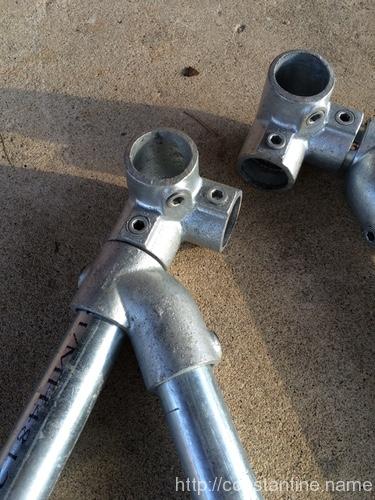
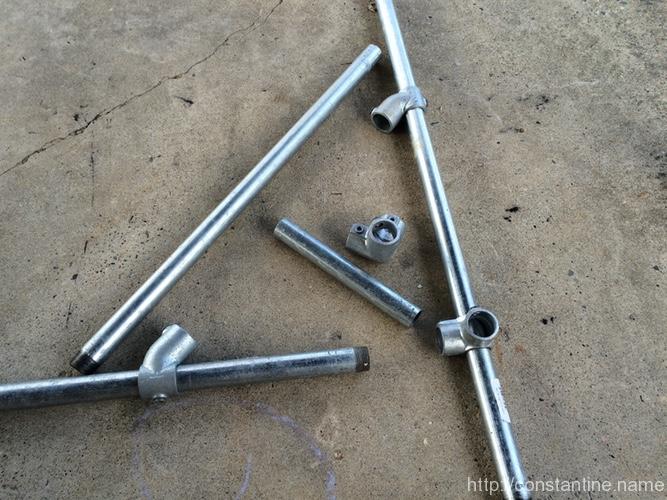
Here are three more clamps. The first two you will certainly end up with, eventually. The third one is just a fun, sort of, “what would you ever do with that?”

Split cross

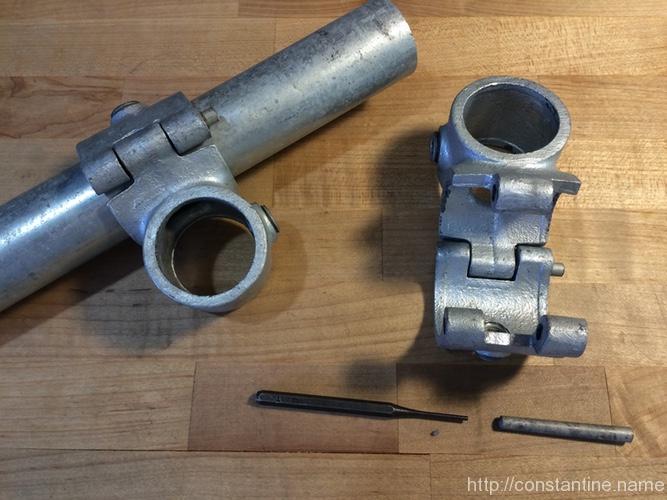
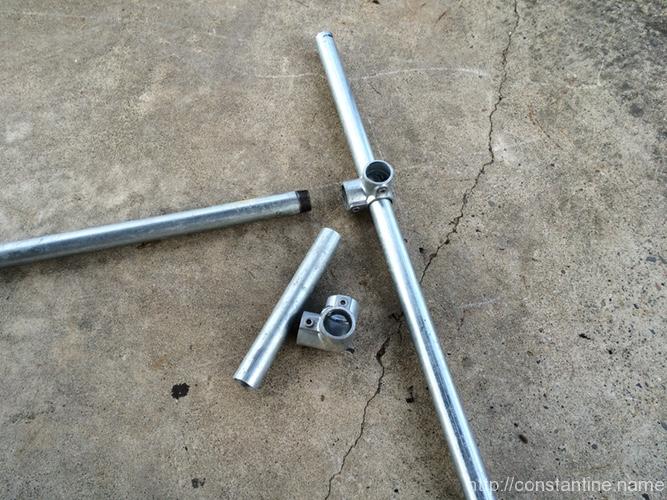
This is your new best friend, the “split cross”. This is better than sliced bread. This clamp can be opened (by tapping one of the pins out), and then placed onto an existing pipe in a structure. Note that the pins are slightly tapered. You’ll see they stick out on one side (that’s the thick end) and they are flush on the other (that’s the thin end, the end you tap).

IMG_1537

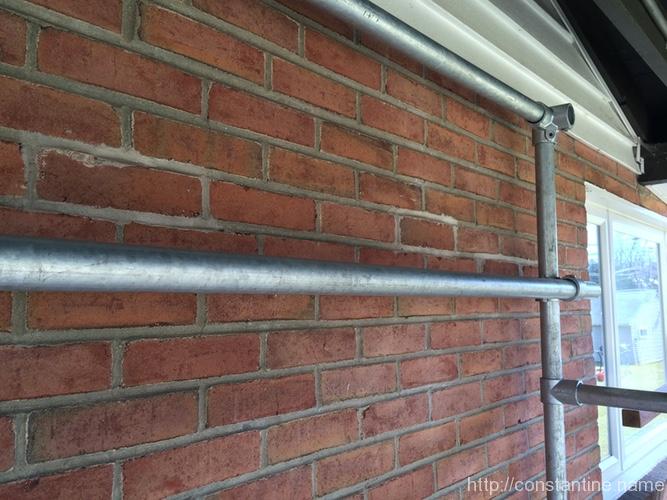
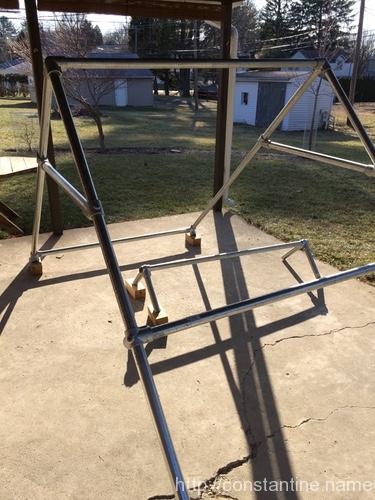
With these clamps, you can add another pipe, like this, when someone says the top one is too high…

IMG_1534

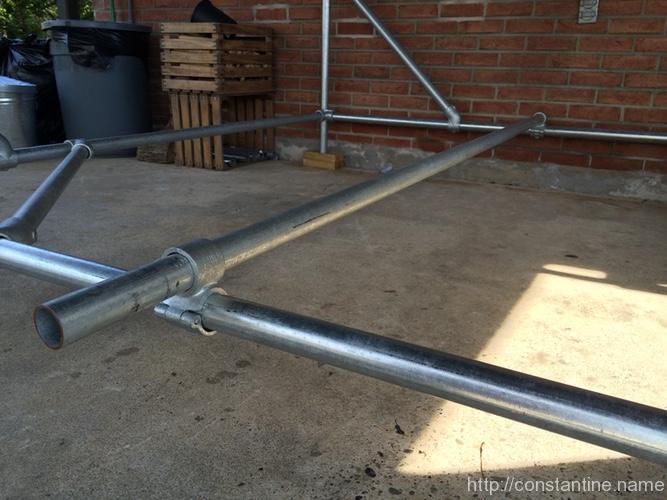
Or you can just throw a precision (or balance etc.) rail right into the middle of a build. I keep one, 10-foot-plus pipe laying around for this purpose. You can even strap on extra bars angled across the build if you bolt to the vertical poles. You can strap to two different horizontal poles, at different heights and make odd-angle slopes. There’s tons you can do with this clamp.

IMG_1533

90° single outlet

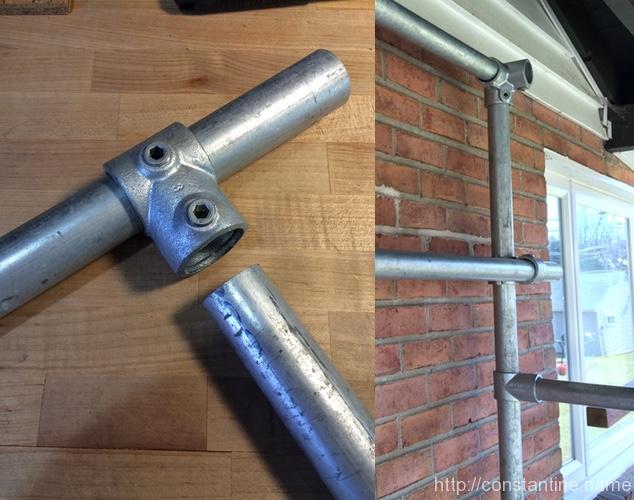
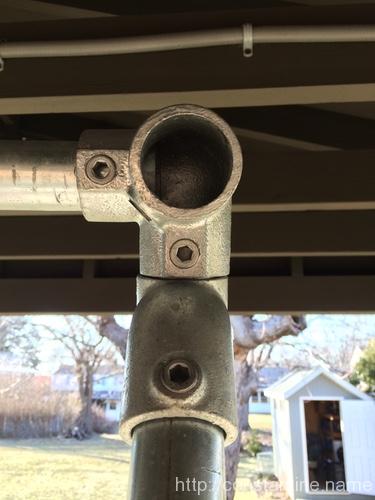
There’s a 90° single outlet tee which is handy for making really clean builds:

IMG_1536

Swivel mount

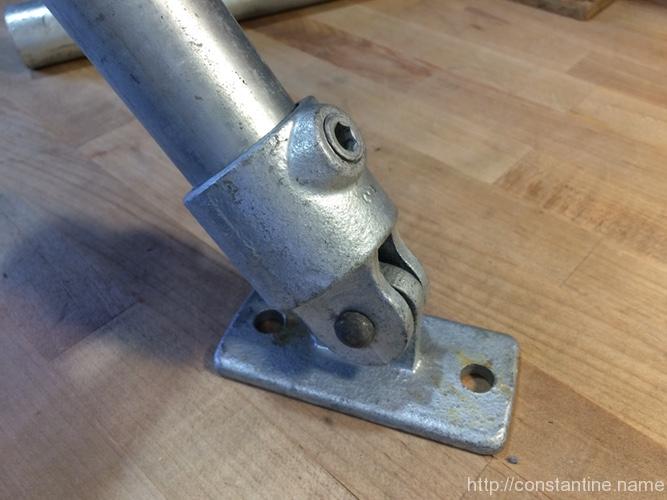
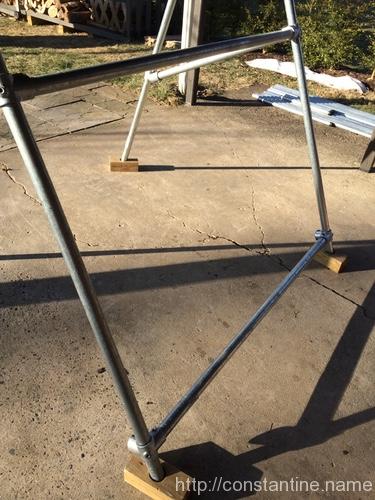
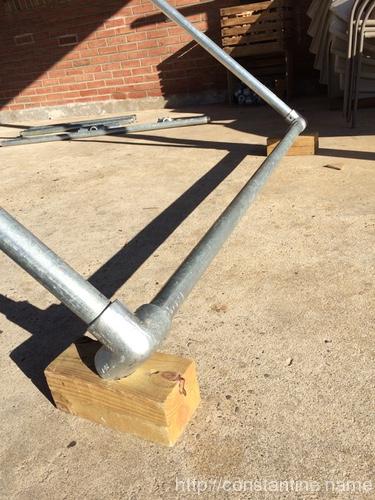
I have a few of these that I use as feet on my ground rails. Makes the pipes sit neatly on just about anything. But you could also attach these to big wooden blocks, and then use them as feet on the bottom of your scaf corners to keep it from sinking into your lawn. (Because of the set screw, these feet would move easily with the scaf when you pick it up.)

IMG_1539

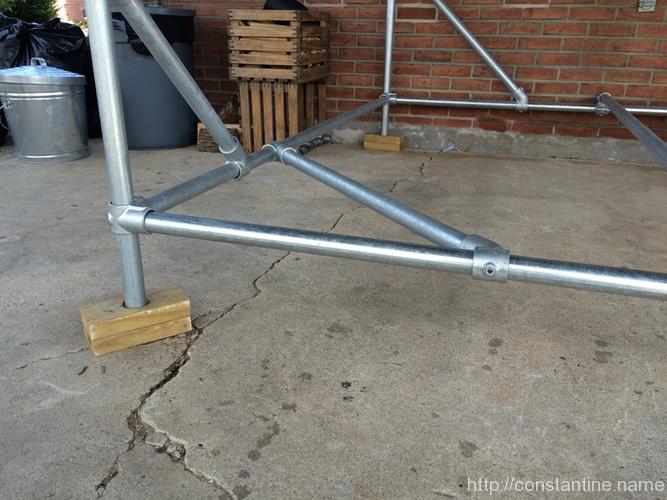
The simple wooden feet are great, but in the lawn, they tend to flip over and come away when you move the scaf. So using feet that are attached to the legs would be slick.

IMG_1535

A few clamps more

Clamps are easy; point, click, ship. (Unless you’re lucky enough to live near a place that stocks them.) But as you accumulate more steel pipe, you’re going to want to start cutting it yourself.

…well, ok maybe you never end up cutting a single pipe yourself. If you buy your steel pipe from a supply house, you can just list all the lengths you want. But if you’re just going to buy a couple sticks at a time, then one day, you’re going to want to make a few cuts.

Ye ‘ol hacksaw is tedious, and the ends are never perfectly square. The gonzo method is to buy a chop saw and fit it with a metal-cutting blade. But the middle-of-the-road method is to buy a heavy duty “tubing cutter”. A steel pipe cutter will make short work of schedule 40, 1-1/4″ steel pipe. (But you will need to clamp the pipe down somehow to resist the cutter’s rotation.) For example, a “Ridgid 32820”.

The good, the bad and the clampy

I think I’ve done a reasonable job of capturing, and organizing everything (and more) that I’d wish I’d been able to find on the first day I started thinking about buying some scaf. Along the way, I had a lot of fun indulging my scaf habit and I hope you (fellow pragmatist) enjoyed reading this far.

Where to go from here? …to the clamp web sites, to the scaf supply depot, to your first scaf build party with friends!

On the other hand, if you’re in the mood to stare at your screen more, I have a #scaf tag for all the scaf posts on my site. They are mostly photos of built scaf, so perhaps you’ll find some ideas/inspiration.

Finally, a big shout out to Blake up in the Boston area for being a huge scaf-addict and spreading the scaf love. They don’t have anything scaf-specific on the web, but if you hunt them down on your favorite social medium or in real life, there’s pretty much scaf everywhere: Parkour Generations Americas Boston on DuckDuckGo

ɕ

Scaf 101: Build 6, Taller A-frame

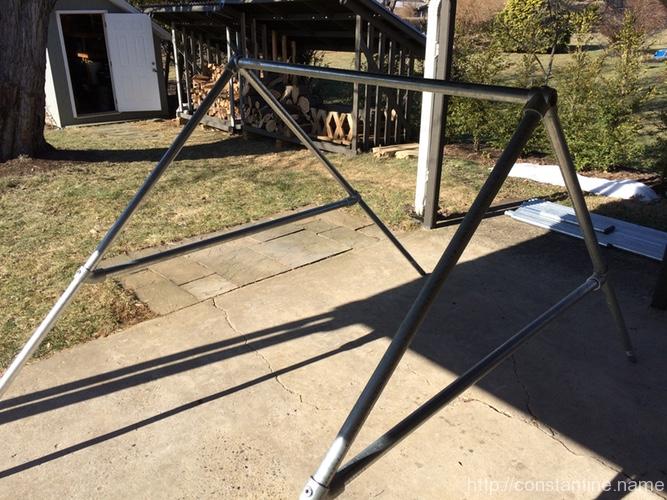
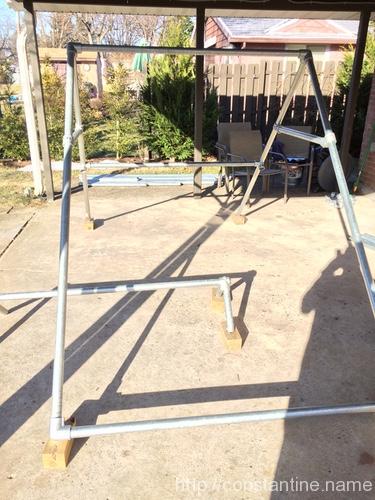
There are some non-obvious ways to use clamps to build unusual things. Early on, in the first “cube” build, I mentioned you could do pullups and work climb-ups. But this build is way better for building a stable, nearly 7-foot high bar.

There’s no layout shot per se, but here’s a pair of assembled 45° apex A-frames. (Note that the unused outlets in the middle both face up.)

IMG_1512

There are two 90° two outlet tees in the middle of the photo, 45° tees on the left and right and 3-foot brace pipes. This looks totally asymmetric, right? Here’s a close up of the tops of the A-frames:

IMG_1513

(I know, right? Does this work?)

Here’s a detail of how you put the top cross bar into the clamps; do not over-insert the ends because we need the width to be correct.

IMG_1517

Wait, this is a thing? It totally is…

IMG_1515

Very tall, very stable for climbing/hanging and you can swing a bit (if you like sketchy swing sets).

We have 5-foot pipes and tees left, so let’s add some more side pipes:

IMG_1516

I love how the outlets on those tees we used early on, suddenly are just perfect for a cross bar. Obviously, that lower one could go anywhere on the set. If you have extra 45°s, you can add some 1-foot diagonals on any (not the top – won’t work up there) of the cross pipes. I’d put two diagonal doing down from the mid-height cross-pipe; that would give a huge stability gain without being in your way.

There are other variations to this build: You could have used 5-foot pipes for the cross-bars when you laid out the A-frames. They’d be much lower down on the sides. You’d still have the fourth 5-foot pipe to make that mid-height cross-bar. And of course in both variations you have 3-foot pipes that can be added as diagonals if you have the extra 45°s. Remember the rail precisions build, with the diagonals that were “off” but still sort-of fit? You could get a 3-foot diagonal up on the top most cross-pipe.

I really like this build. It’s a sort of “sleeper” build where you start feeling like your wasting clamps at the apex of the A-frames and then it turns into this very unusual geometry. Most scaf (except of course Blake’s scaf in Boston) ends up being all 90° and 45° systems.

ɕ

Scaf 101: Build 5, A-frame swingset

By now, you should be pretty comfortable with these builds. So for this one, I’m going to start off by making a poor decision, so you can see how it doesn’t work out at the end. Then I’ll make a change and show it rebuilt.

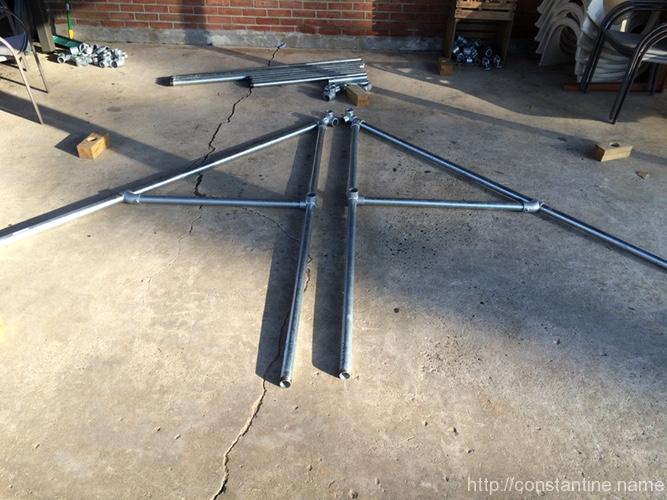
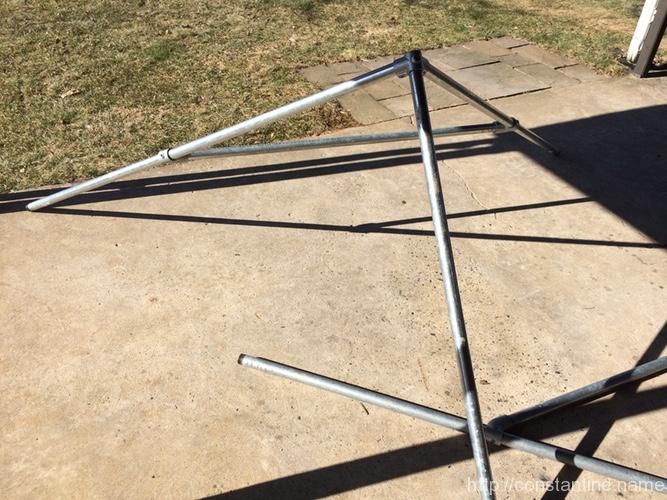
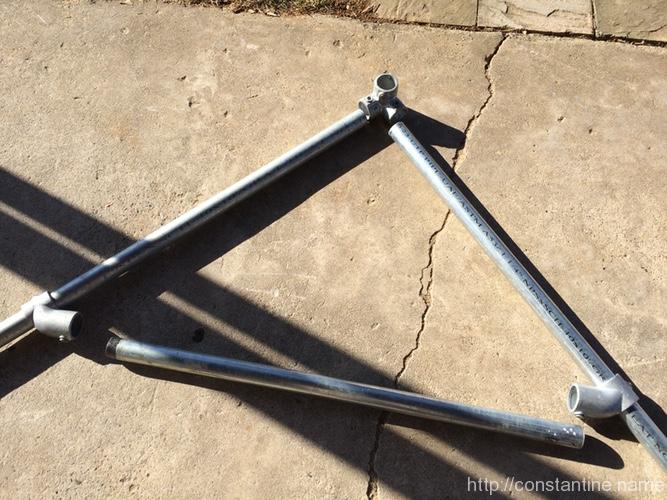
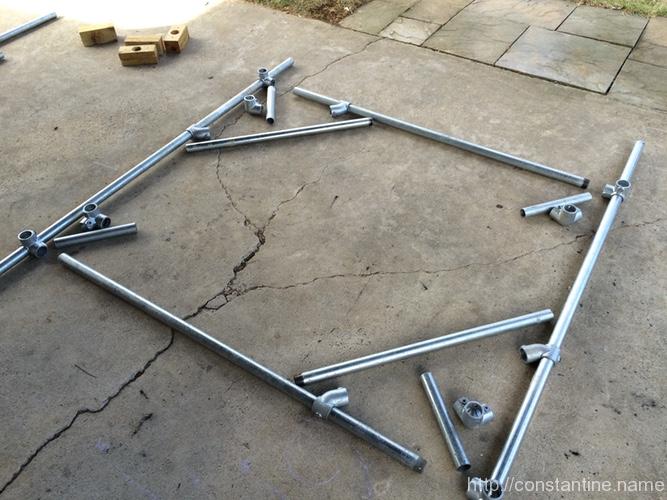
Here’s a layout shot for one A-frame end of a “swing set”. If you look at the apex closely, you’ll see I was considering using a side outlet elbow. (Two 7-foot legs, and a 3-foot cross pipe.)

IMG_1487

At which point I thought this might be an interesting teachable moment. So I swapped in the 90° two outlet tee. This seems like a good idea right? We’re going to use a 5-foot pipe across the top, one end of it has threads, I can slide this clamp further in from the end and it’ll get a much stiffer top corner.

Advanced: If you have the extra 45° single outlet tees you could add awesome little 1-foot braces on two of the corners at the top too. But DON’T – spoiler – we’ll use the 1-foot pieces for something else at the end.

IMG_1488

So I assembled one A-frame side and put in the 5-foot top pipe. You can see the other A-frame side is also assembled on the ground. The 7-foot pipes in this set all have threaded ends, and I’ve left them all facing down so the A-frame top clamps are more stable.

IMG_1489

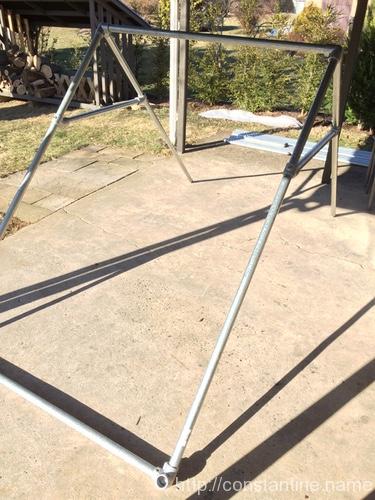
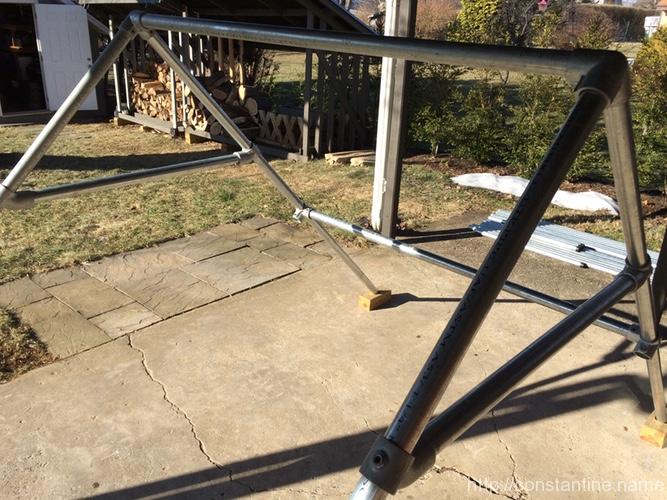
And here’s the assembled A-frame swing set. It’s about 5 feet high and is surprising stable because of the very wide 90° angle at the top.

IMG_1490

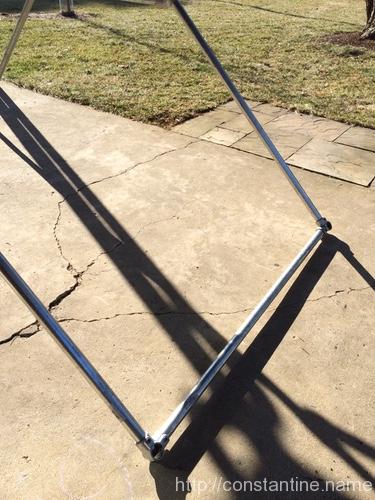
So can we make this more interesting or more stable? Let’s put a 5-foot base across the bottom of one side, just to stiffen it up. (But it can also be a laché precision target too.) Two elbows, a 5-foot pipe, and you’ll see the 5-foot seems long, so bury as much of the pipe’s ends in the clamps as you can. You get this:

IMG_1492

IMG_1493

IMG_1494

We still have two elbows left, so we could do this on the other side and call it a day. But we also have two more 90° two outlet tees, so maybe we could put a bar, across the other legs, but up higher; just to make it interesting? Here you realize that using the two 90° two outlet tees on the top of the A-frame means the entire thing is too narrow to pull this off. In the photo, I have the far side clamped, and the near side just snugged and resting so I could take the photo; it’s clearly too long. If you slid this down low, you could just stretch/spread the legs, but up at this height, it’s a no-go.

IMG_1497

At this point (if not sooner) you’d realize that you cannot get those top clamps out and swap them. You have to tear the entire thing down; thus my thought that this would be good to show, so you never have to do it. :)

Here’s a do-over layout shot for the clamp change, and the finished do-over (with that low base with elbows installed).

IMG_1499

IMG_1505

Now we can add some fun stuff. You can use the two outlet tees (you have four left) to put a base on the other side (note the clamp orientation).

IMG_1506

But we have that on the other side already, so you can flip those clamps and position this 5-foot pipe anywhere. You have a “window” on one side too!

IMG_1507

We really should flip the elbows on the other side, so they “sit” into the feet better. Now we also have a “ground rail” on one side. Perfect to start from before jumping/reaching to swing on the bar, or as a laché landing target:

IMG_1508

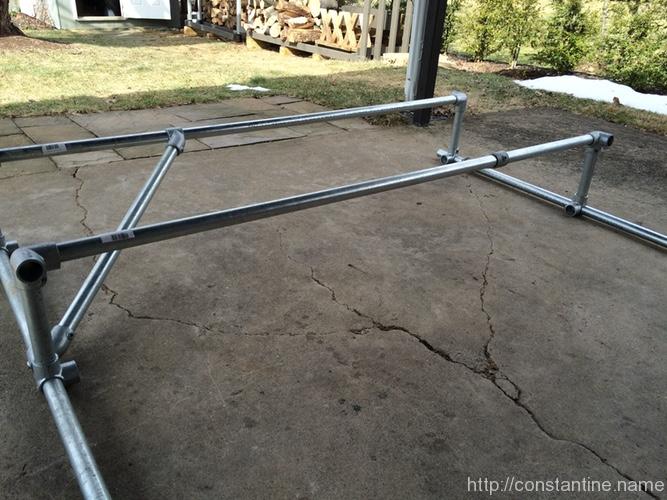
Done? …not hardly! We have clamps left over. Grab that last 5-foot pipe and your four 1-foot pieces, two 90° two outlet tees, and you can make a bomber ground rail (because you made all 8 wooden feet way back when).

IMG_1509

IMG_1510

Finally, you still have two 3-foot pipes left. If you have the extra four 45° single outlet tees, you could add those pipes in somewhere. As diagonals to the base, or in the window, or something crazy like connecting the free ground rail to the A-frame somehow.

So this build ends up being full of options. Climbing/gap challenges around the side braces; balance/cat-on-a-rail challenges; precisions; swinging. This is one of my favorites that you can build with this set.

ɕ

Scaf 101: Build 4, rail precisions

This is a very stable, adjustable setup for learning rail precisions close to the ground.

Here’s the layout shot. The 1-foot pieces will be vertical.

IMG_1453

In this build, I’m going to use 3-foot braces incorrectly; I’m going to build them out-of-plane, where all the angles are just a bit off. Turns out it’s close enough to work because the brace pipes are 3-feet long. This wouldn’t work with shorter braces. (Look at it closely when you put it together to see what I mean.)

Here are closer layout shots of the two types of corners in this build. First, a corner with a brace:

IMG_1454

…and the corners without a brace. The upper clamp that holds the precision rail has an extra outlet we won’t be using.

IMG_1455

Put the 90° two outlet tees on the 7-foot bases. This is a little trick to make the pair on each pipe have matching alignments. This also makes their set screws super easy to tighten. Set the distance between the clamps (on each pipe) to be the distance of the precision you want to end up with in the finished setup.

IMG_1456

Put all the verticals in place. Since each of the elbows has an outlet I’m not using, I’ve turned them out/away from the jump-gap.

IMG_1457

Put the cross bars (the ones you’ll jump on) in place, and build the 3-foot braces. You can adjust the distance by loosening 3 set screws and sliding one side. (Another spot where you can use the wooden feet to prop up the ends of the 7-foot base pipes so yo can get at the set screws that are on the ground.)

IMG_1464

Minimum is about 2-feet, limited by the angle braces:

IMG_1462

IMG_1463

…maximum is nearly 7-feet. If you never plan on going out to seven feet, you could also do the build using the other 5-foot pipes as bases. (Sorry about all my other scaf pipe sneaking into the shot. All of these builds I’m doing with just “the set” described in the beginning.)

IMG_1465

ɕ

Scaf 101: Build 3, parallel-sorta-bars

This is another variation on the cube (the next build I’m going in a totally different direction ;). basically, take the 7-foot side pipes and turn them into stabilizing legs, so you can do some limited laché (there’s a better build for that though), pullups, climbing and under-bar stuff.

Here’s the layout shot:

IMG_1470

Assemble the ride side (which will be vertical). Do the two uprights and the top 3-foot first. Note the 45° single outlet tee on the righthand vertical.

IMG_1472

Next, clamp the verticals to the 90° two outlet tee (we’re not using one of its outlets though.) Then clamp the 90° two outlet tees to the 7-foot base pipe. I just eyeballed the centering.

IMG_1473

Stand this side up, and put a 7-foot pipe into one side. Remember to slip the other 45° single outlet on here. (Again, I snug these clamps down a bit so they don’t go sliding.)

IMG_1477

Assemble the other side; verticals, top pipe and bottom. Remember the 45° single outlet on the opposing vertical. Position the two assemblies like this:

IMG_1480

Stand up the side, lift up the 7-foot pipe and convince them to line up:

IMG_1481

Fiddle the other 7-foot long side pipe into place. Make up both braces. (Bonus, if you have the extra 45° single outlet tees, you could add two more braces to this build.) Stick the feet on it (otherwise the 7-foot base legs don’t actually touch to add stability – but you could shim them with whatever.)

IMG_1484

I took the above shot at about eye level – obviously, it’s a 5-foot tall setup. And stable enough to do climbing and some gentle swinging.

IMG_1485

ɕ

Scaf 101: Build 2, railings

This is simply a slight variation on the “cube” build. You can either assemble it this way, or slide the 90° two outlet tee clamps along the vertical legs when you’re done with your cube.

In the cube build, when you’re assembling the upper frame – the second half of the build – simply lower the position of the 90° two outlet tees. Alternatively, you can convert the cube into this by loosening the 90° two outlet tees on the four corners and then slide the frame down the verticals. (Truth be told, I had to coerce the frame down with a rubber mallet.)

ɕ

Scaf 101: Build 1, cube

This first build is the most obvious thing to assemble and you can do a lot with it. (Yes, it is not actually a cube; I suppose it’s a right cubic rectangle.) I’m going to give a TON of detailed instruction on this build with a million photos. On subsequent builds I’ll be brief.

Advanced: As I’m assuming this is the first build you have ever done, I’m keeping the diagonals to only two. However, if you bought the four extra 45° single outlets, you can add two 1-foot diagonal braces to the mid-sized sides. I’ll mention how to do this as we go along.

Prep

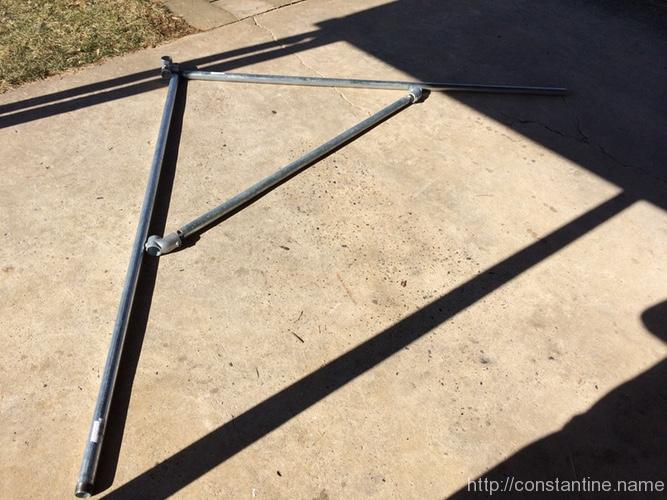
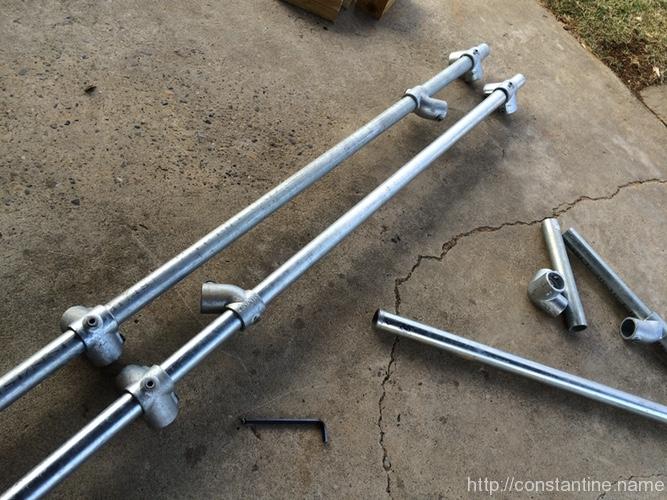
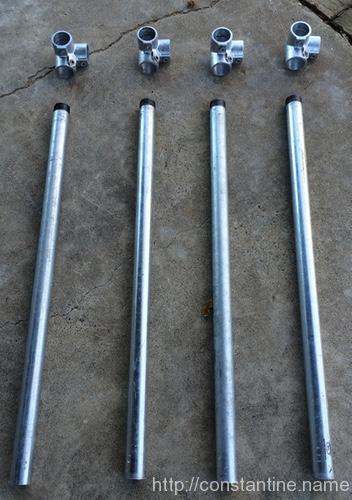
Begin by clamping the four 3-foot pieces into the elbows. Note that the threaded ends go in the elbows.
IMG_1518

Notice the orientation of the clamps. The two set screws that will be used later, are facing the pipe. You’ll be happy these screws are facing up a few steps from now.
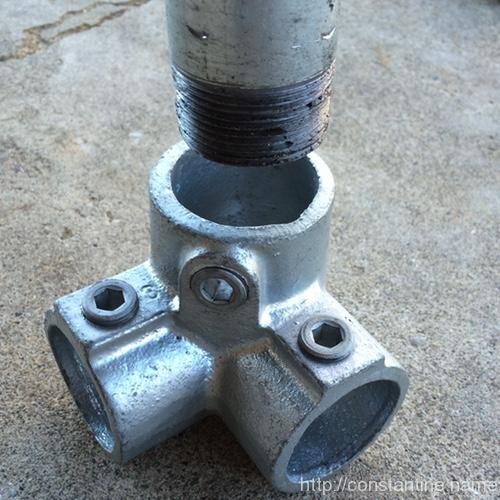
IMG_1519

Why are we putting the threaded ends in these clamps? You’ll see why when we clamp the other ends of these pipes. For now, recall the discussions about inserting the pipes a little farther so the body of the pipe – i.e., not the tapered threads – is touching the inward land in the clamp.
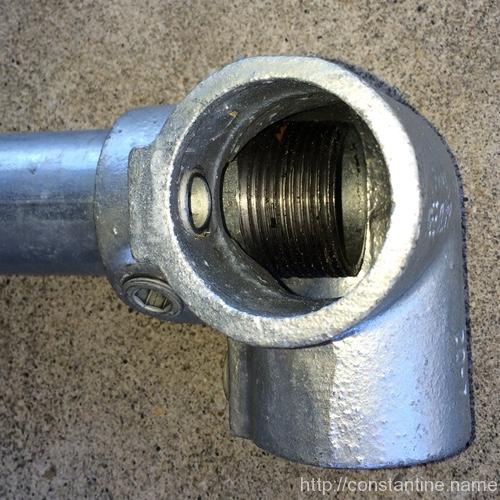
IMG_1520

The bottom

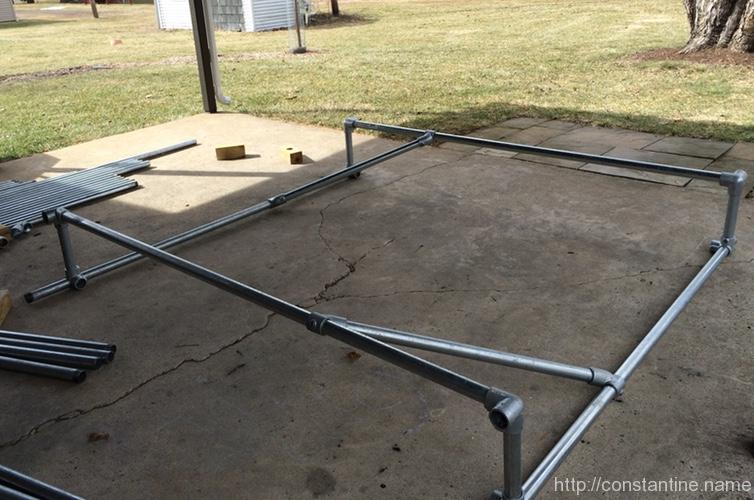
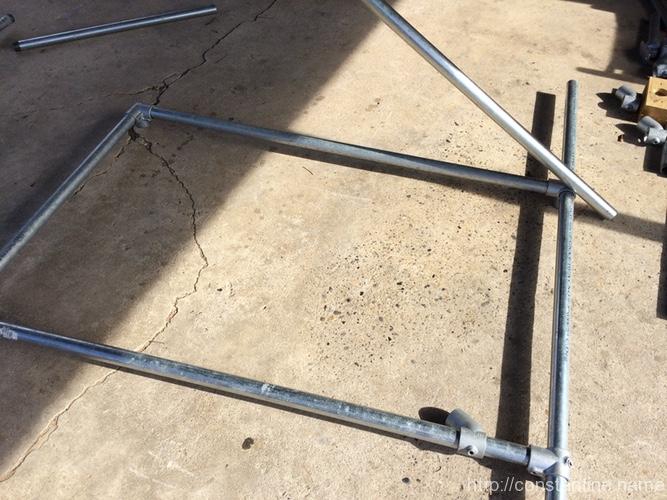
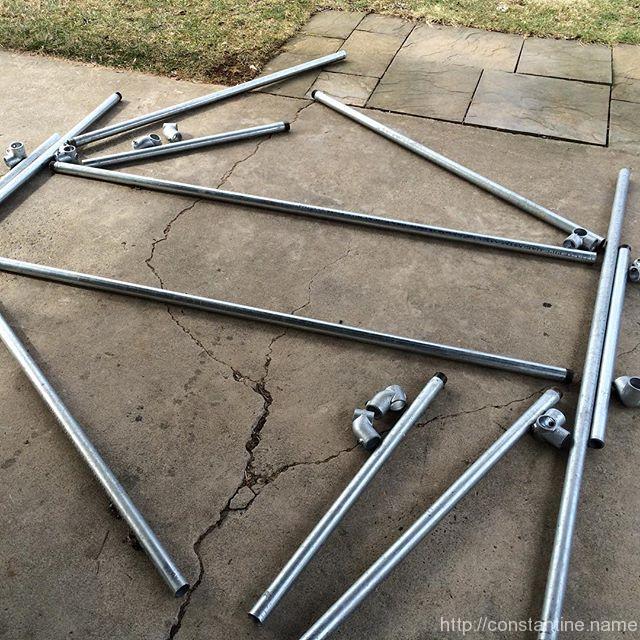
Introducing the “layout” shot. I find it really helpful to lay everything out (until you get really good at scaf) so you can see that you have all the pieces you need. This is just a partial layout; it’s obviously not all the scaf for this build. In later builds, I’ll take an entire layout shot so you can see the mess. I think the layout (looking at a photo before it’s built) helps you visualize how you convert the loose junk into the finished product. Anyway, here’s the layout shot for the first corner:
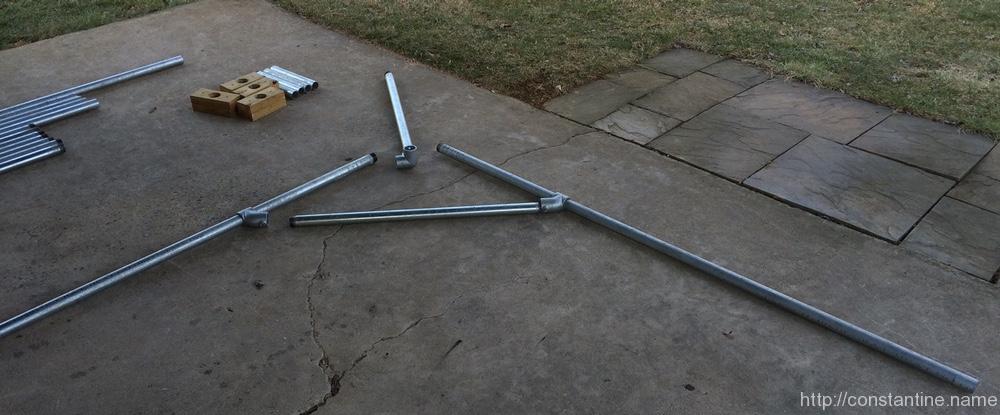
IMG_1391

Of particular interest in the above shot: I’ve slid the two 45° single outlet tees onto the side pipes. That’s a 7-foot pipe on the right, a 5-foot pipe on the left, and the cross brace is another 3-foot pipe.

Below is, basically, another layout shot. Notice that I’m putting the threaded ends of the side pipes into this clamp. Can you guess why?
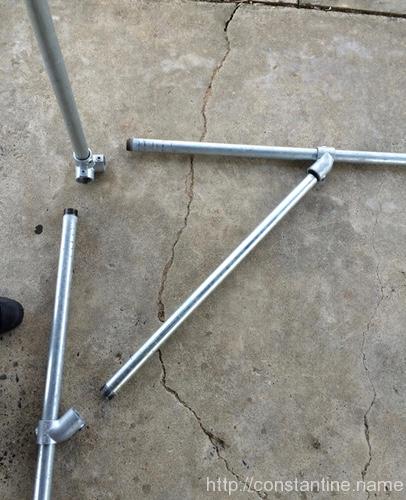
IMG_1390

This is a hair splitting detail to deal with the fact that this pipe has threaded ends. This clamp already has the first pipe pushed a bit into the center space. So the next two pipes are not going to be able to be inserted extra to get their non-threaded bodies to the lands. (Boo!) But this problem has to happen somewhere in the build, right? So I’m doing this here, where there is a corner brace that will beef up this corner. Because all the pipes have one threaded end, this “fixes” two of the twelve threaded-end problems in this build.

Advanced: Turns out we’ll have both ends of the 3-foot pipes occupying the clamp bodies. So all of the 5-foot and 7-foot pipes’ threaded ends aren’t going to land perfectly. (Because, taper.) So, if you have the extra 45° single outlet tees, you can add a brace on each of the 3’x7′ sides. That will brace two more (one per each brace) of the remaining four threaded ends. Again, I’ll explain more as we go along.

Next is a finished shot of this corner assembly. Here you’ll see another reason why I love those wooden feet. Things like this are so much easier to assemble with the feet doing a little propping up. Note that this prop trick doesn’t always work. It’s handy here for this brace, but after this, the setup has to stay flat on the ground. We’ll do another angle brace soon, and it will be on the top face, so no need to prop it up.
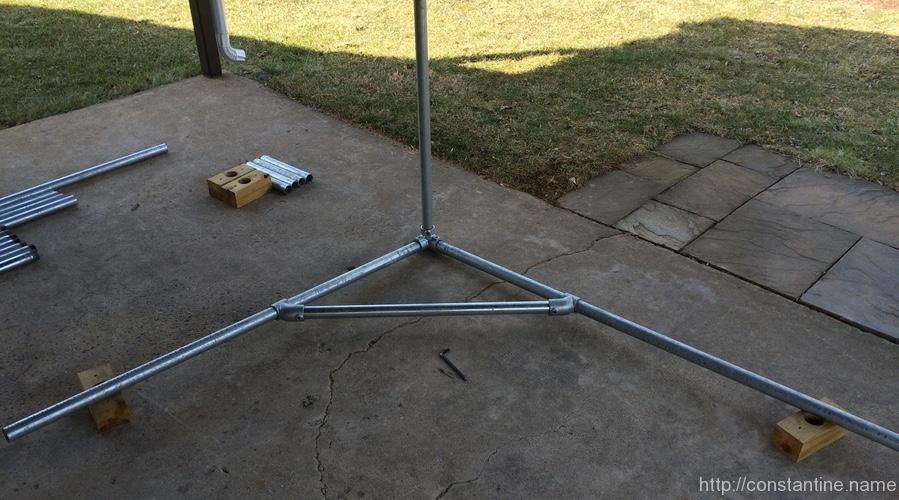
IMG_1395

The next photo is the layout shot for the rest of the parts for this “lower” part of the cube.

Please notice that the next few photos incorrectly have the vertical 3-foot pipes with the threads out. Right after I took these photos, I realized it would be better with the threads in – which is how it’s described above, to this point. So I flipped the pipes around… and promptly forgot to retake these photos. When I realized these shots were wrong, I didn’t feel like doing the entire build all over… because this space is already full of other scaf. :^P
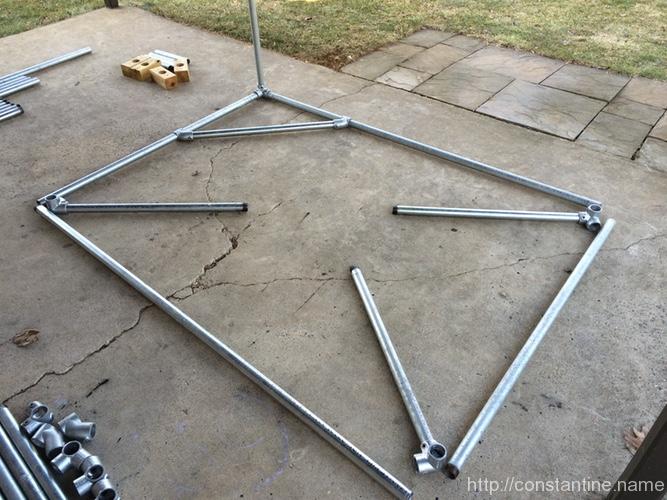
IMG_1396

Advanced: If you have the extra 45° clamps, and want to add a brace, you should add a clamp where I have the red arrow. That’s the end of the 7-foot pipe that has a thread, and would most benefit from bracing. The clamp should angle towards the corner, since you’ll put the other clamp for this brace on the 3-foot, vertical pole. I’m splitting hairs here about where to put braces. But, this is meant to be educational, ‘ya know?
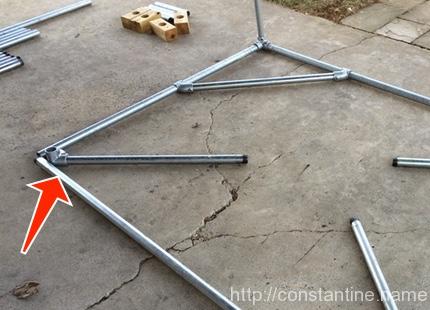
IMG_1396

The next photo shows two more verticals, and the 7-foot side clamped tight. Just the fourth vertical, and the last, 5-foot side remain to be installed.
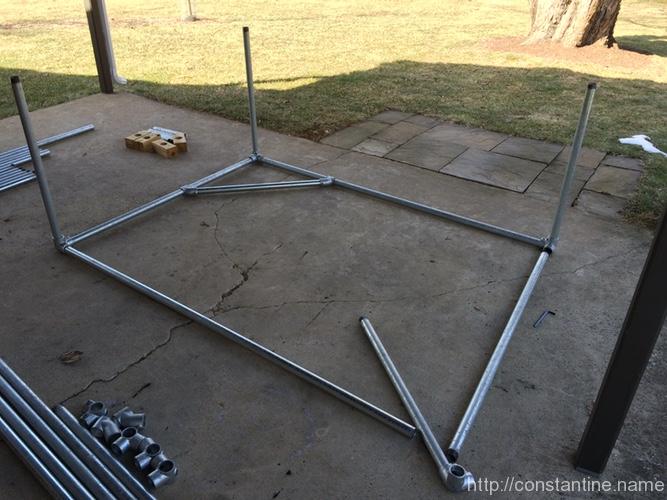
IMG_1397

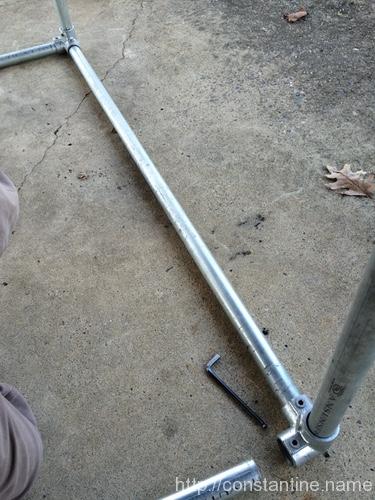
At this point, insert the 5-foot pipe into the clamp (the one towards the top of the photo.) The pipe, of course, will just lay there when you let go. Then clamp the fourth vertical to the pipe. (That’s the clamp/set-screw where the Allen wrench is laying.) You’ll have enough swing/wiggle in the 5-foot for this to be easy even with one hand always on the vertical pipe.
IMG_1398

Why? Diatribe about safety: Yes, this build is pretty harmless. But as you build bigger things, you will live longer if you are always thinking, “when I forget and let go” or “when I slip” or “when I get stung by a bee and drop this part”. At this instant in the build, that fourth vertical looks like it’s attached – it’s clamped to the 5-foot side pipe, but the pipe is free to rotate but you cannot tell at a glance. The vertical may even stand for a while before falling over. This is exactly how someone gets hurt. Something that looks stable, actually isn’t clamped yet.

Now tighten the other screw on the vertical pipe’s corner clamp which fixes the 7-foot pipe into this corner.

Anything else? Yeup, the other end of that 5-foot pipe. Learn to keep track of what’s tight. Learn to spot proud set screws that need to be tightened (or whose clamp alignment needs fixing so the screw goes in farther). While you’re at it, give the structure a couple shakes, and then go check every set screw.

Pro-tip: Soon you will have a feel for “this is how much I torque these things” and you’ll go around and just sort of torque torque torque them quickly. In an instant, you can apply “just that right amount of torque”, and when the screw doesn’t move, you’re happy. This is another way to spot good scaf builders: They do not go around and actually tighten each screw a little bit more each time. (The screws cut hickies the tighter you make them.) Good scaffers know what a tight set screw feels like before it moves.

Mastery-tip: The set screws scratch the steel pipes and move the Zinc coating. That leads to a tiny bit of corrosion between the pipe and the screw, which makes the set screw stick in place. That’s a good thing because it helps prevent things wiggling loose. So if you’re in the habit of actually moving each screw when you periodically check things, then you’re messing up the one time when corrosion is actually working in your favor.

So, here’s what you have, everything tight and ready for the upper frame (except, of course, your 3-foot verticals are not upside-down like mine are in the photo):
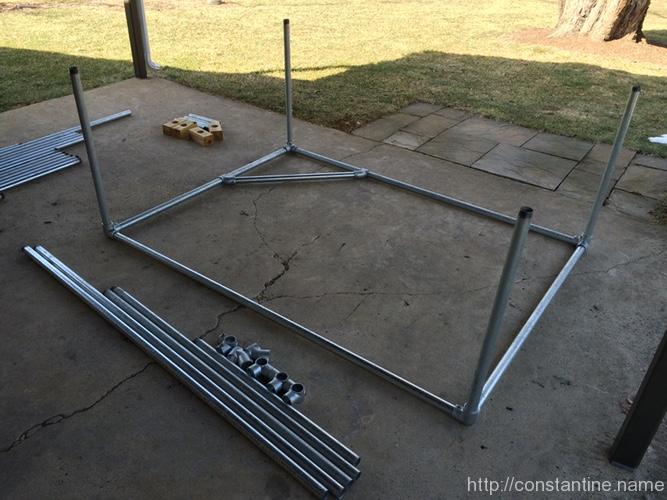
IMG_1399

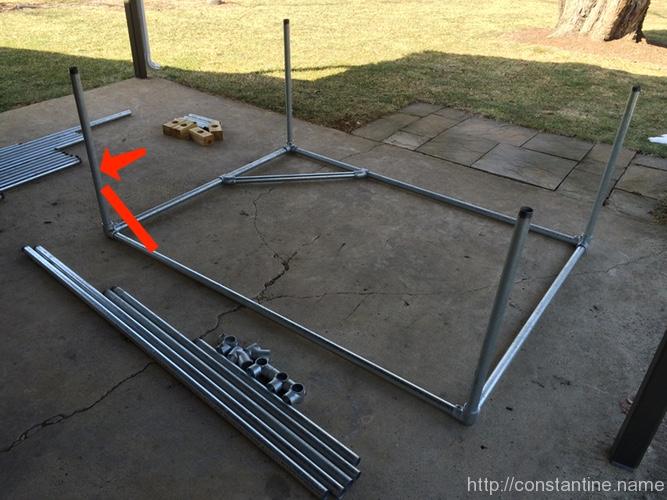
Advanced: If you’re doing the extra brace, you need to drop the second 45° angle outlet clamp onto the vertical (arrow). Later – no, do not do it now – we will install a 1-foot brace where the line is.
IMG_1399B

The top frame

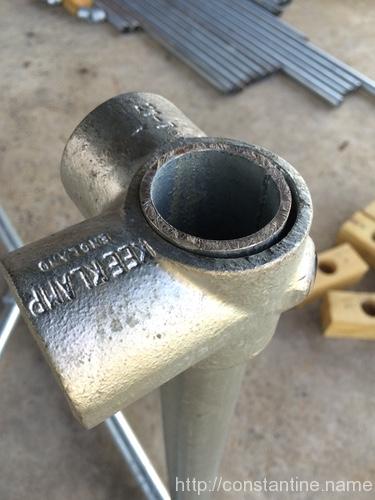
Attach two of the 90° two outlet tees to the tops of two diagonally opposite vertical pipes. Be sure the pipes are inserted far enough so the cut off end lands correctly.
IMG_1404

This is why the 3-foot pipes are threads-down. If the threads were currently UP, well, the threads would have to stick out. On the other hand, if you assembled this entire thing with the threads UP, when you flip it over, those threads would be PERFECT for dropping into those neat wood feet. This is how I actually set this cube up when I use it flat. I DON’T put the thread into the clamps at the very first step and then I flip the entire build over and use the wooden feet. It’s actually just like the “railings” build that we’ll do next. But I’m getting ahead of myself.

Anyway, here’s the status shot with two clamps on two of the verticals:
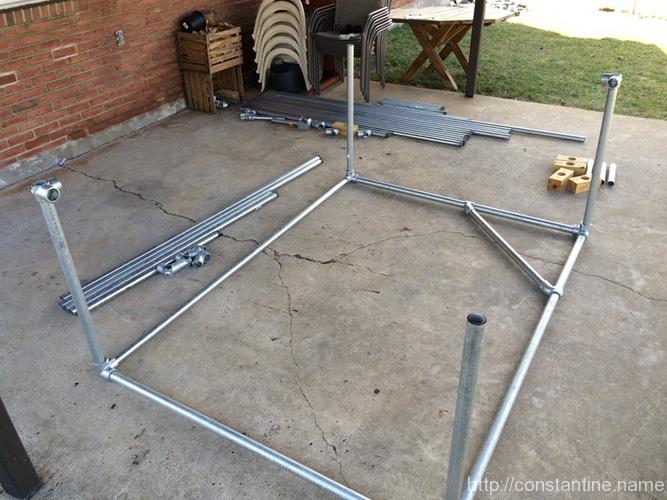
IMG_1406

Here’s another layout shot showing the 7-foot pipe (with 45° single outlet tee) and the 5-foot pipe that will be added next. Notice I’m putting the threaded end of the 7-foot pipe down where the second diaglonal brace will go.

Advanced: The second 1-foot diagonal will go on the last 7-foot pipe, on the other side.
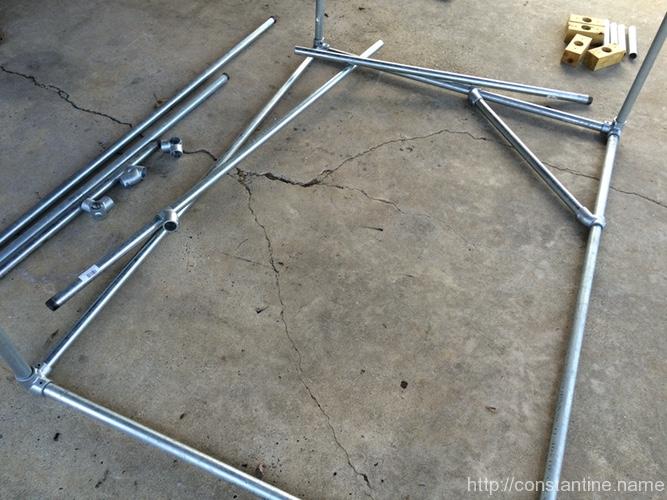
IMG_1414

Another diatribe about safety: Loose clamps on poles lead to the “sliding death clamp” problem. You’ll experience this some day. You’ll pick up a pipe, and somewhere on the part that is NOT in your field of view, there will be a loose clamp. You’ll hear the sliding sound of a clamp… and you have a split second to figure out if the clamp is coming your way and about to pinch your fingers on the bar, or if it’s going the other way and going to hit someone else. Bonus points: if the clamp falls off, the pipe balance changes quickly and you have the slap-stick, not-funny, swinging pipe joke.

…so when you put “middle” clamps on pipes that you are going to lift or carry, snug their set screw so they don’t move.

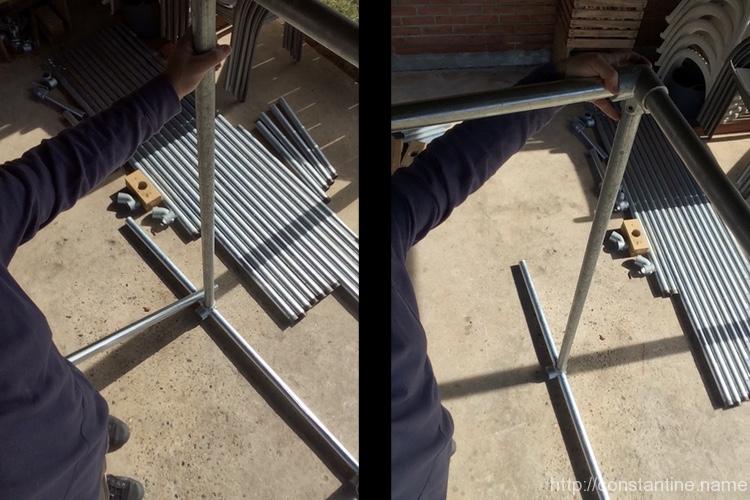
Pickup one of the 90° two outlet tees in your right hand. (Bear with me, this is clever.) Stand inside the setup, pickup the 7-foot pipe and put the left end (with the threads) into the corner clamp:
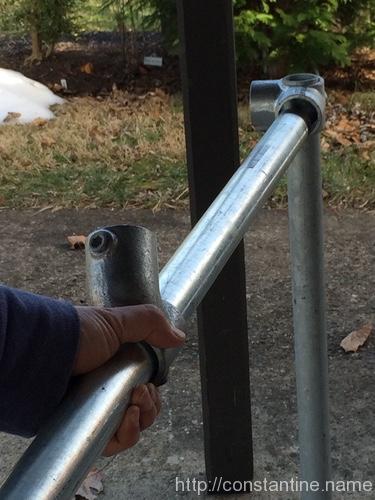
IMG_1417

Drop the clamp onto the vertical pipe. This is not how we’ll install this clamp, I’m just using it as an extra hand. If you’re paying attention, you’ll realize this entire build can be done by yourself perfectly safely. (Nit-picking: I was also holding a camera through all of this. I should have flipped that clamp so the screws were on the other side… you’ll see in a moment.)
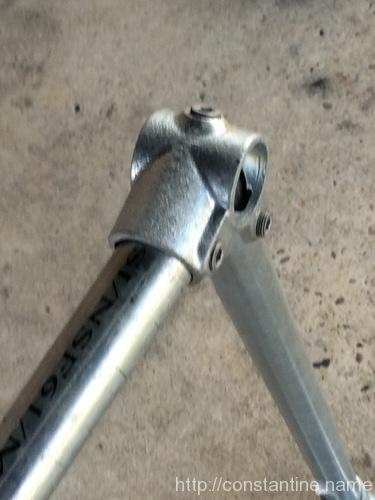
IMG_1419

Boop! I no longer have to hold that 7-foot pipe; it’s trapped on both ends. Now go to the other end – the end we inserted first – and lock it in place with the set screw. We don’t want it coming out, and we may need to pull on it in a moment.

Next, pick up the 5-foot pipe and put the right end into the corner clamp:
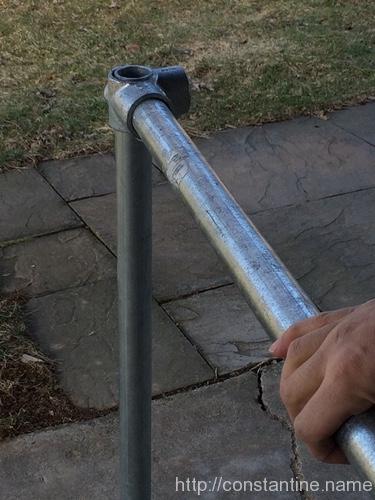
IMG_1420

No photo for this part, but: Rest the left end on top of the 7-foot pipe, and then lock the right end of the 5-foot pipe into its corner. Like the 7-foot pipe, we may need to pull on it and we don’t want it coming out.

Now, holding the 5-foot pipe in your right hand, lift the 7-foot pipe and the clamp – and here I had to stop and flip my clamp, but you can just – rotate the clamp to receive the 5-foot pipe. (Happiness: You can’t drop either pipe because their out-of-sight ends are already locked in.)
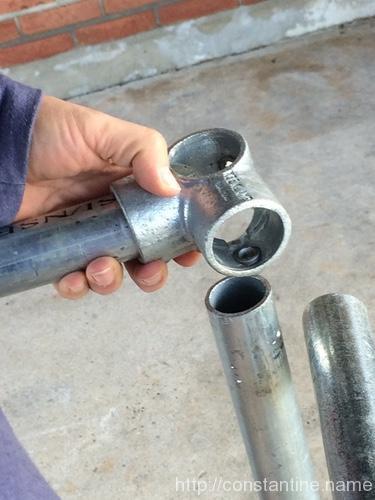
IMG_1422

Line them up holding the clamp. Since we had the forethought to already clamp the other ends, the other ends won’t fall out on us as we wrestle this part.
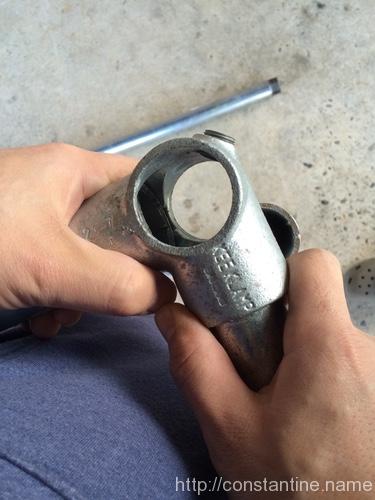
IMG_1423

Now this gets tricky. You may have to coerce the vertical pipe to come over and want to go into this clamp. (If you’re doing the advanced version, the extra 1-foot brace would fight us at this time.) Eventually, you get this:
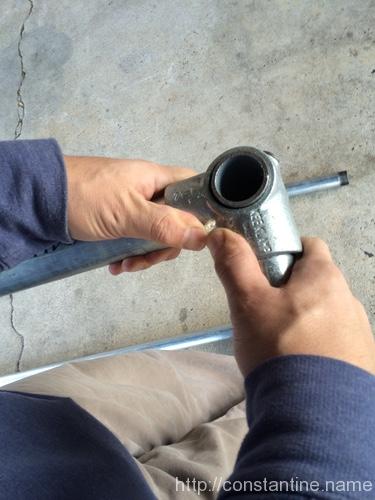
IMG_1425

Now tighten up all three screws on this corner clamp.

Advanced: Now you can assemble and tighten the 1-foot corner brace that is on this vertical pipe.

Finally, you now have half of the upper frame:
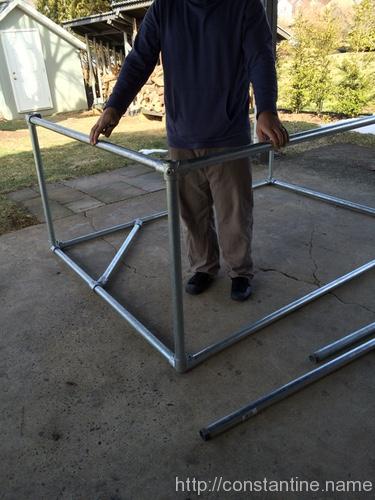
IMG_1431

Place the last 5-foot pipe into the right side; Put the threaded end to your right (towards the braced corner.) Notice the 45° single outlet tee clamp for the top face’s corner brace is on this pipe. Use the last clamp to hold the end for you. Tighten up the far end of the 5-foot pipe. (We’re going to be pulling/pushing on this pipe like we did on the other corner.)

Advanced: If you’re doing the extra 1-foot braces with your extra 45° single outlet tees, drop the one of the 45° brackets onto the vertical pipe angled upwards.
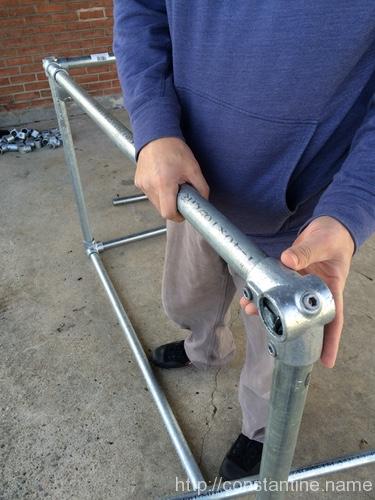
IMG_1438

Advanced: 1-foot corner brace? Slip your last 45° single outlet onto the 7-foot pipe, angled facing the vertical.

Slip the left end (farthest away in the next photo) of the last 7-foot pipe into the far clamp. Rest the pipe on the 5-foot pipe or temporary clamp, and tighten the far end.
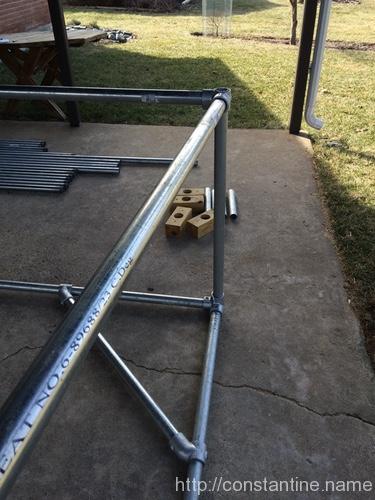
IMG_1439

Pick up the 5-foot pipe and the clamp with your right hand, rotate the clamp to accept the 7-foot pipe:
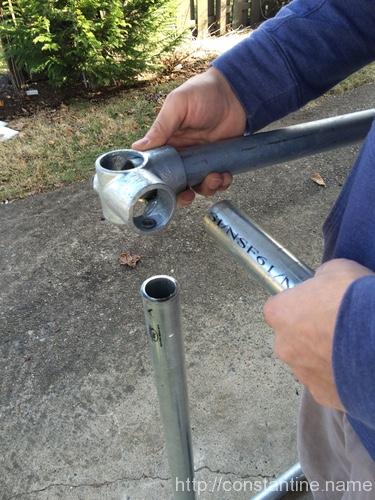
IMG_1440

Make up the corner and coerce it into alignment:
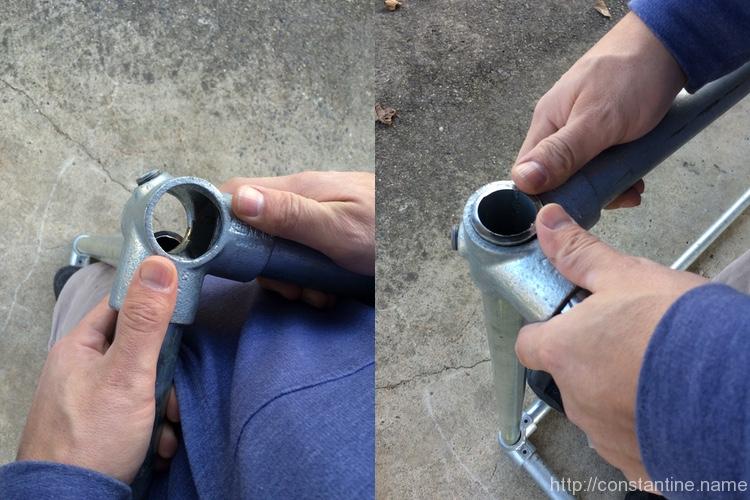
IMG_1441

Tighten all three screws on this corner clamp.

Advanced: Make up that last 1-foot corner brace!

Finally, finish that 3-foot corner brace on the top face:
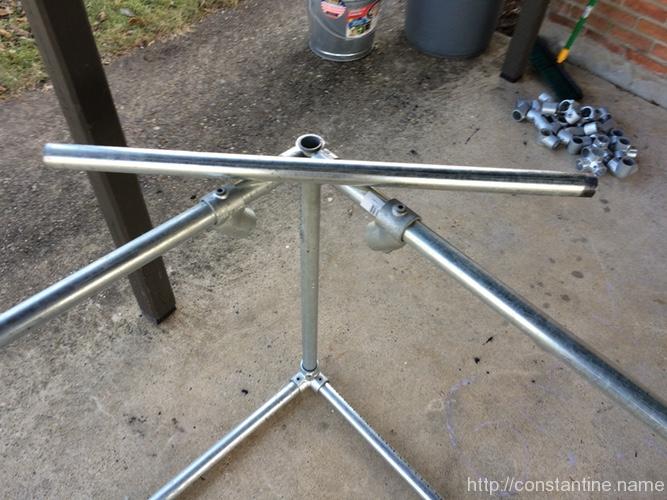
IMG_1445

Voila!

Flat: You can use it with the round-faced outside corners down (as you assembled it), or flip the slightly more rough 90° two outlet tees to the bottom, or (bonus points) assemble threads up so they’d be sticking up at this point, then flip it over so the threads disappear inside the feet you made!
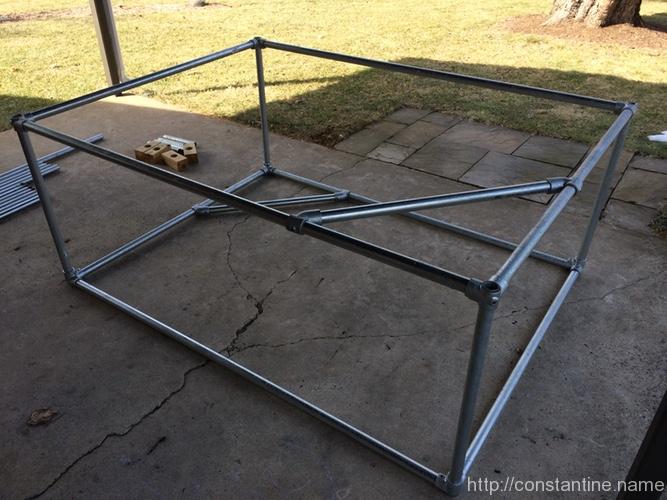
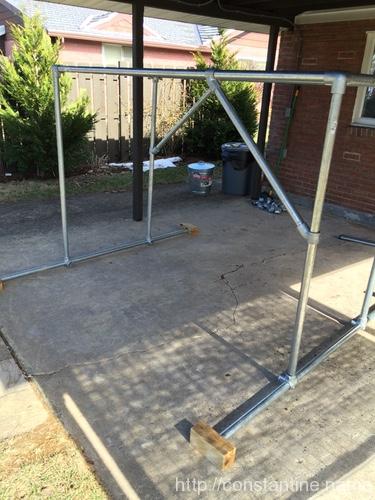
IMG_1446

Side: Flip this way for 5-foot high climb-ups etc. You’ll learn how sturdy it is. (Answer: reasonably.)
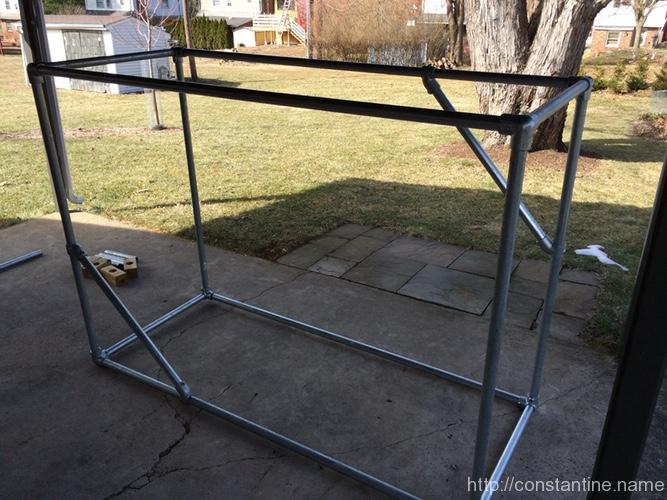
IMG_1447

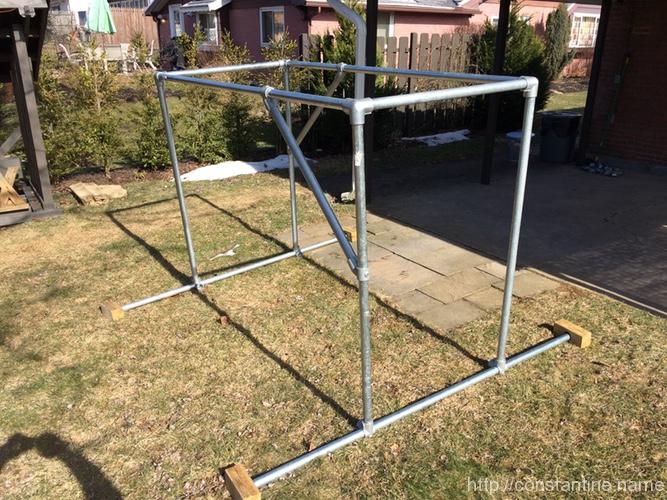
Tall: Finally, stand it up all the way for pullups or climbing challenges etc.
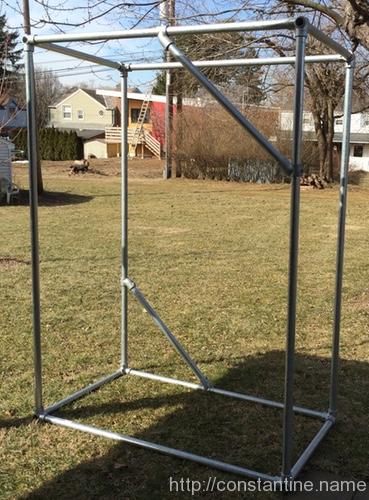
IMG_1449

ɕ

Complexity… but, progress

Not including a spreadsheet snapshot this week, because this nonsense (last week, this week) will only make sense to my crazy brain.

As I described in my last update, my right forearm is the gating issue. I’ve been doing about 30 pullups per day, as sets of 2… just going to the bar every 20 minutes or so and doing two pullups, without my right pinky on the bar (releases the part of the forearm that is sore.) After a week of this, my forearm feels better (not 100% though), and I’m going to see how I feel doing sets of 3 so the odometer goes a little faster towards 10k.

Squats feel better now that I’m going down only to the point where I’d have to unload my heels. Solidly below parallel though, but without the bottoming-out sort of cheat-stop at the bottom. So these are probably the best squats I’ve ever been doing. Fifteen is straightforward, but I’ve been doing 7s and 8s randomly, just because I’m constantly going to the pullup bar to do a lousy 2 or 3.

Pushups are easy/fun.

For handstands, I’m doing 15-second stands because it’s awesome kickup and balance (against the wall, working on free-standing) practice.

Bar-precisions I’ve a pause on (all last week) because I ripped all my scaf apart last week. I spent all day saturday building scaf variations for some blog posts I’m doing. Today (probably tomorrow) I’ll go build something for rail precisions so I can get back on track with those (I’m 3×75 behind from last week.) But these I can just crank out, so I’m not concerned.

This week, going by my now-usual 3-days rotating thing, I’d have three 80 rep workouts, (a +5 bump as I ramp up for the last few months of hauling the mail). Instead, I’m going to not plan specific workouts — since I’m just doing things randomly through the day. I’ll spreadsheet the actual daily numbers for my next check-in. I’m a little nervous about not having specific planned workouts — but I’ve already been NOT doing the plan (last week) so may as well make a real plan (to just do what I can through the day) and keep an eye on the pace.

Bigger picture: This year-long goal is hands-down the hardest thing I have ever tried to do. Harder than losing weight, because the weight loss translates immediately to other results/benefits. Cranking on these activity numbers is just like staring at an odometer. …well, the pullups led to noticable improvements, but now even they’re more like staring at an odometer. Big set-numbers would be cool, but not until my forearm heals.

Onward!

(shuffles to the other room, does 3 pull-ups and a 15-second handstand against the wall… :)

ɕ

Scaf 101: Inside the clamps

Remember when I said I’d start by explaining everything? Well, you should understand how the clamps work, so that you understand how to put them together. If you do it wrong, they wiggle loose and come apart surprisingly quickly.

Pro-tip: Scaf should be quiet! If you hear a rattle or tapping sound stop. Something is very loose — you probably forgot to tighten something. Or, you didn’t have things lined up correctly, then after the scaf is jostled a bit, things shift and voila! Loosey goosey. Learn to pay attention to your “scaf sense”. When your scaf sense tingles, stop and figure out what’s going on.

“omg Craig shut up already and let’s build something…” This is the last background information post. We’ll start building stuff in the next post. Please read this one carefully, this gets technical. But, if you understand this material, you’ll be a happy clamper later on.

Depth

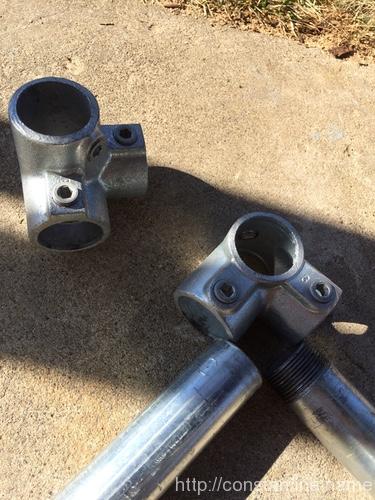
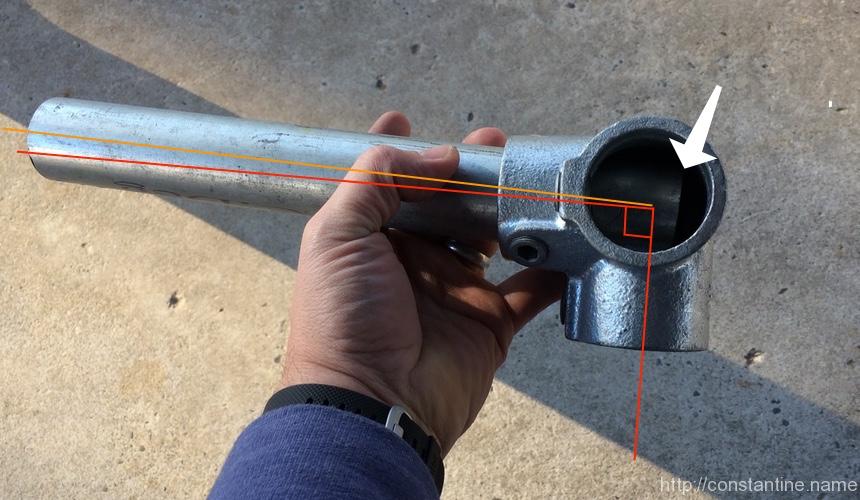
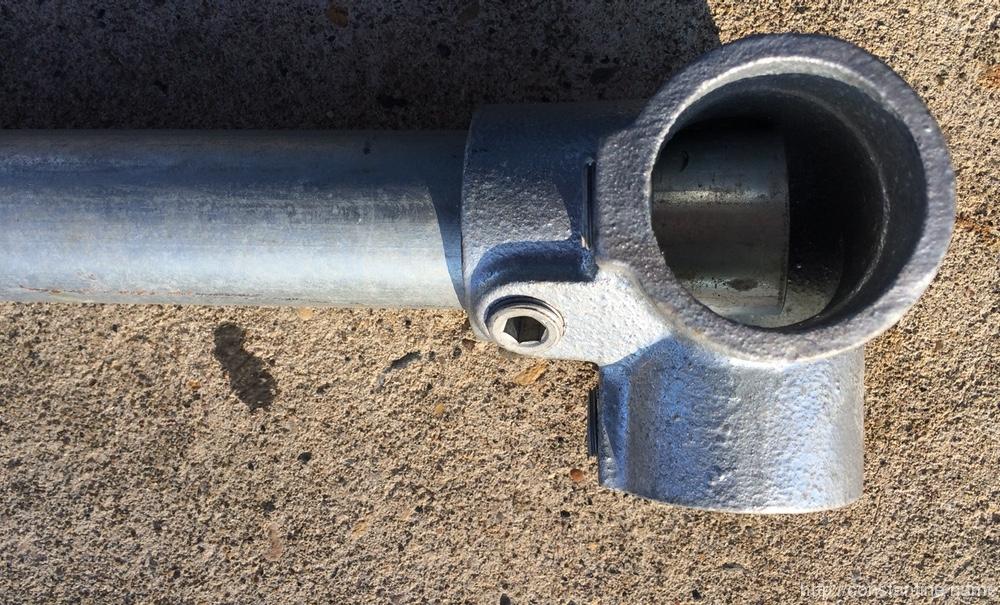
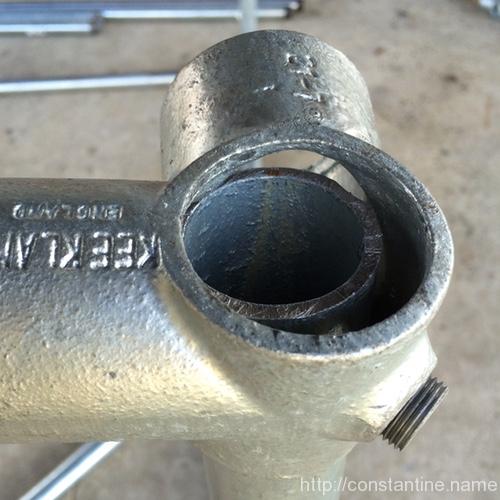
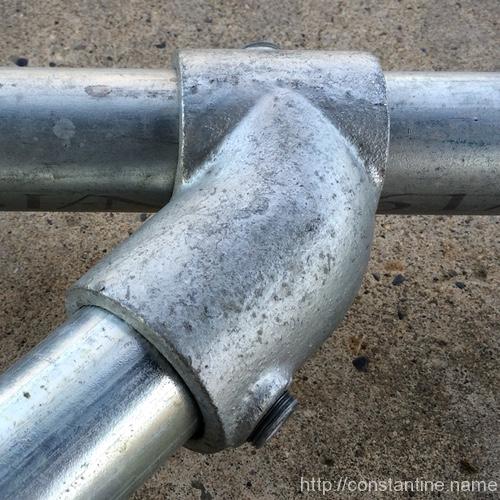
On some of the clamps, you can actually insert the pipes too far. Usually, it’s the first pipe that you insert too far. In these pictures, the first shows the pipe inserted so far that the end of the pipe has bumped into the curved body of the clamp. That’s too far! You can see how the straight line of the side of the pipe looks out of whack. Tightening the screw will not fix this; although it will get tight. You will have two problems: 1) The overly inserted pipe might be in the way of some other pipe’s space, messing up alignment/lengths. 2) Things don’t turn out square/correct because when you start tightening everything else, this clamp is fighting the additional angle added by the mis-aligned pipe. If you get it right, your pipes make nice 90° (or 45° or whatever) angles.

WRONG:

pipe_insert_wrong

RIGHT:

pipe_insert_right

Bear in mind that the problem comes up when you cannot really see the angle you’re making. You have to sort of feel that the pipe is inserted correctly, while holding a pipe up over your head, or holding three pipes at once and aligning the clamp. You’ll get the hang of it.

More depth

But wait, it’s worse. Next you have to be thinking about whether each pipe will interfere with the other pipes. So in the “RIGHT” photo above, the pipe is still inserted too far. Why? Well the pipe inserted from the bottom of the photo looks like it has enough room. But the pipe inserted from your point of view probably should go father into the body. Or maybe it shouldn’t; maybe all three pipes need to be equally inserted for this setup. My point being that you have to pay attention. First, pay attention to my assembly hints. Later, you’ll understand intuitively how “an extra pipe width here”, or “a half pipe width there”, adds up to make your assemblies fit, or not fit. If I have included a close-up photo that shows the ends of pipes inside a clamp, then I’m thinking the insertion depth is really important in that clamp. As we go farther along with these setups, I’ve assembled (and photographed) some mistakes on purpose, and I’ll show you how it ends up messing up the setup and how to correct it.

Lands

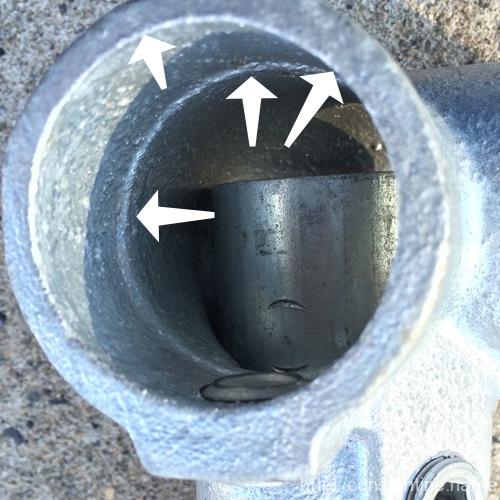
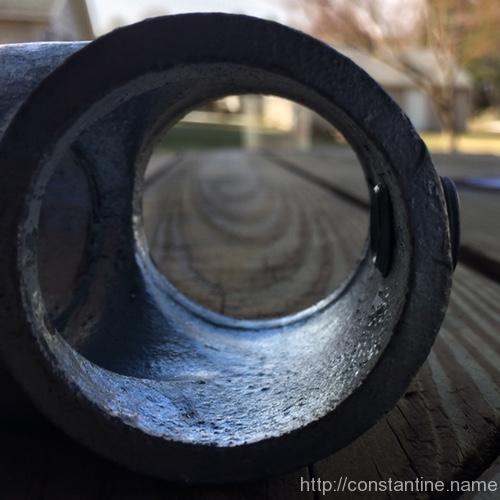
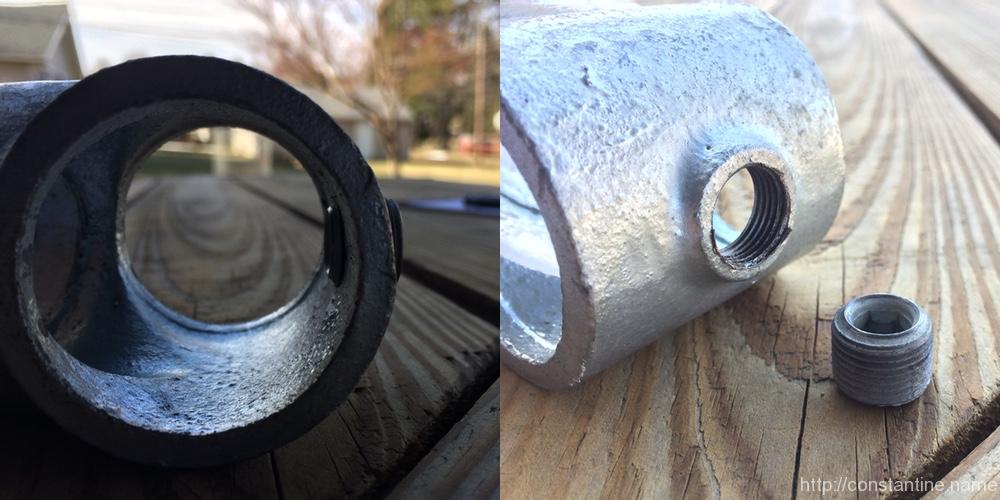
In machining, a “land” is the accurately machined part (of something) that some other thing is supposed to rest on. Pipe clamps are not machined (they are cast in molds) but they do have lands; the places where the clamp actually touches the pipe. In Kee Klamps, the lands are circumferential raised ridges on the interior of the clamp. Each set key presses on the pipe midway between the two lands; it’s like how you might press down on the middle of a board resting on two saw horses as you cut the end off. The set key is pressing in the middle, and instead of flat saw horses, the clamp has round ridges that cradle the other side of the pipe. Here are photos of some pipe lands:

IMG_1359

Above: One land deep inside the clamp is easy to see. The other land is at the very face (closest to you in this view) of the clamp. (The already-inserted pipe is surely in far enough to be over both of its lands; in fact, it might be in so far as to hit the clamp body and cause that alignment problem discussed above.) When inserting a pipe in this view, the set screw will drive the pipe upward until it touches both lands, at the top of the photo.

IMG_1375

Above: Lands are the extreme nearest and farthest sides of this clamp. Set screw is pressing from the right, so the pipe will touch the lands on the left. Also, the pipe will have to go all the way through (protruding slightly) on both sides of this clamp.

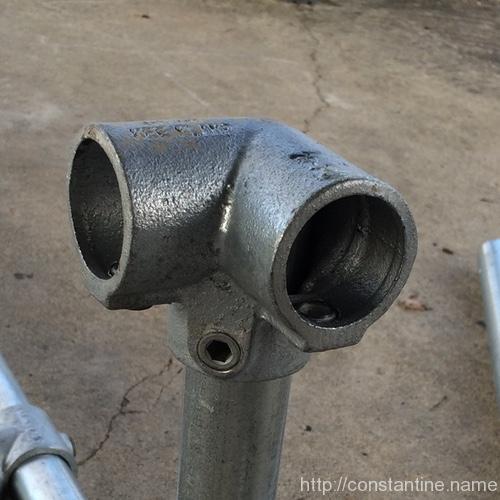
In the next photo is a similar clamp where the pipe is not through (upwards towards the viewer) far enough to reach the land at the top opening of the clamp. This pipe could wiggle loose. As it is now, tightening the screw will drive the pipe into the clamp body. It looks like the end of the pipe will touch the clamp body where the body is rounding from one side-out to the other side-out. There, the body is curved (convex) enabling the pipe end to wiggle; compared to the land (concave) at the pipe opening face which would cradle the pipe.

IMG_1403

Next is just another shot of a clamp, its lands and the set screw on the bottom. Remember, you have to understand, and insert the pipes correctly when you cannot actually see what’s going on.

IMG_1458

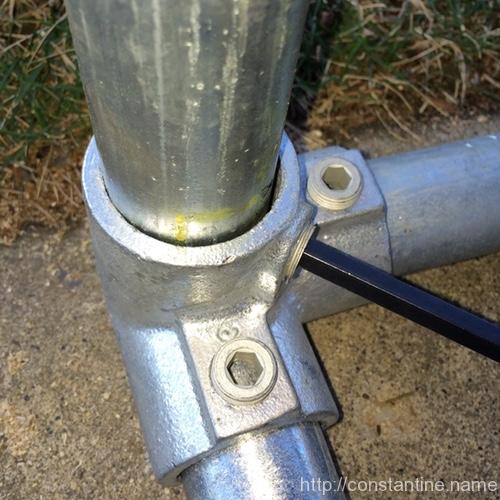
Once you get the feel for this, you’ll recognize when you have it right. The pipe will be loose in the clamp initially. As you tighten the screw, the pipe will move to the opposing side of the clamp. Ideally, if you have it all lined up right, it reaches the lands at the same time (or things are loose enough that the clamp pivots easily to bring the second land into contact). When you do it wrong, you get one land, and the pipe hits the clamp body or the mis-aligned clamp just torques against the screw-and-one-land. That’s a recipe for wiggling-loose.

At this point, you should see why you don’t simply stuff the pipes into the clamps as far as possible and then tighten the screws. It’s all about having sufficient insertion depth to reach the lands.

Next is a photo of “this looks good”. It’s a good sign when all the space is on the side with the screw, and you can see the pipe is flush up against the other side (i.e., against the land). What you cannot see, but have to feel, is whether the pipe “registered” (i.e. “found it’s correct location”) when the end of the pipe in the clamp was driven to its land.

IMG_1364

One last item: Now that you know where the six lands in this clamp have to be, you understand how you could choose how far extra to insert the pipes. Any one of these three could be inserted (roughly) an extra half-pipe-width to occupy the central hollow of the body. Or, all three could be democratically not inserted beyond the interior land.

Mastery

In the next photo, you should now have an “a-HAH!” moment about why the threaded pipe ends are a bad thing. (Which, we’re only dealing with because this is “getting started with scaf on the cheap.”)

IMG_1488

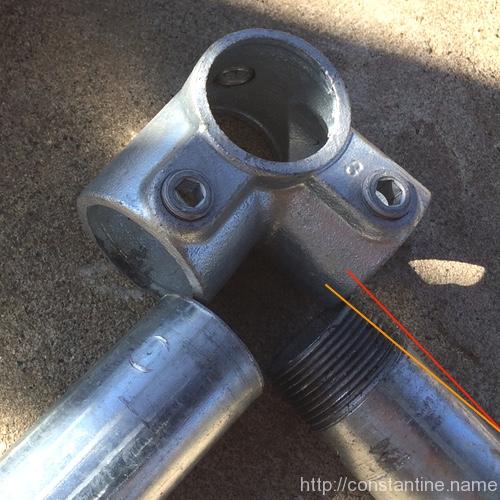
I’ve drawn the red line parallel to the pipe’s side and offset a little so you can still see the pipe. I’ve drawn the orange line parallel to the threads (and offset a bit so you can see the threads.) Now, the pipe on the left could touch the inward land at the end of the pipe (because no taper). But the pipe on the right has it’s diameter reduced slightly by the thread cutting producing a tapered end. So if you put the threaded pipe in so the threads just reached the inward land then the pipe (or the clamp) will be pulled slightly on an angle as the pipe end has to be driven just a smidge farther to reach the land.

So it turns out that if you know this little detail you can do things like orient all the 3-foot pieces (which all have a thread on one end) the same way, and insert them all father into the clamp body so the unthreaded pipe body reaches the inward land. To do that you have to not insert some other pipe into the clamp and occupy the middle space. You’ll see an example of this in the first build. And this little trick about how to insert threaded ends just a little farther only makes sense once you understand lands and how the clamps work.

Look away, insanity ahead: So know you understand that pipe threads are bad for our scaf build. What to do? Easy, buy all your pipe by the bundle via freight without the threads. (Wee! …thousands of dollars.) Or, on the longer pieces where an inch doesn’t matter (you know, those 7-foot pipes Depot cut for you from 10-foot sticks) just cut the threads off the end of each pipe with a hacksaw. Or cut all the threads off all the pipe and deal with the fact that your scaf all has an inch missing here and there. Or, go full-on insanity mode, buy a lot of extra pipe from Depot, cut all your scaf pipe in perfect integral-foot sizes withOUT the threads, and recycle all the odd-sizes you end up with. (Bring the pipe home uncut, start with a 10-footer, cut off an inch, cut off a 7-footer, cut off a 2-footer, throw away the other few inches. etc. You can make a 9’10” stick, one-8-and-one-1, 7-and-2, 6-and-3, 5-and-4 if you’re willing to make a ZILLION hacksaw cuts.)

Whizardy

In the beginning, remembering which way to orient the 45° single outlet tees can be tricky (because they go onto different pipes at different times as you’re assembling). But beyond that, angle braces are actually pretty hard to assemble well.

Exercise: Let’s look at this photo and make some wild guesses about of what might be going on…

angle_braces_suck_actually

  • The set screw towards the bottom of the photo is snug. Gap is on the screw side. But probably not fully tightened because the screw seems to be a little proud (sticking out too far.) Opposing side of pipe has no gap, good.
  • No idea if the pipe is in so far that it’s hitting the other pipe, instead of resting in the inward land. Hmmm, would have to feel that as it was put together. WAIT… why is that screw so proud? Maybe the end of the pipe is hitting the upper pipe, that would twist the pipe clockwise, I can see the outside land is tight. Oh, the pipe is in too far. Or the pipe is being held by hand and that screw isn’t tight at all. Gah! …this is hopeless.
  • The upper screw seems to be not at all tight because the clamp is resting on the pipe (down toward the concrete.
  • IF the lower screw is tight, and IF the lower pipe is correctly landed, then the orientation of the angle brace is off; it needs to have it’s left end (out of the photo) moved clockwise. What? Why? …look at the alignment of the clamp at the very top edge and that side of the pipe. The whole clamp needs to rotate clockwise.

The best way to assemble these angles is to slide the clamps along their side pipes, and insert the brace pipe into both clamps at once. Then, get one end of the brace pipe on both lands (without inserting it so far that it hits the other side pipe in the tee), and tighten the screw moderately. Next, do the other end of the brace. Hopefully, you can still wiggle and shift the clamps on the side pipes, because you need to orient the brace so that both of the clamps will land correctly when you tighten the screws to lock them onto the side pipes. You will only be able to make all four lands on the side pipes touch if the corner is close to a 90° angle. Sometimes you land/clamp the ends onto the brace piece, only to discover that you can then not get the clamps to land perfectly on the side bars. But, if you get all eight lands to touch, you will have an insanely strong corner. Unfortunately, building good angle braces is something you just have to learn by doing.

Bam! You’re now a clampion. (What’s with the puns? I know, right!) But, as I sad at the very beginning, I wish someone had put all this together in one place when I started. Having read to this point, you have now just saved yourself about a year of “learning the hard way” about how to build with scaf.

ɕ
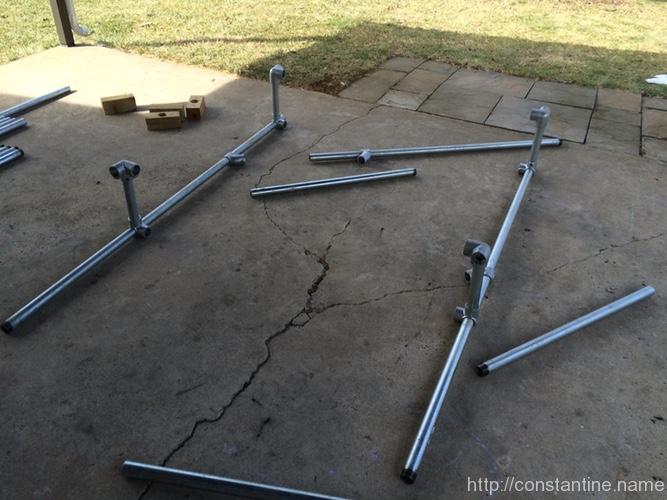
Scaf 101: The set

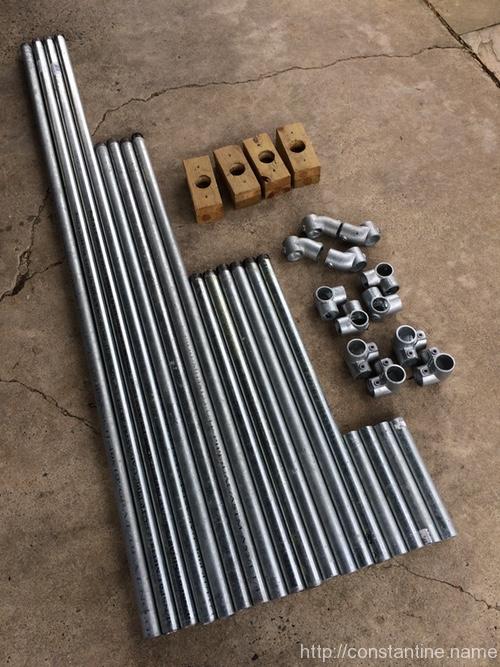
This is the set:

4 feet (8 feet if you made all the ones I suggested)
4 side out elbows (lower group of clamps in the photo)
4 double socket tees (middle group)
4 45° single socket tees (8 if you bought the extras I mentioned)
4 7-foot pipes
4 5-foot pipes
6 3-foot pipes
4 1-foot pipes

ɕ
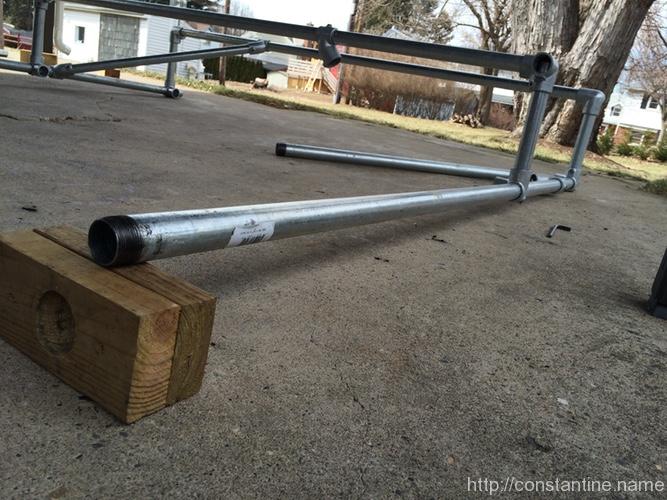
Scaf 101: Parts list

You need about $450 for everything in the set I’m describing in this series. You’ll need a bit more if you need all the tools, and want to make the wooden “feet” too. …or a smidge less if you have the tools already and skip the feet. (But I suggest you build the feet too. You’ll be happier down the road.)

Clamps

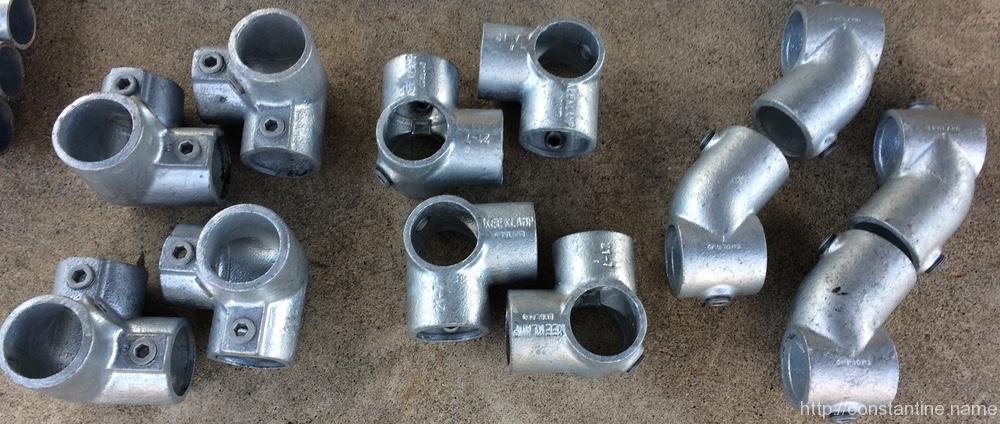
You need only 12 clamps for this set. They’re pictured below, left-to-right.

4 of Kee Safety Klamp 20-7 – “Side Outlet Elbow”, Size 7 aka 1-1/4″ Dia. $17.50 each

4 of Kee Safety Klamp 21-7 – “90 Degree Two Socket Tee”, Size 7 / 1-1/4″ Dia. $14.00 each

4 of Kee Safety Klamp 12-7 – “45 Degree Single Socket Tee”, Size 7 / 1-1/4″ Dia. $15.75 each

kee_clamps_examples

The best place I’ve ever found for clamps is Global Industrial. Here’s the link to the Kee Safety family of clamps:

http://www.globalindustrial.com/g/storage/fittings-framing-rail/Kee-Klamp-Fittings/galvanized-kee-klamp-pipe-fittings

Currently, you have to choose brand “Kee” and then choose pipe size “1-1/4” to narrow the page down to showing just the clamps you want. The 12 clamps listed above are $170 (circa Feb 2016). When they add tax and shipping, the total comes to just under $200.

Skip to the exciting part: No don’t. But I will say, if you have just a little extra money — about $65 more — buy four additional 45° single socket tees. Way down the road, in the later builds, I’ll mention, “Hey, you’ll notice you have some 1-foot pieces you’re not using in this build! If you have those extra 45°, add a brace here…”

Pipe

7 pieces of 10 foot, galvanized steel pipe, size 1-1/4″, ~$220.

(The “breakdown list” is further down explaining the lengths to cut it into.)

Pro-tip: Steel pipe is dirty, and the threaded ends have grease on them. Don’t expect to simply toss this stuff in your car. Almost all of it will fit in a trunk, but the 7′ long pieces may give you trouble.

When I first bought this pipe it was about $23, then it was $27, and most recently $29. Since this pipe is just standard schedule 40 pipe, you can call around and price shop. But remember, you need someone to cut it for you, or you have to do a LOT of hacksawing. You definitely CAN get a better per-foot cost, but you may have to buy “bundles” of pipe. As a bonus, it won’t have any threads on it. But the pipe will be longer than 10-feet lengths, and probably delivered as “freight” by a truck. Again, the whole point of this series is to get you started on the cheap. So just buying 7 pipes from Depot is the way to go. (But don’t take my word for it, call around.)

Home Depot will cut the pipe for you. The pipe is sold with threaded ends. (They receive it that way. They don’t sell it without the threaded ends.) They charge $1 to cut the pipe AND put threads on the ends. Depending on the employee, they may cut the pipe for free (since threading the ends is the tedious part). But, if they charge you $11 for the eleven cuts (see below), be happy. $11 is WAY better than hacksawing steel pipe.

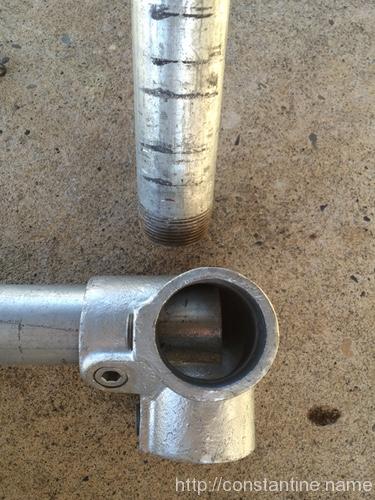
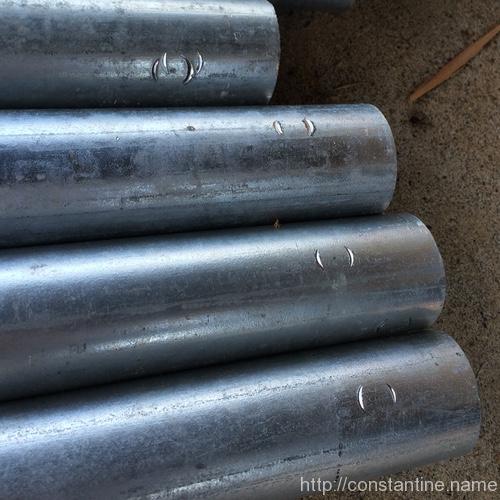
One last note about cutting the pipe. If you have Depot do it, they use a machine that grabs the pipe and spins it (it makes sense when you see it done.) The machine leaves a few little marks in the pipe. You can feel them, but they’re harmless.

clamping_marks

Tools

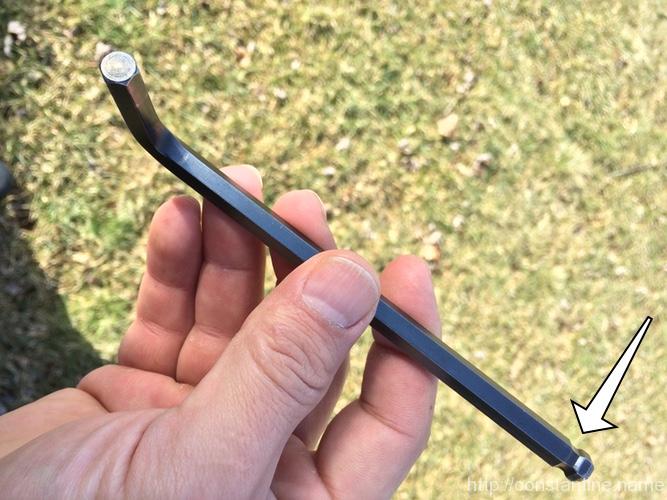
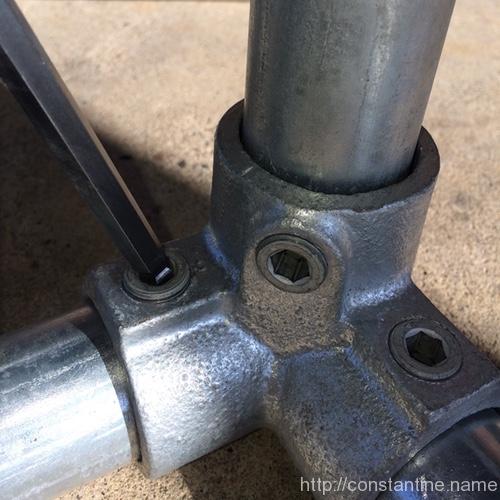
You need an 8mm Allen wrench. You’ll be happier if you have more than one because your new scaf set means you’re going to have new friends who you can put to work. Does this really need explaining? …fine, here’s a photo of a hand model holding a wrench:

allen_wrench

See that neck on the end of the wrench? That allows you to insert the wrench on a slight angle and spin it quickly with your fingers. Really handy to keep the upper L-bend from swinging into pipe/clamps — you’ll discover that happens ALL THE TIME, and is why people use rachet wrenches after a while of this. Seriously Craig? You took a photo of the angled Allen wrench? Yeup:

angled_allen_wrench

You can use a regular wrench as pictured, which has the advantage of keeping you from over-tightening the screws. The downside of this little wrench is you have to work pretty hard and it’s tedious to use.

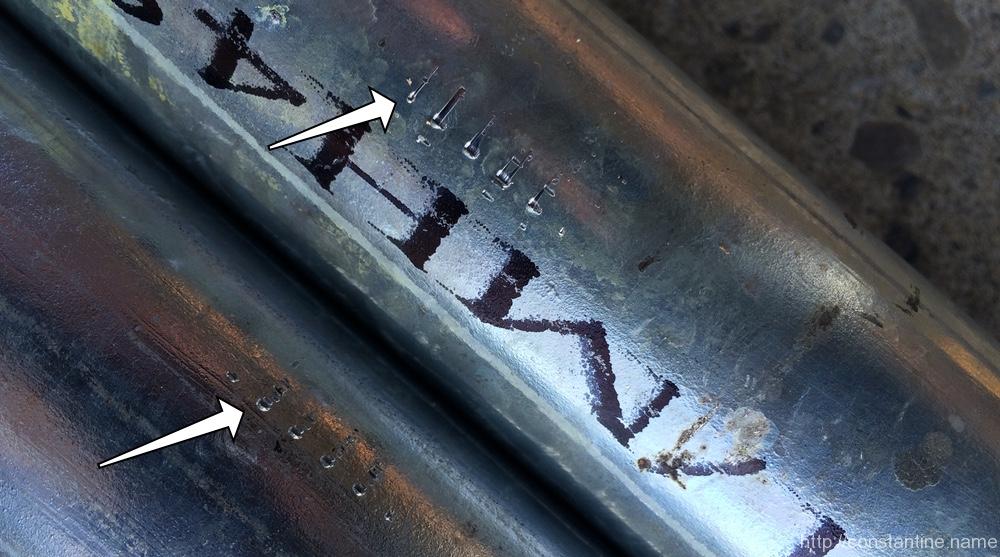
Euphamism alert! The screws cut little pairs of curves into the pipes, making the scaf pipe look less sexy. The light marks (shown below) from reasonably tight screws I like to call “set screw kisses”, and the really deep gouges — that can sometimes cut your hand (none shown below) — from really tightened screws, I like to call “set screw hickies”. Yes, I’m a simple creature, easily amused.

set_screw_marks

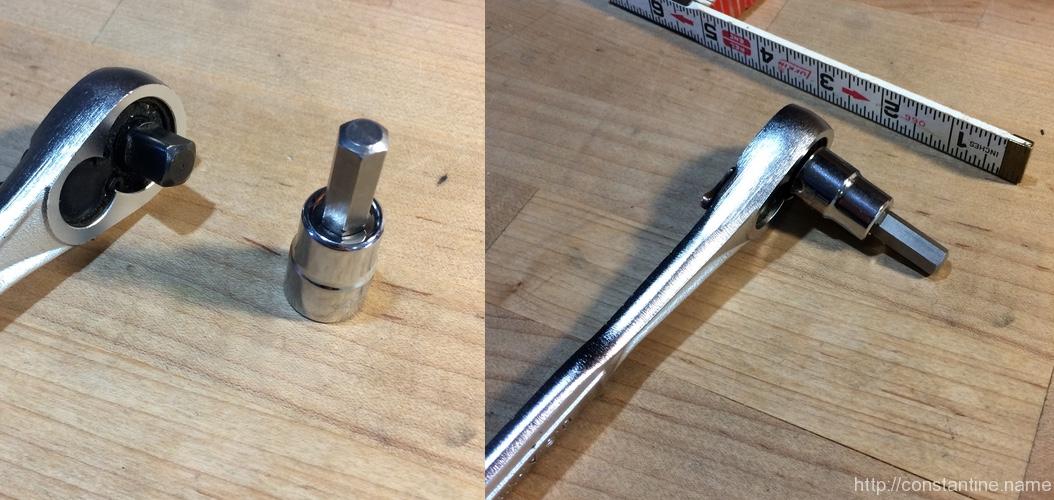
Alternatively, you can buy the Allen driver to fit into a standard ratchet wrench if you already have one of those sets. The 8mm socket attachment should come as a 3/8″ drive socket – meaning it fits the “medium” sized driver. (Some people also buy the 3/8″-to-1/2″ drive socket adapter so they can put the 3/8″ drive socket onto the large, 1/2″ drive handle.)

IMG_1528

One last word about those set screw “kiss” marks: On the ends of the pipes, it’s not that big of a deal. The pipes will almost always be hidden inside clamps. But some of the clamps you will be positioning in the middle of the pipes. If you tighten the screws really hard, you make deep marks in parts of the pipe that you WILL be later stepping or grabbing. Experienced scaffers (did I just invent a word?) are more gentle on mid-pipe clamps, returning to snug them later, rather than tightening the daylights out of them immediately.

Break down

You need to make the following cuts. The employee at Depot is unlikely to appreciate the four, one-foot cuts. I recommend smiling, being polite and asking nicely. :)

Cut 2 pipes in half (i.e. at 5 feet.)
Cut 4 pipes at 7 feet.
Cut 1 pipe into 4 one-foot pieces, and 2 three-foot pieces.

You’ll end up with 18 pieces of pipe:
4 x 7′
4 x 5′
6 x 3′
4 x 1′

R&D digression: A bit about how I came up with this set: I have PILES of scaf and clamps. What I did was come up with small sets of parts and then figure out what I could build. I kept adding/removing/changing the pipe/clamp combinations to see what could be built. I also kept in mind that starters have to buy 10′ pipes; doesn’t make sense to go, “oh, we need just one more 4-foot piece” when they then have a 6-foot “extra”. So it’s a balance of cost, what you can cut from 10-foot pieces and how many clamps are needed. Way WAY at the end of this series I’ll mention a few places where having a few more 45-single outlets would let them add some bracing in the setups where they are not using the little 1-foot pieces. You can toss a little 1-foot angle brace in almost anywhere and it makes for bomber builds. I digress.

Extra credit: Feet

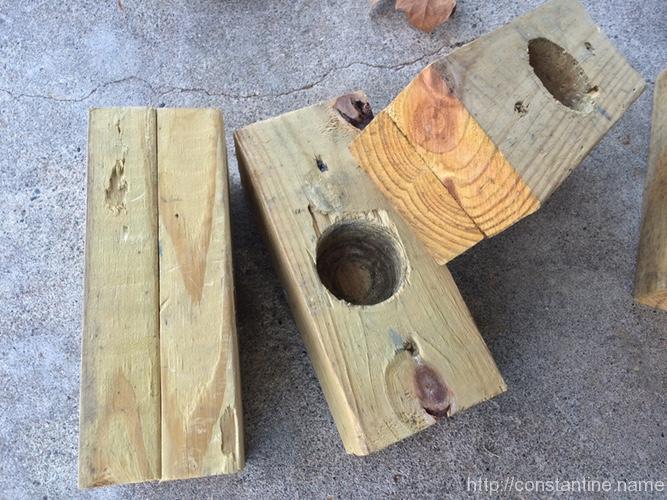
I bought a pressure treated 2×4 and made feet for the scaf. If you’re setting it up on concrete, the pipe WILL dig up the concrete when you have it set up certain ways. (The “A” frames for laché, the “railing” setup where the pipe ends rest on the ground, etc.) If you have these feet, you can just set the pipe ends in the feet.

scaf_feet

Mark out 8, 10-inch cuts on the 2×4. Use a 1-3/4″ (or whatever) hole saw to drill through 4 of the pieces. Then cut the 2×4 into pieces and screw them together. Viola!

Pro-tip: If you’re making feet, make more than 4 because the 2×4 is plenty long. You’ll use the feet down the road when you have more scaf. A lot of scaf designs I see have clamps and pipes right down on the ground to avoid the naked pipe ends resting on the floor/ground. Well, if you have feet for those pipe ends, you have a whole range of options where you move the pipes up from ground level (changing clamps of course) to give you more intermediate bar options. It will all makes sense once you are fully addicted to Pipe Culture. Anyway, if you want to go full out, make 8 feet (mark 16 10-inch pieces, drill through 8 of them) and you’ll use them on my last example setup.

ɕ
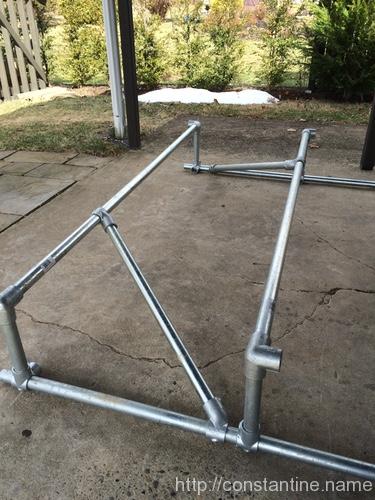
Scaf 101: Introduction

This series of posts (12 total, navigation is at the very bottom of each post) is intended to give you enough basic information to get started with scaf. I’m going to give you a specific list of things to buy — what I’m calling “The Set” — while trying to keep the cost as low as possible. I’m also going to show you a number of completely different things you can construct using the set.

In the initial posts, I’ll assume you know nothing and I’ll explain everything. As I show various setups, I’ll initially explain every step of assembly so you understand how to put things together without killing yourself (by working too hard, or by dropping pipe on your, or your friend’s, head). I do not recommend skipping to the end because the instructions on the later setups assume you understand what’s going on, and they only mention the “this is unusual or interesting” parts.

Once you spend some time building, and playing on, scaf, you’ll understand what is easy to build, what is hard to build, what is pretty stable and what is not. But how do you get started? The hard part is figuring out what should be the very first pile of stuff you buy. You want enough to have fun and options, but not more than you need, because scaf gets very expensive very quickly. VERY roughly, it’s almost $20 for every clamp, and almost $3 per foot of pipe.

This entire set is about $400 and will build you some really neat setups. There is a detailed parts list and buying instructions/links in the next post in this series.

Safety

Hey! Let’s get this out of the way now…

This sh*t is DANGEROUS. Seriously. You have been warned. I’m not being hyperbolic here.

The easy-to-get pipe used in this set comes with threads cut into the ends. The threads are razor-sharp. (The clamps cover the ends of the pipe.) I know what I’m doing, and still I’ve cut myself many times.

Steel pipe is heavy. If you lose control of even a seven-foot piece as you stand it on end, it will KILL someone if it falls on someone’s head. But what about pinched fingers and dropped-it-on toes? …I’ve had too many to count. Plus the old (not funny at all) slap-stick humor of carrying pipe, turning and striking someone with the end behind you. Steel pipe is heavy. There’s no “oops, sorry bro’,” just lacerations, crushed fingers, concussions and broken bones.

…and there’s the danger of the clamps working loose. You are planning to jump on, step on, swing from and generally use this NOT in the way the manufacturers intended. You have to learn how to align the pipe in the clamps, (or everything will wiggle loose even more quickly). You have to learn how tight to make the clamps, (so as not to break things, but tight enough to hold). You have to be smart enough to check and tighten things occassionally.

…and THEN there’s the danger of falling OFF the scaf. Or having it topple over ONTO you, or with you ON it. …or IN it.

Terminology

Back on day one of my Life With Scaf, this was very confusing and I wished someone had written a getting-started guide. So, here it is:

Kee Safety Klamps – This is a brand name of a type of pipe clamps. There is a whole collection of clamp types with neat names like “side outlet elbow”, “90 degree two socket tee”, etc. The set I describe in this series contains just three types of clamps that will get you started. As you buy more — and you will buy more because scaf is a highly addictive habit — you’ll have no problem figuring out what the other clamps are for.

kee_clamps_examples

Set screw – Each clamp has several screws (one screw for each pipe the clamp accepts) that are threaded into recesses in the body of the clamp. You will need an 8mm Allen wrench to tighten them. Clamps come with their set screws but there’s no wrench. This isn’t IKEA. (More on wrenches later.)

kee_clamp_set_screws

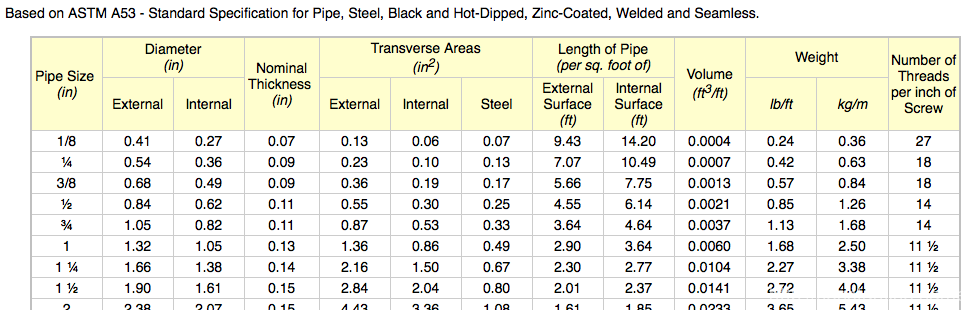
Schedule 40 – You don’t really need to know this, but it’s common to encounter the terms “schedule 40”, and “schedule 80”, when talking about scaf pipe. A “schedule” is a giant table of specific details like exact dimensions, and strengths for each of the various sizes of pipe. It’s used when building engineered structures where they’re computing loading for realsies with math. What we need to know for this series is that you want “schedule 40” pipe. (If anyone should ask you, that is.) Schedule 80 is much heavier, and therefore stronger, but is the same EXTERIOR size. So it fits all the same clamps as schedule 40 pipe. Down the road, you might want to shell out for a special schedule 80 pipe or two if you’re doing a lot of gonzo bar precisions or something. Anyway. You’ll have a good understanding of schedule 40 pipe after you play with this set. The longest pieces in this set are 7-feet, and they’re going to feel pretty nearly “bomb proof”.

steel_pipe_schedule_40

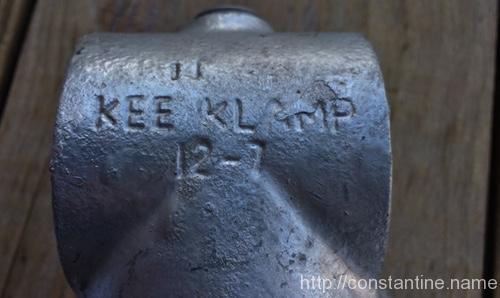
1-1/4″ pipe – The least obvious thing about scaf is what size do you use? It turns out that this size is the best balance of weight, cost and strength. So the most commonly used size is “Size 7″. (For clarity: That is the seventh pipe size in schedule 40, also the seventh row in the table, and is known as 1-1/4″ or one and one-quarter inch.) Home Depot or other Big Box stores will just label it as 1-1/4”. Here’s the confusing part: There is NO dimension on 1-1/4″ pipe which is 1-1/4″. The interior diameter is close to 1-1/4″. Anyway. Just learn: “Size 7, otherwise known as 1-1/4″ pipe.” Kee Safety clamps have their size molded into their body; They have two numbers, like “20-7”, meaning clamp style 20, size 7. Again, after you play with this set, if you ever encounter a clamp that’s not size 7, it sticks out like a sore thumb. (I once received a pile of clamps in a box, and there was one number 8 incorrectly included… it was instantly obvious.)

kee_clamp_markings

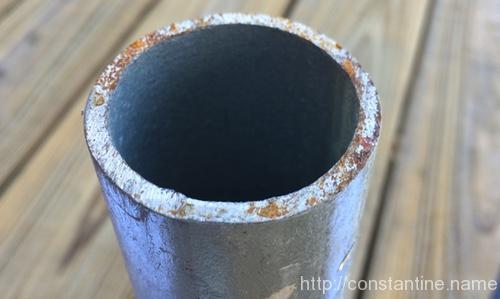
Galvanized steel – You want “galvanized steel pipe.” You will also find “black pipe” at your local Big Box store. Do not use “black pipe”. For one thing, it feels different to the bare hands, and I like it less. For another thing, it will rust if you have it outside. “Galvanized” means the steel is coated with some Zinc. The Zinc will corrode away before the steel rusts, and black pipe is NOT galvanized. For yet another thing, I have NO IDEA about the strength of “black pipe”. When you cut pipe, you expose steel which is not galvanized, and lo and behold! …it rusts. The pipe in the photo never got wet, that’s just good old humidity and oxygen doing their thing. (“Rust never sleeps!”)

galvanized_pipe_cut

Summing up

We’re building this scaf set with size 7 Kee clamps, an 8mm Allen wrench, and schedule 40 galvanized steel pipe.

ɕ
6,000 slides

A couple years ago I started this project of scanning slides. About 3,000 slides in, I thought I was done… and then more slides were found. So, this is, I think, really and finally the end of scanning. I am now working through tagging the…

Crash, burn, reboot

Workout catchup…

…ok, so yes, I’ve been sick, but I’m still a slacker. This past week, I went to the doctor and got some good cough medicine to improve my sleep. Friday I was feeling better and coughing less, so I talked myself into going out and trying to finish the 30-reps, second-half of the workout I had split in half the previous week. So I got that done, but, ….brrrrrrrrr CHILLY!

Bar-precisions…

This is challenging again. My latest scaf setup has higher bottom bars. Used to be about 4 inches off the floor — scary as hell when you start out, but at the low height, it’s nearly impossible to hurt yourself if you slip long or short. New setup has the bars about a foot high, so this is again SCA-RY when you slip or don’t have your feet where you want them. Also, the current setup makes the bars rock-solid. So the old setup you could pre-load the bar flex just before jumping and then the landing bar is nice with just a bit of flex. Now, if you don’t do the legs correctly on the landing, it’s a bone-jarring bang when you land. Anyway, just yakking about an exercise that I’ve tweaked just a bit and is suddenly a fresh challenge.

Squats…

Hip ROM is one of my current “projects”. I’ve been working (desk-type work) on the floor in my living room using my coffee table as a desk. It’s like japanese-style living :P I’ve a couple yoga blocks to sit on as a starter-crutch and I cycle through cross-legged, one-straight, seiza, etc to work on hip ROM/flexibility. I usually run a 15 minute or so timer as I work and then shift to a couple of minutes of working on a flat foot squat. So doing body-weight squats is ever-so-slightly easier. I can take a bit-wider-than-shoulder stance and do a full squat to seated, but up into multiple sets numbers it starts to feel tight in the knees and then I let my heels unload… I’m thinking going forward I should keep the heels planted and just not squat all the way down. (Would also increase the difficulty on the descent as I’d have to do more negative work to stop before the movement limit. Probably also a good thing.) As soon as I unload the heels (even the slightest) I can feel that I’m no longer pushing the hip/ankle ROM like I could be. So I think just stopping before the last few inches of squat depth would yield more results in hip ROM. I can take a *wider* stance, but then it seems the knee pull/torque comes to my attention *sooner*.

Pullups…

These are definitely a “can do” exercise now. Getting better velocity/acceleration from the dead hang, and the consistency of height, and height in general are slowly improving. (I don’t dead hang most of them — I prefer to run up and down with the shoulders/lats remaining activated at the bottom.) I’m convinced the next step in my progression is to shave off a bit more dead weight. There’s 5, maybe even 10, pounds I can easily drop just by paying attention to carbs. So I’m off to try and get that in the coming weeks.

Related, two weekends ago I did my first ever “climb up” in perfect form. Basically, a fingers-over-top wall grab, feet on the wall, arms fully extended, pull up to max height and with the last of the momentum, hop your hands up on top of the wall, so the heel of you hand can bear weight. Haul your chest forward (low) over the top of the wall so you center-gravity moves into where you can push up through the dip part of the lift. Never managed the fluid hand transition before as a continuation of the pulling movement. It’s crazy difficult; the transition of hands is pretty easy, but if you do it and end up too low, you’re not able to tricep-push your way out of the dip (because the wall is in your way in front of you) …can make for a smash-your-chin/face train wreck if you mess it up. ANYWAY, my point is, pullups are really paying off in some of the functional movements that have been on my list for years. The grip-strength gains alone are crazy-useful.

Now for the problem: My right forearm is no longer sore/aching in general. Before this two-week-ish sick break, I could make the muscles ache just by making a fist and flexing my wrist pinky-side. That’s healed/gone away. But as soon as I start pullups, that exact muscle/area complains. I did 6×5 on Friday and it was a consistent “you better cut that out”. So again, losing a few pounds would help.

But my workouts require getting 70+ pullups in to make the 10k goal. I have the general strength/stamina to do it in an hour-ish workout, but it’s going to trash that right forearm if I go at it. So I’m going to experiment with a few things: 1) Banking pullups indoors; I have a smaller sized bar indoors versus the 1-1/4″ scaf pipe outside that is way harder to grip. So doing 5 or 10 reps, a few times through the day will allow me to vastly reduce the pullup reps when I do the “main” workouts. (Bonus, reduces how much I have to take my gloves off to do pullups outside… fr-fr-fr-fr-icking cold scaf pipes!) 2) Changing the grip; perhaps switch to the easier chin-up grip on one side. I’m not sure if its better to switch the right grip to not aggravate the muscles, or switch the left grip so I can do more work on the left to lessen the load on the right. I’ll also try removing pinky finger from the right grip since that corresponding side of the forearm muscle is the part that complains. 3) shift the hanging position (eg slight archers) to just load the left side more.

So, lots of work remains with pullups.

Worksheet/workouts…

Snapshot attached with usual-looking plans for next week. Bearing in mind that for the pullups, I’ll be working on banking reps in the day(s) before each workout.

Screen Shot 2016-02-13 at 11.45.08 AM

ɕ

Setbacks are inevitable

Last weekend I trained exceptionally hard all weekend. Monday and Tuesday were tired, sore and broken-down recovery days (as exepected.) But by Wednesday, it was clear I was also sick. booo.

Screen Shot 2016-02-06 at 7.21.14 AM

So all week I did nothing other than some stretching/yoga-esque recovery work. (In addition to moving and reassembling the scaf on my patio.) All week I was sore, achy, and just felt like there was “no gas in the tank”.

By friday, it was pretty warm(-ish) and I was getting cabin crazy with the new scaf setup still unused. So I tried to go out and do one of the full workouts. It was a planned workout, just now about a week behind schedule. It called for 70s of everything. Well, my right forearm didn’t feel up to it, and I was just really low on energy. (I’m pretty confident the forearm pain is in the muscle, very close to the tendon, but not the actual tendon nor the attachment point.) So instead I made it into a really low intensity workout of just 40 reps… Just enough to put some numbers up on the board. I also mixed in some light work, like moving firewood (in small arm loads) and cleaning up the patio just to move around and get my heart rate up.

I’m feeling better today, so I’ll see what plays out. Some friends are coming over this afternoon to play on the scaf.

In my worksheet, I’ve just been “pushing” the workout numbers forward rather than spend time juggling all the rows in the future. Once I have some idea how long it’ll take to get back up to speed, then I’ll rework the schedule. So I’m not actually going to try to do all those every-day workouts that seem to be scheduled for next week. (All the columns are identical now, so I just snapped the pushups.)

ɕ

Haulin’ the mail

Whatever it is that you think you could NEVER do, figure out how to make a small step in the direction of your goal. Take that first step. Then look back and say, “well, now that I’ve come this far, I may as well go a little farther.”

I hope someone reads this, gets riled up, and thinks: “YEAH! I want to go for a walk!” …or a run, or a 5k, or swing on some bars, or walk a flight of stairs without gasping for breath, or lower my cholesterol, or be alive to play with my grand-kids. Whatever your goal is, GO CRUSH IT!

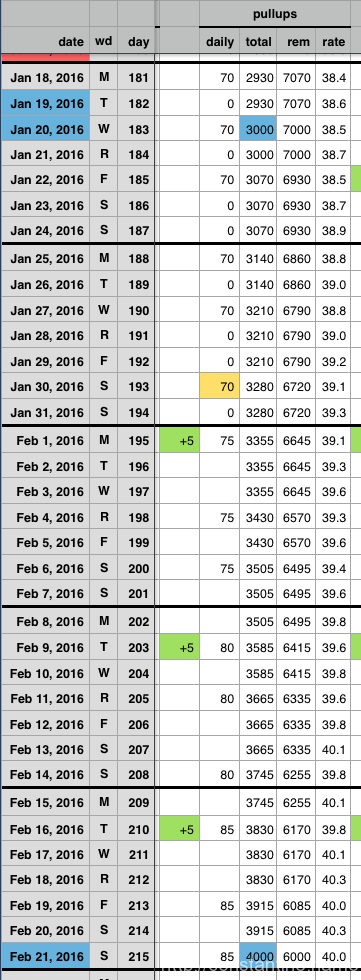
I remember when doing ONE STINKING PULLUP was inconceivable. Now I’m doing 70 — yes SEVENTY — per workout. The things that used to CRUSH me in class? …that stuff’s now my WARM-UP. Here’s a part of the worksheet that shows what’s going on with the pullups odometer. 3,000 reps is in the past (again, INCONCEIVABLE!) 4,000 is right on the horizon. Every workout through 4,000 is planned. A few more of the workouts are an identical, “all 70’s”, setup. Then, there are three weeks of bumping everything up +5.

In this screenshot, I’ve just completed January 27th/Day #190. The yellow block is the next planned workout; an exact repeat of today. There are more columns for the other activities, but now that all the activities’ numbers are in sync, they’re all the same. The pattern of workouts-to-rests is work-rest-work-rest-rest so that I have a regular, two-day rest over and over. Also, that’s a 5 day pattern so my workouts do not have the same weekdays — that’s really important to keep things from turning into “Monday’s suck” if I had a fixed weekly pattern. The double-rest also gives me a space to pull a workout one-day-earlier if I need to rearrange things, without making it into a killer two-days-in-a-row. (The things you think of when you do this for six months. D8 )

Screen Shot 2016-01-27 at 4.08.34 PM

If anyone wants the details: The workouts are a ~45 minute circuit, based around 5 sets. Pushups, squats and bar-precisions are 5×14 (that’s 5 sets of 14 repititions.) The pullups are 5×6 (5 sets of 6 reps) plus 8×5 (8 sets of 5). So I do a set of pushups, squats and bar-pre’s to get really warmed up, then do a set of pullups between each set of everything else:

SET 1
14 pushups
14 squats
14 bar-precisions

SET 2
6 pullups
14 pushups
6 pullups
14 squats
6 pullups
14 bar-pre’s

SET 3
6 pullups
14 pushups
6 pullups
14 squats
5 pullups
14 bar-pre’s

SET 4
5 pullups
14 pushups
5 pullups
14 squats
5 pullups
14 bar-pre’s

SET 5
5 pullups
14 pushups
5 pullups
14 squats
5 pullups
14 bar-pre’s

FINALLY
5 final pullups (but sometimes I just wedge this in somewhere above)
40 second handstand (against wall)
30 second handstand

When I do a +5 bump, I just turn all those “14s” into “15s” and the 5-set layout makes a tidy +5. For pullups I can add a separate set of 5 at the end, or turn 5 5s into 5 6s, whatever — I have to see what I feel like in a few weeks.

ɕ

Resignation speech of George Washington

… Having now finished the work assigned me, I retire from the great theatre of Action; and bidding an Affectionate farewell to this August body under whose orders I have so long acted, I here offer my Commission, and take my leave of all the employments of public life.

~ George Washington, from Washington’s Resignation Speech

slip:4ueese1.

December 23, 1783, from the Resignation Speech of George Washington

ɕ