Self-delusion

Delude not yourself with the notion that you may be untrue and uncertain in trifles and in important things the contrary. Trifles make up existence, and give the observer the measure by which to try us; and the fearful power of habit, after a time suffers not the best will to ripen into action.

~ C. M. von Weber

slip:4a843.


To handle others

To handle yourself, use your head; To handle others, use your heart.

~ Eleanor Roosevelt

slip:4a782.


Vulnerability

I had no choice but to let my guard down and be vulnerable for the first time. Shockingly, rather than drive my employees away, it drew them closer. Young team members actually pulled me aside and confessed that they used to think I was “superhuman,” meaning I was unrelatable [sic]. Now that I was showing my vulnerability, they said, they would follow me anywhere. The lesson: Rather than striving to be superhuman, I would aspire to be less “super” and more “human.”

~ Linda Rottenberg

slip:4a759.


Power

The most common way people give up their power is by thinking they don’t have any.

~ Alice Walker

slip:4a737.


Power

The most common way people give up their power is by thinking they don’t have any.

~ Alice Walker

slip:4a737.

Since I’m guilty of this, I often try to catch myself having power. One way I do this is to journal; If I write down, “Yesterday I did these 12 things, and people said such-and-so about my having helped them,” that’s glaring evidence that I’ve affected the world by exercising my power.

Another way I try to catch myself is to zoom farther out and look for longer-term successes. So if—for example, just sayin’, askin’ for a friend—one feels they cannot affect change in the world, but the evidence after 7 months is that one created the spark that ignited a community… well, maybe I—err, not me, my friend should stop thinking they have no power.

And instead start asking: What could I do in the next 5 minutes?

My answer: I could write one blog post which might inspire someone else!

ɕ


Inner knowledge

Make yourself proud. I think we spend too much of our time trying to please everyone. And we forget that it’s all already within. Your instinct, your inner child, your soul, all of those know what’s good for you and the world. The public opinion of your friends and strangers online, not so much.

~ Jérôme Jarre

slip:4a711.


Before the fall

Pride is generally an emotion encountered only when looking backward. But we can also experience it when looking forward to each day, each month, each year, each decade, and even to the end of our life when imagining what we were able to accomplish in that time.

~ Chris Bailey from, What do you want to be proud of?

slip:4uaiwa1.

I’m also familiar with, “Pride goeth before destruction, and a haughty spirit before a fall.” I’m not certain the meaning of haughty, although I’d bet that one who exhibits indignation, (anger or annoyance provoked by what is perceived as unfair treatment,) would qualify as “haughty.”

And I sometimes joke that “indignation” is my other superpower.

All of which, I suppose, it a good thing. There are situations where indignation is righteous. But I’m well aware that my indignation—when it flares—is not. So maybe this exercise of looking forward could be a way to refine my pride? If I imaginatively project forward I can consider something I’d be proud of. Then, if I imagine not succeeding at that something, the pride disappears… and does indignation appear?

Does that seem right? …if success or failure in something, which is never actually in my control—reminder: the dichotomy of control—determines whether I experience pride or indignation, is that something actually one worth pursuing?

Could I find instead something about which I’d feel pride regardless of success or failure?

ɕ


Refuge

Keep this refuge in mind: The back roads of you self. Above all, no strain and no stress. Be straightforward. Look at things like a man, like a human being, like a citizen, like a mortal. And among the things you turn to, these two: Disturbance comes only from within—from our own perceptions. That everything you see will soon alter and cease to exist.

~ Marcus Aurelius

slip:4a702.


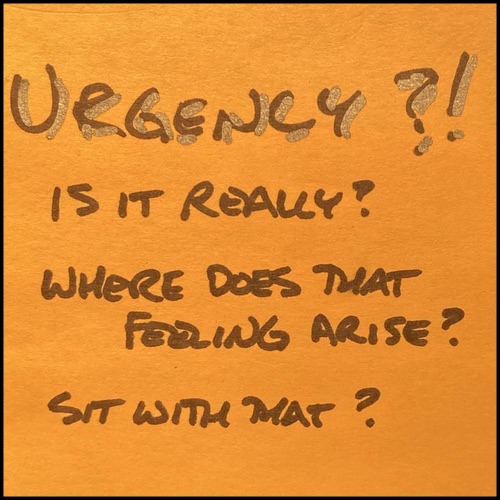
Urgency

As always, I continue my project of self-improvement. I’ve long been aware that I take on too much— and yet, all efforts to “take on less” only seem to lessen the problem; Like pulling Dandelion weeds but not getting the entire root out. I’ve made an insane effort in countless ways over several decades to make progress towards “take on less.” I’ve long known there must be something underlying.

I love to use a tool I refer to as a “wedge”, to affect changes by altering the normal sequence of things. A wedge can be used to create a space for consideration, to divert my thinking, or to initiate (or change) an activity. It works because the presence of the wedge alters the mental context. My mind proceeds from idea to idea, with an evolving context for that thinking. As the context changes, it constrains—or maybe, “helps select” is a better description—what ideas are going to come to the fore of my mind next. Trains of thought develop this way. The inserted wedge causes, (if it’s done right,) enough of a shift in my mental context.

It’s really difficult to have the wedge be a thought. But orange sticky notes work well. (Until you no longer notice them, of course.)

The action of this wedge is to make me think about why I’m about to do this next thing that feels so urgent.

“Is it really [urgent]?”
…like, how a smoke detector sounding off is urgent? Okay, so it’s not that urgent.

“Where does that feeling [of urgency] arise?”

And that is where my train of thought shifts. (So far it has been every time I’ve felt urgency to do something.) Because the feeling comes from my desire for control; There are countless examples. That explains why I’m forever taking on too much.

“Sit with that?”
Sit with that realization that the urgency is a reaction to a desire for control. Sit with the knowledge that every attempt at control—all types, all sizes, all shapes, all degrees… attempted control of anything external—has never ended well for me.

That’s not hyperbole.

ɕ


refine refine refine

There are lots of places—but two in particular are top of mind—where I’m storytelling these days. There’s this very difficult form of storytelling where you have to craft an experience of discovery for someone. You have a project, and it’s on the Internet. Someone comes to some part of it. From somewhere. Maybe someone told them something about some part of it; What they were told may be correct, incorrect, useful, or distractionary. (Is that even a word?) And every single one of those variable things would be different for each person.

And I have my ideas, my wants, (what I may want this new person to do,) and my way of seeing and understanding the world and this thing this other person is experiencing. I can use language, colors, design (esthetics, affordances, familiarity, etc.,) audio, video, gamification, revealed complexity, feedback, and more.

I create something, and release it into the world. Let’s say, for the sake of argument, it is the best thing I can possibly create. Later, I look at it—perhaps after seeing someone encounter it for their first time and their having a flawed experience, perhaps after asking someone to review the thing, whatever… Later, I look at it and omgbecky I suddenly see several serious, glaring flaws. Not spelling error type “flaws” — no, this whole story is told backwards, or this isn’t the right thing to tell at this point in their journey type flaws.

I used to get petulant when that happened. I’d worked so hard on it, and now it’s clear that my best wasn’t very good after all.

But today, my reaction is the opposite. I get really execited! “Wait— slow down— I’m scribbling notes as fast as I can,” excited. I used to think, “where were you when I worked so hard on this,” and now I’m thinking, “being able to see that this thing actually sucks, is awesome because now I can make it better.”

ɕ