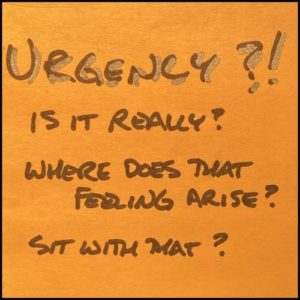
Urgency

As always, I continue my project of self-improvement. I’ve long been aware that I take on too much— and yet, all efforts to “take on less” only seem to lessen the problem; Like pulling Dandelion weeds but not getting the entire root out. I’ve made an insane effort in countless ways over several decades to make progress towards “take on less.” I’ve long known there must be something underlying.

I love to use a tool I refer to as a “wedge”, to affect changes by altering the normal sequence of things. A wedge can be used to create a space for consideration, to divert my thinking, or to initiate (or change) an activity. It works because the presence of the wedge alters the mental context. My mind proceeds from idea to idea, with an evolving context for that thinking. As the context changes, it constrains—or maybe, “helps select” is a better description—what ideas are going to come to the fore of my mind next. Trains of thought develop this way. The inserted wedge causes, (if it’s done right,) enough of a shift in my mental context.

It’s really difficult to have the wedge be a thought. But orange sticky notes work well. (Until you no longer notice them, of course.)

The action of this wedge is to make me think about why I’m about to do this next thing that feels so urgent.

“Is it really [urgent]?”
…like, how a smoke detector sounding off is urgent? Okay, so it’s not that urgent.

“Where does that feeling [of urgency] arise?”

And that is where my train of thought shifts. (So far it has been every time I’ve felt urgency to do something.) Because the feeling comes from my desire for control; There are countless examples. That explains why I’m forever taking on too much.

“Sit with that?”
Sit with that realization that the urgency is a reaction to a desire for control. Sit with the knowledge that every attempt at control—all types, all sizes, all shapes, all degrees… attempted control of anything external—has never ended well for me.

That’s not hyperbole.

ɕ


refine refine refine

There are lots of places—but two in particular are top of mind—where I’m storytelling these days. There’s this very difficult form of storytelling where you have to craft an experience of discovery for someone. You have a project, and it’s on the Internet. Someone comes to some part of it. From somewhere. Maybe someone told them something about some part of it; What they were told may be correct, incorrect, useful, or distractionary. (Is that even a word?) And every single one of those variable things would be different for each person.

And I have my ideas, my wants, (what I may want this new person to do,) and my way of seeing and understanding the world and this thing this other person is experiencing. I can use language, colors, design (esthetics, affordances, familiarity, etc.,) audio, video, gamification, revealed complexity, feedback, and more.

I create something, and release it into the world. Let’s say, for the sake of argument, it is the best thing I can possibly create. Later, I look at it—perhaps after seeing someone encounter it for their first time and their having a flawed experience, perhaps after asking someone to review the thing, whatever… Later, I look at it and omgbecky I suddenly see several serious, glaring flaws. Not spelling error type “flaws” — no, this whole story is told backwards, or this isn’t the right thing to tell at this point in their journey type flaws.

I used to get petulant when that happened. I’d worked so hard on it, and now it’s clear that my best wasn’t very good after all.

But today, my reaction is the opposite. I get really execited! “Wait— slow down— I’m scribbling notes as fast as I can,” excited. I used to think, “where were you when I worked so hard on this,” and now I’m thinking, “being able to see that this thing actually sucks, is awesome because now I can make it better.”

ɕ


Paying attention

I understand now that I’m not a mess, but a deeply feeling person in a messy world. I explain that now, when someone asks me why I cry so often: “For the same reason I laugh so often— because I’m paying attention.”

~ Glennon Doyle

slip:4a675.


Attitude adjustments

Sometimes, definitely more often than I like to admit, I need to have my attitude adjusted. Like, a giant kick in the ass, adjustment.

Someone once explained to me their self-esteem box idea. Which is, by the way, a frickin’ brilliant idea. Ever since then the idea has rattled around the back of my head. Finally, this idea gelled into something I can use. It goes like this:

Sometimes I find experiences that eject me from Grumpy Land. They are rare, but they are glaringly obvious to me when it happens. POW! Well, that adjusted my attitude. The first part of my idea is to capture those into posts here on the ‘ol blog. (It’s easy to jot a simple note and write a blog post later as I do that a lot already.) This is classic “capture” in action.

The second part is that I’ve created an Attitude adjustments tag, and I’ll be tagging those posts as such. It’s easy for me to get to that tag. (I find it trivially easy to type, off the top of my head, the full URLs to specific tags.)

…and the magic part is a little plugin I found which will bounce me to a random post for a given tag. Depending when you are reading this, there might be 1 or 100 items in that tag, so this may or may not be random and interesting: Random attitude adjustment, please.

ɕ


Freedom in every moment

One of the great discoveries of my life is that this freedom is always available to us. In any moment.

~ Leo Babauta from, Find Freedom in Any Moment – Zen Habits Website

slip:4uzeui1.

I’ve said many times that all of my problems come from me. The flip-side to that of course is that my freedom is available to me at any moment.

ɕ


Attitude and assessment

It seems likely that Jack Sparrow’s admonishment about attitude is an echo of Aurelius’s reminder to himself two thousand years earlier. This idea that the attitude and assessment is most important has really helped me relax. Things will never be done, and I create all of my problems. I’ve come to understand that concrete goals and clear progress are detrimental to my health. They’re necessary, yes, but detrimental. The more goals I set, the more clear progress I can measure, the worse off I become; Mentally and physically those things grind me down.

Since they’re necessary—without them, it seems I’d simply devolve to being a blob on a sofa—I must have something in my life which counters the damage so that I can continue setting some sane number of goals and measuring some concrete progress. One of those things is practicing my attitude and assessment. I set aside time for this each morning. It’s not meant to take long. 15 minutes is really long enough. I read through a prompt from a set that I’ve created for myself. I read through a selection from some key books. I write in my journal, usually copying a single new quote from my collection as the beginning of the journal entry. I write some thoughts. I write some observations from the previous day.

Unfortunately, just about every morning, my urge—affliction? addiction?—to measure and create goals creeps into my morning reflection. Why am I taking all this time? (I’m up to something like 4,000 hand-written pages of journals!) Am I getting benefit from all this reflection? What’s the optimum “dosage” of reflection which yields the most benefit? How do I even measure the benefit? Is that page—that one I just wrote, an instant before these questions pop into my mind—worth writing? If I read that page in a year, will it in any way help me? Is the entry for today long enough? Should it have more “here’s what I did yesterday,” type stuff, or less? Maybe I should be also making a small note on my mood, or how I feel physically? Maybe I should… Oh, crap.

Close the journal, and go on with today!

ɕ


Silent majority

The great biographer Robert Caro once said, “Power doesn’t always corrupt, but power always reveals.” Perhaps the same is true of the most powerful networks in human history.

Social media has not corrupted us, it’s merely revealed who we always were.

~ Mark Manson from, The Real Dangers of Social Media

slip:4umaso1.

There’s a lot of good—writing, concepts, anecdote, data—in this article. But the thing that leapt out at me was something I’d already known, but seem to have forgotten… or, if not fully forgotten, I’d failed to connect it to other things in my model of the world: The idea of the silent majority.

About 90% of the people participating on social networks, are not even participating. They’re simply observing. It turns out that the other 10% are the people with extreme views; not “blow stuff up” extreme, but simply more towards the opposing ends of whatever spectrum of views you care to consider.

Two things to consider: First, boy howdy guilty as charged! I’m on Facebook, Instagram and LinkedIn— but the only content I post is related to my projects. I don’t engage with anything, reshare… or even, really, participate unless it’s related to a project. *face palm* Woa! I’m literally a member of the silent majority. Perhaps you are to? If 10 of you are reading, then 9 of you are just like me.

Second, because math! If you look at the stream we all like to say, “it’s endless!” Right. There must be thousands of posts, right? I’ll pause while you do math… right. If there are only thousands of posts for me to see, I’m clearly not seeing all the activity from the millions of people. Sure, some of that is the platform filtering, but I have the feeling that the numbers hold true: If everyone posted a lot we’d have thousands of times more stuff flying around.

ɕ


The school is a surgery

The school of a philosopher is a surgery. You should not depart from it in pleasure, but in pain, for you are not healthy when you come in, but one of you has a dislocated shoulder, another an abscess, another a fistula, another a headache. And am I to come up with pretty thoughts and reflections, so that each of you will go away praising me, but with the same dislocated shoulder, the same aching head, the same fistula, and the same abscess that you brought in?

~ Epictetus

slip:4a295.


Who’s using whom

The problem is that our New Tools are winning the battle of attention. We’ve gotten to the point where the tools use us as much as we use them. This new reality means we need to re-examine our relationship with our New Tools.

~ Shane Parrish from, Don’t Let Your (Technology) Tools Use You

slip:4ufodo1.

Also see, Jaron Lanier‘s comments about the Internet in general and social networks in particular. I consider myself fully innoculated against information overload and against my tools using me.

And yet, my mind wanders. I sit down to try to write out a blog post or three, and I find myself doing other things. The majority of my disruptions these days are simply ducking into my various projects and messaging platforms. The problem is that when I do, there’s always something to do. It’s not some inifite scroll that catches my eye, but rather a new message—from one of dozens of ongoing conversations—or something I spot which can be improved.

It’s not enough to simply do only productive things. No rather, I actually do far too many different productive things. A minute here replying to this person, two minutes there improving this little feature, 5 minutes writing a bug report, 10 minutes responding to a product vendor, … where was I? Right, trying to write this blog post.

ɕ


Last vestiges

It can be hard to say no. It means refusing someone, and often it means denying yourself instant gratification. The rewards of doing this are uncertain and less tangible. I call decisions like this “first-order negative, second-order positive.” Most people don’t take the time to think through the second-order effects of their choices. If they did, they’d realize that freedom comes from the ability to say no.

~ Shane Parrish from, Break the Chain: Stop Being a Slave

slip:4ufobe1.

I think the “slavery” [to things, to money, to “more”] metaphor is inappropriate, but philosophers from Epictetus and earlier have been using it, so it’s entrenched. “Freedom” is mentioned in the pull-quote, and the metaphor also appears in the article. None the less, it connects a few different ideas together and gives good guidance if you’re new to the ideas. (Or if you could use a wee refresher.)

For me, the last vestiges of the yearning—as Wu Hsin put it—is the yearning for experiences. I am quite often restless. I often joke: “I do not idle well.” In my series on parkour-travel I even mentioned the idea of, when spare time exists, move towards the next scheduled-thing, and kill time there. I believe this yearning springs from my bias to action. As a counter-practice, I like to pause—often seemingly randomly—to remind myself: If this isn’t nice, I don’t know what is.

That phrase can get tossed around lightly, but there’s deep wisdom in it. Once I understand that this is in fact nice, right now, then when I realize that I wasn’t—just then, in the moment—feeling how nice it is… then the second part of the phrase has power: I don’t know what is. Put another way:

If I know what is nice, then this is.

ɕ