I came up with an idea almost a year ago, please steal it: https://openpodcastdirectory.org/
An open podcast directory →
Practice practice practice →
Depending on your own personal history, there isn’t necessarily a lot at stake in how you conduct yourself at a cash register. What I’m trying to get at with my idiosyncratic cashier-focused story is this: there’s a vast difference between the habit of getting by, and the habit of getting better, and you may, without realizing it, be free to choose between them.
~ David Cain from, The Difference Between Getting By and Getting Better
slip:4urage1.
I’ve not gone down the exact same rabbit hole as Cain. However, being intentional with my work on the podcast interviews is amazing—it’s the same iterative path of discovery as he’s describing.
I’ve done well over 100 interviews—indoors, outdoors, quiet spaces, noisy spaces, while healthy, while sick-ish, with shy people, with insanely energetic people, during the day, at night, across sunsets with natural light, English-speakers and English-as-second-language speakers, old-ish, young-ish, men, women, couples, teams, while working alone and with an assistant, sleep-deprived and well-rested, with the occasional tech problem, in comfy chairs with tea, in an unpadded folding chair for 12 interviews in a row, well-fed and ravenous, . . .
None of that matters.
The conversations are always amazing. Time after time, once we get into the flow state, it turns out that people are interesting— most of the time surprisingly interesting. The more I work at this, the more I’m coming to believe that the art of communication, and in particular conversation, is the single most important skill for a human to possess.
ɕ
Prompts and it’s not a test →
When you’re in a job interview, a podcast interview, a sales call, a meeting… if we take the approach that this is a test and there’s a right answer, we’re not actually engaging and moving things forward.
~ Seth Godin, from Ignore the questions
slip:4useio1.
In a conversation, if a guest slips into this-is-a-test mode, things get awkward. If I ask, “what’s something people get wrong about you,” the guest will think I’m looking for dirt, and that I want something they’d not want to share. Or worse, they wonder if I already know something, and suspect I want to drag that skeleton from their closet.
But the sort of conversations I’m interested in creating are ones where those involved are working together to create something interesting and respectful of the subject. So it’s important to create the environment where the guest naturally treats questions as prompts. It turns out that this is easy to do.
If I honestly want the good sort of interview, then my actions follow automatically. I share things about myself and doing so invites the other person to share. I take things seriously which conveys that I value the interaction and what I’m hearing. I express my interest directly by asking interesting questions; questions which show the other person I’m generally curious. Overall, I demonstrate that I’m listening because I’m interested rather than because I want to do something with what I’m about to hear.
I’m listening to comprehend; not listening to respond nor refute.
ɕ
slip:4c2co3c1.
Someone has to be the first guinea pig →
The story behind episode one is challenging. How much do we want to know? How much do we want to share about the birth of the podcast? That all plays into Episode One. I picked Adam as the first guest because I wanted a guinea pig. I had bought a Zoom recorder and some microphones and cables. There’s a guy who did our audio editing for the first two years, and I had sent him some test audio files just to verify that when I press “Record” it does what we think it does.
I had been training with Adam for years, so I approached him and said, “Hey, I’m thinking about starting a podcast. You want to sit down and have a conversation?” In hindsight, I now realize it takes a lot of chutzpah to actually say, “Okay, I’ll sit down with microphones,” but he was totally up for it. I said, “I need a guinea pig. I’m going to screw it up, and I want you to just be game for a radical F-up.” And, sure enough, now I realize the zeroth rule of podcasting is always press “Record” and then double-check that you’ve actually pressed “Record.” These days we actually have a system, because sometimes it still happens. The person who sits in and listens actually takes notes and uses the time codes from the recorder. So you have to actually look at the recorder, and if the timer isn’t running, we know that I haven’t pressed “Record.”
(more…)WebSub or PubSubHubbub →
I recently found James Cridland’s article, A Podcast Industry Guide to WebSub, or PubSubHubbub. It’s a good unpack of how the RSS-is-a-pull-service impediment to scaling is solved by creating aggregators that support pushing RSS update notifications.
…how does your podcast player notice that daily podcast is out, without polling the podcast’s RSS feed every minute?
I’ve added a link to Cridland’s article to my Deep Dive About Podcast Feeds.
ɕ
Road trip to Dylan’s →
I met Dylan Johanson in 2013. I went to an ADAPT certification course at Kutztown University run by Parkour Generations, and Dylan came down from upstate New York. He hadn’t really had a chance to train with a lot of other people, so this was the first time that he had had a chance to be in a group of roughly 27 candidates for the course, which was enormous. He was just so happy. He was basically running, jumping or laughing the whole time because he had never found such a large group of people with the same passion.
The first day he was sort of playing the, “I’m old,” card because he was in his late 30s at the time, having started parkour after quitting his previous business life. When he eventually bumped into me, it was like, “hey, fellow oldster!” We just sort of clicked, and we wound up walking from the training spots to where lunch was and back and forth. When I started doing the podcast years later, I was always thinking his story was interesting because of—as he talks about in the podcast—his early “days of the ninja”; He would just pick a straight line through Kingston on a Sunday when everything is closed and run over fences, dogs and all that.
(more…)Podcasts and good old RSS →
Once I started seriously listening to podcasts, I quickly reached the point where there are more podcasts, (entire shows, not just episodes,) than I can possibly keep up with. I’m left with the choice between staying subscribed to podcasts where I want to listen to only some of the episodes, or unsubscribing and knowing that I’m missing some gems.
…and then I remember this is all just RSS.
In my podcast player, (which is Overcast,) I now keep only the shows that are my dedicated favorites; shows that I generally listen to every episode. I moved all the other podcasts into my RSS reader, (which is Reeder.) I even added a bunch of shows which I had completely given up hope of being able to even follow them looking for gems.
This had two huge benefits:
First, it improved my podcast listening experience: Not keeping all of those podcast shows subscribed in my podcast player, means less downloading and less skipping. I don’t like having to wait, so I have everything set to pre-download, and removing a lot of podcasts makes a big difference. But even more important, there’s now much less distraction. When I’m in the mood, (or the time, or the place,) to listen to podcasts, I tend to continue listening by default. I’m more likely to listen “just a bit farther” to see if this episode is going to be good, whereas if I had read the summary I might have skipped it altogether. So my podcast listening experience winds up having far more great episodes because it’s just the shows I love.
Second, it actually leads to me finding more gems: When I open my RSS reader, (as I do every day,) I’m in “skimming mode.” I’m looking for things to queue for later reading. (Pocket and Instapaper for the win.) There’s very little effort for me to skim the episode descriptions, and when I find one that looks good I add it to my podcast player. This does require me to switch apps, search, and then add a specific episode. But this small effort helps ensure that the episode is likely to be one I would really like to listen to.
There’s one detail that is a slight snag: How do you find a podcast’s feed URL? We’re all so used to searching in our podcast player apps, but you need the actual podcast feed URL to add it to your RSS reader. You’ll discover that none of the podcast player apps, and none of the directories, (Stitcher, Google, Apple, etc.,) make it easy to find the shows’ underlying podcast URL. The easiest way to do it is to use the handy search on James Cridland’s, Podnews.net (no relation/benefit to me.) It pulls the show’s information from the directories, and explains all the details about that show’s configuration including a handy RSS link icon that has the URL.
So, unpacking this idea a bit more, with some visuals we have…
Feedbin
If you don’t already have a favorite RSS reader, the easiest way to start is to use a web site which will corral all your RSS subscriptions. It will show you a nice web front end with all your feeds together. Later, if you want to run a dedicated RSS reading application on your phone or computer, any of the good ones will let you say, “I have my subscriptions in Feedbin,” and boop! you have all your feeds: Feedbin.
RSS in action
Here’s an example of what it looks like when I encounter an updated podcast feed in my RSS reading application.
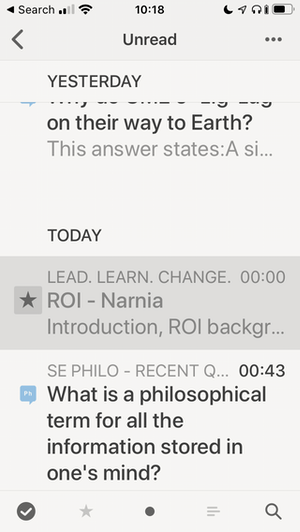
Here’s the “stream” of RSS items. Sorry, I have the font size on my phone super-huge; so this only shows a few items. But the first one, under “Today”, is from a podcaster friend’s show.
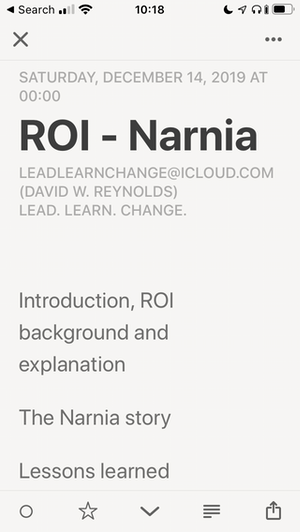
Touching it leads me to the full RSS item’s view. Exactly what you see in this view depends on exactly what each RSS feed chooses to include.
I’m still not on the web here—still simply looking at the data in the RSS feed.
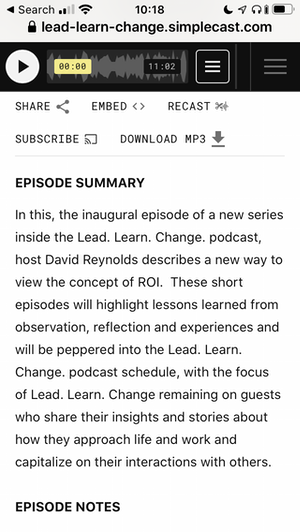
At this point, my brain goes, “oh yes! David put out his next episodes!” Let’s see what he’s written up… (swiping left) I get an in-app web browser view of the item from his web site.
I could even press play, right here, if I had 11 minutes.
If this were an episode I wanted to listen to—in my “I’m listening to podcasts” mode, as I described above—then I’d flip over to my podcast app and search for this episode and add it to my listening queue. In reality, it’s even easier: My podcast player app remembers the shows I’ve listened to before, so I can just touch the show, scroll to the episode and hit ‘download’ for later listening.
You can keep an eye on a LOT of podcasts this way—looking at their descriptions—without piling up more in your podcast player than you can possibly listen to.
ɕ
Productivity heaven →
I was recently a guest on the Productivity Heaven podcast. The host Jey Jeyendran is super-curious about productivity and podcasting. Check it out on Apple Podcasts or on Google Podcasts
Seattle and back again →
I think I may finally have reached a point where travelling is all-out pleasant. Not the sacharine, “I’m excited to be going on a vacation,” pleasant, but the really core-deep, “if this isn’t nice, I don’t know what is,” sort of pleasant.
For a long time I’ve been dutifully posting every day. It’s important to me because it involves writing and I’m a firm believer of: If you cannot write clearly, then you don’t think as clearly as you think you do. But as I departed for Seattle, I was simply okay with knowing I wasn’t going to write for a week (or more, as it turns out.)
Mind you, I get stopped by TSA every time. Even now that I’ve registered with the TSA as a known traveler, I still get “pulled aside.” On the way out, they looked for the podcast audio cables. On the way back, they wanted to see my bar of soap. Mind you, they’ve run a background check on me, and fingerprinted me to register as a “known traveler.” But at least I get to go to the speedy line for being pulled aside. And it was still pleasant. So many great things lay ahead and behind during both legs of the trip, that I was just like, “if this isn’t nice, I don’t know what is.” And, “yes sir, you’ll find the soap in that little black zipper back, in the black plastic case. It’s shaped liked a bar of soap. #sorrynotsorry about the hair.”
Driving into and out of the Cascade Mountains? Bonkers awesome. (Words fail me in case you cannot tell.)
Spending days with 100 friends old and new? Bonkers awesome.
Rustic cabin, roaring wood stove, food, conversations, 30 interviews with all the event presenters and session leaders, and the massive waves of positive comments and thank-you-s for the entire Movers Mindset project and team? Bonkers awesome.
Seattle AirBNB, coffee, 7 incredible interviews for the podcast, coffee, dinnerS with local friends, coffee, playing in Volunteer Park barefoot in “the tree,” coffee, random organic apples, coffee, more friends, more coffee? Bonkers. Awesome.
Home, then exhausted, then bronchitis and maybe some GI complications from my new friend Lyme Disease? Seriously, still bonkers awesome.
Chilly fall evening, grill going, sunset? Definitely bonkers awesome.
If this isn’t nice, I don’t know what is.
ɕ