This might get personal

these nine principles for interviewing people about tender, personal, tough subjects are tactics that are helpful in any hard conversation. You want to be clear about your objectives for the conversation, to be prepared to listen closely and actively, to prepare the person you are talking to for a different, deeper sort of exchange. You need to respect the dignity of the person you’re talking with, and respect yourself enough to speak up when you disagree.

~ Anna Sale from, Treat an Interview Like a Relationship – Transom

Whether or not you’re doing recorded conversations with guests, there’s a bunch of great advice in that article. I’m particularly drawn to Sale’s point about how her interviews are enabled by the fact that she is creating a relationship with the guest. In any conversation, everything we do either builds up, or tears down, a relationship bit by bit.

In any conversation, it’s my experience that the more intentional I am, the better it goes. Part of that is intentional listening; listening primarily to understand. Another part is being mindful of the other person; deploying empathy and compassion. Another part is keeping sight of where you are headed, and also where it is not possible to get to; knowing what to stretch for and what to let pass is critical.

ɕ

Community for podcasters

So I went and built a new thing: The Podcaster Community.

If you create podcasts — whether you’re thinking about it, just starting out, or are publishing your 100th episode — we’d love for you to join us. It’s free to create an account. Logging in enables the platform features and you can immediately begin posting/replying in the public categories.

I don’t idle well. I get an idea in my head, and I start thinking about all the ways it could be realized. Recently, I’ve had a few separate conversations with podcasters who were looking for something—what they each wanted was different. And so I set off to build it.

ɕ


Podcast fracturing continues

Exciting times! Facebook is getting into the game of making Yet Another ™ place that podcast creators will have to jump through hoops to get their podcast shows heard.

Isn’t this all so strange? I mean, shouldn’t the content creators have the power? Shouldn’t entities looking to create a business model have to deal fairly with the creators? It’s as if we, the podcast creators, are doing something fundamentally wrong…

https://openpodcastdirectory.org/

ɕ


Walled gardens are always a trade-off

To serve relevant ads and, in return, increase its CPM for advertisers, Spotify needs to know its users intimately. This means that Spotify needs its users to spend as much of their digital lives as possible in its walled garden. The quickest way for Spotify to enable this is to build a podcast streaming capability and stream all available podcasts through its music app.

~ Kay Singh from, How Spotify is Killing the Open Podcast Ecosystem

Elsewhere, this is 4usibo2. — slipbox

In the end, Spotify has managed to create a large garden and they’ve enclosed a large portion of the revenue.

The beauty of the Internet—for as long as this remains true—is that it is open. Open technology, open connectivity, open space. That means no wall garden can ever completely contol the thing it encloses. And that’s not even what Spotify wants to do. They’re simply trying to run a business.

And anyone who wants to be an independent podcaster, that too simply goes on.

ɕ


Microphones and the human voice

This is a well written article about the human voice, and how microphones really work in terms of capturing it. Even if you read this and plan to forget everything—you’ll come out *way* ahead when recording your and your guests’ voices.

Facts about speech intelligibility

Elsewhere, this is 4udami1. — slipbox

It’s full of insightful information, about the human voice:

…the voice changes spectrum in almost any other position than when we approach the speaking person with our ear – or microphone. Each position on the head or the chest has its’ own sound color – or timbre. For instance, the spectrum of speech recorded on the chest of a person normally lacks frequencies in the important range of 2-4 kHz. This results in reduced speech intelligibility. If the microphone does not compensate for this you should make corrections with an equalizer.

Important frequencies:

The important frequencies in non-tonal (Western) languages are illustrated by the diagram below. Here, the frequency band around 2 kHz is the most important frequency range regarding perceived intelligibility. Most consonants are found in this frequency band.

…and about what affects intelligibility in a reproduction of the voice:

A lot of research has been carried out in this area. In general, the results demonstrate that:

1. Optimum speech level is constant when background noise level is lower than 40 dB(A)
2. Optimum speech level appears to be the level that maintains around 15 dB(A) of S/N ratio when the background noise level is more than 40 dB(A)
3. Listening difficulty increases as speech level increases under the condition where S/N ratio is good enough to keep intelligibility near perfect

Furthermore, the 1-4 kHz frequency range should be “kept clear”. When, for instance, adding music as background for narration, a parametric equalizer cutting the music 5-10 dB in this frequency range will improve intelligibility.

ɕ


Performing with a safety net

When recording conversations for the Movers Mindset podcast the guests know I’m not going to edit what they say to change their meaning. They know I’m bringing journalistic integrity to the conversation. (I’m not doing strict journalism, but that feature of journalism is present.) I do my best to set up the correct space (physical, emotional and mental,) so that we can co-create the best conversation possible. I’m not digging for dirt, creating tension, nor trying to create any other saccharine artifice. But that doesn’t change the fact that we are performing for an audience. The final necessary piece to facilitating a great conversation is a safety net.

Each conversation… each performance is better if we can reach just a bit farther than we might normally be comfortable doing. That’s why I bring a safety net. I very clearly give the guest a safe word which they can incant at any time to take back what they’ve said.

I don’t include the guest in the post-production process. They’re not invited to review the material, or to give additional thoughts about what to keep or what to cut. In fact, the only people who have time to do that, are wanna-be cooks, who will only mess up the soup if I let them in my kitchen. Instead, I and my team do all the post-production difficult work which is in fact our responsibility. The guest already did the really hard work of being themselves on-mic.

I do also say, “take your time— silence is free and we can easily trim out 30 seconds of you thinking before you speak.” I’ve also a few other little coaching tidbits I share to prep them for being recorded. But it’s the safety net which makes them feel comfortable trying something they might otherwise hesitate about. Part of the magic of a great conversation is how it develops organically, and without the safety net most people dial their caution up a few notches to be safe. With a safety net, most people are delighted to take a leap to see what they can do.

ɕ


Some thoughts on file organization

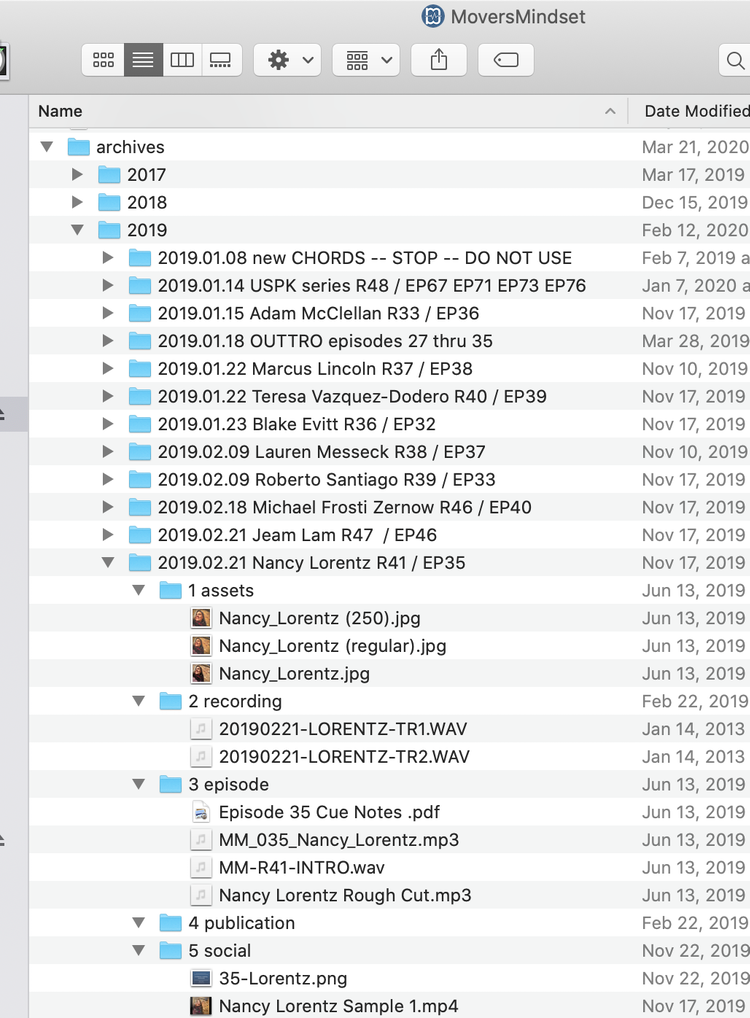
Within the team that creates the Movers Mindset podcast, we assign numbers to our projects. We use “R42” for our 42nd recording project, then R43, and so on. This enables us to start naming things from day one, in a way that we don’t have to change later. If you’re putting your files in a folder, what would you name it, that you could be sure wouldn’t change?

We also use our podcast’s initials on file names, “MM.” When we see files whose name contains, MM-R42… we know what it belongs too. It’s part of the Recording-42 project for Movers Mindset.

We also exclusively use people’s family names on files. So a raw WAV file from an interview is 20200423-MM-SMITH-TR1.wav … April 23, 2020 recording for Movers Mindset, of someone named “Smith”, and this is track one [a recording from one microphone.] 20200423-MM-SMITH-TR2.wav is track two, and so on. No matter where you toss that file, it’s going to make sense.

Eventually, a recording project might lead to one (or more!) episodes of our podcast. They get assigned episode numbers, EP56, EP57, etc. Then we have filenames like MM-EP57… and it’s always clear what that is.

Sometimes we have a dozen files to keep track of in a podcast episode and we end up with
20200423-MM-SMITH-TR1.wav
20200423-MM-SMITH-TR2.wav
MM-EP56-INTRO.wav (introduction recorded after interview)
MM-EP56-OUTRO.wav (outro recorded in post production)
MM-GCORD.wav (a little music ‘button’ used when joining bits of interview)
…the final episode is then MM-EP56-SMITH.mp3

Since I’ve typed this much, here’s another thing we do: We use consistently numbered folders to store the files. Every project has a folder, 2020.04.23 Bob Smith R42/EP56 — we create 2020.04.23 Bob Smith R42 in our archives when we do the raw recording, and at the very end we add the /EP56 to make it easier to find things. In side each project we create five folders 1 assets, 2 recording, 3 episode, 4 publication, and 5 social — the leading number ensure they sort in nice order in various displays. 1 contains anything the guest gives us (photos, writing) or any photos we take during recording. 2 is the raw original recordings, 3 is everything to make a podcast episode (intro, outro, whatever we have to assemble, AND the finished MP3), 4 is anything we create as part of publishing the episode (transcript, articles, highlights ) and 5 is anything that’s ok for social media and sharing. And then we have a multi-terabyte file server with a “few” files on it:

ɕ


Self-esteem box

Today, two thoughts popped into my head in rapid suggestion: “Self-esteem box,” and “I’ve never pull-quoted Movers Mindset.”

Brandee Laird

Craig: So for me it’s I know if I go for a walk that’s almost, not always, almost always enough to make it so I can go back into the cave of ugliness and get back to work kind of thing. So what are some things that will help you turn that corner, brighten you up or energize you?

Brandee: Yeah, that’s a great question, because I do get very dark moods pretty often actually, because with compassion comes the pain of caring so much about all these people and all this situation, it feels very futile a lot of times, like what can I do to change this. Yeah, I get there and I have a few tactics, I basically build protocols for myself for when I get in those moods. So one of the first things I go to is my self-esteem box.

Craig: This sounds like a good idea.

Brandee: And my self-esteem box is digital, it’s a digital self-esteem box and what I have done, is I have taken screenshots and copy/pasted and just dumped in all kinds of nice things that people have said, either to me or about me over the years.

So I have this file that is just full of gratitude and compliments and just stuff that I have had to read over and over and over in order to actually believe it. So that’s actually more like last resort is the self-esteem box. If nothing else works, open the self-esteem box, look through here.

Craig: In case of emergency, break glass, right?

Brandee: Totally. Totally. So that’s something I think everyone could and should do that. I guess I’ve never really told anyone about that. But it’s a nice thing.

Craig: I think that’s a really good tactic. People talk about doing gratitude journaling, but the gratitude journaling. I mean, I know that you know what it is, but gratitude journaling is a process which you have to execute on the spot when you feel like you’re having a bad mood. But the idea of having a self-esteem box is a clever one.

Brandee: Why, thank you.

~ Brandee Laird from 46’30”, https://moversmindset.com/72

I think these two thoughts popped into my head as the photo-frame on my wall changed. One of the smartest things I’ve ever done is set up a digital photo-frame. I email it photos of things—you know, all those digital photos you never do anything with. :)

Anyway. I love love LOVE my photo-frame. It’s chock full of hundreds of great photos. It’s not quite a self-esteem box. But it generally has the same effect. Every single time I glance at it it makes me smile.

Meanwhile, ever since I had that conversation with Brandee, (in September 2019,) I’ve been toying with the idea of creating a self-esteem box. I’m not quite sure where to put it [digitally] though; Also, I really do not need to make up yet another system for myself for organizing and storing things.

But the idea keeps calling to me.

ɕ


Equipment matters

I have a confession to make: even though I love sound, I don’t really like sound equipment. […] Unfortunately, my bad attitude clashes with an important truth about audio storytelling: your equipment matters.

~ Andrew Wardlaw from, Recording Kit Tune Up

Elsewhere, this is 4utare1. — slipbox

Today, more of a bookmarking post than deep thinking. If you do anything with recording interviews—or even if you just own ONE cable to charge your phone—this article is chock-full of neat ideas.

…of course, if you’re into recording, I recommend handing your cash/cards over to someone you trust before reading it. I confess I was off on a few sites hovering over the buy button on a few new toys. ;)

ɕ


Mono versus stereo

As people get started in podcasting, the question soon comes up: Mono versus stereo?

For the Movers Mindset podcast, we produce our content as mono, and not because we don’t care about audio quality—rather, because I don’t feel stereo gains me anything. Here’s a bunch of things to consider:

But first, an aside: Newb mistake with voices: Don’t put one voice in one channel, and the other voice in the other channel. This isn’t “stereo”, it’s simply a mistake.

Data file size: Stereo is roughly twice the size as mono. Two channels of data versus one, so double the size. Size directly affects download time, storage size on listeners’ devices, their cellular data usage, and relates to my personal disdain for data-size bloat on the Internet in general; all of which cause me to take that “twice the size” very seriously. If the file is going to be twice as big, I want it to be twice as good—or at least drastically better. Stereo isn’t, and so this alone is enough for me to pick mono.

Monaural listening: Many people only put one ear bud in, and some people only have one ear.

Mostly voices: The Movers Mindset podcast is mostly people talking. In fact, it’s mostly just two people talking… often just one person at a time. That single sound source is picked up by one microphone. The other voice, in one other microphone. So here again, publishing stereo gets me no improvement in the final product.

Music: is usually generated by a collection of instruments and voices and that performance does have a three-dimensional aspect. And that’s why we see music in stereo… but we also see lots of “surround sound” systems that do a much better job than a simple left-right channel setup. Meanwhile, the Movers Mindset podcast doesn’t have any music at all, so this doesn’t even factor into our decision. (We use just simple cords, played on a single guitar, recorded—you guessed it—with a single microphone. So even our “music” is already in mono.)

Immersion: If I wanted to really go all-in, to record what it really sounds like—what would it sound like if I was literally sat there—you need to use binaural recording. This involves using two microphones positioned literally like the human eardrums are. This requires either using expensive microphones that you wear in your ears, or using microphones which are built inside a mannequin head. Because it turns out that the presence of your head and bone conduction all affect how things sound to us.

ɕ