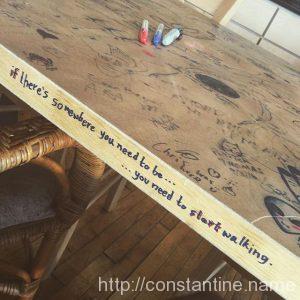
For me, fully internalizing this one powerful piece of inspiring profanity has been transformative. But I still find that returning regularly to the well makes all this work even better. So I downloaded both of the Goggins’s audiobooks and worked through them in little chunks on my morning walks over the period of a month. Then I moved on to Peter Attia’s Outlive, and Jocko Willink’s Extreme Ownership.
I really do know what I should be doing. (I have no idea if you, or anyone else, does too.) But I can tell you that even though I know… it’s still tough to do the soul-crushing work. I’ve not read any of the books above—although Outlive is on my to-read pile.
“The obstacle is the way” is not a phrase from Art du Déplacement. It’s a two-thousand-year-old comment from a Stoic (writing in a personal journal to himself.) In a similar vein, he also wrote that, “nature turns all things to its own purpose.” Likewise the more modern “Rust never sleeps,” is equally pithy.
The real lesson is of course that there’s a season for everything. Sometimes more challenge is the key to progress, and sometimes simply being is the key. (Which is also something thoroughly covered in the Stoic philosophy. And please: Stoicism is not at all about suppressing one’s feelings.) I think I learned that seasons lesson early on from bicycling. I’m from Pennsylvania, from an area of rolling, often wooded, hills. Every bike ride ever was an endless repetition of “down a hill, ’round a corner, up a hill, round a corner, down a hill, …” In a very real sense, all parts of that were equally fun.
In a comfortable, prosperous country like ours, some of the built in tendencies of Human nature tend to work against us, saying, “Hey – I’ve noticed we have plenty of food and reasonable shelter and that’s good enough. So let’s just double down on the Netflix, comfort foods, and occasional luxury purchases and that will keep us safe.” Instead, I want you to set your life treadmill to just a bit of a steeper, healthier incline setting.
I’d like to mention that “Culdesac” in that linked URL is a town’s name; You can go read that article either for the life advice, or to learn about one of several towns in the U.S. now which are being built as people-first. (As opposed to basically every other town and city which is built as cars-first.)
People who become engaged with movement in the found environment develop a new way of seeing their environment. Well, t e c h n i c a l l y , they recover a way of seeing their environment which they lost. Mountains, hills, water, stairs… and the moats that criss-cross our communities where the big metal and plastic boxes whiz along— these all become “challenging.” Walls (of various heights from knee to enormous), railings, painted lines— these all become “challenging.” And yet, I’ve had the pleasure on countless occasions to stumble into a built space which feels different. Spaces which don’t require me to see differently. Spaces which beckon me to sit, stand, move, climb, and play.
That we immediately switch to building our cities and countries around people, instead of cars.
Cars (small trucks, commercial trucks, planes, trains and ships) are tools. As I’ve said before what really matters about tools is one’s thinking and choices about tools. What I rarely hear mentioned is that tool choices also affect us. Our use of tools changes us. That’s what I really care about. How am I enabled (to do other things, to live more fully, etc), or constrained, by my choices with respect to tools? Furthermore, how do my choices enable or constrain those close to me? …in my community? …country? …world?
So the longer-term challenge is simply designing your life so that you have more of this stuff and less of the fluff. Look at every activity as you go through your day and think, “Is this contributing to getting me a better day—today—and if not, is there anybody in the world who has managed to design this activity out of their lives and still succeed beyond my level?
Luckily, this problem has a solution: I call it Getting Your Brain Back, but it is a time-honored problem that has been solved by many people in the past. Originally limited only to company CEOs and world leaders, the excess of information has trickled down to the rest of us. To survive in this flood, we need to learn how to swim, in much the same way as busy and important people have always done.
So let’s solve it. If we are really just buying feelings, who has the best ones on sale at the lowest price? Different people approach this problem with different levels of sophistication.
I remember when this sort of thinking seemed so alien. I remember when I truly believed the bill of goods I had been sold about the rat race, chasing success, consumerism, etc. Now I very explicitly use money to buy happiness. And then, having accomplished that, I move on to the important things in life.
Watching TV, for example, or playing massively multiplayer online games, can feel relaxing and even stimulating at times. But those hours spent relaxing and stimulating yourself can really add up, and when you tally the eventual sum of the life benefits, it ends up awfully close to zero. Many other leisure pursuits (complaining, ATV riding, shopping) often end up the same way.
An unexpected benefit of all this self-imposed change is that it helps protect you from forming bad habits, which are hard to change once you get them. In fact, change itself becomes the habit, which is a good one to carry with you through your life. The willingness to experience change brings opportunity, wealth, learning, and happiness for most of us who embrace it.
On the other hand, if you dump your trash in the forest to avoid paying the city’s garbage fees, or haggle endlessly with the manager at big-box store to get things for free, you’re not helping anyone but yourself. Canceling TV service and taking up the more productive hobby of reading library books is Frugal. Saving the same amount of money by voting down property tax funding for your local school system is Cheap.
There. That was a mouthful, and it makes you sound like a loser. But all of a sudden, you’re no longer a victim. Suddenly, you’ve framed the problem entirely in terms of things you can control yourself, and thus you can finally make some progress towards solving your problem.