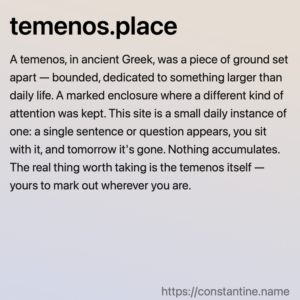
Creating my own sacred space

I’ve been working on myself a long time— structured prompts, journals going back years, books chosen deliberately. That practice is mine, and it’s working. But there’s something I can’t yet do: Know that Jesse is also in it. Or that Mike showed up this morning and set something down for me. I have no way of feeling I’m not the only one.

I didn’t want a group chat. Group chats are about response and obligation. I post, someone reacts, the thread pulls all of us back in. (Or it gets washed down the screen by all those other messages.) I didn’t want a social network either, with its metrics and its performance. I wanted something closer to what a good café used to be for writers: A place where you showed up, do your own work, and just know that others were there too. The ambient awareness of shared striving. No agenda.

The ephemerality matters. I wanted a space that wasn’t an archive. It’s not for posterity. Posts disappear automatically because the point is showing up now, not curating a record of having shown up. Presence, not pursuit.

I called it Temenos because that’s exactly what it is — a sacred precinct, a piece of ground cut off from ordinary use. Jung used the word for the protected psychological space where transformation happens. That’s the room I wanted to build. Small. Quiet. No notifications. No likes. Just the slow accumulation of people doing the work, leaving a trace, moving on.

ɕ


Discipline

What do you do when you don’t feel like it? Especially then.

~ Seth Godin, from Our practice

It’s been said that discipline is how you earn freedom; freedom in the sense of being able to do what you want with your time. Freedom, with a capital, is of course an inherent right. I tend to add systems and queues (a fancy word for piles of stuff to do) to both get things out of my head and to impose some order.

But to answer Godin’s question specifically: When I really don’t feel like doing any of the things I’ve set myself up for, I step back and survey. Because it’s usually a sound indicator that I’ve got too many things I’m imagining I’m going to get done.

ɕ


Begin it

Whatever you can do, or dream you can, begin it. Boldness has genius, power, and magic in it.

~ John Anster

slip:4a1565.


Strategy

What matters is whether a certain approach gets you to where you want to go. And let’s be clear, using obstacles against themselves is very different from doing nothing. Passive resistance is, in fact, incredibly active. But those actions come in the form of discipline, self-control, fearlessness, determination, and grand strategy.

~ Ryan Holiday

slip:4a1558.


Two different purposes

There’s two different main purposes for routines, and advice-givers mix them up. They lump these two quite different things under “morning routine” and it causes trouble when you try to design your own.

~ Mckinley Valentine, from The Whippet #185: Shielded and flower-like

slip:4utesi3.

Partly, I include this because The Whippet is a sometimes quirky, often insightful, but always interesting little missive that I enjoy following/reading.

But also, WAIT WAT! …how is it I’ve never heard this idea/distinction before? Scroll down about 2/3 in issue № 185 to find this neat stuff about habits.

ɕ


What if I just did the thing?

Another interpretation is that everyday life, for most people, is an untapped gold mine. Certain undone tasks represent huge gains, waiting just a short time away, behind one session of elbow grease. Even ten or fifteen minutes of directed effort, judiciously applied, can improve your life far more than the wages you earn for the same period.

~ David Cain, from Fix Three Broken Things

slip:4urafi1.

It’s interesting to note that I only just read this, this evening… after fix a table on my patio today. Yesterday, I grouped together a pile of errands—four different stops with multiple “I need…” for different chores and repairs at each stop. The table is a hulking cedar and steel pipe beast. I need some wood putty, and spar varnish. Today, I got out the sander and mixing little work sessions, with other things, I worked through various sandpaper grits, wood putty iterations, and 3 coats of spar varnish. I did an “80%” jobs at every step of the way. By tomorrow it will be completely dry and ready for use again. I use it every day spring through fall, and this couple hours of work will now yield—probably—3 more seasons of unfussy use.

I also used the rest of the little can of varnish to slap a coat on the garden gate.

What’s next?

ɕ


Start the clock

I sometimes talk about “moving forward” as a default mindset I have. For example, all other things being equal, go to the airport and wait in the terminal, not a home. But in the end, it all boils down to my having deeply apprehended the lesson that the first 90% of everything is vastly easier than the second 90%. So I generally tend to do-now, rather than wait.

It struck me that this has become a kind of dividing line between success and failure within my team. Those who haven’t worked out haven’t been able to start the clock or return the ball very quickly. It’s not just my team—it’s a source of frustration that fills the letters and dispatches of just about every great general, admiral, and leader throughout history.

~ Ryan Holiday from, You Can’t Succeed In Life Without This Skill – RyanHoliday.net

slip:4uryyo1.

Unfortunately, in my case, do-now can become a millstone upon which one can be ground to oblivion.

ɕ


Discipline

I’ve recently started reading a book about the importance of having exactly one thing upon which to focus. As with priority, becoming priorities, focusing on exactly one thing soon becomes two, and then three. Suddenly, it’s 23 things. And since the first 90% of any thing is vastly easier than the second 90%, in short order I’m busy, overwhelmed, sprinting in multiple directions. As the Russians say: Chase two rabbits and you’ll catch neither.

Do you want to be the artist who loses their joy for the process, who has strip-mined their soul in such a way that there is nothing left to draw upon? Burn out or fade away—that was the question in Kurt Cobain’s suicide note. How is that even a dilemma?

~ Ryan Holiday from, The Indiscipline Of Overwork

slip:4uryte2.

To answer Holiday’s first question I say emphatically, no! Thus I’m currently well into clearing the decks of multiple focuses. I’m imagining endings for things, major pivots and minor adjustments. There’s a great quote from Epictetus about how any idiot can steer the ship when the wind, sea and weather are good, but in challenging times all it takes is but an instant of distraction to lose the whole ship.

ɕ


Resistance

Opinions are strongly divided about Pressfield’s concept of Resistance. And yes, some days I do find myself over in the Resistance-is-bullshit encampment thinking: No, Resistance is not real. It is important and meaningful for me to be spending my time rearranging these deck chairs, polishing this silverware, sorting these shelved books, getting the edge of my lawn just so, tagging and organizing all these blog posts… And then, “Curse you, Resistance!!

For myself, I was years into the act of having a practice before I even thought about its efficacy as a strategy to overcome my own Resistance. Resistance was (and is) a given for me. It wakes up with me. I know I will have to face it every day, and I know it will never diminish or relent or go away.

~ Steven Pressfield from, A Practice and Resistance

slip:4useaa1.

I’ve been looking for a word to replace “professional” in my regular usage. (Please hit reply if you’ve got one.) I’ve given up on changing how others perceive the words I say; People take professional to first refer to getting paid for one’s efforts. But by professional I mean—and this is the way Pressfield uses the word—competent, skilled, assured, and approaching mastery. Steve Martin is talking about that sort of professionalism, not about money, when he says, “be so good they can’t ignore you.”

Why do I care? Because with the concept of getting paid pushed aside, then professionalism can be used as a razor for cutting through resistance. I simply consider my practices (left for another day is the discussion of whether or not it works to have more than one practice) and ask the question: Would a professional do this?

Yes, a professional would take time off for this restorative activity. No, a professional would just ignore these deck chairs. Yes, a professional would spend 3 days writing software tooling so 10 years from now this stuff is still organized and useful. No, a professional would not stoop to that level. Yes, a professional would totally get this part pitch perfect.

ɕ


Rhythm

Simply put, all of my problems stem from trying to jam too much into each day. Partly that’s from my having too many ideas. But mostly that’s from insufficient self-awareness to let things go. Over a few decades I’ve steered away from the typical schedule (and it was never anything like a 9-to-5 job.) But I’m still on a strict sleep schedule, with strict light hygiene practices, and no alarm clock. I sleep in utter darkness, and I awake as the room lighting slowly comes up to full brightness—a mimicked sunrise. But I’m still clinging to set times.

Sometimes I break routine by staying out, or up, past my usual bedtime. Sometimes I’m traveling and staying with others. In either case, I don’t seem to have trouble bending my sleep schedule. I’m often the first person to “crash”, but other than that, with a bit of balance-the-total-sleep-time over-sleeping… I feel pretty normal the next day.

All humans, animals, insects and birds have clocks inside, biological devices controlled by genes, proteins and molecular cascades. These inner clocks are connected to the ceaseless yet varying cycle of light and dark caused by the rotation and tilt of our planet. They drive primal physiological, neural and behavioural systems according to a roughly 24-hour cycle, otherwise known as our circadian rhythm, affecting our moods, desires, appetites, sleep patterns, and sense of the passage of time.

~ Karen Emslie from, Broken sleep

slip:4uaeea13.

Except for how much I can get done. On those “next days” where I’ve been off my rigid sleep times. I get vastly less done, and not just because there are fewer hours in the day when I sleep longer in the morning. In fact, the more I glimpse that other world—went to bed whenever, slept until the right amount of time… and then face a less-productive day. The more I realize, that is the better amount of things to attempt to accomplish: Sleep on a healthy, light-driven cycle, and do half as much in the day.

ɕ