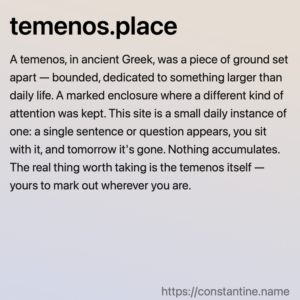
temenos.place

A small marked enclosure where a different kind of attention is kept.

A temenos, in ancient Greek, was a piece of ground set apart from ordinary use — bounded, dedicated to something larger than daily life, and respected as such. Not a temple, necessarily; just a marked enclosure where a different kind of attention was kept. People went there to do something they couldn’t quite do anywhere else — pay attention to what was hard to see in the noise of regular life. The marker around the place mattered as much as anything that happened inside it.

Temenos.place is an instance of one. A small daily instance. Each day, one thing appears on a page behind this one — a sentence, a question, a quote. Anyone who’s joined can sit with it. They can leave a short reply, where the others can see it but no one responds to it. Tomorrow the post is gone, the replies are gone, a new one is there. Nothing accumulates; there’s no archive, no body of work being built, no count of anything. People can show up today, or not, and either is fine. There is nothing to fall behind on.

The thing worth taking from this page is the temenos itself, which is yours to mark out wherever you are. A notebook, a chair, a corner of a morning, a daily walk — anywhere you decide that a particular kind of attention will be kept. If reading this gives you the word for something you’ve been doing already, or the permission to start, that’s enough.

ɕ


Access to a temenos

It’s important for us to remember in our own journey to self-improvement: one never arrives. The sage—the perfect Stoic who behaves perfectly in every situation—is an ideal, not an end.

~ Ryan Holiday

For me, the first glimmer of my own access to a temenos (the ancient name and clarity of the place’s meaning and utility came much later) was when I took up a daily reading practice. At first, I selected a physical book designed to be a daily devotional, and later I’ve bent all my daily reading into digital formats. The key point being: I needed to anchor my daily habit in an analog context, away from all the digital addictions I had developed. Later, once the habit was the thing I enjoyed more than the digital distraction, I was able to bend digital tools to my use.

As opposed to how digital tools normally (by their creators’ designs) bend you to their use.

ɕ


Creating my own sacred space

I’ve been working on myself a long time— structured prompts, journals going back years, books chosen deliberately. That practice is mine, and it’s working. But there’s something I can’t yet do: Know that Jesse is also in it. Or that Mike showed up this morning and set something down for me. I have no way of feeling I’m not the only one.

I didn’t want a group chat. Group chats are about response and obligation. I post, someone reacts, the thread pulls all of us back in. (Or it gets washed down the screen by all those other messages.) I didn’t want a social network either, with its metrics and its performance. I wanted something closer to what a good café used to be for writers: A place where you showed up, do your own work, and just know that others were there too. The ambient awareness of shared striving. No agenda.

The ephemerality matters. I wanted a space that wasn’t an archive. It’s not for posterity. Posts disappear automatically because the point is showing up now, not curating a record of having shown up. Presence, not pursuit.

I called it Temenos because that’s exactly what it is — a sacred precinct, a piece of ground cut off from ordinary use. Jung used the word for the protected psychological space where transformation happens. That’s the room I wanted to build. Small. Quiet. No notifications. No likes. Just the slow accumulation of people doing the work, leaving a trace, moving on.

ɕ


Temenos, part 2

Today one can conduct an interview on the phone or via Skype, but ideally, in order to truly foster reciprocities of rapport and insight in a meeting, one requires a live countenance and a quiet physical space-like the ancient Greek temenos, with its sacred enclosure or holy grove or magic circle— in which an interview can live and flourish.

Jonathan Cott, xiv, from Listening: Interviews, 1970-1989

There’s this word, again!

I’d spotted it previously… and it came to mind during Steve Heatherington’s monthly podcast call. I was reminded of it by his discussion of telic. But I couldn’t exactly remember the the word temenos at first. I am certain I first heard it mentioned in an episode of Boston Blake’s Mythic podcast, but I couldn’t find a reference to a specific episode (on my blog or by searching.) Then I realized the word appears in the Introduction to a terrific book. Which was also literally sitting on my desk… a crazy confluence of events.

When I first encountered it, I’d not thought of it in the context of what we podcast hosts do for our guests. But Cott makes it crystal clear.

ɕ


Temenos? What’s that?

Me, the other day after hearing a brief mention of a new-to-me-word on a podcast: “Is there a Greek work, something like (sounds like) tem-in-oss, that has to do with a special protected place of healing, particularly out in nature?”

ɕ

You’re likely thinking of temenos (τέμενος), pronounced roughly “TEM-eh-nos.”

In ancient Greek, a temenos was a sacred precinct or sanctuary—a piece of land marked off and dedicated to a god or gods. These were often places of worship and healing, particularly sanctuaries dedicated to Asclepius (the god of medicine), where people would go for ritual healing practices.

The term literally means “a piece of land cut off” (from the verb τέμνω, “to cut”). These sacred spaces were set apart from ordinary use, often located in natural settings like groves or near springs, and served as protected places for religious activities, healing rituals, and refuge.

In Jungian psychology, Carl Jung later adopted “temenos” to describe a protected psychological space for inner work and transformation—which connects nicely to the original sense of a sacred, healing precinct.