Someone has to be the first guinea pig

This entry is part 4 of 4 in the series The interviews from my perspective

Adam McClellan / Episode 1

The story behind episode one is challenging. How much do we want to know? How much do we want to share about the birth of the podcast? That all plays into Episode One. I picked Adam as the first guest because I wanted a guinea pig. I had bought a Zoom recorder and some microphones and cables. There’s a guy who did our audio editing for the first two years, and I had sent him some test audio files just to verify that when I press “Record” it does what we think it does.

I had been training with Adam for years, so I approached him and said, “Hey, I’m thinking about starting a podcast. You want to sit down and have a conversation?” In hindsight, I now realize it takes a lot of chutzpah to actually say, “Okay, I’ll sit down with microphones,” but he was totally up for it. I said, “I need a guinea pig. I’m going to screw it up, and I want you to just be game for a radical F-up.” And, sure enough, now I realize the zeroth rule of podcasting is always press “Record” and then double-check that you’ve actually pressed “Record.” These days we actually have a system, because sometimes it still happens. The person who sits in and listens actually takes notes and uses the time codes from the recorder. So you have to actually look at the recorder, and if the timer isn’t running, we know that I haven’t pressed “Record.”

(more…)
Sedimentation and erosion

I have this image of our home as a bunch of related-rates problems: There’s inflow and outflow. Energy: In through my electric meter, out through lighting, waste heat and heating/cooling, water heater, etc.. Climate control: Heat flow in from heating/cooling system, the wood stove, the sun, versus losses through the attic, windows, doors, etc.. Mass: The balance of the rates of the flow of all the stuff.

Ever stop to think of that? Think of your home as a sealed balloon which has two, (or more of course,) doors, (garage doors count,) through which everything passes. Everything—no exceptions—passes in first, and then out second. Everything–every single thing, including the people–is only inside temporarily. The people come and go most frequently, (some pets might exceed some people I suppose,) and some things might remain inside for decades. But still, inside only temporarily.

You know that at some point you, (and everyone else if you share your home,) will go out for the last time. You might carry some things with you on your last exit, or you might arrange for someone else to come in, (and go out and in and out and in and out one last time,) to remove things after you go out for the last time. And of course eventually the entire structure will be removed and certainly at that point, everything you brought in—everything that was temporarily still inside—will go out at that point.

Where does everything you carry in from the market and grocery store go? Where does the furniture go? The books? The nick-naks? The packages and packing material from purchases? The clothes? The postal mail? The firewood you carry in is vastly more massive than the ashes you carry out; where does all that mass go?

Based on how the things around me make me feel, I know I have too much stuff. When I think of our stuff this way—as just a mass of stuff that’s temporarily inside our home—it’s much easier to keep my life under control. Too much stuff? …all I need to do is make sure more goes out than comes in, on average, and the problem will subside.

…and I can have fun with it. If something breaks, is worn out, or I’m done with it, that’s the outbound mass for today! Can I recycle this random thing? Can I FreeCycle this random thing? I no longer feel bad about sending things out, (wether that means landfill, recycle, giveaway, whatever… as appropriate.) Instead, I now find I feel bad about bringing things in. Each time I consider buying something, I think: Do I want to bring that into my life?


I am not my work

“I am not my work,” is one of those aphorisms that I need to have etched into my cornea. Have you seen watermarks on images? I need this phrase watermarked directly onto my vision.

Long ago–if memory serves–I was motivated by extrinsics. Doing something well resulted in external confirmation; so generating that external confirmation was easy for me. But–as everyone knows–it’s a vicious cycle of saccharine sweetness. Eventually, that lesson was learned. The obviously better option is to be intrinsically motivated. Check. Got it.

Unfortunately for me, there’s another onion-skin layer to peal away below, “be intrinsically motivated,” which is to not take criticism of work done as criticism of myself. The immediate hack is that I’ve inserted a mandatory, “thank you,” in response to criticism. This doesn’t fix the problem of identifying myself with my work. But it does buy me a few moments. By the time I’ve said thank you and acknowledged the critic, it’s become possible to see the criticism as being ‘of the work.’ Crucial moments indeed.

ɕ


Presented without comment

Buy less, buy better. Notice the materiality of the things you use. Live in your body. Feel the ground when you walk. Chop wood, carry water.

~ David Cain, from We Are Not Materialistic Enough

slip:4urano3.

Go read this. In fact, go read everything on Raptitude.

ɕ


Antler-locked

Today, it’s alarmingly easy to find yourself antler-locked with some remote, faceless person who’s trying to tell you that universal healthcare is a communist plot, while you’re waiting for your potato to finish microwaving. This facelessness turns up our impulse to argue even more. You may have noticed it’s a lot less pleasant to argue with someone when you can see their eyes.

~ David Cain from, The Art of Letting Others Be Right

slip:4urate14.

I find it, in fact, so unpleasant to argue with people that I’ve effectively given up the effort entirely.

The first phase comes of self-reflection once you think you might—at least some of the time—be wrong. The second phase comes when you realize that your sometimes-wrongness might apply to the interactions with other human beings. Phase three is when you wonder why it is important to change the other’s mind. Phase four is when you stop judging people at all.

This has the side effect that you also give up trying to get people to stop arguing at you. If I don’t argue, then the other person assumes their idea has carried the argument, when in reality I’m focused on how delightful my iced tea is, or the weather.

I’m reminded of the ages of roots, fire, water and air that I mentioned a few days back; Once you start flirting with the age of air, the only person left to argue with is oneself.

ɕ


§21 – It’s all about love

This entry is part 33 of 37 in the series Study inspired by Pakour & Art du Déplacement by V. Thibault

For me, what defines a human being is the combination of our intellect, our self-awareness, and our mortality. Developing the first two, and in particular becoming comfortable with the third takes a lot of time. It’s clear to me that there are seasons to our human lives. The best description I’ve heard is that of four seasons: roots, fire, water and air, corresponding to beginning, actively carving one’s path, learning acceptance and understanding, and finally wisdom. (This is obviously a variation of the four, classical elements.)

Frequently over the past year I’ve found myself thinking about the transition from the season of water to the season of air. What would the season of air feel like if I experienced glimpses of it from the season of water?

I believe I have an answer: Understanding self-love.

To come to grips with one’s own mortality requires a deep apprehension of the temporary state of our existence, and I now believe understanding self-love is the doorway to the age of air.

ɕ


On splitting

Caution: seemingly disjointed thoughts ahead, followed by unifying insight.

I hope.

I’m pragmatic and rational with the usual dose of emotions thrown in, because, human. I also find that I too often ignore the messaging coming from my body and my brain. I sometimes get into deep work on something technical, and I have trouble knowing when I should stop. (Answer: A few hours in, at a place where I know what I should do next. Never work until stuck; Don’t stop there.) I push everything too far and then crash mentally, or even physically.

I’ve recently found I have Lyme disease. “Boooo!” But the treatment—at least, the initial treatment option—is a simple antibiotic called Doxycycline. “Yay, modern science!” Which I take twice per day on an empty stomache and it makes me pretty nauseous. “Booooo,” (more vociforously.) I usually eat dinner by 6:30pm, and the evening 8:30pm pill isn’t usually bad. But the 8:30am pill on a totally empty stomach is nausea-roulette about 40 minutes later.

Splitting is the name for all-or-nothing thinking: You’re either with me, or against me. This project is suceeding or failing. I am a sucess or a failure. Partly this comes from focusing on outcomes; I set lots of goals, and I set them high on purpose, so usually I don’t reach them. “Booooo,” combined with some splitting leads to, “I suck.”

In Stoic parlance, a “dispreferred indifferent” is something you do not prefer, and over which you have no control and are therefore indifferent to the outcome. (Stoicism crib notes: Almost everything is an “indifferent” since you fully control only your own thoughts.) Vomitting around 9am every day is definitely a DISpreferred indifferent. I can drink plenty of water, I can pay attention to my posture, (unexpectedly it drastically affects my stomach reaction,) I can avoid laying down, I can avoid getting up, etc. …and it’s still nausea-roulette.

I have had a superlatively enjoyable week since starting this medication.

Wait, what?

Seriously. Something about having this [actually quite minor] regular nausea thing seems to be treating my splitting thinking. “Oh, nice it’s time to work on this cool thing I want to see suceed!” “Oh, nice it seems to be time to vomit!” “Oh, nice that was just a wave of nausea!” “It’s really going to be hot outside today, but it’s cool on the patio for now. Nice!” “Oh, are we vomitting now? That’s nice too!” “Oh, I have an idea for something to do this afternoon. Nice!” It seems to have all just run together into this general state of, “nice!”

Ok, yeah, that may be pretty messed up. But, gotta go, it’s 8:30.

ɕ


Are you self-aware

The following is from Bruce Lee’s hand-written essay entitled, The Passionate State of Mind, which I discovered in the Artist of Life by J Little.

To become different from what we are, we must have some awareness of what we are. Whether being different results in dissimulation or a real change of heart—it cannot be realized without self-awareness. Yet is is remarkable that the very people who are most self-dissatisfied and crave most for a new identity have the least self-awareness. They have turned away from an unwanted self and hence never had a good look at it. The result is that those most dissatisfied can neither dissimulate nor attain a real change of heart. They are transparent, and their unwanted qualities persist through all attempts at self-dramatization and self-transformation.

~ Bruce Lee

I wish I had read that 20 years ago. But I suspect I wouldn’t have understood it the way I do now. I only understand because of the path I’ve taken through my life.

Bruce Lee was not an Exceptional Philosopher; Please stop quoting, “be water my friend,” as if it’s the ultimate grain of wisdom for the ages. Rather, I suggest that Bruce Lee was an Exceptional Person because he asked questions and he followed those lines of enquiry wherever they led, often inward into his thinking, beliefs and goals.

Are you self-aware enough to ask, “am I satisfied with myself?” and what are you going to do with the answer?

ɕ


§5 – M’urgency Kit

This entry is part 5 of 5 in the series Travel Gear

I sometimes call this the “M’urgency” kit as it covers both emergency and urgency situations. After the small convenience bag, this is my most-used, ready-to-go item.

First off, you have to decide wether you need a full, commercial, medical kit. If, like me, your primary concern is the common items you need, then I recommend going the route described here. There’s an unavoidable trade-off between size/weight and preparedness which you have to evaluate for yourself.

Deciding what to include was difficult. I began by searching the internet for emergency kits, but all of them had way too much stuff. On the other hand, I could create two separate kits: A micro-sized kit of a few ounces, and a larger one for more serious traveling. In the end, I settled on the kit described here as the best of both worlds. It is worth its weight in gold. Any time I have a bag, this kit is inside.

I’m a huge believer in having things pre-packed. “Containerizing” everything does use some additional space and weight, but it’s worth it if you can find the perfect size containers. For this kit, you want a sturdy container that will resist crushing, since this kit is going to take tons of abuse; It will be thrown around, leaned on, jostled and stuffed in/out of bags countless times before that one day when you need it.

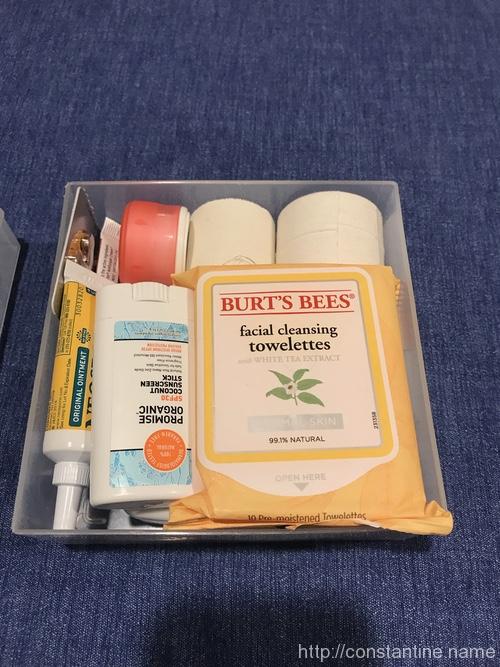
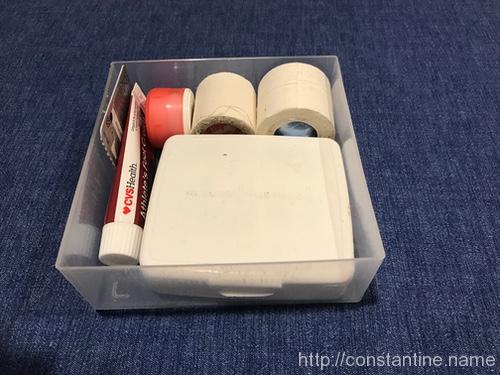
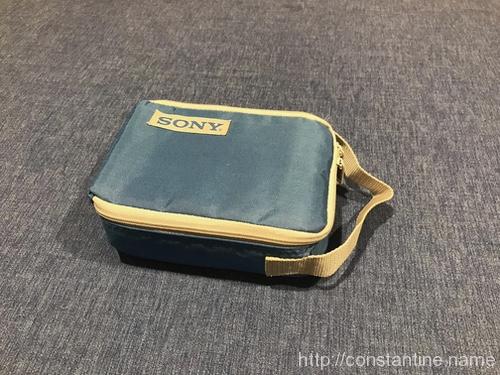
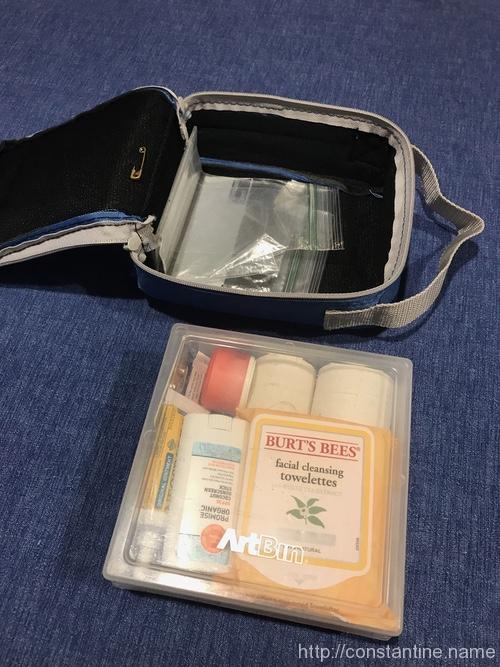
My kit began with a clear-plastic “art box” — unfortunately, I’m not sure where this box came from. In my first iterations, I used this box, held closed with some rubber bands. One day I realized that this box would fit inside a zippered-bag I had laying around. The bag was an ’80s cassette-tape case, which I literally had from the ’80s for storing cassettes. I tossed the cassettes and the internal hard plastic organizer, and the art box fits easily but cannot open once zipped inside.

Eventually, the already tired case came apart and I had to buy a new one off eBay. You might have trouble finding these now because I bought most of them off eBay when I realized they were becoming rare. Since they are different colors, they are easy to find when rummaging in a backpack. (Another one of these bags will appear in a subsequent post.)

  • large, heavy-duty plastic bag for every time I wish I had a bag for trash, food… and emergency phone storage when getting soaked unexpectedly.
  • safety pin; pinning, but also can eject SIM cards
  • …and the plastic box; the really hard part is to pack the box so it does not rattle when you shake it :)
  • facial towelettes are awesome; a bathroom sink, one of these used for more than “face”, and a clean shirt.
  • I don’t normally use sunscreen; but the day you need it a swipe-on stick of facial sunscreen can save you and several friends
  • next layer down (I’m a child of Tetris :)
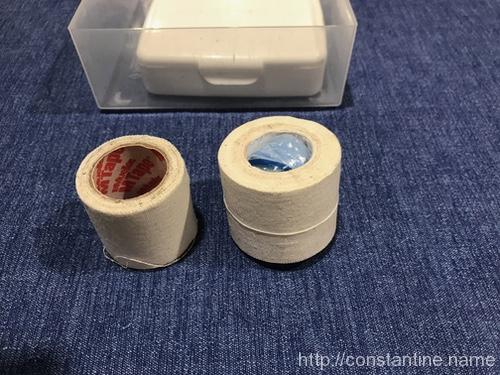
  • save some athletic tape rolls near their end and they fit. Useful for taping anything of course. Similar to wrapping some tape around your water bottle for random use
  • there’s a space in the tape rolls!
  • on the right is a tiny plastic bag with 3 nylon gloves. Yes three, because you always tear one.
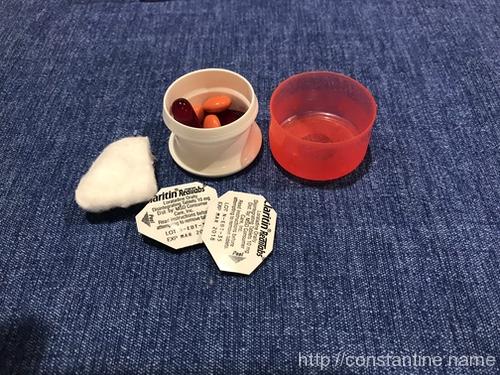
  • this tiny little pill holder is amazing. You can open it with one hand by pinching it anywhere around it’s middle and it *clicks* open immediately.
  • packed in here are my preferred selection of drugs. A few standard pain killers and my preferred allergy drug.
  • the cotton ball ensures things don’t rattle. Here, it’s important to keep the pills from jiggling into powder as well as to eliminate noise.
  • top row…
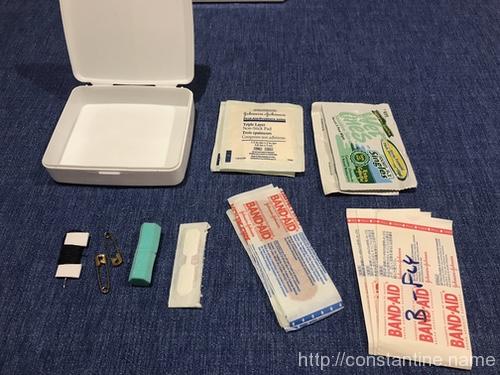
  • a small band-aid box I found somewhere. It was a standard pack of various band-aid sizes which I’ve repurposed.
  • couple of small gauze pads and some alcohol wipes
  • bottom row…
  • a needle and a few yards of thread
  • two safety pins
  • disposable ear-plugs
  • small and large butterfly “sutures” and band-aids

Clearly, this also requires some maintenance. What I usually do is any time I use something (say, I give someone some Advil) instead of refilling the pills, I toss ALL the pills and replace the stockpile to keep them fresh. Anything you keep in here can go out of date or dry up etc. and keeping this kit “fresh” is as important as creating it in the first place.

As I said at the top, I don’t expect you to build this exact kit. :) But I do hope that it has given you a few ideas for what you might want to keep on hand.


Being a great guest

This entry is part 5 of 5 in the series Parkour Travel

This post is entirely rules, tips, and ideas about how to be an insanely great guest in someone’s home. It’s organized into three sections. The first two sections are meant to get you thinking about how your host, and other guests, perceive you. The third section is focused on the day-to-day details of living in an unusual space. It’s meant to get you thinking about solutions to problems, and ways to make travel more enjoyable.

tl;dr: Empathy.

For my purposes here, empathy is the psychological identification with the feelings, thoughts, or attitudes of another person. I’m not suggesting that you must continuously empathize with everyone. I’m suggesting that empathy is a tool that can be used to inform your plans and behavior. Simply put, artfully using the soft skill of empathy will transform you into a great guest.

(more…)