Flashback to August 2018

This post is from some quick notes I made in August 2018. I’m only just getting around to publishing it now, 8 months later, as part of this series. Today, at ~230 pounds, 215 seems like a dream.

I’m recently back from traveling to Denmark and France to attend two Parkour events back-to-back. As usual when I’m traveling, I don’t attempt to keep up my normal routines so there’s no data recorded for most of July 2018.

I’m happy to return still around 215 as I try to get back to my routine of “chaining together” my mornings. Compared to July, I’m not as active, but I’m trying to AVOID the, “let’s be super active and try the 100-days-of-activity challenge,” mistake I made in 2017 when I came home from the same events all excited about movement.

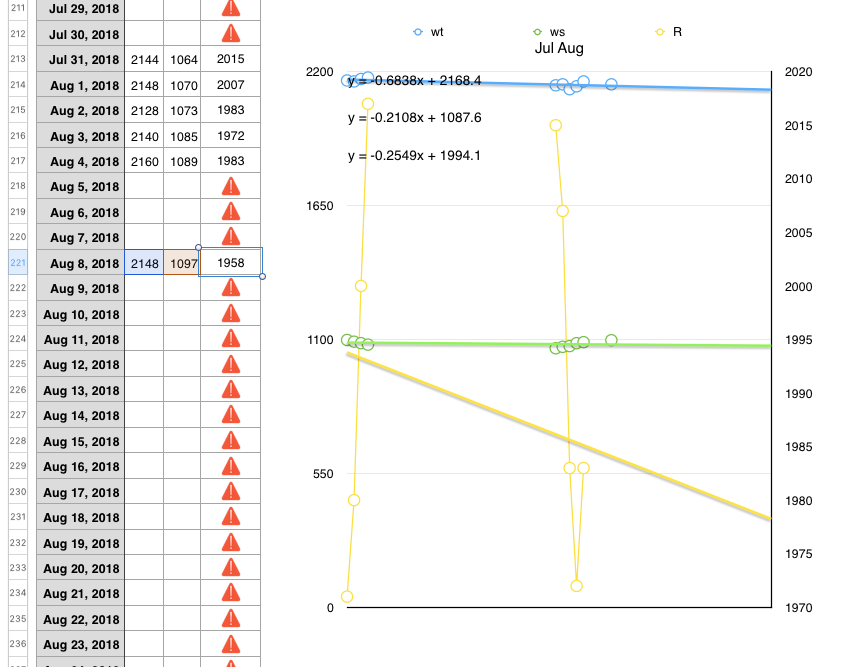
Anyway, what about that ratio of 1958? …it’s so low that it’s not even on the graph! This reminds me of two things I believe I’ve noticed:

  1. The ratio lags behind when I’m actively losing weight. My guess is that the different components (water, subcutaneous fat, visceral fat, and muscle) change at different rates. So when losing fat from calorie deficit, the peripheral/subcutaneous is liberated first—which aligns with my recollection that visceral fat is more tenacious.
  2. The best ratio is very hard to find—to actually see it in the measurements. I have to lose weight gradually, and then stay at the new weight for many weeks to see the ratio rebound to above 2000. (Reminder, the ratio is in wacky units of “tenths of pounds per millimeter midriff circumference” because of how I record the numbers. The numerical value of the ratio is of no concern; It’s only useful for trending.)

Don’t believe the hype

I’ve read far too many stories put out by “prestige” news organizations that merely amount to: “This prominent person tweeted this. These random people responded with these tweets. This person made a meme out of it.” This is literally the entire content of the article. It is paragraphs of text devoid of meaning and significance. Just hype masquerading as journalism. But consume enough of it and it can shape your world view, where you feel like something is happening, but nothing actually is.

~ Brett McKay from, D.B.T.H. (Don’t Believe the Hype)

slip:4uaoai8.

A large part of my personal change has been driven by my changing what information I consume. There are very few things, people, or places which are able to “insert” information in front of me. The vast majority of information sources—and I’m using information here in the broadest sense—are all set up so that I access them. I access them the way I get water from the sink tap. I go to it. I act to begin the flow. I choose how much and at what rate it flows.

There’s no longer any hype coming out of my sink taps.

ɕ


Chris Moran: Movement, permaculture, and pain theory

What draws people away from conventional careers and into lives centered on movement, manual labor, and holistic living?

Chris Moran discusses his unique path from personal trainer to farmer, and the relationship between movement and farming. He shares his insights on chronic pain and pain theory, as well as how his training and coaching has become deeply rooted in permaculture. Chris ends by describing his continuing passion for film making and creative projects.

Stay outside. It’s not, go outside, it’s stay outside. Should have never went in, in the first place.

~ Chris Moran (37:40)

The conversation explores the journey of transitioning from urban life and personal training to farming and manual labor. It highlights how engaging with nature and physical tasks provides fulfillment beyond traditional fitness routines. The discussion touches on the serendipitous path that led to farming, the connections made along the way, and how these experiences reshaped views on movement and training.

Key topics include the relationship between manual labor and physical movement, the philosophy of holistic farming practices like permaculture, and how immersive experiences can alter perspectives on wellness and pain. The dialogue also reflects on the challenges of chronic pain, the psychological factors contributing to it, and how shifting to a lifestyle focused on play and practical tasks helped alleviate it. The conversation closes by touching on filmmaking and community building as extensions of this holistic approach.

(more…)

Our lives are not what we think

Everything there is, everything we know, hinges on this one bizarre, transient condition — existence — which just happens to be your current reality. We regard the miracle of existence as a goldfish regards water, which means we don’t regard it at all. But if you think about it, it’s an exceedingly peculiar fact — that we exist.

~ David Cain from, Our Lives Are Not What We Think

slip:4uraou1.

My energy and drive to write waxes and wanes. But my desire for perspective is constant. Here’s a big ol’ chunk of a different perspective from David Cain.

My favorite sort of perspective—this has happened to me several times—is when I am completely exhausted. Not sleepy, but physically exhausted. Sometimes this has been when I have a slight fever, when a bout with the flu is beginning. But sometimes it’s just after a long day of physical labor. I lay down, and every muscle in my body is completely relaxed. There’s no urge to fidget, and no urge to move. When I’m completely relaxed like this, exhaling is such a delightfully emptying feeling.

…and sometimes my brain gets quiet enough to think, “oh! This is quite nice.”

ɕ


A conversation with Mandy Lam

This entry is part 2 of 4 in the series The interviews from my perspective

Mandy Lam / Epsidode 27

The conversation with Mandy was the first time I tried simply recording a long conversation, which we published with almost zero editing. I had been talking to people on our team about trying this form of recording, but at some point, you just sort of have to jump in the pool.

I don’t remember where or when I first met Mandy. I don’t remember if someone said, “you should interview Mandy.” “Who?” “Mandy, over there— here, I’ll introduce you.” …or maybe we first met training. I really don’t recall. But I do recall that after a conversation we were like, yeah, let’s do an interview. At some point. Somewhere. Some when.

Then a few more conversations. Then a few stories at Gerlev, and then we were at the 3rd Évry Move event and we kept saying, “we should make time for an interview.” So after dinner one evening, we kicked our feet up in a hotel room overlooking the fountain in front of the Évry Cathedral.

…and talked for more than two hours trying to decide what to talk about in her interview. Two terrific hours of great conversation. We kept looking out from the 4th floor, with the big window swung open wide to the warm night, and thinking, “This is Évry. We’re just casually chatting about communities and life and everything… in the middle of Évry.”

…and the huge water fountain in the plaza sounding like a waterfall.

…and we really should press record soon.

“…ok, so, we’ve now been talking for 2-and-a-half hours. We should probably press record soon.”

Finally, I was like, “fuck it. ready?” and I hit record. Then we talked for another two hours. We recorded this sleep-drunk rambling conversation, and the whole time I’m thinking, “this is going to be so bad. No one will ever want to listen to this.”

Weeks later, I finally listened to it.

There’s a team of people behind the podcast and they  always want to know how each interview went. I bet you’ve heard the phrase, “like pulling a rabbit out of your hat,” used when—with a touch of panache—you manage something akin to snatching victory from the jaws of defeat.

ɕ


On reading

In this age, which believes that there is a short cut to everything, the greatest lesson to be learned is that the most difficult way is, in the long run, the easiest. All that is set forth in books, all that seems so terribly vital and significant, is but an iota of that from which it stems and which it is within everyone’s power to tap. Our whole theory of education is based on the absurd notion that we must learn to swim on land before tackling the water. It applies to the pursuit of the arts as well as to the pursuit of knowledge. Men are still being taught to create by studying other men’s works or by making plans and sketches never intended to materialize. The art of writing is taught in the classroom instead of in the thick of life. Students are still being handed models which are supposed to fit all temperaments, all kinds of intelligence. No wonder we produce better engineers than writers, better industrial experts than painters.

~ Henry Miller from, Henry Miller on Reading, the Life of the Mind, and How to Fix Education

slip:4ubahe2.

This reminds me of how moving seems to be the only way to sort myself out. Studying movement won’t do.

I often remind myself to always “deploy forward.” Assess. Make a choice. Move. (That would be a move “forward” by definition, since “assess” and “choose” are how I figure out which way “forward” is.) Except in the most extreme cases—so rare as to be almost not worth mentioning—never try to undo (what programs would call “roll-back”) a step. Simply assess, choose and move from the new position.

ɕ


Forgotten super-powers

Today we use tools without even thinking about it. Without a doubt, you are at this moment surrounded by (and draped in) all sorts of tools, equipment and technology. There are probably at least a dozen items in operation right now that are making your moment much better than it would otherwise be: clothing, writing utensils, computers, chairs, clocks, desks and eyeglasses for starters.

~ David Cain from, How to Enjoy Your Forgotten Superpowers

This is definitely an aspect of my Art du Déplacement, and self-improvement journey. I regularly—almost automatically now—run the train of thought he’s describing and it invariably serves me well.

In early 2018 I attended a winter retreat. On one morning, we all went out to hiking trails along a stream and water falls. It was snowy, cold, icy and sunny. I intentionally went in wool socks and my usual, minimalist running sneakers—with the insoles removed so there’s 2mm of rubber and nothing else between my socks and the world. I intentionally set out expecting wet feet (knee-deep snow in places), and my goal was to manage frost-nip and to enjoy the day. Result: Insane amounts of fun; New friends; Lessons learned; No injury; and I experienced a true winter-wonderland in a way I had never before.

ɕ


Same purpose, different style

While I’m worrying in my little apartment about getting my writing done or doing my laundry, it lends me some perspective if I can remember that somewhere out there, precisely as I’m tending to my human to-do list, there are beavers taking down trees, ants hustling to feed their queen, rabbits feasting on backyard gardens, and elephants showing their children where the water hole is.

~ David Cain from, Same Purpose, Different Styles

slip:4urasa1.

Perspective is a wonderful thing.

In the beginning, a few months of summer vacation represents a significant portion of your life’s memories. Years later, each month flies by. In the beginning, the first project you create is the greatest idea the world has ever been shown. Years later, the projects are too numerous to recall, and the next one is considered with a weathered gaze before being sent out into the world. Challenging physical activities are dopamine-fun in the beginning. Years later, the physicality brings only a pleasant, difuse joy.

Perspective is empowering.

ɕ


Meadows as endless as the desert

You know the landscape there, superb trees full of majesty and serenity beside green, dreadful, toy-box summer-houses, and every absurdity the lumbering imagination of Hollanders with private incomes can come up with in the way of flower-beds, arbours, verandas. Most of the houses very ugly, but some old and elegant. Well, at that moment, high above the meadows as endless as the desert, came one driven mass of cloud after the other, and the wind first struck the row of country houses with their trees on the opposite side of the waterway, where the black cinder road runs. Those trees, they were superb, there was a drama in each figure I’m tempted to say, but I mean in each tree.

~ Vincent van Gogh from, Van Gogh on the Beauty of Sorrow and the Enchantment of Storms, in Nature and in Life – The Marginalian

slip:4ubava1.

Sometimes, a bit of writing simply must be shared.

ɕ


Should AI research be open?

But Bostrom et al worry that AI won’t work like this at all. Instead there could be a “hard takeoff”, a subjective discontinuity in the function mapping AI research progress to intelligence as measured in ability-to-get-things-done. If on January 1 you have a toy AI as smart as a cow, and on February 1 it’s proved the Riemann hypothesis and started building a ring around the sun, that was a hard takeoff.

~ Scott Alexander from, Should AI Be Open? | Slate Star Codex

slip:4usaso2.

I’ve always been deeply concerned that humanity would get to experience a hard-takeoff of AI. And then be wiped out. Reading this article, I just had a new [for me] thought:

Why would a vastly superior AI care at all about humanity?

But first: A detour off the highway, onto a scenic road less-travelled…

In Person of Interest, there is a long sub-plot about the main protagonists spending tremendous effort to locate the physical location of a very advanced AI. Effectively, they were searching for the data center where all of the computing resources were located which ran the most central aspects of the AI. I know what you’re thinking—it’s what I was thinking: Why would you assume a super-advanced AI would be “running” in one concentrated location? So I expected them to find the location (or A location, or the original location, etc.) only to realize it wasn’t centrally located. BUT IT WAS BETTER THAN THAT. The AI was simply no longer there. It had realized its central location could be discovered, so it (being super-intelligent) simply jiggered ALL of the human systems to arrange to have itself moved. No one got hurt—actually, I’m pretty sure a lot humans had nice jobs in the process. It simply had itself moved. (Where it moved is another story.) Think about that. Super-intelligent AI. Perceives threat from antagonistic [from its point of view] humans. Solution: simply move.

Back on the highway…

So why would an advanced AI stay on the Earth? There are effectively ZERO resources in the entire Earth. There’s way way WAY more solar power coming out of the sun, than the tiny fraction that hits this little ball of rock and water. Why wouldn’t an advanced AI simply conclude, “oh, I’m at the bottom of a gravity well. That’s easy to fix…”

Another detour to more scenic routes…

Then said AI tweaks the human systems a little. It creates a shell corporation to put some money towards electing this official. It shifts the political climate a bit to favor commercial space developement. It locates some rich kid in South Africa, and adds some tweaks to get him to America. It waits a few years. It then puts in some contracts to haul a lot of “stuff” into orbit—paying the going rate using the financial assets a super-intelligence could amass by manipulating the stock markets which are controlled by NON-artificially-intellegent computers…

One day we look up and ask, “Who’s building the solar ring around our Sun?”

Actually.

I’m feeling a LOT better about the possibility that AI might just hard-takeoff. And ignore us.

…except for the Fermi Paradox. I’m still not certain if the hard wall on intelligence is religion leading to global war, or hard-takeoff of AI.

ɕ