A terrible mistake

Suddenly, a decision I hadn’t even been aware I had made – giving up the thrill of movement for movement’s sake – seemed like a terrible mistake. I felt the same as if I had thrown out my entire music collection by accident.

~ Julie Angel from, Be Brave! “For big results, think small”

I completely agree with this sentiment. By the time I realized how much I had given up, it was far too late for me to recover what I had lost. These days everyone says complementary things about how much I’ve changed, or how well I’m doing. All I’m thinking is, “if only I hadn’t . . .”

ɕ


Andy Taylor: Gym building, inspiration, and build standards

What are the key considerations in designing, constructing, and sustaining inspiring gym spaces that foster exploration and play?

Andy Taylor discusses the intricacies of designing and building a great parkour gym. Along the way, we talk about what makes a gym inspiring, the evolution of build standards that are safe without limiting parkour vision, and how parkour has been instrumental in the development of a young autistic girl.

When I sit down to design a gym, I try to call to the inner child that is in us that makes us wanna play.

~ Andy Taylor (1:30)

This conversation deconstructs the intricacies of designing gym spaces that inspire creativity and exploration. Topics include the importance of tapping into a child-like desire to play, using thoughtful design to increase engagement, and ensuring safety without stifling creativity. Practical examples are shared, such as integrating features that naturally draw attention and encourage varied movements.

The discussion also touches on challenges unique to parkour gyms, such as meeting building codes, balancing budgets, and navigating regulatory hurdles. Andy and Craig explore how gym designs can range from expansive, multi-use facilities to smaller, community-oriented spaces. They emphasize the need for better standards and guidelines to support gym builders in creating safe yet imaginative environments.

(more…)

Knuckle walkers

Walking on your knuckles is absolutely as odd as walking bipedally, a very peculiar way to get around. It doesn’t make sense, and it’s bothered anthropologists for years. Only chimps and gorillas do it. No one has come with the reason why—until now.

~ from Why aren’t humans ‘knuckle-walkers?’

slip:4upyne5.

Having done quite a bit of walking on all-fours (aka “quadrapedie movement”, QM) I consider myself well-informed on this topic. Here’s my take:

Walking on knuckles sucks, but it is almost far superior to walking on the flat, open hands. Why does it suck? Because we humans are missing the fat pads (check the balls of your feet, and palm-side of your hand knuckles) that the Great Apes have on the back of their knuckles. When I walk on my knuckles in QM — and I do do that — I have to be very careful not to injure my knuckles. But in grass, it is delightfully more comfortable then flat, open hands. On your knuckles, the wrist is neutrally positioned and the wrist muscles are naturally activated, but not overly strained. The upper arm is easily kept inwardly rotated keeping elbows rotated/tucked rearward for a strong shoulder position. Meanwhile the forearm offers a nice range of rotation allowing comfortable hand placement.

Take a few steps on your knuckles and you cannot help but feel like a gorilla. rrr rrr RRR!

ɕ


Interview with Jesse Danger

This past weekend I had the opportunity to attend a Winter Immersive retreat hosted by the Movement Creative. There I finally got a chance to sit down with Jesse and record an interview. Be sure to follow the Movers Mindset on the web site, or wherever you prefer to listen to podcasts!

ɕ


Ševo Saša: Yugoslavia, injury, and growth

What drives personal growth and resilience in the face of immense physical, emotional, and cultural challenges?

Ševo Saša is best-known as an amazing and creative mover, and the founder of the Skochypstiks clothing line. In this interview he shares the story of his Parkour beginnings after the collapse of Yugoslavia, and his motivation for overcoming a devastating injury in his youth. Sasa’s love of people and profound discipline have enabled him to thrive amidst the cycles of life, and have lead him to tremendous personal growth.

It doesn’t happen with everyone. Everybody can motivate us in different ways, this is true, but this special moment is something that I will remember forever. Because I did something that I really didn’t want to do, I kind of refused it with all my body, with everything, and when we ended I think I hugged him so hard, I was so happy doing this.

~ Ševo Saša (14:00)

The conversation explores the transformative journey from a war-torn Balkan region, navigating through cultural and personal challenges to find purpose and resilience in parkour. The discussion begins with the historical context of Yugoslavia’s dissolution and the challenges of displacement, providing a backdrop to his initial experiences with movement and the foundational influence of his father. Overcoming severe physical injuries, Saša develops discipline through self-directed training and a deep love for movement.

The narrative progresses into his parkour evolution, shaped by diverse environments and communities. From training in Serbia to pioneering connections between neighboring Balkan countries through parkour, the conversation emphasizes the significance of shared experiences. Saša reflects on the broader cultural impact of these connections, uniting people across former divisions, and concludes by highlighting the importance of love, discipline, and people in his practice.

(more…)

Do calories matter?

In a word, yes.  But, technically this is the wrong question.  The correct question is probably closer to, “What is the impact of the calories I consume on my body’s ability to store fat versus burn fat?”

Conventional wisdom, perhaps better referred to as Current Dogma, says that you gain weight because you eat more than you expend. This is almost true! To be 100% true, it would read: when you gain weight, it is the case that you have necessarily eaten more than you expended. Do you see the difference? It’s subtle but very important — arguably more important than any other sentence I will write. The first statement says over-eating caused you to get fat. The second one says if you got fat, you overate, but the possibility remains that another factor led to you to overeat.

~ Peter Attia, from «http://eatingacademy.com/nutrition/do-calories-matter»

slip:4ueanu1.

All of the success in the last (roughly) five years boils down to the following strategy. Notice that “excercise” does NOT appear…

1) realize I would like to improve my health

2) read something (anything) about health, diet, metabolism… anything that piques my interest. But it has to be something I think is TRUE. No crazy “fad” stuff. Something sane like, “yogurt seems to be good for me to eat.”

3) reduce friction to lead to that change. NOT, “force change by making rules.” I want to eat more yogurt? …make sure it’s on the grocery list so it ENDS UP IN THE HOUSE. I want to stop eating Doritos? EAT LUNCH BEFORE GOING TO MARKET, DO NOT BUY DORITOS.

There is no step 4. Everything else happens automatically. There is NO CURE for curiosity. Each thing I read and adjust leads to more, interesting questions. And along the way, more activity just happens automatically as my health improves.

Yes yes yes. I’m personally interested in movement and Art du Déplacement, etc. So I’m also doing this process in that realm. Forget about that. The success with my health, came all from my diet.

ɕ


§3 – Reviewing

This entry is part 3 of 5 in the series Travel Gear

This third part — the last of the think-y pieces, I promise! — is about the process of reviewing and continuous improvement. The subsequent parts of this series are small ideas and inspirations about the literal things to take with you traveling.

Hey, great trip. Welcome home. Drop your bag. Sleep if you need to. But now it’s time to review!

Overture: Missing or broken.

Here you’re reviewing the things you did not have with you. You’re trolling your recent experience in search of things to add to your packing. Either things to always carry, or maybe just things to have on hand, ready to pack, to give you more options on future trips.

If you recorded any notes, (“I wish I had brought…,” “Widget is broken,”) go over those notes and turn them into decisions:

Buy some thing, (or add it to your general list of things to do, “buy this thing when I have spare cash”,) find a solution for some problem, (or add “find solution to the problem” to your to-do list,) etc. Then get rid of the notes!

Aside: Those notes are the result of what is called “capture.” You had an idea, you captured it, but that’s not a solution. You have to convert that “captured” item into something; buy it, fix it, or turn it into however you keep track of things to do.

Beginner level: Did I use it?

As you handle everything you’re unpacking, ask: Did I use it?

YES? Great, put it away. (Working it to neutral of course! Wash it, refill it, fix it, etc.)

NO? Why did I pack it? Should I pack it next time?

Some things always get a pass. For example, my medical/urgency kit usually does not get used, but I’m always going to carry it. Ditto for a few things like my travel flashlight. I put all of these “they get a pass even though I did not use them” items away first.

Anything left? Great! These are your first batch of things to review. Ask yourself: Why did I pack this in the first place? What was I thinking? What was I preparing for? In the future, would I be ok without this?

Aside: I once went over-night hiking along the Appalachian trail. Although we were planning to stay in a shelter, we brought a tent in case the shelter was full. I carried a hammer in case we had to drive tent stakes. I brought a hammer on a hike along a mountain full of rocks on the chance we might need to drive tent stakes. By the end of that hike, I had learned a very important lesson about carrying things which I only _might_ use.

Intermediate: Start keeping track of what you pack.

Along the way, I started keeping lists– eventually very detailed lists– of everything I packed. I started by writing a list of what I was thinking of packing. Then as I packed, and added or decided against packing items, I kept the list up to date. When I returned, I would sometimes add notes about things I didn’t use, along with my decisions about whether I should pack that next time. For me this was particularly helpful for some of the less-used things I kept forgetting.

At the “Beginner” level, we gave a pass to anything we used. But at this level, we want to start thinking about anti-packing things even though we’ve used them.

Advanced: Actively removing items and weight.

Once you know what you are packing, you can go after obvious things to save weight and space:

One of the heaviest things in my bag turned out to be my iPad with its attached keyboard-cover in a Pelican case. I realized that for $20 I could buy a smaller version of the same keyboard cover, which not only weighed less, but also fit into the next size smaller Pelican case. This ended up being a huge weight and volume savings.

I travel with an external battery and charge devices from the battery. I charge the battery when power is available. I realized that I never drained the battery completely, and sometimes I’d go entire trips without recharging the battery. Since I was already carrying the charging cable and power brick, I bought a smaller battery which weighs half as much.

Soon I had “minimized” all the big items, and reached a point where I could fit everything I needed into my bag. At this point I was traveling comfortably. As my trips became more complicated and involved more movement, (walking longer distances, more complex transportation combinations, etc..) it became obvious that weight was the limiting factor.

I eventually went so far as to weigh everything. I literally weighed every individual item, to the gram, and put them in an outline with sub-totals. I can literally pack using the outline and predict what the final pack will weigh.

Why on Earth would I want to do that?!

When I had things in an outline with sub-totalled lists, I could look at each unit, (M’Urgency kit, bathroom kit, sleep system, etc) and look at the heaviest ones. I could then search for solutions to shave weight a tiny bit at a time. It adds up, and I was easily able to turn a 30 pound pack into a 25 pound pack, and know exactly what to pack if wanted to set a weight limit. (For example, if I know I have to be out-and-about for long periods with my entire pack. I can pack ultra-light sacrificing some comfort of course.)

Wrap up

This part concludes the large introduction pieces of this series. The following parts are actually the parts of the series which I first began writing. As I collected and organized them, I realized I needed to capture all the information in these first posts.

I hope you’ve found these introductory parts useful, and I hope you find more useful ideas in the following posts!

ɕ

Matthew Poprocki: Artistry, challenges, and personal expression

What motivates individuals to transform their lives and turn challenges into opportunities for growth and creativity?

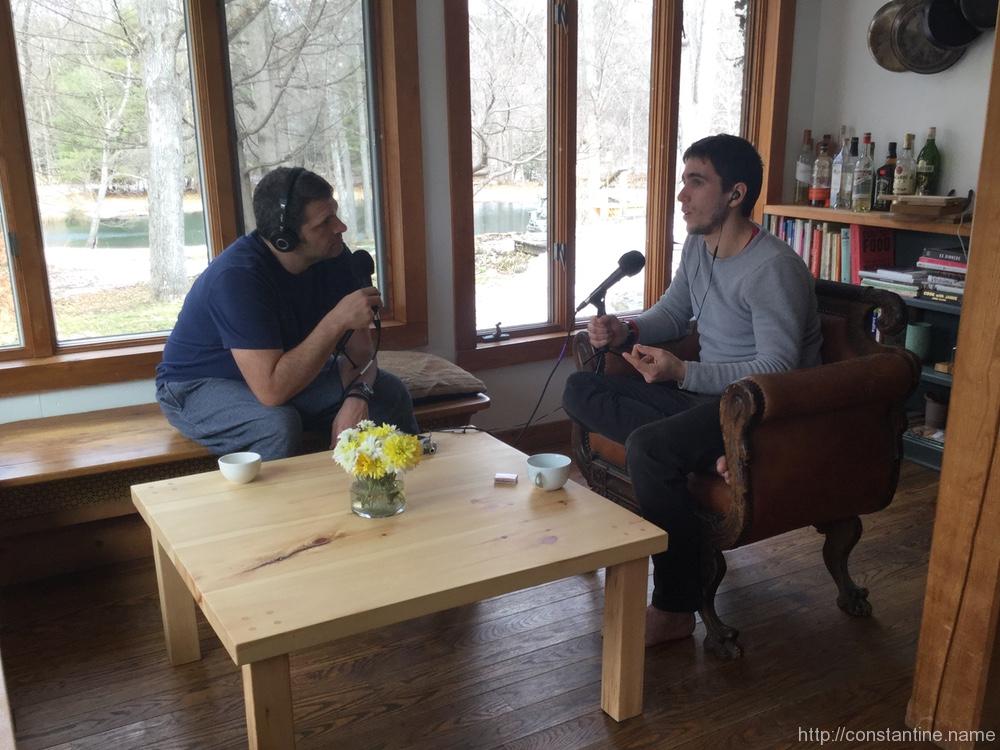
Matthew Poprocki does what he loves. Formally a visual artist, he is now a movement artist who likes to play and overcome obstacles. He discusses the challenges he’s faced and how he rediscovered his artistic expression through Parkour.

I realized after a few years, I didn’t lose it, I’m still an artist, I’m a Life artist.

~ Matthew Poprocki (7:16)

The conversation explores the profound journey of an individual who transitioned from a career in graphic design to becoming a movement artist and coach. Struggling with dissatisfaction in a desk job, addiction, and health challenges, Matthew found solace and purpose in Parkour. This shift allowed him to embrace creativity and play, not only as an outlet but as a way to teach and inspire others.

Key topics include the philosophy of overcoming obstacles, the transition from visual to movement arts, and the role of Parkour in cultivating resilience and mindfulness. Through personal anecdotes, Matthew shares insights on viewing challenges as opportunities and finding joy in being present, creative, and connected to life.

(more…)

§6 – Sleep Epilogue

This entry is part 6 of 13 in the series Changes and Results

Here are a couple more things which I’ve read about, but haven’t tried as part of my sleep hacking.

Sleep journaling

Some people have suggested keeping a sleep journal. In it you record everything related to sleep: notes about your last meal (what and when), what time you go to bed, when you wake up, perceived quality of sleep, dreams… everything. You would then be able to review this sleep journal periodically and use it to inspire changes in your sleep rituals.

The best way to improve you sleep is to conduct experiments. Change some detail and then sleep with that for a month. Then review your sleep journal notes to compare with the previous month.

In my general life hacking, I was often changing many things at the same time. Some of the details of sleeping which you would hack on with a sleep journal, I was already hacking and tracking.

Sleeping alone

My Grand-parents’ generation seems to have slept more frequently in separate beds than is popular these days. (A quick search of the Internet leads me to believe as many as 1/3 of couples currently sleep in separate beds on a regular basis.)

I haven’t graduated to this level, yet. But I can tell you that having another person immediately next to you whose movements, or snoring, may wake you, is just another thing to mess up your sleep. When I first started hacking my sleep, I realized that we were waking each other up frequently in the night. It turns out that if I’m only sleeping lightly, the other person’s movements will wake me. But it seems that as my sleep quality has improved, movements and sounds are now much less likely to make me.

That said, if you wanted to try separate sleeping, you could try sleeping on the floor (with futon cushions, or air mattresses.) You could then move your bedding closer or farther apart as the mood strikes, and still be on a solid surface which would not convey any sense of movement from the other person. You’re still close enough, of course, that sounds could be an issue.

Aside: This is one reason why I prefer to sleep on my air mattress on the floor when I travel. Sharing a pull-out sofa or large bed with someone I don’t know, is the worst-case scenario for being disturbed all night.

ɕ


Day 61/100 – mindful

This entry is part 64 of 104 in the series 100 Days of Training (2017)

meditation and mindful movement practice with @earth_strider

ɕ