Intentional

About a month ago, I was lamenting the loss of some of my Movement mojo. After some soul-searching, we started with a simple change: Rather than waiting for movement to happen as a part of our day, we began asking a simple question, every day:

“What are we doing tomorrow?”

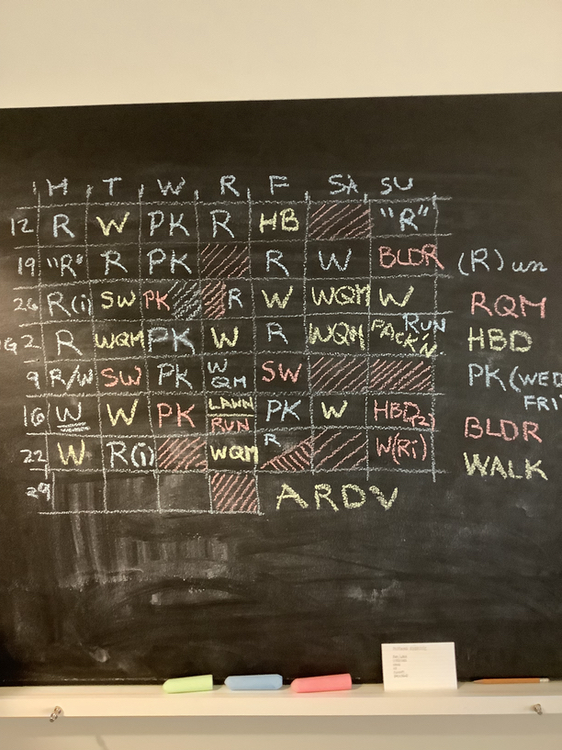
For fun, we set this chalkboard-wall up to encourage activity and to let us savor the decreasing number of days to American Rendezvous, a Parkour event held in Somerville, just across the Charles River from Boston.

ɕ


Connection with Bryon Howard

How does a supportive community influence the success and motivation of podcasters?

Shared experiences and mutual encouragement shape the journey of podcasting beginners.

The magic of sound comes through… it surprises you every time.

~ Bryon Howard (9:55)

The conversation highlights the impact of community in the podcasting journey, focusing on how collaboration and mutual encouragement help creators persevere through challenges. Bryon and Craig discuss the importance of connections formed during a podcasting workshop, noting how these relationships motivated them to continue their work despite initial uncertainties. Bryon reflects on how a few key individuals in his network were instrumental in his success.

Bryon also examine the technical and emotional aspects of podcasting. The discussion includes overcoming imposter syndrome through listener feedback, practical tips for in-person and virtual recording sessions, and the value of genuine interactions. Bryon explores how podcasting, even as a hobby, can provide meaningful personal and professional growth.

(more…)

Getting control of mornings

Staring this month, I’m making another large change to how I’m structuring my mornings. For as long as I can remember I’ve woken up about 5:30. There’s variability, but it’s a rare morning if I’m not actually awake, vertical and puttering towards my desk by 6:00. Unfortunately, for what might be two years now, what I’ve been doing upon reaching my desk has been an every-morning battle between my intention, and what I had actually set myself up for.

My intention was: Do self-focusing, restorative things. Meditate, some movement [yoga, mobility, etc.], maybe a quiet podcast, then do my reflection reading, and write in my journal. Then “surface, ” which means waking up a computer and checking in on a variety of places—multiple email programs, web sites, etc., to get a pulse for what today looks like. Checking the calendar to verify appointments, calls, etc.. And then, at 6:30 exactly, Tracy and I would have a quick morning meeting to compare our days. We’d discuss the day’s activities, meals, chores, our respective meetings, etc.. Each morning I make up a very crude, quick listing of things for the day, in a very small notebook that I carry around. But what actually happened was that, because I use a program to track everything, and I need to look some stuff up to fill out my little notebook to start my day, I’d end up starting by just peeking into one or two things… and bam! It’s 6:30 meeting time. Dammit.

I’ve come to the conclusion that I must begin the morning without any devices. (Pretty sure that’s safe to do without checking with my doctor, since it was fine for the first 25 years of my life, right?)

Have our evening meeting, figure out the basic layout of tomorrow, and jot my notes in my little notebook. In the morning, get up, gather my coffee, and start my day with the little notebook. No phone for podcasts, nor music… just me and my notebook. We shall see.

ɕ

Obsession with Andrew Obenreder

How does an obsession with movement shape personal practices and creative expression?

Exploring movement extends beyond physicality into music, art, and mindfulness.

I try to listen to whatever my heart tells me to be doing.

~ Andrew Obenreder (5:37)

The conversation explores Andrew’s lifelong obsession with movement and its far-reaching impact on personal and creative practices. Movement, in this context, is not just about physicality but also integrates art forms such as music, painting, and tattooing. Andrew describes movement as an intrinsic part of their life, dating back to childhood, where their passion extended even to the mechanical elegance of trains. He also reflects on how balance is a recurring theme—balancing creative urges, physical demands, and mental well-being.

Stress and mindfulness emerge as critical themes. Andrew challenges traditional notions of stress, suggesting it can be constructive in pushing boundaries. He also emphasize the importance of being present and prioritizing genuine desires over societal or internal pressures to perform. This perspective encourages letting go of “should” and replacing it with intentional actions aligned with personal motivations.

(more…)

Family with Steve Mululu

What role does storytelling and legacy preservation play in fostering family and cultural connections?

Cultural heritage is explored through the lens of podcasting as a modern storytelling tool.

The first time I listened to a podcast, it took me back to my very early childhood years because it reminded me how much my own father, how much my own grandfather, how much stories, how much history, they passed to us after every meal in the evening. It was traditional for us to sit down with our elders, for them to tell us about their upbringing, about our culture, about what kinds of foods to eat, how to relate with your brothers, how to relate to your sisters, what kind of future is expected of you as a man— all those things.

~ Steve Mululu (1:23)

The conversation explores how storytelling plays a central role in preserving cultural and familial legacies. Steve reflects on childhood memories of elders sharing wisdom and history after meals, emphasizing the importance of capturing these stories before they are lost. Podcasting emerges as a modern extension of this tradition, allowing such narratives to be recorded and shared across generations.

Other topics include family dynamics and the challenges of maintaining unity in a large family. Steve describes how the lessons and authority of parents can act as a binding force, providing a shared foundation amidst disagreements. This contrasts with the experiences of small families, which may lack this communal grounding. The conversation also touches on values like sacrifice and the transition from individualism to communal responsibility, highlighting cultural differences in these principles.

(more…)

Sedantarism

Right now, “sedentary culture” is part of the broader, overarching culture, but subcultures—including our individual culture—can also be sedentary. These sedentary subcultures end up reinforcing the overarching culture, so what can we do? I’m (obviously) interested in working on sedentarism at the broadest cultural level, but I recognize that the most immediate benefits can be found by changing our personal culture. I’ve made working on sedentarism at this level part of my work as well.

~ Katy Bowman from, «https://www.nutritiousmovement.com/changing-a-sedentary-culture/»

slip:4unuca1.

Overall, the amount of activity [for Americans] has gone up slightly since the 1970s. The big issue is that our diet is killing us. Becoming more active alone isn’t enough—and Bowman’s take is nuanced, I’m not disagreeing with her article. But the first-order thing is diet. (I don’t mean “restriction” or “reduction” per se, I mean what specifically are you eating? That, “diet.”) That said, “eat better stuff” and “move around” is the prescription.

I’m reminded of, that room we all euphemistically call a living room: Would I call it my sedentary entertainment room, if I were honest? I realized that I should call it that, and so I rearranged the entire room, and got rid of the dedicated “tv” device. I still consume entertainment, but now it’s just one thing I can do in that room, rather than what the room is designed to be used for. We’ve done this, and continue to redo this occassionally, for every space inside and outside our home. For example: We don’t have a “second bedroom” nor “guest room”; We have [what we call] the “middle room”… and it’s got foam mats on the floor and random exercise, self-care, movement stuff… a finger-board over the door, a full-length mirror, a pull-up bar bolted into the ceiling, a chalk-board wall for tracking and notes… space for books. And the room also has a folding frame, air mattress, and bedding for the extremely rare guests who visit.

Frankly, there isn’t much in the way of “sedentary” left that I can trim out of my life. The vast majority of what I do is mental work. So I’m reading, writing and computing a lot. What’s left for me is to develop a healthy relationship to food. I get mental—over think, extreme thinking, stuck in my head… that sort of thing—and the way I’ve learned is the easiest escape is to run to entertainment. And to eat while being entertained. But, I’ve only learned that as being the easiest. There are a number of other things that also work to “fix” my thinking: Reading, writing, and physical activity can all work too. The hard part is changing my learned behavior. For me, it’s a matter of crafting my environment to encourage me to do things other than seek entertainment. (Learning to not mentally stress myself out would be even better, and I’m working on that too.)

ɕ


Tick tock

Because we can look back and see that the way time has been measured throughout history has changed, it’s reasonable to imagine when looking forward that it will continue to change – our current use of hours, minutes, weeks and months may be as obscure and forgotten as the nundina, the akhet, or the gesh several millennia from now. The day, the year, and the movements of the other planets in our solar system, on the other hand, aren’t at the whim of the powers that be or of passing cultural trends. The 10,000 Year Clock, therefore, keeps track of these robust and durable units of time. The Clock’s main dial keeps track of the Sun, Moon and stars while The Orrery models our solar system.

~ Austin Brown from, Long Now’s Orrery Prototype For The 10,000 Year Clock – Long Now

slip:4ulooe1.

Immediately before reading the above article, I read something about the eastern Sahara Desert. About a researcher who managed to extract a 50-foot core-sample from a lake bed spanning 11,000 years of seasons. What is now a desert was once a lush paradise.

The projects and updates from the Long Now Foundation always fill me with awe and wonder. They always make me try to imagine 10,000 years from now. And that makes me feel like a slightly better person for having spent some time trying to think bigger-than-myself. But that core sample? …it covered still more. 10,000 years is but a blink in geologic time.

ɕ


Epithets

Epithets for yourself: Upright. modest. Straightforward. Sane. Cooperative. Disinterested.

Try not to exchange them for others. And if you should forfeit them, set about getting them back. Keep in mind that “sanity” means understanding things—each individual thing—for what they are. And not losing the thread. And “cooperation” means accepting what nature assignes you—accepting it willingly. And “disinterest” means that the intelligence should rise above the movements of the flesh—the rough and the smooth alike. Should rise above fame, above death, and everything like them.

~ Marcus Aurelius

slip:4a467.


You had me at ‘bacon’

One of the central conceits of the “man’s natural state” argument is that if we go back to some point in time, we’ll find it. We’ll finally come across the state of being where man lived totally in harmony with each other and with nature; eating the perfect diet for health, worshipping the correct gods, having sex in the natural and acceptable way. And besides studying religious texts, the tool that’s most frequently employed is the study of ancient, “pre-historic” man and woman. We hope that, by going back far enough, we’ll hit some arbitrary Point of Naturalness. That’s partially the approach used, for example, by the Paleo movement which has become such a popular force in nutrition. We evolved to eat bacon, right?

~ Shane Parrish from, The False Allure of a “Natural State” of Man

slip:4ufote8.

I have avoided—I’ve no idea how—the rabbit hole of, “what is natural [for a human being’s flourishing]?” I have limited time, (I suggest doublechecking, as yours may also be limited,) and I’m really only interested in, “what is best for this human being’s flourishing?” I don’t care if we evolved to eat bacon. I do care how I feel after I eat bacon. …after I eat different types of bacon. …after I consider the monetary cost of buying bacon. …after I assess the environmental cost/footprint of eating bacon. …after I assess the societal aspects of bacon.

Sorry. All this talk of bacon. I lost my train of thought. Oh, right—

For a short span of several decades, I have complete control over my thoughts. At no time do I have absolute control over anything beyond my thoughts. (I have pretty reliable control over many things—movement of my hands for example. But even that control is not absolute. See: Disease, accidents, etc. At any moment, my preferences related to all the things beyond my thoughts, can easily be frustrated.) So the only thing that makes sense is to discover, reflect and then exercise what efficacy I have at any give moment: What do I know? How do I know it? What decision should I make now/today, given what I know? How would I find where my unknown unknowns are?

ɕ


Mike Araujo: Coaching, World Chase Tag, and community

What role does movement, particularly parkour, play in fostering personal growth, connection, and creativity?

Playing tag on national television was never something Mike Araujo imagined when he started training parkour. He discusses his path in parkour and the opportunities he’s gained from it. Mike shares his experiences with World Chase Tag, and his thoughts on competition. He explains his personal definition of parkour, sharing it with others, and his thoughts on how the community has changed.

Everyone needs to find the thing that moves them to move. Whether that be parkour or whatever other sport. I think as long as you’re moving and connecting with people and your environment then you’re on the right path.

~ Mike Araujo (7:07)

Mike Araujo is an athlete and head coach with the Movement Creative. He has trained parkour in NYC for over a decade, and coached nearly as long. Mike often travels for parkour, and recently competed in World Chase Tag’s first USA based event.

The conversation explores the transformative power of parkour as a practice that transcends physical movement. Parkour serves as a medium for personal growth, offering opportunities to connect with one’s body and environment intentionally. The practice is presented as adaptable, requiring no specific equipment or space, which makes it accessible to anyone seeking a meaningful connection with movement.

The discussion also examines parkour’s evolving culture, from intimate, small gatherings to large-scale global events. Topics include the impact of structured competitions like World Chase Tag, the community’s adaptation during the pandemic, and the balance between maintaining the sport’s original spirit while embracing its growth. Reflections on coaching and transitions in life highlight the importance of aligning passion with action, even when faced with uncertainty.

(more…)