When do you stop? →

I’m away at a parkour event this weekend, lots of walking and playing and jumping. One session was a discussion of fear, and of consequences. And one particular question for discussion was, “When do you stop?” People raised lots of ideas—good ideas, wise ideas… lots of things I was in agreement about.

But I was also thinking, “Wait. Why do I have to decide that?”

I know I’ve certainly faced decisions about stopping. Work, play, relationships, sports, parkour practices (ask me about the time I climbed across a train station outside of Paris,) … yes, deciding if, when and why to stop is an obvious question.

If I think about two paths—perhaps diverging in the woods, if you like that imagery—an hour’s hike along the path of one choice, I might decide I’m going the wrong way. There’s one of those when-to-stop decisions. But the mistake was an hour before, where the paths diverged.

This business venture: what if I had truly been committed, and had planned clearly the way we’d know when to stop? The question is gone. This relationship: could it be planned, or could two people be so honest, that the question doesn’t appear? This parkour jump, at the end of an exhausting day of training: why am I standing here, right now? If I’d planned better, could I have gotten all the same benefit, but a few minutes before right-now, I’d have moved to something else?

Might it be possible to still have challenge, commitment, growth, love, spontaneity, and humor… without ever having to decide, “should I stop this now?”

ɕ


Epochs of problems →

Avoiding problems avoids the opportunity for growth. Most of the time, problems don’t go away, instead they grow.

~ Shane Parrish from, The Four Tools of Discipline

Elsewhere, this is 4ufote5. — slipbox

It seems to me that there are epochs of problems. In the early days of my journey, I made dumb mistakes. Slowly I learned through stubbed toes, hurt feelings, expensive mistakes and bridges burned that life is hard, yes. But it’s much harder if you’re stoopid. More time passed.

I resolved the internal issues that led to bad impulses and choices. I learned the Kastanza Lesson of opposite day; If every instinct you have is wrong and causes things to turn out badly, one should at least trying doing the opposite. In short, I intentionally crafted a moral compass. Effectively gone—unless I just jinxed it—are any problems which are my fault. I’m not talking about errors here; I drop things, make wrong turns and forget things, of course. More time passed

And I’m left wondering how I move beyond my current problem: The setting of unrealistic expectations for myself, and of setting expectations [of any sort] of other people. I’m reminded of my thoughts on Discovery, Reflection and Efficacy. Perhaps if some more time passes? That seems to have worked twice now.

ɕ


Sedantarism →

Right now, “sedentary culture” is part of the broader, overarching culture, but subcultures—including our individual culture—can also be sedentary. These sedentary subcultures end up reinforcing the overarching culture, so what can we do? I’m (obviously) interested in working on sedentarism at the broadest cultural level, but I recognize that the most immediate benefits can be found by changing our personal culture. I’ve made working on sedentarism at this level part of my work as well.

~ Katy Bowman from, «https://www.nutritiousmovement.com/changing-a-sedentary-culture/»

Elsewhere, this is 4unuca1. — slipbox

Overall, the amount of activity [for Americans] has gone up slightly since the 1970s. The big issue is that our diet is killing us. Becoming more active alone isn’t enough—and Bowman’s take is nuanced, I’m not disagreeing with her article. But the first-order thing is diet. (I don’t mean “restriction” or “reduction” per se, I mean what specifically are you eating? That, “diet.”) That said, “eat better stuff” and “move around” is the prescription.

I’m reminded of, that room we all euphemistically call a living room: Would I call it my sedentary entertainment room, if I were honest? I realized that I should call it that, and so I rearranged the entire room, and got rid of the dedicated “tv” device. I still consume entertainment, but now it’s just one thing I can do in that room, rather than what the room is designed to be used for. We’ve done this, and continue to redo this occassionally, for every space inside and outside our home. For example: We don’t have a “second bedroom” nor “guest room”; We have [what we call] the “middle room”… and it’s got foam mats on the floor and random exercise, self-care, movement stuff… a finger-board over the door, a full-length mirror, a pull-up bar bolted into the ceiling, a chalk-board wall for tracking and notes… space for books. And the room also has a folding frame, air mattress, and bedding for the extremely rare guests who visit.

Frankly, there isn’t much in the way of “sedentary” left that I can trim out of my life. The vast majority of what I do is mental work. So I’m reading, writing and computing a lot. What’s left for me is to develop a healthy relationship to food. I get mental—over think, extreme thinking, stuck in my head… that sort of thing—and the way I’ve learned is the easiest escape is to run to entertainment. And to eat while being entertained. But, I’ve only learned that as being the easiest. There are a number of other things that also work to “fix” my thinking: Reading, writing, and physical activity can all work too. The hard part is changing my learned behavior. For me, it’s a matter of crafting my environment to encourage me to do things other than seek entertainment. (Learning to not mentally stress myself out would be even better, and I’m working on that too.)

ɕ


Deep dive into books →

Today I thought I’d share a thorough explanation of what I do “to” a book these days. This process—which to be honest I don’t follow for every book I read—is the result of combining a few different ideas:

  • I love the physicality of books. The typography, the paper, writing in them, desultory bookmarks, (I add my own ribbon bookmarks,) and numerous sticky-notes poking out the side.
  • I love the peaceful, inertness of books. They literally sit there and do nothing. There are no alerts, and no interaction, (from anyone beyond the author’s original magic spell.)
  • I’ve always wanted to retain more of the knowledge from a book once I’ve read it.
  • I’ve wanted to be free of my self-imposed rule of reading every page.
  • These days I have a slipbox, and I want it to grow.
  • I love to collect quotes.
  • I’ve always wanted a set of crib notes, summary, or something that I could lay hand on after reading a book.

Arrival

Fortunately, books arrive slowly. It took practice, but I learned to do all of the following in a minute or two.

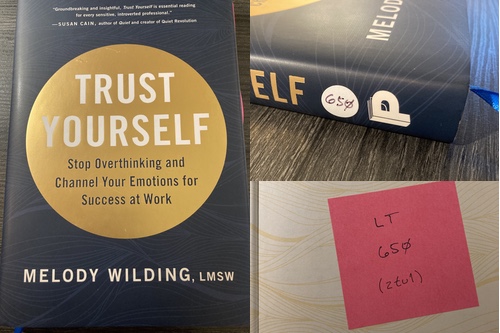
If it’s a new book, I take a few moments to prepare the spine. (Please tell me you know how to do that.) I affix a small, white, circular label on the spine, and I slap a sticky-note on the first face opposite the cover.

I skip over to librarything.com and find the book in “Your Books”—my books, that is. Most arriving books are coming in after already being in my “wishlist” collection; They get moved to the “library” collection. Otherwise they get searched for and added to my collection. Books get tagged as “physical,” (as opposed to those tagged “PDF,” “iBooks”, or “Kindle,” because, yeup, I track those too.) I see what MDS number Library Thing says the librarians of the world have chosen.

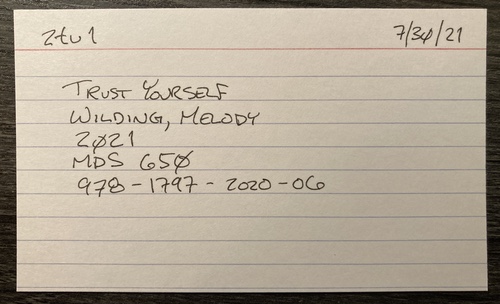
On the sticky-note, I write “LT”, (for “this book is entered into Library Thing,) and the MDS number. I write the main, three-digit part of the MDS number on the label on the spine.

Finally, I skip over to bookmooch.com and remove it from my Wishlist over there to ensure I don’t forget about it. (Lest I accidentally “spend” my Book Mooch points requesting a book I now have.) If this is a book that someone sent me because of Book Mooch, I hit the “Received!” button instead.

This book is now “ours.” And some amazing things are now possible just by having spent a couple minutes on each book as it arrives. (Please ignore the entire week I spent bootstrapping ~500 books when I started doing all this. :)

  • Physical bookstores are fun again! What books are on my wishlist? (500+ at the moment) …okay, what wishlist books are tagged, “priority”? (about 250 — yes I have a problem.) Picking up a book… “this looks interesting…” Do I already have it in the house, maybe now is the time to buy it? Did I once have it, and it’s no longer in our collection, (part of my collections in Library Thing is “had but gone now”)?
  • Long-term storage of books doesn’t mean they are lost. A big portion of the books in our house are here because we want to keep them. They sit for years untouched. Those are shelved by MDS number. Ask me for a book, and I can walk directly to it; It’s either laying about somewhere and top of mind, or it’s shelved where it can be found immediately.
  • This is morbid, but if the house burned down I could decide what books to replace.

Books are for reading

Well, technically, one can also build a thing called an anti-library. But eventually, hopefully, or at least this is what I keep telling myself: I start reading the book.

I do tend to read the entire book. But generally I read the table of contents first to see what I’m getting into. If I think the book is going to be a really deep read—something I want to read more than once, refer to, and really ingest—I probably read the Afterword first. The Afterword was written dead-last, after the book was done and the author is a different person at that point. Then maybe the Foreword, or some books have a Summary, or a Preface, whatever.

I’ve no qualms about skipping parts. For example, in books like Trust Yourself by M Wilding I skipped all the anecdotes and skipped all the workbook/exercises stuff. I ended up reading only about one-third of all of the pages. (Still, a good book by the way.)

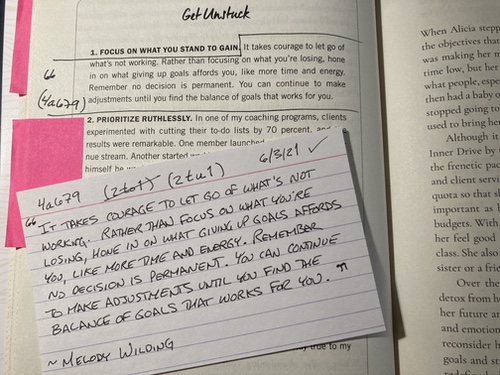
As I’m reading, if anything quotable jumps out, I’ll capture that on the spot. This leads to me making some marks, allocating a slipbox slip address, and I’ll leave a small post-it sticking out the side. I’ve never met a book worth reading that didn’t have at least one quotable bit awaiting me within.

Slipbox

As soon as the first slip gets created from the book, that slip needs to refer to the book. That means the book itself needs to be in the slipbox. Apparently, I always wanted to be a librarian.

And now I can leave a “(2tu1)” reference on the quote’s slip.

So that’s a bit of detour, but it really only takes me about a minute. You’ll notice—first photo at top—that the sticky-note for this example book has a slipbox reference, “(2tu1)”—the parens mean “this is a reference”. I didn’t put that on the sticky-note when the book arrived. That was added when I put the book into the slipbox by creating slip “2tu1”.

But mostly, I’m just reading the book.

Identify summarizing bits

One day, I’m finished reading.

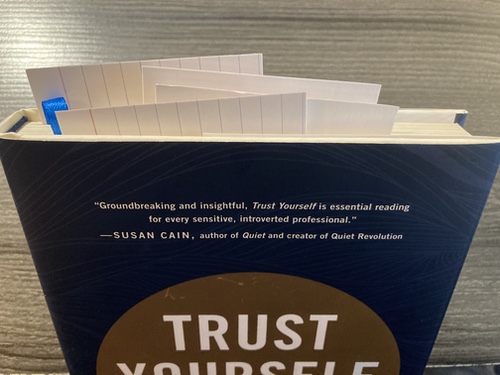
I find that even if it took me months to finish, the book’s contents remain pretty fresh in my mind. I flip through the book cover-to-cover, just skimming and noticing what I recall from reading. When I see a good, representative bit, I simply stick in a blank card at those spots. This lets me gauge how many slips my “summary” will be; Two is too few, and 20 might be too many.

Each spot has some key point that I want to include in my summary. I don’t write anything at this point. The goal is just to stick the cards into all the places that I want to include in my summary.

(I once tried using a printed template whose layout facilitated taking brief notes and had pre-printed page numbers. Folded, it doubled as a bookmark so I could build some notes as I read. When an idea leapt out, I’d find the page number on the sheet and jot a note. It was a neat idea, but didn’t work out for me.)

Summarization

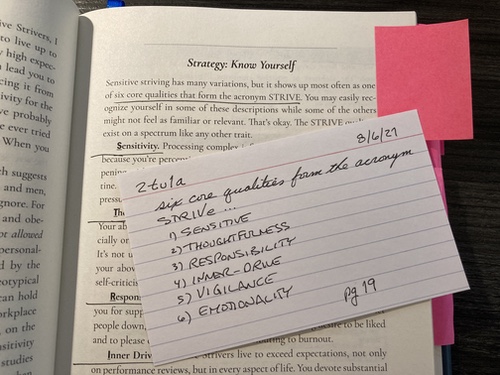
Finally, I go through all the spots I’ve identified and I do a little underlining. I jot the basics of the idea on a slip and address it. So for this example book, whose slip is addressed “2tu1”, this first of the summary slips goes “below” as “2tu1a.” Next summary slip would be, “2tu1b”, “2tu1c” etc.

ɕ

Yes, relax →

This is the training. Relax the narrative, loosen your view, and drop into the openness of the present moment. Breathe deeply, and relax your body. Relax the jaw, relax the muscles in your torso. Feel the openness in this moment.

~ Leo Babauta from, Training to Be Relaxed in Stressful Situations – Zen Habits Website

Elsewhere, this is 4uzere2. — slipbox

It took me a long time to understand that the only source of stress in my life is myself.

I’ve been in two car crashes where I’ve instantly gone from automobile operator to roller-coaster rider. I’ve been absolutely wiped out, in countless variations, in martial arts context. I’ve discovered mid-air that I’ve been launched off my mountain bike. I’ve been obliterated while skiing. I’ve had too many—I’m refusing to count—nearly serious automobile accidents where my driving skills, applied consciously with to-the-inch and to-the-split-second accuracy saved the day. I’ve had bones broken. I’ve been fallen upon, by a poor fellow who was saved from an 8-foot, head first, fall onto concrete… by the flex of my rib cage. I’ve been hit in the face with a max-power, line-drive, point-blank soccer ball penalty kick. I’ve been flattened by a skull-to-skull running-speed impact. Sucker-punched in the gut. T-boned into the sticker-bushes at high speed on a bicycle. Beaned by a 2×6 board. I once fell 12 feet from a tree with my head being the first thing to land… on a tree root. I’ve been clipped by a truck, and blown a bicycle tire at high speed, ending up happy to reach the ditch rather than the asphalt. I rear-ended a car at speed (on my bicycle.) I’ve been banged up, flipped over, slammed into, … but also yelled at, and put upon. I had someone angrily invoke the name of my dead father in an attempt to shame my actions. I’ve been laughed at, and picked last in gym class. I’ve run out of money and bummed rides to work. I’ve been chewed out by a boss. I’ve had my credit card declined while in public. I’ve been scammed by street hustlers, lied to by various people, and pre-judged in various dimensions.

…and I can now truthfuly say: The only source of stress in my life is myself.

ɕ


Zoomed way, way out →

It’s true that such adaptations are now anachronistic; they have lost their relevance. But the trees have been slow to catch on; a natural consequence of the pace of evolution. For a tree that lives, say, 250 years, 13,000 years represents only 52 generations. In an evolutionary sense, the trees don’t yet realize that the megafauna are gone.

~ Whit Bronaugh from, Ecological Anachronisms – Long Now

Elsewhere, this is 4uloeo1. — slipbox

There’s an effect in film making which you’ve seen but may not have realized exactly what you were seeing: The dolly zoom shot. “The dolly zoom is a famous technique invented by Alfred Hitchcock for his 1958 film Vertigo. The shot is achieved by simultaneously tracking backwards or forwards while zooming in or out.”

The narrator is too breathless for my tastes, but still, take a few minutes to watch this explanation of the dolly-zoom. You can thank me later: https://nofilmschool.com/2017/05/watch-what-dolly-zoom-can-do-you

Ahem. Now, back to my top-quote and what I wanted to say in the first place…

Text-based, disorienting dolly-zoom!

ɕ


Cole’s law →

Hofstadter’s Law – “It always takes longer than you expect, even when you take into account Hofstadter’s Law.”

~ “rogersbacon” from, Eponymous Laws Part 3: Miscellaneous — LessWrong

Elsewhere, this is 4ulepo9. — slipbox

It’s part 3, and it is a nifty collection of serious and whimsical laws. However, I doubt that Stigler is the originator of Stigler’s Law. Sometimes the only reason I write this stuff is to see if I can entice you to go read the thing to which I’ve linked.

But more often I do have a point. I’m wondering, in this case, how much of our urge to create, and our delight in such pithy Laws as Dilbert’s, comes simply from our mind’s desire to find patterns. There are a slew of cognitive biases, (confirmation bias springs to mind as fitting the pattern of my example,) which feel like they arise from pattern matching gone overly Pac Man.

ɕ


And sometimes I trip over answers →

Why do great writers write?

~ Shane Parrish from, Why Great Writers Write

Why, indeed. I write—and this reason is one of many mentioned in that article—because it’s the only way I know to be sure I actually understand a concept. I used to think that, at least some of the time, I was writing because I had something which I found interesting, and I’d wanted to share it. But I now realize that, no, what makes me want to share it is that I don’t want to forget it [the interesting thing.] Wait, sorry. I’m not explaining this very well. I write because the act of pinning-down my thoughts, to create concise— no wait, it’s not really about concision. (Score! It’s a rare day in mixed metaphors that I get to use that one.) The act of choosing one idea, from my usual flurry of thoughts, forces me to evaluate them; Choosing forces me to decide which of these thoughts is the most important— *derp* I was talking about why I write, and now I’m talking about how I write. I’ve gone astray. With word play. Clearly then, I am not a great writer, and actually I never claimed to be one, nor have I ever, truth be told—interjections be interjected… Do you know the difference between using—these guys—or these guys, to delimit an aside, (versus going full-on into parenthesis)? Swimming. Dashes are when you expect the swimming reader to duck their head under water, and commas—but never comas—are for a brief dive in the shallow end, (and we get out the parenthesis when our swimmer needs the warning that a deep breath will be required before we dive to the bottom of the deep end to investigate something sparkly spotted therein.) Quite proud of that ridiculous, previous sentence which uses as it espouses the variations thereof. *glancing up* Wait no, I’ve written a rambling wall of text.

Why, indeed, do I write? CLEARLY I have no frickin’ clue.

Perhaps I should settle for: Why did I write this post? Why did I use that linked article, combined with a title hinting that I learned something over which I’d tripped? Because It contains a larger block of context around a quote which I already, very much liked about the Muse.

ɕ

PS: The title is a reference to, Sometimes I look stuff up.


Entry points →

When I began trying to understand how a Slipbox would work for me, I think I was most stuck on the idea of entry points: Where and how would I find myself going “into” the Slipbox?

Turns out, I’m “in” the Slipbox a lot simply because I’m often adding things to it. So of course I run into other slips and ideas inside the Slipbox.

But I’ve had a lingering concern: What happens when I want to locate something in particular within the Slipbox?

All the instructions and guidance I see caution one to not try to structure the Slipbox from the beginning; cautions against trying to incept the perfect categorization of all the stuff you don’t yet realize you are going to want to add… They are correct; that way madness lies. And so I set off creating top-level slips.

But still that lingering concern: What happens when I want to locate something in particular within the Slipbox?

And so I’m stealing a trick from the even-older-than-Slipboxes/Zettelkastën methods of creating commonplace books: How to create an index on physical media (journals, blank books, or little paper cards going into a Slipbox!)

slip 4c is “Slipbox indices”
slip 4c1 is “people by last name”

Here I’m hacking the Slipbox addressing system. Yes, I’m leaving room for a later 4c2 that could be another index, by topic. But mostly, I’m making sure that the slips under 4c1 can then be letters— 4c1a, 4c1b, 4c1c and so on.

And here’s the hack from commonplace books: To Build an index that doesn’t get out of hand, take the first letter and the next letter which is a vowel.

Constantine > “co”
Washington > “wa”

Easy. But the following are not under “an” …

Anka > “aa”
Antisthenes > “ai”

And…

Armstrong > “ao”
Curie > “cu”
Einstein > “ei”
Epictetus > “ei”
Gracián > “ga”
Irvine > “ii”
Twain > “ta”

And so on.

If you’re wondering, that means there could be 26×6 slips in this index. (a-z gives 26 first characters, times a, e, i, o, u, y gives 6 second characters.) But in reality I’ve reached about 40 slips and I’ve not had to add another for a while now.

What’s on each slip? Just references to other slips in the Slipbox…

4c1wa has
Ward, William A — pj4.28
Wayne, John — 4a7
Ward, Bryan — 4b21
Washington, George — 4a19

It’s not sorted. It’s simply in the order I added those names. If the card overflows, I’ll add an identically addressed 4c1wa since the items on those two 4c1wa cards aren’t in any particular order.

What? Is it worth it? …yes. I’ve already gone in to add a person, only to discover they are already in the Slipbox somewhere completely different and that’s a connection I hadn’t noticed before…

BOOM! There’s the other part of the Slipbox I wondered about: How is this thing going to make new things fall out of my thinking.

ɕ

Elsewhere, this is 1c1. — slipbox


Reflection: Day 27 →

CONCENTRATION — “It takes but a little to destroy and overturn everything, just a slight deviation from reason. To overturn his ship, a helmsman does not need the same proficiency as he does to keep it safe, but, if he turns it a little too far into the wind, he is lost: and even if he does not do so deliberately, but simply loses his concentration for a moment, he is lost. Such is the case here too. If you nod off for just a moment, all that you have acquired up till then is gone.” ~ Epictetus, 4.3.4-6


You are using a trigger to practice reflection. Is there anything in your day that resembles the reflection trigger? Opportunities where you could reflect spontaneously?

ɕ

Arrived in the middle? Visit the first post, Where to begin?
(The entire series is available to download as a PDF ebook.)