Three dots →

Let me be clear that no part of me idealizes the bygone agony of waiting three weeks for a letter from your lover to cross the Atlantic—a letter that might never arrive from a lover who might be dead by the time it does arrive. But let me also be clear that, in another century or two, if humanity is wise enough to survive and reconsider its compulsions, posterity will look back on us gobsmacked that we put ourselves through the agony of the three pulsating dots.

~ Maria Popova

Elsewhere, this is 4a951. — slipbox


Incomplete with Janne Laurila →

Movers MindsetIncomplete with Janne LaurilaJun 22, 2022 · 21:24How does movement influence personal change and adaptability in life? Movement evolves from a tool for improvement to a means of adapting to life’s challenges. I think that when I started doing Parkour, the movement was a kind of like— it was cons

How does movement influence personal change and adaptability in life?

Movement evolves from a tool for improvement to a means of adapting to life’s challenges.

I think that when I started doing Parkour, the movement was a kind of like— it was constant exploration. […] But as more time has gone, I started to feel that that change isn’t just trying to improve. [It’s] more to adapt on how you can perform? Or how would— How do you see a challenge? Or how do you process a challenge?

~ Janne Laurila (1:47)

The conversation explores how movement intertwines with personal growth, adaptability, and energy management. Starting with parkour as a way of improvement, Janne shares his journey of evolving to see movement as a tool for adaptation rather than mere enhancement. Factors such as physical energy, time management, and life changes, like raising children, shape his relationship with movement.

Living in Finland adds layers to this experience, with long periods of light and dark influencing mood and activity. Balancing responsibilities as a parent, entrepreneur, and student while managing ADHD highlights the challenges of maintaining schedules and finding moments of recharge. The conversation concludes with reflections on compassion, curiosity, and the acceptance of being incomplete as guiding principles.

(more…)

Entering this moment →

To be in any kind of balance state, especially if it’s new is incredibly valuable to bring you into this moment, because the moment is in constant change. That’s why we call it infinite, right? You can’t grab hold of it and then be there. The second you’re there, it’s gone and you’re in the next one, and that’s this awake kind of living. Balance is the fastest way to enter into that space.

~ Thomas Droge

Elsewhere, this is 4a809. — slipbox


Unstuck with Robbie Swale →

PodtalkUnstuck with Robbie SwaleFeb 4, 2022 · 22:16How can individuals overcome barriers to starting and continuing creative projects? A 12-minute train ride sparks the idea for a method that helps people overcome procrastination. The creative hell of having something that you know you want to do

How can individuals overcome barriers to starting and continuing creative projects?

A 12-minute train ride sparks the idea for a method that helps people overcome procrastination.

The creative hell of having something that you know you want to do and haven’t done, is much worse than having done it and it gone wrong.

~ Robbie Swale (2:26)

The conversation explores the challenges and processes involved in creative work, starting with the guest’s ambitious goal to appear on 100 podcasts within a year. This goal is tied to promoting a book and sharing a method designed to help people overcome procrastination. The “12-minute method,” inspired by quick train commutes, emphasizes short, focused creative sessions followed by immediate sharing, reducing the barriers to starting and completing creative projects. The discussion includes reflections on the emotional struggles associated with creative paralysis and the relief of simply beginning, regardless of the outcome.

Another topic discussed is personal branding, as Robbie shares how his identity has evolved across multiple roles—author, coach, and podcaster. He discusses the difficulty of balancing different audiences and platforms while maintaining a cohesive brand. This is paired with insights into the art of having meaningful conversations, whether in podcasts or personal interactions, and the transformative power of stripping away non-essential elements in both creative and conversational practices.

(more…)

Audience →

Elisa Graf is both a writer and an editor and has started a podcast called Mystic Takeaway. She loves stories about the transcendent and the everyday world colliding, and the surprise, joy, and wonder that ensues. Her podcast showcases extraordinary stories of mysterious encounters and miraculous healings.

In our conversation, we found ourselves talking about podcast show statistics. They come up often when people first dive into podcasting. Everyone quickly realizes there’s an array of numbers that can be tracked. But what do those numbers mean? What numbers should we be shooting for? What does a “download” or “listener” even mean? But rather than dive into techno-babble, I was curious about what first surprised Elisa about podcasting stats when she published her podcast.

(more…)

Caution: Tulpa →

I’ve recently made a startling discovery: Maybe there really is a tulpa in my head.

First, I’ve said for many years that my brain is broken. (Yes, I am aware I have terrible self-talk.) Here’s why I call it broken: I am literally unable to NOT see problems. I notice an endless onslaught of things that, in my opinion, could be improved. I don’t mean, “that sucks, I wish it could be better.” No, I mean, “that sucks and it’s obvious this way would be better and if you’d just let me get started . . . ” Adderall might help, I suppose.

Everyone loves that I get stuff done, and try to make things better. But unless you have this same problem, I’d imagine it’s hard to understand how this is debilitating. I am aware that this is recursive—I see my own brain as a broken process that I feel I should repair. All I can say is that you should be happy, and thank your fave diety if that’s your thing, that you don’t understand. Because to understand is to have the problem, and you do. not. want. this. problem.

Second, I’ve also said for many years that, “the remainder cannot go into the computer.” I’m referring to a endless source of struggle in programming and systems administration; Computers are exact, and the real world—with its real people, real problems, and things which really are subjective shades of gray—is not. So programmers and systems administrators factor, in the mathematical sense of finding factors which when multiplied give you the original, reality into the computers. And when factoring reality, there is always a remainder. That remainder shows up when you find your software does something weird. That could be a mistake, but I tell you from experience, it is more often some edge case. Some people had to make choices when they factored.

The result of that second point is that I’ve spent the majority of my life factoring, (and “normalizing” for your math geeks who know about vector spaces,) problems into computers. And then trying to live with the remainders that didn’t go into the computer. The remainders are all in my head. Or on post-it notes on my wall, (back in the day.) Or the remainder is some scheduled item reminding me to check the Foobazzle process to ensure the comboflux has not gone frobnitz. To do that I had to intentionally be pragmatic and logical. And the really scary part is I also learned that the best way to do all of that was to talk to myself—sometimes literally, bat-shit crazy, out loud, but usually very loudly inside my own mind—to discover the smallest, least-worst, remainder that I could manage to live with.

What if those two things were sufficient to create a Tulpa. (I am serious.)

I think there’s a Tulpa in here! (My title is the sign on the front gate.) It is absolutely pragmatic. It knows an alarming amount of detail about things I’ve built, (or maintained, or fixed.) It is cold and calculating. It is terrified that it will forget about one of those details, 2347 will happen, and everyone will run out of ammunition defending their canned goods from the roaming bands of marauders. I definitely don’t “have” the Tulpa. It’s more like discovering there’s an extra person living in your house. Although, I don’t hold hope of banishing this Tulpa, Yoda does make a good point if I’m going to try. So, I should definitely give it a name.

Maybe, Sark?

That is an intriguing idea indeed! Sark, what do you think?

ɕ

In the end →

Not just that every day more of our life is used up and less and less of it is left, but this too: If we live longer, can we be sure our mind will still be up to understanding the world—to the contemplation that aims at divine and human knowledge? If our mind starts to wander, we’ll still go on breathing, go on eating, imagining things, feeling urges and so on. But getting the most out of ourselves, calculating where our duty lies, analyzing what we hear and see, deciding whether it’s time to call it quits—all the things you need a healthy mind for… all those are gone.

So we need to hurry.

Not just because we move daily closer to death but also because our understanding—our grasp of the world—may be gone before we get there.

~ Marcus Aurelius

Elsewhere, this is 4a674. — slipbox


Conversation with Helena Roth →

PodtalkConversation with Helena RothNov 4, 2021 · 22:09What makes a conversation meaningful and how does one cultivate the skill of engaging in impactful dialogue? The interplay between coaching and conversational skills reveals itself in surprising ways. [I]ts more towards the other [end] in my podca

What makes a conversation meaningful and how does one cultivate the skill of engaging in impactful dialogue?

The interplay between coaching and conversational skills reveals itself in surprising ways.

[I]t’s more towards the other [end] in my podcast. […] There hasn’t been an agenda. There hasn’t been a set timeframe. There hasn’t been any, ‘this is what we need to get through, or the goal we need to reach, or anything.’ And, surprisingly, you know it’s gone really well.

~ Helena Roth (1:07)

This conversation explores the dynamics of creating meaningful dialogues, with an emphasis on curiosity and presence. Helena and Craig discuss the distinction between structured interviews and organic conversations, highlighting the challenges and rewards of allowing spontaneity to guide the flow. Insights are shared about how to cultivate an environment where natural exchanges can thrive, contrasting the vibrancy of unplanned dialogue with the rigidity of pre-set agendas.

They touch upon the art of listening and the interplay of coaching principles in conversations, including withholding judgment and fostering genuine curiosity. Reflections on well-known podcasting styles illustrate the impact of personal involvement in interviews. Practical techniques, like recording from the first moments to capture authenticity, also surface, underscoring the importance of preparation in producing organic conversations.

(more…)

State of Franklin →

As I headed out of Asheville, North Carolina it occurred to me to wonder why I was heading north on Interstate 26. It was clearly labeled “North,” I was currently pointed north, and as far as I could tell—glancing at the dashboard’s big bright display while negotiating the swerving and undulating roadway—it was going to take me very-much northward. None the less, even-numbered Interstates are usually east-west routes. Also odd: The signage in North Carolina said “future” I-26, but it looked pretty in-existence to me.

North Carolina’s license plates say, “from sea to mountains.” Or something like that. Asheville and surrounds take that seriously. Lots and lots of hills and mountains and valleys for my little 4-cyclinder van to lumber up and down. Dang pretty though. Lots of evergreens, but enough deciduous trees that I bet the fall foliage is a spectacle.

At which point Siri announced: “Welcome to Tennessee!” Wait, wat?

I really should look over the map route before I start driving. I was expecting to go straight from North Carolina into Virginia. In hindsight, I see that was an option if I’d gone east from Asheville and northward from, like, Charlotte. And so I got an extremely brief glimpse of an extremely beautiful part of Tennessee.

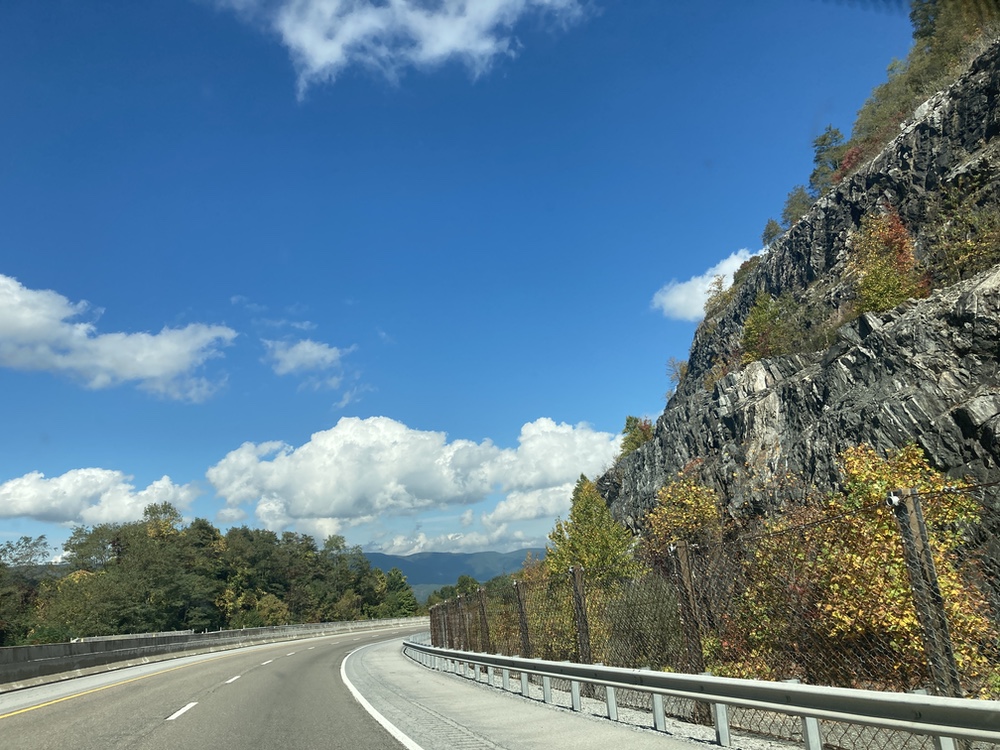
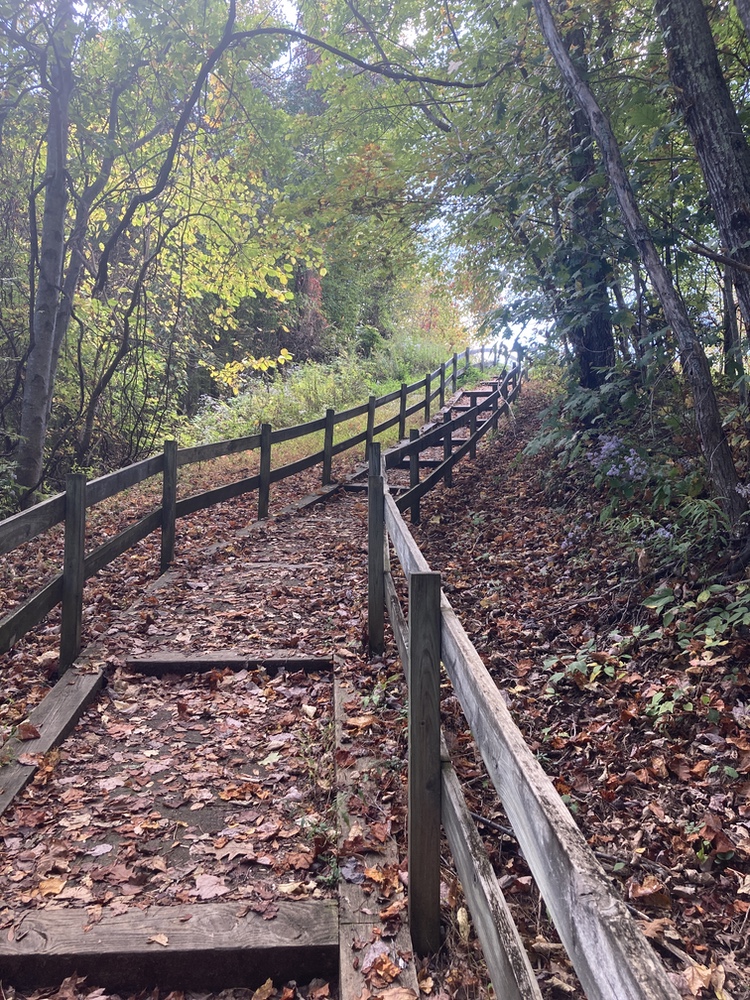
But first, I drove up and down 42 steep hills like this one:

Somewhere along the way I saw a sign for the almost-was-a-State of Franklin. I’d read about that years ago, and—serendipity!—here I was driving through it. (The entire far-eastern pointy bit of Tennessee was once almost-sort-of Franklin.) Anyway.

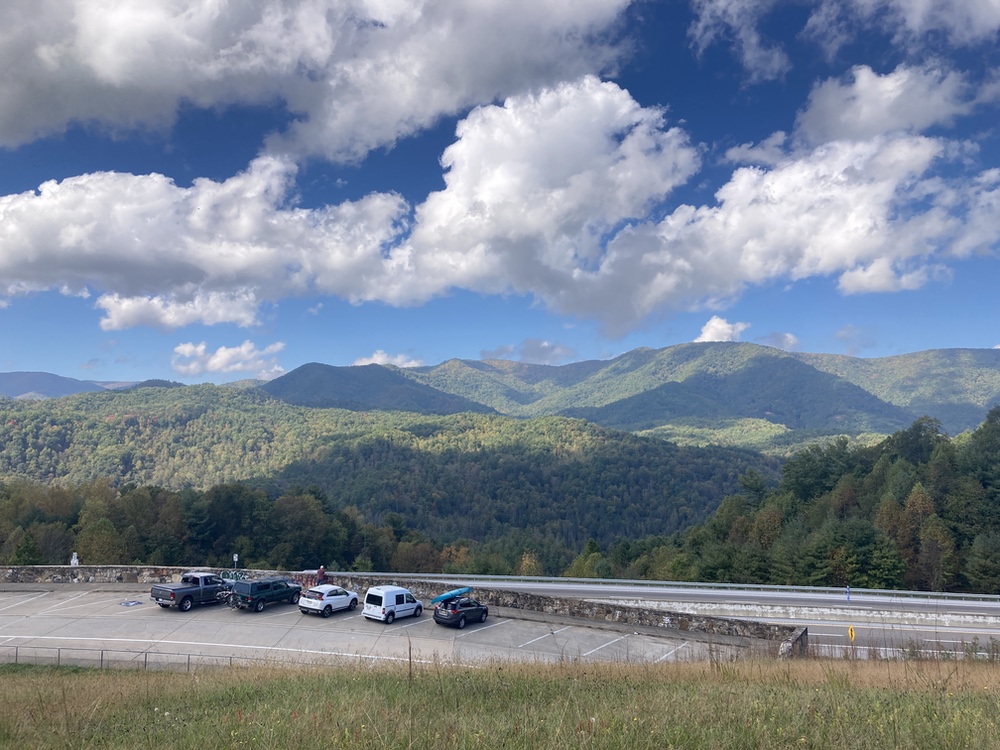
Eventually I reached that quintessential American experience: The scenic overlook. I parked here:

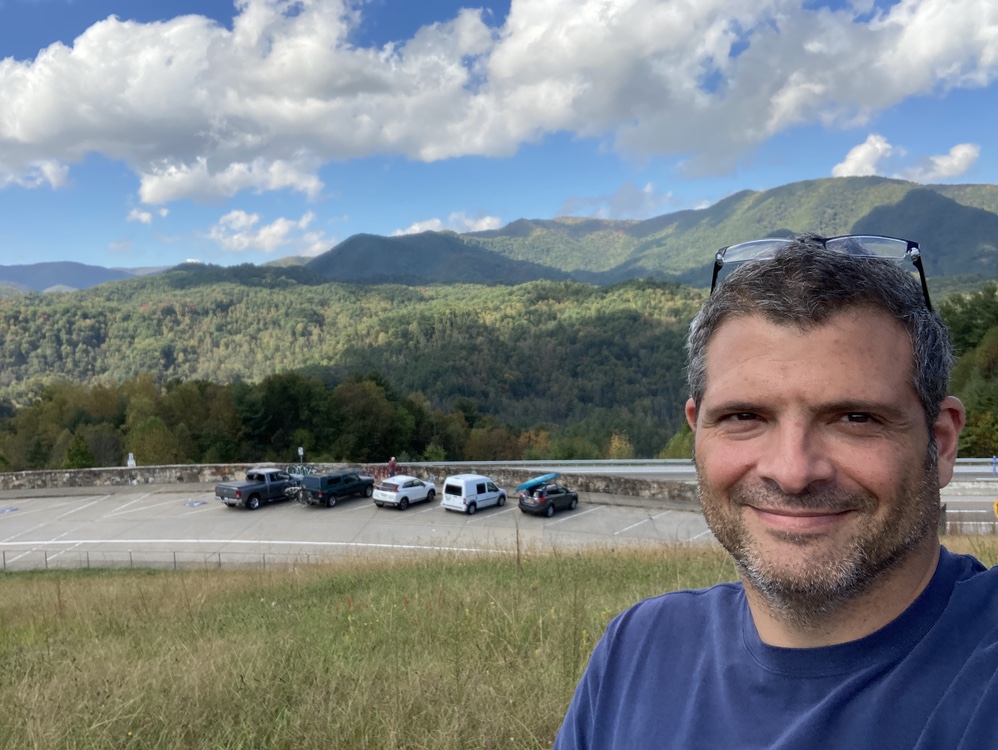
I can tell when I’ve been sitting too long, riding in a car for days… I get the urge to bound up the stairs, one might even say the urge to run. Same shot, selfie-mode:

Two tricks to better selfies: Look at the camera lense, not the screen, as you trip the shutter, and intentionally lower the shoulder of the arm holding the camera. The one shoulder scrunched up is the dead-giveaway in selfies. Also, dude, get a hair cut and shave.

As I was strolling away, I realized there was a side trail. It mentioned 800 feet, and 150 feet vertical. I didn’t “run” up. I briskly walked up while thinking, “oooooh max heart-rate cardio… didn’t see that coming either.” But it was worth it:

ɕ


Connection with Fred Martin Gutierrez →

PodtalkConnection with Fred Martin GutierrezSep 16, 2021 · 20:18What is the unique power of sound as a medium to connect with others and foster understanding? The essence of podcasting lies in its ability to preserve authenticity and humanity. Ive gone through a career as an architect and as a builder, andu0026nbs

What is the unique power of sound as a medium to connect with others and foster understanding?

The essence of podcasting lies in its ability to preserve authenticity and humanity.

I’ve gone through a career as an architect and as a builder, and acoustics are often overlooked […] I always have this dream of building the perfect bar, or the perfect restaurant, because I think the acoustics in those spaces are more important than anything else. That ability to be with somebody, but be in public, and acoustics can influence that dramatically— or make it a horrible experience.

~ Fred Martin Gutierrez (17:16)

The conversation begins with reflections on the unique emotional resonance of sound, emphasizing how podcasting enables connection through its focus on auditory experience. Sound’s unedited authenticity, as seen in music and live conversations, is contrasted with the more curated nature of other mediums. The importance of pauses and space in fostering deeper thought and connection is highlighted, both in podcasting and in writing.

The discussion transitions into technical aspects, such as the role of acoustics in spaces like bars and restaurants, where it can enhance or detract from experiences. The conversation also touches on podcasting as a tool for self-discovery and reflection, particularly during midlife, revealing how it offers an avenue for learning and personal growth. Finally, the talk explores the human connection fostered by shared experiences, whether through podcasts, music, or even reaction videos.

(more…)