I cannot believe that the inscrutable universe runs on an axis of suffering; Surely the strange beauty of the world must somewhere rest on pure joy!
~ Louise Bogan
Elsewhere, this is 4a1503. — slipbox
I cannot believe that the inscrutable universe runs on an axis of suffering; Surely the strange beauty of the world must somewhere rest on pure joy!
~ Louise Bogan
Elsewhere, this is 4a1503. — slipbox
Grandiose fantasies are a symptom of Resistance. They’re the sign of an amateur. The professional has learned that success, like happiness, comes as a by-product of work. The professional concentrates on the work and allows rewards to come or not com, whatever they like.
~ Steven Pressfield
Elsewhere, this is 4a1502. — slipbox
I really enjoyed Curtis Cates’s episode 14, Transformation can be fun…!.
Lately, I’ve been back to my regular walking, and I’ve started getting serious listening time in. I was delighted to get a chance to hear from Curtis.
(Yes, yes, I’m way waay behind on the Hansel & Gretel Code.)
Like you, my to-listen-to podcast cup runeth over! I’m regularly adding newly-released episodes. But I also have a way of systematically looking through shows’ entire back-catalog. So I’m also, regularly adding very-old episodes.
Yikes!
…and I heard one of Curtis’s sound-bites as I typed that.
Anyway, if you’re already familiar with Curtis’s work, drop back into ep14 of H&G, just for fun. If you’re going “Curtis who?” … start below. And, you’re welcome!
art is personal
~ Curtis Cates, from Kristo.art
and what qualifies or disqualifies something as art is all up to you
ɕ
PS: I don’t subscribe to shows; I add episodes one-by-one when I see interesting episodes via my daily RSS-feed reading.
Spending time in solitude with your artist child is essential to self-nurturing. A long country walk, a solitary expedition to the beach for a sunrise or sunset, a sortie out to strange church to hear gospel music, to an ethnic neighborhood to taste foreign sights and sounds—your artist might enjoy any of these. Or your artist might like bowling.
~ Julia Cameron
Elsewhere, this is 4a1499. — slipbox
To live a creative life, we must lose our fear of being wrong.
~ Joseph Chilton Pearce
Elsewhere, this is 4a1498. — slipbox
Individuals who are realized in their own lives almost never criticize others. If they speak at all, it is to offer encouragement. Watch yourself. Of all the manifestations of Resistance, most only harm ourselves. Criticism and cruelty harm others as well.
~ Steven Pressfield
Elsewhere, this is 4a1497. — slipbox
It is all very well to insist that man is a “social animal”—the fact is obvious enough. But that is no justification for making him a mere cog in a totalitarian machine—or in a religious one either, for that matter. In actual fact, society depends for its existence on the inviolable personal solitude of its members. Society, to merit its name, must be made up not of numbers, or mechanical units, but of persons. To be a person implies responsibility and freedom, and both these imply a certain interior solitude, a sense of personal integrity, a sense of one’s own reality and of one’s ability to give himself to society—or to refuse that gift.
~ Thomas Merton
Elsewhere, this is 4a1496. — slipbox
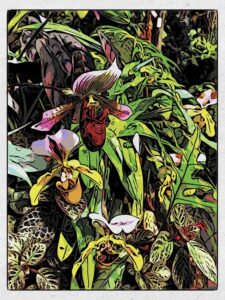
I have written about this before and it is something I wish to emphasize repeatedly: efficiency and clarity are necessary elements, but are not the goal. There needs to be space for how things feel. I wrote this as it relates to cooking and cars and onscreen buttons, and it is still something worth pursuing each and every time we create anything.
~ Nick Heer, from Delicious Wabi-Sabi
Elsewhere, this is 4upobo3. — slipbox
Yes, “efficiency and clarity are necessary elements, but are not the goal. There needs to be space for how things feel.” Hear! Hear!
There are at least three reasons to read Heer’s points. Retro-digital photography is really a thing; the Japanese concept of wabi-sabi (appreciating beauty that is imperfect, impermanent, and incomplete); A bit of hist wondering about software.
It’s the wabi-sabi that got me thinking about podcasting. I’m well-known for cutting the corner when it comes to editing the conversations I record. I’ve always looked at that as a necessity: If I tried to raise the level of quality by editing, I’d not be able to put the episodes out (or at least not as many.)
After reading Heer’s thoughts, now I’m wondering if I’m also—perhaps even more so?—drawn to the wabi-sabi of the conversations with all their blemishes, false-starts, uhm-and-ahs in place.
ɕ