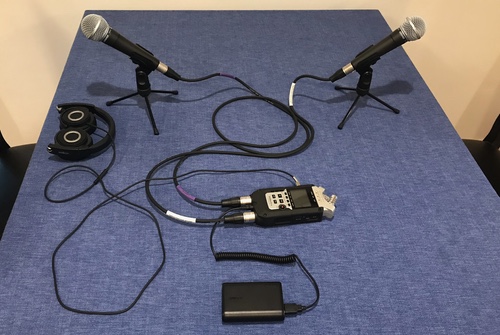
Evolution of my field recording kit

Day One

Zoom H4N recorder, a pair of SM58s (didn’t even have pop filter foam covers) with table-top mic stands. I went to the trouble of finding a power cord that matched the Zoom’s bayonette jack (on the chin at the left, between the XLR cables) and had a standard USB plug on the other. This of course only worked because the Zoom would accept 5v DC. One pair of Vogek folding headphones for me. Stand USB battery brick. I kept this all packed into a Pelican case much smaller than a shoebox.

(more…)

Open Podcast Directory — A proposal to globally enable auto-discovery of podcasts

THIS POST IS HISTORICAL — See instead https://openpodcastdirectory.org/


When you want to visit a web site, you do not need to search for it in a central directory of web sites. Your web browser simply goes into the DNS system and finds the address to connect to.

Today, podcasts are managed inside a huge directory. But they do not need to be in a directory!

Meet the Open Podcast Directory

If you want to find the podcast for example.com why doesn’t your podcast player simply go find that podcast by looking it up in DNS?

All that needs to happen is for people to put information into DNS—a record that says, “the podcast RSS feed is at this URL”—and then podcast players can simply make a DNS query.

  • create a DNS record for host “_opd” in your domain
  • record type TXT
  • record data is the URL of a podcast feed
  • multiple TXT records are permitted, to enable auto-discovery of multiple podcasts within a given domain

In this way, each podcast’s content creator uses the existing, global DNS system to publish the location of the podcast’s feed URL.

Moving your podcast

Want to change where your podcast is hosted? Simply update your DNS.

Why?

Content creators are currently dependent on directories. Apple’s iTunes directory is the de facto standard. We are already seeing a splintering of the podcast space…

Not all shows are podcasts, by John Gruber
The podcast monetization problem…, by Tanner Campbell

$ dig txt _opd.moversmindset.com
; <<>> DiG 9.10.6 <<>> txt _opd.moversmindset.com
;; global options: +cmd
;; Got answer:
;; ->>HEADER<<- opcode: QUERY, status: NOERROR, id: 15816
;; flags: qr rd ra; QUERY: 1, ANSWER: 1, AUTHORITY: 0, ADDITIONAL: 0
;; QUESTION SECTION:
;_opd.moversmindset.com. IN TXT
;; ANSWER SECTION:
_opd.moversmindset.com. 86101 IN TXT "https://moversmindset.com/feed/podcast"
;; Query time: 1 msec
;; SERVER: 10.0.1.1#53(10.0.1.1)
;; WHEN: Fri Apr 26 09:34:04 EDT 2019
;; MSG SIZE rcvd: 91

ɕ


The power to break your back

If you can lighten your burden you must do so. There is no straw which lacks the power to break your back.

~ unknown

slip:4a73.


Adam McClellan: Business, coaching, and outreach

What are the inherent challenges of growing and monetizing a Parkour community without losing its core values and spirit?

35 episodes and 2 years later, Adam McClellan returns to Movers Mindset. Adam deserves a large measure of credit because he was willing to be the original guinea pig for this crazy experiment. Our first interview was a simple Q&A style but in this episode we have an in depth conversation about the cycles a community goes through, the nature of parkour, and the type of people who are drawn to it. Adam explores the intersection of parkour and business, and how the two coexist, before discussing the nuances of coaching children. He opens up about his knee injury and recovery, his thoughts on normalizing parkour to the public, and different ways to design a parkour gym.

One of the things we value about Parkour is there isn’t that hierarchy and structure in place. It’s just you and me, and we’re hanging out, you don’t have to call me anything— There’s no assumed authority, right? We’re just training together.

~ Adam McClellan (21:40)

This conversation explores the growth and evolution of a Parkour community as it transitions from informal outdoor training to a structured business model. The discussion highlights the shifts in community dynamics when money and formal structures are introduced, drawing parallels between martial arts schools and Parkour. Adam reflects on how scaling up often leads to a loss of intimacy and core values, raising questions about whether Parkour can retain its spirit as it grows.

Key topics include the role of leadership in shaping community culture, the unavoidable influence of business practices on Parkour, and the challenge of teaching children while preserving the deeper philosophical aspects of the discipline. There is also a focus on personal injuries, their impact on training, and how physical setbacks shape the journey of a Parkour practitioner.

Takeaways

The growth of Parkour communities — Scaling introduces structure and money, often challenging the core values that initially attract practitioners.

Leadership’s role in community — The personality and values of leaders heavily influence the community’s trajectory and inclusivity.

Business and Parkour — Structuring Parkour as a business introduces operational necessities that can shift focus from movement and personal growth to profit and efficiency.

Teaching children Parkour — Teaching children emphasizes physical skills over the deeper self-exploration aspect inherent to Parkour for adults.

Injury and recovery — Personal injury experiences reshape one’s relationship with movement and coaching, often influencing how practitioners train and teach.

Cultural perceptions of Parkour — Public perception, especially from institutions like police or schools, shapes the accessibility and acceptance of Parkour in local communities.

Community dynamics — Communities inevitably evolve based on the personalities and shared experiences of the core members.

Parkour as self-exploration — The practice naturally fosters personal growth and reflection, often leading practitioners to deeper self-awareness.

Resources

Lehigh Valley Parkour

ADAPT Qualifications — Mentioned in the context of coaching certifications for Parkour instructors.

David Belle Speed Vault — A classic example of the Parkour speed vault technique referenced during the discussion.

(Written with help from Chat-GPT.)

ɕ


Flashback to August 2018

This post is from some quick notes I made in August 2018. I’m only just getting around to publishing it now, 8 months later, as part of this series. Today, at ~230 pounds, 215 seems like a dream.

I’m recently back from traveling to Denmark and France to attend two Parkour events back-to-back. As usual when I’m traveling, I don’t attempt to keep up my normal routines so there’s no data recorded for most of July 2018.

I’m happy to return still around 215 as I try to get back to my routine of “chaining together” my mornings. Compared to July, I’m not as active, but I’m trying to AVOID the, “let’s be super active and try the 100-days-of-activity challenge,” mistake I made in 2017 when I came home from the same events all excited about movement.

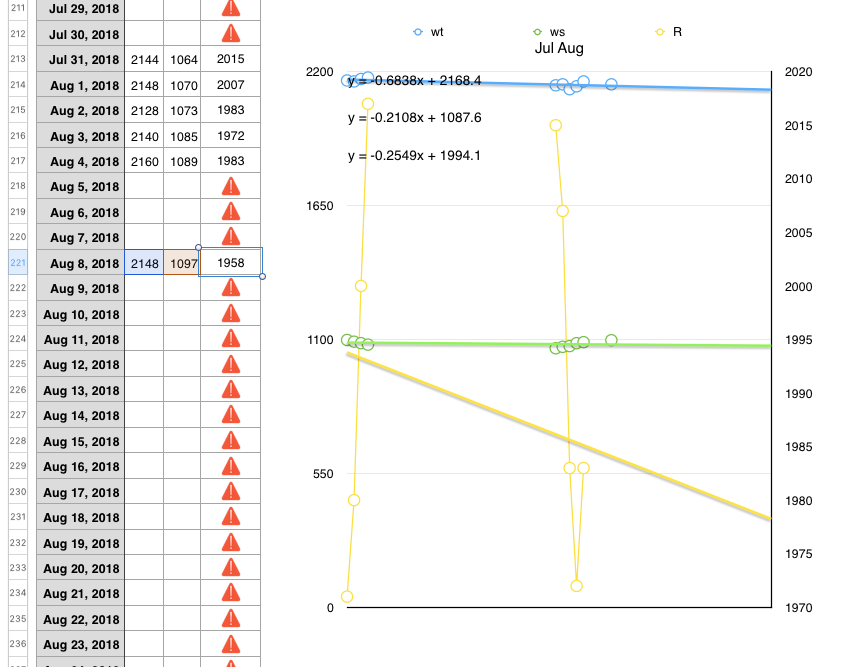
Anyway, what about that ratio of 1958? …it’s so low that it’s not even on the graph! This reminds me of two things I believe I’ve noticed:

  1. The ratio lags behind when I’m actively losing weight. My guess is that the different components (water, subcutaneous fat, visceral fat, and muscle) change at different rates. So when losing fat from calorie deficit, the peripheral/subcutaneous is liberated first—which aligns with my recollection that visceral fat is more tenacious.
  2. The best ratio is very hard to find—to actually see it in the measurements. I have to lose weight gradually, and then stay at the new weight for many weeks to see the ratio rebound to above 2000. (Reminder, the ratio is in wacky units of “tenths of pounds per millimeter midriff circumference” because of how I record the numbers. The numerical value of the ratio is of no concern; It’s only useful for trending.)


All comes out even at the end

Weak as I am, I carry on the war to the last moment, I get a hundred pike thrusts, I return two hundred and I laugh. I see near my door Geneva on fire with quarrels over nothing, and I laugh again; And, thank god, I can look upon the world as a farce even when it becomes as tragic as it sometimes does. All comes out even at the end of the day, and all comes out still more even when all the days are over.

~ Voltaire

slip:4a8.


On not letting go

I experimented by letting go of goals for a while and just going with the flow, but that produced even worse results. I know some people are fans of that style, but it hasn’t worked well for me. I make much better progress — and I’m generally happier and more fulfilled — when I wield greater conscious control over the direction of my life.

~ Steve Pavlina from, Do Your Goals Conflict with Your Personality?

slip:4usebo11.

“Letting go” of my structures and goals is good for short-term health. I do this when I’m traveling, or when something unusual happens, (such as having a house guest for a weekend.) Letting go enables me to see if my default habits have changed, as I’m often working on some goal or project that involves habit change. Letting go creates space for serendipity.

But letting go does not get things done. My mind is meant to have ideas, not to hold them. Systems (a grocery list, a todo list, plans for projects, and so on) are how my mind creates the changes I want to see in the world.

Letting go certainly recharges me. It’s the restorative yin to my personality’s default yan.

ɕ


Deep dive about podcast feeds

This article got out of hand, and is 3,000 words.  I encourage you to skip around; There’s more discussion of specific tools and how-to material in the last third.

In the beginning

In the beginning, podcasts were simply audio files which people shared directly either by emailing them to each other, or by providing download links on their web sites.

RSS technology has been around for a while and provided a way for a web site to publish a “here’s what’s new” feed. It was soon realized that RSS could be used to provide a feed specifically of podcasts. Software able to retrieve and understand a podcast feed, could then automatically download the podcast files, and alert you of new episodes. Sharing a new show with friends then meant simply giving them the “feed URL” which one would “subscribe to” by adding it to your feed reader.

(more…)

§7 – Exercise

This entry is part 7 of 13 in the series Changes and Results

Exercise is not about weight loss.

Exercise builds physical ability and mental health.

For me, it began when I fell in love– with a bicycle.

The story of a boy and his bicycle

Long after college, way down in my downward death spiral, I bought a cheap mountain bicycle. Today, I don’t recall what possessed me to even want to buy a bike. I guess it just reminded me of the freedom I’d discovered when as a kid I first set out on a bicycle.

At the time, we were living in an apartment a short ride from a long park that followed a meandering creek. The park has long trails—some asphalt, some packed gravel—that follow the creek, and it has a few, short, side trails that almost resemble mountain biking.

I fell in love.

I fell in lust is probably more accurate.

I pedaled and pedaled. …and then I pedaled some more. …and then a lot more. I literally wore out that cheap, beautiful bike in the first summer.

During that summer we bought a mountain bike for my dad. He bought an hybrid bike for my mom. Then for a Christmas present, my parents and Tracy bought me a nicer bike. Whereas I was previously crazy about riding, with a new, better, lighter bike, I took things up several notches to addiction, and began riding the daylights out of everything.

I bought a “Mountain Biking Pennsylvania” book and started just heading out to ride trails from the book. Tracy bought a Cannondale when she changed jobs, and then things got out of hand—like Fear and Loathing in Las Vegas out of hand. In the end, I was directly responsible for 27 people going to a particular bike shop and buying bikes because I kept trying to find someone who had the bicycling bug as bad as me.

I pedaled on into the seasons. I commuted the short 2 miles to and from my office in rain and snow. I had studded snow tires for the winter. I replaced bike parts as they wore out, and modified the bike more and more until the bike shop owner, (at this point, a good friend,) finally said, “You know, there are other bikes.” It had never occurred to me that I could own more than one bike. he looked at me like the simpleton I was, “Craig, some people have so many bikes, they hide the newest ones from their wives.”

Re-learning to move

The story continues of course. (The new bike is named Beelzebub, and is the first bike I’ve ever named.) But this article is about “exercise”, not about my affairs with bikes.

In the midst of it all, I understood that it was all partly the runner’s high aspect. But also knew that I simply felt better the more I rode those bikes. Sure my wrists got sore, and I became a menace in the local park zooming around and around like it somehow mattered in the grand scheme. But in the process, my body was changing.

Much later I learned that what I had done was change my identity; changed the way I saw myself. I became the sort of person who would get up early on weekends to drive an hour to ride a bike all over some trail because it was “Trail number #87” in a book. I became the sort of person who learns about bikes, then learns about exercise, and then learns about glycogen storage in muscles.

At the very beginning of the bicycling epoch, I was building a lot of muscle. Well, a “lot” compared to the gelatinous blob of fat I had converted myself into after college. Muscle requires energy to build it and then some energy to maintain it. So in the beginning I got a small win on weight loss, just by adding muscle. As my daily caloric needs went way up, it halted the creeping weight gain.

Years later I learned that exercise is simply, generally healthy.

That sounds like a platitude, but it’s not: Even small amounts of exercise have out-sized benefits in your health and your daily mood. If I exercise just a little, (for example, 20 minutes of moderate walking,) then I sleep better that night, and every time I exercise I get a small psychological benefit.

The key point was the change in my mental health: Exercise made me feel better, and the better I felt, the more I wanted to exercise. Exercise didn’t make me lose weight: It improved my health, and I became the sort of person who weighs less. That sounds subtle, but it’s tremendously easier than trying to lose weight directly.

Compensatory adaptation

I changed my behavior (I added biking) and my body responded by adapting. (Compensatory adaptation from Ned Kock is a great, deep-dive.)

I added some muscle, changed some hormone levels and interactions, cleaned up some mitochondrial function, and other things improved. But soon (it was probably about a year) my body had adapted to where its new state worked well enough for the activities I was doing regularly. This is the famous plateau effect.

As I’ve mentioned, I didn’t realize this is what was happening (the plateau). I just bike bike bike bike biked all over everything. Meanwhile I was tracking things in my health journal, tweaking things here and there (sleep, moving dinner-time earlier, food choices, etc..)

How would you implement this intentionally? If you are even farther out of shape than I was at the start, I don’t suggest starting with biking. Walking is probably better, or maybe even swimming. Exactly what you do isn’t the point. It’s that you begin to exercise. Don’t to do in the sense that, “I have to go exercise now.” (This is why gym memberships generally don’t work as a New Year’s resolution.) Rather, you want to exercise just as something you do, and that will transform yourself into the type of person who exercises.

I am the type of person who…

ɕ

Nancy Lorentz: Cancer, PK Move, and parkour spirit

What impact can parkour have on recovery and personal growth after a serious health challenge?

Nancy Lorentz opens up about her experience fighting cancer, and the role that parkour played in her recovery. She unpacks how her recovery inspired the idea of PK Move, and shares her ‘parkour origin story.’ Nancy discusses her thoughts on parkour’s growth and spirit, PK Move’s current goals, and finishes with her insights on how to attract older individuals to parkour.

[A]t the time of the diagnosis and going forward from there, I was not thinking about how parkour was part of this until afterward. I think once you are in that situation, you’re just going through the steps and getting through the treatment and what you have to do— the surgery or whatever. The fact is that, it did occur to me afterward— I thought, oh my gosh, [yes.] I really do say that parkour saved my life.

~ Nancy Lorentz (5:13)

Nancy Lorenz shares her personal journey of surviving cancer and how parkour became a crucial part of her recovery. She describes how the physical and mental resilience built through parkour helped her endure treatment and how this experience inspired her to co-found PK Move, a nonprofit organization dedicated to bringing parkour to underserved communities. The conversation covers her introduction to parkour, the challenges she faced during and after her illness, and how the supportive community around her played a significant role in her healing process.

The discussion highlights the mission and vision of PK Move, which focuses on providing adaptive parkour training to individuals who may face barriers to participating in traditional gym environments. Nancy details how PK Move brings parkour directly to people in their own communities, particularly targeting older adults and cancer survivors. Additionally, she reflects on the broader impact of parkour and the importance of preserving its core philosophy as it expands into mainstream fitness spaces.

Takeaways

Parkour and Recovery — Parkour played a crucial role in aiding physical and mental recovery from cancer.

Community Support — A supportive parkour community can make a significant difference during personal health battles.

Inspiration for PK Move — Personal experiences with illness and recovery inspired the founding of PK Move to make parkour more accessible.

Target Audience — PK Move focuses on underserved communities, including older adults and those facing physical challenges.

Health Benefits — Parkour can improve muscle mass, mental resilience, and overall health, which are important for aging populations and cancer survivors.

Adaptive Training — PK Move adapts parkour training for people with mobility issues, ensuring inclusivity.

Expanding Parkour — The future of parkour may involve integration into mainstream fitness, but maintaining its philosophical roots is essential.

Overcoming Stereotypes — Educating the public and challenging misconceptions about parkour can help broaden its appeal to different demographics.

Strategic Growth — PK Move aims to scale its PK Silver program to reach more older adults, emphasizing fall prevention and functional fitness.

Resources

PK Move — A nonprofit organization co-founded by Nancy Lorenz that focuses on bringing adaptive parkour to underserved communities.

Urban Evolution — A parkour gym in Alexandria where Nancy Lorenz trained and found support during her recovery.

Forever Young Program — A UK-based parkour program focused on older adults, which inspired the PK Silver initiative.

National Breast Center Foundation — A foundation supported by PK Move’s fundraising events, helping underinsured women receive cancer care.

Tempest Freerunning Academy — A welcoming parkour gym that left a lasting impression on Nancy Lorenz during her travels.

(Written with help from Chat-GPT.)

ɕ