Temenos, part 2

Today one can conduct an interview on the phone or via Skype, but ideally, in order to truly foster reciprocities of rapport and insight in a meeting, one requires a live countenance and a quiet physical space-like the ancient Greek temenos, with its sacred enclosure or holy grove or magic circle— in which an interview can live and flourish.

Jonathan Cott, xiv, from Listening: Interviews, 1970-1989

There’s this word, again!

I’d spotted it previously… and it came to mind during Steve Heatherington’s monthly podcast call. I was reminded of it by his discussion of telic. But I couldn’t exactly remember the the word temenos at first. I am certain I first heard it mentioned in an episode of Boston Blake’s Mythic podcast, but I couldn’t find a reference to a specific episode (on my blog or by searching.) Then I realized the word appears in the Introduction to a terrific book. Which was also literally sitting on my desk… a crazy confluence of events.

When I first encountered it, I’d not thought of it in the context of what we podcast hosts do for our guests. But Cott makes it crystal clear.

ɕ


Your current reality

You must never confuse faith that you will prevail in the end—which you can never afford to lose—with the discipline to confront the most brutal facts of your current reality, whatever they might be.

James Stockdale

slip:4a1567.


This Isn’t Journaling

Let’s be clear about what we’re talking about here.

This isn’t journaling. Journaling is about processing emotions and experiences. That’s valuable, but it’s not what this is for.

This isn’t “morning pages” or free writing. Those are about getting words flowing without judgment. Again, valuable for what they do, but different purpose.

This isn’t a task management system. You can track tasks if you want, but that’s not the main point.

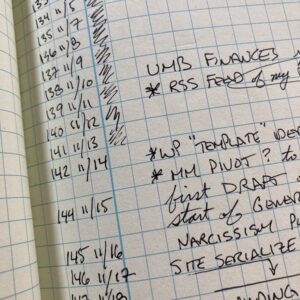
This is using paper to think better.

It’s externalizing the process of figuring things out so you can actually see what you’re thinking instead of just feeling overwhelmed by it.

When you keep everything in your head, you’re constantly using mental energy just to remember what you’re supposed to be doing. You can’t see patterns. You can’t build on previous thoughts—you just repeat them.

The notebook becomes a record of your thinking that you can reference, build on, and learn from.

That’s what makes it useful. Not the paper. Not the pen. The externalization.

ɕ

This is part of a series about Hand-Write. Think Better.—a method for people who feel overwhelmed to start simply writing more on paper. Get the book →


Differential Prognosis

Most people have heard of a differential diagnosis—the ranked list of possibilities a doctor holds in mind when figuring out what you have. It’s a useful framework because it forces you to hold multiple possibilities simultaneously, weigh them against evidence, and re-rank as new information arrives.

Two things before I get into specifics. If you know me, this post contains a lot of clinical detail about my situation, and I apologize if any of it catches you off guard. If you don’t know me, you can let the specifics of my particular case blur past—because the underlying idea, differential prognosis, is something you will need someday. Everyone does. The specifics are mine; the framework is yours.

I’ve been thinking about a related idea that, as far as I can tell, nobody has named: differential prognosis. Not “what do you have,” but “where is this going”—and critically, how that ranking should shift as new evidence arrives.

Here’s why it matters.

About 1 in 8 men will be diagnosed with prostate cancer in their lifetime. I’m one of them. Gate one.

When I was diagnosed at 52, that itself was unusual. Only about 2–3% of prostate cancer diagnoses happen at that age. Most men are in their 60s or 70s. Being in the left tail of that age distribution isn’t just a fun fact—it correlates with more aggressive biology. Gate two.

Post-surgery pathology came back with extracapsular extension, a positive margin, Gleason 3+4, Grade Group 2. None of those findings individually is rare, but the combination starts narrowing the population I actually belong to. Gate three.

Then my PSA never became undetectable after surgery—a distinction clinicians pay attention to, because it’s different from dropping to undetectable and later rising. It suggests something was there from the start. Gate four.

Then my PSA doubling time landed at roughly three months. Among men with biochemical recurrence (technically defined as PSA reaching 0.2—a threshold I hadn’t even crossed yet, but with a trajectory this clear, no one was waiting for a number), only around 10–15% have doubling times under six months. Three months puts me in the aggressive tail of an already-selected subgroup. Gate five.

The naïve way to interpret all of this—and I’ve encountered it from well-meaning people, and even from some clinicians—is to treat each of those gates as an independent coin flip. “Only X% of men with recurrence have a doubling time that fast, so the odds are still in your favor!” But that treats my trajectory as a series of fresh rolls of the dice. It isn’t.

What’s actually happening is that each gate is evidence of a latent variable—call it underlying disease aggressiveness, or biology, or whatever you want. That variable doesn’t change between gates. Each time I pass through a low-probability bad gate, I’m not just unlucky. I’m accumulating evidence that the hidden variable driving all of this is unfavorable. The gates are correlated through that hidden factor.

This is Bayesian updating, and it’s not complicated once you see it. Each gate is a filter. By the time you’ve passed through four or five of them on the unfavorable side, the population you actually belong to—statistically—is very different from the one your original diagnosis placed you in. Your prior for the next branch point being unfavorable should be substantially higher than the base rate would suggest.

That’s the differential prognosis. It’s a living, ranked list of possible futures that gets explicitly re-weighted at each gate. Not a static risk label you were handed at diagnosis and carry around forever.

And I think naming it matters, because the standard way prognosis gets communicated tends to be snapshot-based. You get staged, you get a risk stratification—CAPRA score, NCCN risk group, whatever—and that label tends to stick in people’s minds even as subsequent events should be revising it. “You’re intermediate risk” can persist psychologically long after the actual picture has shifted substantially toward unfavorable. Clinicians implicitly update their thinking, but patients often don’t. They anchor on the original framing.

The differential prognosis framework fights that anchoring by making the updating the point. You’re not revising a fixed label. You’re maintaining that ranked list and explicitly moving things up or down as you pass through each gate.

Where I think this has real power is in arguing against complacency at each new decision point. In my case, when it came time to decide on radiation and hormone therapy, the sequential history argued for treating aggressively—18 to 24 months of ADT rather than the minimum 6. My history is the prior, and the prior says: don’t bet on the favorable tail anymore.

There’s one nuance I want to be honest about. The framework is stronger at up-regulating concern than at down-regulating it. A negative PSMA-PET scan should move favorable trajectories back up the list. Good news is real and should count. For the framework to be complete—and not just a machine for generating anxiety—it has to account for that symmetry.

And there’s a ceiling effect. At some point you’ve already updated your prior substantially, and the next bad gate provides diminishing informational value. You’re already modeling aggressive disease; one more confirmatory data point doesn’t shift things as much as the first few did.

But I think most people facing a serious diagnosis are nowhere near that ceiling. They’re still anchored on their original risk label, still hearing base rates that no longer apply to them, still treating each new finding as a fresh surprise rather than as another piece of a pattern they should have seen forming.

The differential prognosis says: Pay attention to the pattern. Update the list. And make your decisions from where you actually are—not from where you started.

ɕ


The Empty Space Isn’t Waste

New day = new page.

Even if yesterday’s page is mostly empty.

This is going to feel wasteful at first. You’re going to look at all that empty space and think “I should fill this page before starting a new one.”

Don’t.

The empty space doesn’t matter. What matters is that you can find things later, and dating each page is how that works. If Tuesday and Wednesday are on the same page, you’ve broken the one feature that makes the whole system useful.

Think about it: three weeks from now, you’re trying to find something you wrote. Was it Monday? Tuesday? If every day has its own page, you can flip right to it. If you crammed multiple days together to “save paper,” you’re hunting.

The notebook is cheap. Your time spent searching is expensive.

Starting a new page each day isn’t about perfection or following rules. It’s about having a system that actually works when you need to look something up.

ɕ

This is part of a series about Hand-Write. Think Better.—a method for using paper to think more clearly. Get the book →


Does this actually work? Here’s my honest answer.

People ask if this works. I don’t know how to answer that.

I can’t promise you results. I can’t show you a before-and-after photo or a chart of my progress. Bodies are complicated. Minds are complicated. The relationship between them is very complicated.

Here’s what I can say.

It’s working. Slowly. I can’t point to a moment when things changed. I just notice that they have.

What I notice now

The way I think about food is different than it was when I started. Some of that is the prompts. Some of it is probably other things. I can’t run a controlled experiment on myself.

I don’t promise anything. I don’t know if it will work for you.

What I know is this: Small thoughts, arriving regularly, change how I see things. That’s the bet. If it’s wrong, you’ve lost nothing but a few seconds each morning.

That’s why 365 Changes is free to try. One prompt a day, delivered by email. If it resonates, you’ll know. If it doesn’t, you can unsubscribe and move on.

365 Changes: A daily prompt about eating — https://365changes.com/

ɕ


The difference between trying to eat better and being someone who does

“I’m trying to eat less sugar.”

“I’m not a person who snacks.”

These sound similar. They’re completely different.

The first one is a battle. It assumes I want the sugar and I’m resisting. Every day is a new fight. Willpower required.

The second one isn’t a fight at all. It’s just who I am. The decision has already been made, somewhere upstream, and the moment-to-moment choices flow from it.

I’m not trying to be someone who eats well. I’m trying to become someone who already does.

Becoming, not battling

The prompts help with that—not by giving me rules, but by putting identity questions in front of me. Who do I want to be? What would that person do here?

Eventually, I stop asking. I just do what I do.

That’s the long game with 365 Changes. Not behavior modification. Not willpower training. Just small questions, arriving daily, that slowly reshape who I think I am.

365 Changes: A daily prompt about eating — https://365changes.com/

ɕ


What happened when I stopped following diet rules and started paying attention

Tell me I can’t have bread and suddenly I want bread. Tell me dessert is forbidden and I’m thinking about dessert all day. The harder I grip the rules, the more I want to break them.

I don’t think I’m unusual in this. Rules create resistance. The moment something becomes off-limits, part of me starts scheming.

Diet rules made me want to rebel. So I stopped following them and started noticing what I was already doing.

Noticing instead of restricting

The prompts I use don’t tell me what to eat. They don’t give me rules or meal plans or forbidden foods. They ask me to notice what I’m already doing.

That sounds soft. It is soft. But it’s also the only thing that’s ever worked for me.

Noticing is neutral. It doesn’t demand anything. It just asks: What’s happening here? Why did I reach for that? What am I actually feeling right now?

Most of the time, I don’t know the answer. That’s fine. The noticing is enough. Over time, patterns emerge. Things I didn’t see become visible. And once I see them, they’re harder to unsee.

That’s the approach behind 365 Changes—not rules to follow, but questions to sit with. One each morning. No judgment, no tracking, just attention.

365 Changes: A daily prompt about eating — https://365changes.com/

ɕ


What nutrition knowledge couldn’t teach me

Over the years I’ve learned about the food pyramid, serving sizes, how to read labels. Whole grains vs refined, good fats and bad fats, processed vs whole foods. Fiber, added sugars, protein and carbohydrates.

And yet… the more I learn, the more my body tells me I’ve missed the point.

I decided to stop trying to make myself eat better. Stop trying to change my body. Instead, I’d change my mind—so my mind and body could be well together.

Information taught me facts about food. Daily prompts teach me to notice how I actually eat.

So I built this: 365changes.com: A Daily Prompt About Eating

ɕ


I’ve read the nutrition books. None changed how I eat.

I don’t know how many books I’ve read. The ones about habits, about willpower, about the science of satiety and the psychology of cravings. I understood them. I agreed with them. Then I closed them and continued eating the way I always had.

Sound familiar?

There’s a difference between learning something and having it change you.

You can read about pull-ups. Or you can do one pull-up a day for a year. Only one of those changes your body.

Why information doesn’t stick

The problem isn’t information. The problem is that information doesn’t stick unless it arrives repeatedly, in small doses, over time.

The prompts are small on purpose. A single question. A single thought. Something you can hold in your head while you make coffee. That smallness is the point—it’s what lets them accumulate.

I didn’t need another book. I needed the same few ideas to show up again and again, from different angles, until they stopped being things I knew and started being things I did. That’s what I built.

365 Changes: A daily prompt about eating — https://365changes.com/

ɕ