Side quests

I [generally] hate the Internet. I wanted to start this post with a reference to a little children’s TV skit I saw many (many) moons ago, on Sesame Street or maybe it was the Muppets… about a guy named Henry with a bucket with a hole who tried to fix it based on another character’s—named Liza—ministrations, but which eventually lead him to need the hole-y, original bucket to haul water to complete the bucket-repair process. If you’re not yet grabbing your head, try reading: “There a hole in my bucket. Dear Liza. Dear Liza.” Fortunately, Wikipedia, and a pile of YouTube clips I managed to not watch, have me covered. Long live the Internet!

“Holey-bucket-fixing” is a long chain of tasks which turn out to be circularly dependent. Obviously, I don’t realize it’s holey-bucket-fixing at the start of the side quest. I start off on some simple problem. To do A, I need B. To do B, I need C. To do C, I need… A? Where’s the Tylenol?!

But sometimes, I start off on some simple problem and it goes very well. As in . . .

Your merry band enters the dimly lit inn, glad to find shelter from the stormy night. The rogue among you sticks to the shadows to the left, the dwarf angles right, (in both senses of the word,) towards the bar, and the elf-archer, with the balance of the band in tow, strides for a long table against the doorless, far wall. The dwarf orders the first round of whatever-it-is-they-serve-around-these-parts, and the bartender strikes up a conversation. “Haven’t seen you folks around before. You look like you might be up for an adventure.” If you want to go on an adventure, turn to page 42. If you just want this idiot to shut up so you can drink your whatever-it-is-they-serve-around-these-parts in peace, continue reading.

And so, with a hole in my bucket, or a simple question in mind, or—challenge-loving dwarf-at-the-bar that I play so well—just too curious for my own good… I almost always turn to page 42.

ɕ

Practicing peace

Walking is a deliberate, repetitive, ritualized motion. It is an exercise in peace.

The Buddhists talk of “walking meditation,” or kinhin, where the movement after a long session of sitting, particularly movement through a beautiful setting, can unlock a different kind of stillness than traditional meditation.

~ Ryan Holiday from, Take A Walk: The Work & Life Benefits of Walking – RyanHoliday.net

slip:4urybe1.

Running is also a deliberate, repetitive, ritualized motion.

But gosh do I hate running. There’s no peace at all. At the very least, I’m glad that I can run (in the shoes I like to wear, for the general health of my feet,) without injury. I can go a good mile—where “good” refers to the length, I’m not cheating calling the distance “a mile”… I emphatically do not mean the running of said mile is A Good Thing. I digress. I can go a good mile and I’m confident that the next day I will not be in agony. I know that running is exceedingly good for me. I sleep better that night, am in a better mood the next morning, and something about that level of effort just turns the volume down on the rest of the world for a good day or even two.

But I know people who swear that running is peaceful. …that running is meditative. …that running is an enjoyable part of their life. …something they even look forward to.

I sure wish I could figure out how to reconcile those two alternate realities.

ɕ


Responsibility with Jule Kucera

How can podcast hosts ethically navigate sensitive conversations while protecting their guests’ vulnerability?

Creating a safe space for guests involves mindful preparation and ethical guidelines.

Vulnerability is okay. Nakedness is not.

~ Jule Kucera (3:52)

The conversation explores ethical storytelling in podcasting, focusing on the host’s responsibility to protect their guests while crafting engaging stories. The discussion highlights moments when personal content felt too raw and decisions were made during editing to maintain respect. The concept of “vulnerability versus nakedness” is introduced as a guiding principle for ensuring sensitive topics are handled appropriately.

The discussion touches on the impact of post-production choices and the host’s editorial power, emphasizing the importance of maintaining trust and authenticity. Strategies for preparing guests, understanding their boundaries, and creating a safe conversational space are discussed as integral to fostering meaningful and ethical interviews.

Takeaways

Creating a safe space — Ensuring guests feel comfortable and supported during conversations.

Editorial responsibility — Making mindful choices in post-production to protect the integrity of the conversation.

Avoiding exploitation — Being cautious not to engage in “trauma porn” or exploit guests’ vulnerabilities for dramatic effect.

Guiding principles — Using mottos or guidelines, such as “vulnerability is okay, nakedness is not,” to navigate sensitive storytelling.

Lasting impact — Recognizing the permanence of recorded conversations and respecting how they represent both hosts and guests.

Resources

Jule Kucera

Reflections — Jule’s podcast.

Movers Mindset podcast — A podcast mentioned during the conversation as an example of careful and intentional storytelling.

(Written with help from Chat-GPT.)

ɕ


Avoiding unrighteousness

The difficulty, my friends, is not in avoiding death, but in avoiding unrighteousness; For that runs faster than death. I am old and move slowly, and the slower runner has overtaken me, and my accusers are keen and quick, and the faster runner, who is unrighteousness, has overtaken them. And now I depart hence condemned by you to suffer the penalty of death, and they too go their ways condemned by the truth to suffer the penalty of villainy and wrong; And I must abide by my award—let them abide by theirs.

~ Socrates

slip:4a401.


The grind

Sometimes, programming feels like magic: you chant some arcane incantation and a fleet of robots do your bidding. But sometimes, magic is mundane. If you’re willing to embrace the grind, you can pull off the impossible.

~ Jacob Kaplan-Moss from, Embrace the Grind – Jacob Kaplan-Moss

slip:4ujaae2.

I’m not 100% a programmer, but that’s a big part of what I do. I’ve been grinding so long that the impossible… accomplishing the impossible isn’t even interesting any more. I command an army of robots— but I’ve no idea what would be worth doing with them.

It’d be as if I did a magic trick and no one noticed. After doing that show six-days-a-week for a while, that got old. And so now I’ve become a sort of tottering crazy wizard. “Strange sounds and lights, and sometimes odd smells, arose from the tottering fool’s workshop at the top of the tower. No one dared go there any more, and few even thought to wonder at the long shut oaken door.” You know, that sort of crazy.

I do so love Alice’s take: Curiouser and curioser.

ɕ


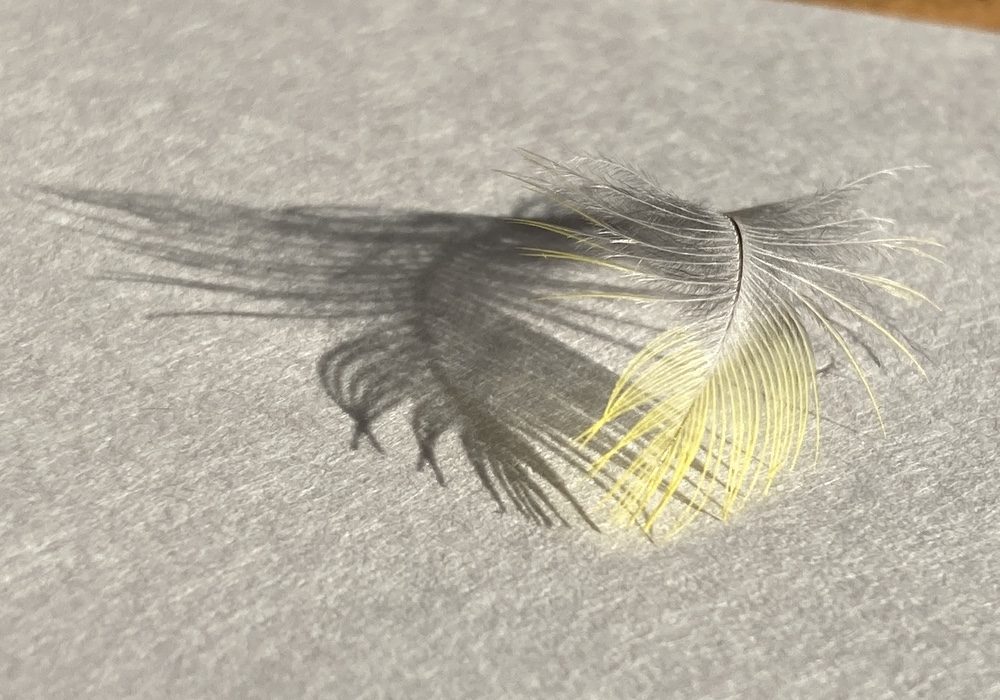
Golden down

Sitting on the patio one morning, in the cool humidity and calm air of what was going to be a blazing-hot summer day, this single down feather drifted down. It skimmed along the tabletop and disappeared off the edge taunting me to chase it.

ɕ


Those who understand

The cucumber is bitter? Then throw it out. There are brambles in the path? Then go around them. That’s all you need to know. Nothing more. Don’t demand to know, “why such things exist.” Anyone who understands the world will laugh at you, just as a carpenter would if you seemed shocked at finding sawdust in his workshop, or a shoemaker at scraps of leather left over from work.

~ Marcus Aurelius

slip:4a506.


The balance of no-balance

There was no sense of trying to balance my desire for doing good and useful things with my desire for comfort and pleasure. I let the good and useful always outrank the pleasurable and comfortable. Operating this way entailed a fair amount of physical discomfort, but it felt far more emotionally comfortable than trying to manage two competing sets of values.

And here’s the interesting part: pleasure and comfort arose constantly anyway. I enjoyed them when they did, with no sense of tradeoff or guilt. However, I didn’t do anything just because it was pleasurable or comfortable, and ironically that made for a much more pleasant and comfortable existence.

~ David Cain from, The Ancient Art of Using Time Well

slip:4urate3.

I have a few reminders that are variations of the idea that I cause all the problems I experience. The more I let that idea seep in, the better things seem to get. It takes energy to balance; balancing priorities, balancing goals, balancing time-frames of planning, balancing rationalization versus guilt, balancing energy levels, balancing responsibilities, balancing gratification versus delay, …

Try this: find something to balance on. Something pretty easy. A 2×4 laid on its wide side, or stood on it’s narrow edge. A curb. A railing if you dare. Get a stopwatch and balance (your toes/heel go along the thing you’re on, not perched like a bird) for 30 minutes. No music, no walking forward or backward, no doing anything else. Shift to the other foot when one side is tired. If you fall off, don’t chide yourself. Simple get back on. Practice being kind to yourself as you do this.

Balancing takes tremendous energy.

ɕ


Meditations

It would be for me, what Tyler Cowen would call a “a quake book,” shaking everything I thought I knew about the world (however little that actually was). I would also become what Stephen Marche has referred to as a “centireader,” reading Marcus Aurelius well over 100 times across multiple editions and copies.

~ Ryan Holiday, from 100 Things I Learned in 10 Years and 100 Reads of Marcus Aurelius’s Meditations – RyanHoliday.net

slip:4uryti2.

There is an insane amount of anecdotes, (his memories of his experience upon, or around, reading some part of the book,) tangential knowledge, take-aways, lessons learned, nuances of translations, … You can skim Holiday’s post and learn a lot about Aurelius’s Meditations. You can read more carefully and it will tip you over into deciding to read it yourself. If you’ve already read it once, (or thrice even,) you can read Holiday’s post and find a number of new avenues of exploration within Aurelius’s Meditations.

I did the latter. It took me three separate sittings with his article until I was all the way through. I bought one new book, re-read several pieces from Meditations on-the-spot to see what I thought [based on what I did to my book,] and what I thought [staring at it in that new moment.] But mostly I thought: “It’s impressive that he was able to write so many thoughts and recount so many inspirations and connections, from one book.” What would it be like to spend enought time with a book . . .

At which point I was reminded of my study of, Parkour & Art du Deplacement by V Thibault.

And then I realized it’s been over a year since I added a part to that series… (pause here) And I’m back after fetching the book from the book shelf and moving it to my small pile of books that lie directly on my desk. Actually, I think I’ll snap photos of all the pages and turn it into a daily reader/study like I did with The Daily Stoic.

ɕ


Breath with Nadine Kelly

How does proper breathing and posture enhance the podcasting experience and overall well-being?

Confidence and focus emerge from the synergy of upright posture and mindful breathing.

Not only does sitting up nice and tall, or standing nice and tall, benefit your posture, it increases your focus. It’s just good physically. It’s good mentally. It’s good energetically.

~ Nadine Kelly (13:11)

The conversation focuses on the intersections between breathing techniques, posture, and podcasting. It examines how intentional breathing can diminish nervousness, enhance clarity, and improve vocal performance during recording. The importance of proper posture is emphasized, highlighting its benefits for focus, physical alignment, and the quality of breath. Visualizations, such as the “teardrop-shaped balloon,” are introduced as aids for more effective breathing.

The discussion also touches on the role of physical habits and preparation, such as maintaining energy through morning workouts and arranging a workspace conducive to calmness and productivity. Nadine shares insights into crafting moments in podcasting that allow listeners to process heavy topics, underlining the subtle power of breath and pauses to connect with an audience emotionally and physiologically.

Takeaways

Improving breathing techniques — Discusses reducing stress and enhancing vocal clarity in podcasting.

Maintaining good posture — Explains the role of upright posture in breathing and focus.

Morning workout routines — Highlights the benefits of early exercise on energy levels throughout the day.

Incorporating pauses in podcasts — Explores using intentional breath and pauses to enhance listener engagement.

Visualizing breath exercises — Introduces the “teardrop-shaped balloon” method for mindful breathing.

Resources

The Yogi M.D. Podcast — Nadine’s podcast focusing on physical and mental health topics.

Notable Quotables by Nadine Kelly — Companion video series to her podcast that invites listener feedback and reflections.

Akimbo Workshops — Mentioned as a platform where coaching and community discussions occur.

(Written with help from Chat-GPT.)

ɕ


Audience with Elisa Graf

How can podcasters understand and utilize statistics, engagement strategies, and listener feedback to improve their shows?

Podcasting statistics spark a deep discussion on what truly matters in creating a meaningful show.

It’s amazing, really, the whole idea— This medium of finding your voice, and then putting something that you really care about out there in the world, and having it have its own life.

~ Elisa Graf (12:41)

The conversation explores various aspects of podcasting, starting with the motivations and themes behind creating a show. Insights are shared about producing content that showcases transcendent stories and meaningful encounters. Discussions include how podcast statistics can both aid and distract podcasters, revealing what metrics are most relevant depending on the goals of the show.

Engagement strategies and experiments are highlighted, such as leveraging social media platforms and featuring specific guests, to boost listener interaction. Personal feedback from listeners is recognized as a rewarding outcome, affirming the value of creating authentic and impactful content. The broader topic of maintaining motivation and balancing analytics with creative passion is also discussed.

Takeaways

Finding a unique podcast theme — Stories about transcendence and the collision of the extraordinary with the everyday resonate with audiences.

Balancing analytics and creativity — Podcast statistics provide valuable insights but can also become an unhealthy focus.

The role of social media — Strategic use of guest tagging and experiments with platforms can significantly increase engagement.

Podcast longevity and evergreen content — Older episodes often continue to attract downloads, emphasizing the long-term value of a quality back catalog.

Listener feedback as motivation — Personal notes and stories from listeners provide deep gratification and affirm the impact of the work.

Experimenting with formats and guests — Trying new approaches, like featuring family members or changing marketing tactics, can reveal unexpected growth opportunities.

Resources

Mystic Takeaway Podcast — Elisa’s podcast exploring stories of mysterious encounters and the transcendent.

Simplecast Analytics — A podcast hosting platform offering detailed analytics to track downloads and listener data.

Podnews — A daily podcast industry news source featuring articles, insights, and ratings analysis.

Apple Podcasts — A popular platform where listener ratings can influence podcast visibility.

Pandora — A streaming service noted for its unexpected popularity among certain podcast types.

(Written with help from Chat-GPT.)

ɕ


Expectations

When you start something, don’t raise other people’s expectations. What is highly praised seldom measures up to expectations. Reality never catches up to imagination. It is easy to imagine something is perfect, and difficult to achieve it. […] Honorable beginnings should serve to awaken curiosity, not to heighten people’s expectations. We are much better off when reality surpasses our expectations, and something turns out better than we thought it would.

~ Baltasar Gracián

slip:4a307.


Storytelling with Linda McLachlan

How can storytelling techniques be used effectively in podcasting to create compelling narratives?

The discussion reveals the power of asking consistent questions to uncover unique stories.

It really depends on the person and their storytelling style— how tangential we get. So some of them, it’s like a chainsaw that you have to go in with— a chainsaw first, and that’s the first edit.

~ Linda McLachlan (6:35)

The conversation explores storytelling as a central element in podcasting, emphasizing its role in creating engaging narratives. Linda discusses using consistent questions to uncover unique stories while following a structured story arc inspired by workshops like Bernadette Jiwa’s Story Skills. She describes how this approach helps craft compelling episodes, balancing predictability and surprise. Editing styles are also addressed, with Linda explaining how some episodes require significant reworking to achieve clarity and impact.

The discussion touches on influences, mentioning podcasts like “On Being” by Krista Tippett and books by Brene Brown as inspirations for exploring human connection and vulnerability. Linda also reflects on the creative freedom podcasting offers, encouraging creators to embrace restrictions as opportunities for innovation while staying true to their personal vision. The conversation concludes with practical advice for aspiring podcasters, underscoring the importance of authenticity and the freedom to experiment.

Takeaways

The importance of storytelling in podcasting — Structured storytelling can create compelling and engaging episodes.

The use of consistent questions — Repeatedly asking similar questions can uncover diverse and unique stories.

The role of editing — Editing styles vary significantly depending on the guest’s storytelling style.

Inspiration from other creators — Works by Krista Tippett and Brene Brown serve as examples of engaging narrative creation.

Creative freedom in podcasting — Podcasting offers flexibility and freedom to experiment with ideas and formats.

Resources

The Arena Podcast — Linda’s podcast exploring human stories through structured storytelling.

On Being — A podcast by Krista Tippett focused on deep conversations about meaning and faith.

A Bit of Optimism — Simon Sinek’s podcast sharing optimistic ideas and conversations.

Wisdom Shared — Carole Blueweiss’ podcast featuring diverse personal stories.

(Written with help from Chat-GPT.)

ɕ


101

It’s a small thing, and it was really really difficult. But I did it.

Instead of sticking to my “publish on Wednesday’s at 10am”… like I did for the first 100 episodes. 101 was published Tuesday around 7pm. I know that sounds dumb—but I’m not be sarcastic or hyperbolic. Over the years I’ve gotten really adamant about that publication day-of-the-week and time-of-the-day. Sure we weren’t able to do one every week… but I kept trying to keep things neat and tidy. “Wednesdays at 10am” was that one little bit of structure.

But really, who cares. Any structure you’re clinging to?

ɕ


Jade Amber Ragoschke: Deafness, architecture, and accessibility

How do the experiences of deafness, architecture, and parkour intersect to influence design and accessibility?

While it’s not immediately apparent that Jade Amber Ragoshke is unilaterally deaf, it is a defining factor for her life and work. She shares her experiences with deafness, learning about it, and adapting to it. Jade discusses architecture and her ongoing research into the connections between architecture, parkour, and accessibility. She reflects on disability, designing for all people, and creating more inclusive environments in all communities.

I think, after this conversation that we’ve had about art— I think that what art really is, is breaking the boundaries of the standard.

~ Jade Amber Ragoschke (30:14)

Jade Amber Ragoschke is an architect, parkour practitioner, and the vice president of World Deaf Architecture. Her involvement in parkour led to her interest and eventual career in architecture. After finding her place in the Deaf community, she discovered a new perspective and approach to architecture that is more inclusive, empathetic, and accessible to everyone. Jade specializes in accessible design for people with disabilities and provides architectural consultation to parkour communities. She advocates for inclusive play spaces for all ages and is researching the intersections between architecture, parkour, and accessibility.

This conversation explores the unique intersections of parkour, architecture, and accessibility, weaving together personal experiences and professional insights. Discussions highlight how accessible designs often double as ideal spaces for creative physical movement, reflecting an unexpected synergy between inclusivity and play. Jade emphasizes the importance of designing spaces at a human scale, focusing on sensory experiences and personal engagement rather than purely aesthetic considerations.

The dialogue also examines the philosophical and practical roles of architecture and art in memorializing history and shaping societal experiences. By referencing specific examples like the 9/11 Memorial and other landmark designs, the conversation illustrates how architecture can evoke emotions, honor history, and inspire resilience. The shared experiences of adapting to hearing loss further contextualize Jade’s perspectives on design, emphasizing the transformative potential of inclusivity.

Takeaways

Architecture and human scale — The focus on personal experience in space design emphasizes sensory engagement over aesthetics.

Parkour and accessibility — Accessible spaces unintentionally become ideal settings for creative movement and parkour.

Art and architecture integration — Structures can serve as both functional spaces and artistic installations, enriching urban environments.

Design as inclusivity — Inclusive designs provide comfort and accessibility for all, enhancing the utility of spaces.

Memorializing through design — Architecture captures historical moments, offering spaces for reflection and resilience.

Architectural unpredictability — People often use spaces in unintended ways, revealing the dynamic relationship between design and behavior.

Resources

Jade Amber Ragoschke @antiphase.motion

World Deaf Architecture — Organization focused on accessibility and architecture for Deaf communities.

Bjarke Ingels Group — Architecture firm led by Bjarke Ingels, known for innovative projects like those highlighted in the conversation.

ADA Standards for Accessible Design — Guidelines defining accessibility in architecture.

(Written with help from Chat-GPT.)

ɕ


Community for podcasters

So I went and built a new thing: The Podcaster Community.

If you create podcasts — whether you’re thinking about it, just starting out, or are publishing your 100th episode — we’d love for you to join us. It’s free to create an account. Logging in enables the platform features and you can immediately begin posting/replying in the public categories.

I don’t idle well. I get an idea in my head, and I start thinking about all the ways it could be realized. Recently, I’ve had a few separate conversations with podcasters who were looking for something—what they each wanted was different. And so I set off to build it.

ɕ


Impressions

Nothing but what you get from first impressions. That someone has insulted you for instance. That —but not that it’s done you any harm. The fact that my son is sick —that I can see. But, “that he might die of it,” no. Stick with first impressions. Don’t extrapolate. And nothing can happen to you. Or extrapolate. From a knowledge of all that can happen in the world.

~ Marcus Aurelius

slip:4a491.


Two thousand nine hundred and six

Arbitrary milestones are just as useful as nice round numbers. This morning I decided I’d take some time to reflect on blogging.

I love grammar. I wonder if you thought that I meant this blog post would be my reflections on blogging? No, I took some time to reflect on my own. Today I’m yet again beating one of my favorite drums: It is life-critical to intentionally take time to reflect on the things one is doing.

What am I actually doing with my time? What is doing me benefit? What, harm? What things do I believe I must do? Why do I believe those are necessary? What promises have I made? …to myself, to others? What actually happens if I break one of those promises? …would anyone even notice? What could I do if I stopped everything and did some other thing with incredible focus? Why does that other some thing interest me? Could I more simply change what I’m doing to make a little room for it now? If I awoke to find all the things in my head, and on my lists, were done what would I do? …would I rush to add more things to do? …would I work on something new? …would I want to re-do something I’ve done before?

Discovery. Reflection. And then, go be efficacious.

ɕ


Possibly worthy of a tattoo

As usual, I was reading a “this day in…” journal entry of mine, from a too-recent year. I found one of my unfortunately-too-frequent pages of pissed-off scribbling. And just smack-at-the-bottom was this:

If something is important, DO IT NOW,
if not, DO SOMETHING IMPORTANT.

Clearly that’s a kissing-cousin to the Eisenhower “method”. Partly, I like to sprinkle in Wikipedia links to see how easily you are distracted. But more so in this case, because it isn’t even Eisenhower’s idea.

Where might I tattoo this? I was thinking directly on my corneas would be a good place; The first half on one, the second half on the other. It would be like those “floaters” you find in your eye. It would be a true, subliminal message. (Grammar geeks: It would also be a truly subliminal message.)

I can think of no situation where that guidance would fail me, because the sub-text is: What, right now, is actually the important thing to do? Maybe taking a nap, or eating popcorn with a movie, really is important [for my mental health]. Or maybe the important thing is to up-end my day and go all-in helping someone do something.

Maybe the tatoo should be: IS THIS IMPORTANT?

Pop quiz: Grab a writing instrument and write, in cursive, the word, “scribbling.” For an extra 5 points, write in cursive—on the first try, without looking it up—the capitals: H, K, Q and G.

ɕ


Peace

What is called peace by many is merely the absence of disturbance. True peace cannot be distrubed; It resides beyond the reach of disturbance.

~ Wu Hsin

slip:4a335.