Recovery is key

Not only do most deliberate practitioners not spend all day at it, they also devote a lot of time to recuperation and recovery. They sleep as much as their bodies need. They nap if necessary. They take frequent, refreshing breaks. Most of us understand that rest is necessary after physical activity. But we can underestimate its importance after mental activity, too. Deliberate practice needs to be sustainable for the long term. How long a person keeps at a skill is often far more important than how many hours a day they spend on it.

~ Shane Parrish from, The Ultimate Deliberate Practice Guide: How to Be the Best

I’m going to trot out a rare: HOLY CRAP! Because that post is a small book on deliberate practice. If you’re only up for some skimming, click through and smash-scroll to the summary and book list at the bottom of that post.

Then I’m going to briefly stride over one of my fave soap boxes: Sleep.

…and settle onto pointing out that I make a deliberate practice out of working on writing these blog posts. I’ve been working, (off-and-on, one break involved some lawn mowing,) for four hours this morning from that one Parrish post. I’ve read it, blogged [this] about it, posted about it in another community, captured a few quotes, learned more about the Oddyssey, and wrote a blog post about a common Homer quote.

ɕ


Sometimes I look stuff up

Have you seen this quote?

There is a time for many words, and there is also a time for sleep.

~ Homer

Honestly, that’s pretty sharp! There’s good wisdom about a few things packed in there: Picking your battles, perhaps; Knowing the seasons of things, the ages of Man and so forth; Setting managable goals or not tackling more than you can do in a day. That Homer guy with the wisdom!

Until you look it up, and it turns out to be just a throwaway phrase in a transition. Here, read the full paragraphs, XI.35-6 from the Oddyssey:

And Alcinous answered him, saying: ‘Odysseus, in no wise do we deem thee, we that look on thee, to be a knave or a cheat, even as the dark earth rears many such broadcast, fashioning lies whence none can even see his way therein. But beauty crowns thy words, and wisdom is within thee; and thy tale, as when a minstrel sings, thou hast told with skill, the weary woes of all the Argives and of thine own self. But come, declare me this and plainly tell it all. Didst thou see any of thy godlike company who went up at the same time with thee to Ilios and there met their doom? Behold, the night is of great length, unspeakable, and the time for sleep in the hall is not yet; tell me therefore of those wondrous deeds. I could abide even till the bright dawn, so long as thou couldst endure to rehearse me these woes of thine in the hall.’ (35)

And Odysseus of many counsels answered him, saying: ‘My lord Alcinous, most notable of all the people, there is a time for many words and there is a time for sleep. But if thou art eager still to listen, I would not for my part grudge to tell thee of other things more pitiful still, even the woes of my comrades, those that perished afterward, for they had escaped with their lives from the dread warcry of the Trojans, but perished in returning by the will of an evil woman. (36)

~ Homer

It’s basically, “sure bro’, if you’re up for it, I’m game to stay up and tell you the story of . . .”

Question: Is the quote at the top better, or worse now that you know what Homer actually wrote? (Yes, fine, he was actually writing in ancient Greek, but my point stands.)

It’s a cliché that our favorite quotes say more about us, then they do about who we’re quoting. (Left unconsidered is what it says about me if I collect thousands of quotes.) But that cliché is the entire point of being intentionally reflective: I’m searching out new things, (quotes in this discussion,) and I’m thinking about what they might mean; What the original author or speaker might have meant; How that meaning might change over time from original source to my time, and how it might change for me during my life.

See? There is a time for many words, and a time for sleep!

ɕ

The mind is a fortress

Remember that when it withdraws into itself and finds contentment there, the mind is invulnerable. It does nothing against its will, even if its resistance is irrational. And if its judgement is deliberate and grounded in logic…? The mind without passions is a fortress. No place is more secure. Once we take refuge there we are safe forever. Not to see this is ignorance. To See it and not seek safety means misery.

~ Marcus Aurelius

slip:4a497.


Parkour and I, six years ago

It’s endlessly rewarding to regularly read through my old journals. Six years ago, June 5 2015, I can now see was a turning point for me. I hopped in a car with John G. and Nick R. and headed to Brooklyn for what would be a life-changing experience.

I had been jumping on stuff pretty seriously for a few years, and the “USA Motion Tour”—a merry band of a few Yamakasi—was rolling into New York City. Two people, now good friends of mine after many years, hosted me on their floor. That was my first true “parkour floor” experience; two square meters to sleep, wifi and a bathroom. I trained my heart out, in a good way, and it was a gateway to countless and continuing adventures.

To everyone who was there— I cannot thank you enough. On commence ensemble, on finit ensemble.

ɕ


Foucault’s Pendulum

Over on the Astronomy Stack Exchange site, (obviously I follow the “new questions” feed in my RSS reader,) someone asked if it was possible, without knowing the date, to determine one’s latitude only by observing the sun. These are the sorts of random questions that grab me by the lapels and shake me until an idea falls out.

So my first thought was: Well if you’re in the arctic or antarctic polar circles you could get a good idea… when you don’t see the sun for a few days. Also, COLD. But that feels like cheating and doesn’t give a specific value. Which left me with this vague feeling that it would take me several months of observations. I could measure the highest position of the sun over the passing days and months and figure out what season I was in…

…wait, actually, I should be able to use knowledge of the Coriolis Force—our old friend that makes water circle drains different in the northern and southern hemispheres, and is the reason that computers [people who compute] were first tasked with complex trigonometry problems when early artillery missed its targets because ballistics “appear” to curve to do this mysterious force because actually the ground rotates . . . where was I?

Coriolis Force, right. But wait! I don’t need the sun at all! All I need is a Foucault Pendulum and some trigonometry… Here I went to Wikipedia and looked it up—which saved me the I’m-afraid-to-actually-try-it hours of trying to derive it in spherical trig… anyway. A Foucault Pendulum exhibits rotation of the plane of the pendulum’s swing. Museums have these multi-story pendulums where the hanging weight knocks over little dominos as it rotates around. Cut to the chase: You only need to be able to estimate the sine function, and enough hours to measure the rotation rate of the swing-plane and you have it all; northern versus southern hemisphere and latitude.

ɕ


Fries

Giving the public what the public supposedly wants is like asking your kids what they want for dinner and they say, “oh, we want fries.”

~ Francis Ford Coppola

slip:4a383.


Culture

The Halo Effect tells us that we will find a lot of false positives. The attributes we think are causal of success are the same ones we often deem causal of failure when company performance deteriorates. This is the strategy paradox.

~ Shane Parrish from, Culture Eats Strategy: Nucor’s Ken Iverson on Building a Different Kind of Company

It’s an interesting post about culture. I’m interested in Iverson’s memoir— But to be honest, I don’t have time enough as it is to read the shelves of books already in my possession. (Let alone the hundred in the “wishlist” queue.) So ima let this one pass.

But culture does interest me. I’m apparently an inveterate systems builder. For better, but often for worse, I’m drawn to build processes and communities. Once— just once— I’d like to see something I create grow on its own. Not, “…and make me rich” nor “…and make me famous.” Just simply grow on its own. A great idea is not enough. Skill and knowledge are not enough. Timing is not enough. Vision and charisma are not enough. There’s something ineffable—because if I could describe it I’d go do it rather than write rambling blog posts casting about for something I think, despite my efforts to look around, is always just out of my field of view… There is something ineffable which I am missing.

ɕ


Where’s the cake?

Forty years ago, we had cake and asked for icing on top of it. Today, all we have left is the icing, and we’ve forgotten that the cake was ever there. If code isn’t licensed as “free,” you’d best leave it alone.

~ Cory Doctorow from, Cory Doctorow: IP

slip:4uloco2.

This is a sweeping tour of software, and licenses and litigation and … well, it’s a sweeping tour of 40 years as software evolved into what people made of it. Humans move at human speeds. The best of us type north of a 100-words-per-minute, and we’re writing code that actually writes lower code that writes… about 5 layers deep. And day after day we invent new things and new ways to combine those things. We imagine great things and build great things and some of us imagine stupid shit and try to take advantage of others. But most of us just follow our “hey, that’s interesting…”

What’s going to happen in 40 years?

Hah, you thought I was going to end, as usual, on a question. No, I want to say clearly: I have not idea what’s going to happen in 40 years. I know that 30 years ago, I had not the slightest, tiniest, sliver, of an inkling of a clue what any of what we were scotch-taping together would become. A whole bunch of people, whom I had/continue-to-have, the distinct pleasure of exchanging ideas with… Well there’s a whole bunch of people building cool stuff, solving hard problems, and just generally moving the human race forward. Pretty durn happy to be tinkering away in my little corner of The Bazaar.

ɕ


Embracing the obstacles

External things are not the problem. It’s your assessment of them. Which you can erase right now. If the problem is something in your own character, who’s stopping you from setting your mind straight? And if it’s that you’re not doing something you think you should be, why not just do it? —But here are insuperable obstacles. Then it’s not a problem. The cause of your inaction lies outside you. —But how can I go on living with that undone? Then depart, with a good conscience, as if you’d done it, embracing the obstacles too.

~ Marcus Aurelius, 8.47

slip:4a503.

slip:4b62.


The unimaginable future

It’s an idiosyncrasy to which we are dedicated. It’s nerdy fun, but it has a serious point, too. As our co-founder Stewart Brand points out: the present moment used to be the unimaginable future.

~ Mikl Em from, Long Now Years: Five-digit Dates and Y10K-compliance at Home

slip:4ulolo1.

I’ll do the nerd stuff first: They take the leading zero in their representation of years so far, they’ve even figured out how to get it into their WordPress blog URLs. No, I’m not doing that. Yes, I am a supporting-member of The Long Now Foundation. And yes, of course I am on the waiting list to visit the clock they’re well-into constructing—in west Texas, I think it is?

I could easily wax obnoxious for a few thousand words rattling off a few things which are today blasé for me. But instead, I’d like you to hit reply and tell me: What’s something your primary-school-aged self would be astounded to learn about you?

ɕ


You don’t say

This can lead to overwork, burnout, tiredness, and never letting ourselves enjoy a moment of rest.

~ Leo Babauta from, The Guilt of Not Working More, When We’re Done for the Day

slip:4uzegu1.

I am by far my own worst enemy. Go go go. Do do do. In the past year this is the area where I’ve made the most progress. I’ve gotten much better at setting out a sane plan for my days. And when a day doesn’t go exactly as planned—so, basically every day—I’m now able to roll with it.

Also, I’ve long been good at “active” days off. I can spend a day biking or climbing or at some event. It doesn’t need to be gonzo-level physical either. I think the feeling of physical activity convinces my mind that something meaningful has been accomplished.

But what I cannot do is simply idle. Sit on a beach… not drinking nor reading nor writing nor thinking. Or relax on my patio. “Just be,” is definitely still beyond my grasp.

ɕ


Fortune

Good fortune has its own rules, and to the wise not everything depends upon chance. Fortune is helped along by effort.

~ Baltasar Gracián

slip:4a315.


The only way out is through

If it’s easy, you’re not growing.

It’s like lifting weights: if you can do it without trying, you’re not going to get any stronger.

The whole point—of life, of working out, of work—is to push yourself, and to grow as a result of pushing against and through that resistance.

~ Ryan Holiday from, If You’re Not Seeking Out Challenges, How Are You Going to Get Better?

slip:4uryse1.

Nine years ago I was smack in the middle of my HVAC-installer apprenticeship. I lovingly refer to the roughly two-week period as, “that time I got really into attic-yoga.” The contractor installing our central HVAC had a young fellow working with him, and that guy hurt his knee. I spent days learning how to make and insulate hard duct work, HVAC line sets (the wiring and refrigerant piping), electrical, removed the ancient mouse-pee infused blown-in insulation and eventually put in new fiberglass insulation through the attic. It was hell. Hot. Sweaty. Ichy. Low roof. Things to climb in, over, around, through and under. Mostly while carefully stepping, squatting, leaning, and crawling on the long thing ceiling joists. And it was not something I was planning on doing. One day I was all like, “Benjamin is installing the HVAC!” [that’s a money reference] and the next day I was studying attic-yoga.

I bring this up because it’s too easy to think “I’m doing the hard work!” when you are simply going to the gym (or for the morning run, whatever.) Sure, you’re working hard, you’re sweating, and building muscle; you are literally doing hard work.

But that’s nothing compared to choosing to do the hard work, on the spot. Do I whinge and call AAA (road-side assistance club) or do I climb under the van to figure out how to get the spare tire out at Midnight after a long day? Do I take the time to split the portion of the firewood that would be a pain 8 months from now, or do I just stack it and hate my today-self in the dead of winter? Do I take the time to carefully explain something even though it’s not my responsibility or do I just “walk past” that person who needs a hand? Right now, on the spot, do you choose the hard path?

ɕ


Trees

But among all of nature’s beauties, nothing inspired him more than trees — those eternal muses of scientists, artists, philosophers, and poets alike — and what Margaret Fuller so unforgettably called “that best fact, the Moon.”

~ Maria Popova from, Of Trees, Tenderness, and the Moon: Hasui Kawase’s Stunning Japanese Woodblock Prints from the 1920s-1950s

slip:4ubaha1.

I hesitated to share this. …because the book she’s writing about is out of print and only rather-expensive copies seem obtainable. But obviously I came down on the side of, “it’s trees, I have to share this.”

I was once in random conversation with a professional arborist. I cannot recall for certain even who or where or what we were discussing. (But I’m certain is wasn’t something as obvious as they were at my house trimming a tree. It had to be some social encounter.) He dropped a phrase which has stuck with me ever since. He mentioned, “caring for The Big Plants.” I feel that, somehow, he said it in capitals, just like that.

I’ve seen a couple of trees in my day; in Muir Woods, off the beaten paths in Japan, the Rockies. There are some singularly towering specimens in my neighborhood. I like to snap random photos of trees too. I don’t have a point coming, either.

Way back in “the day,” Carl Sagan made a comment in one of the original Cosmos episodes about DNA. As I recall, he was standing near a Big Plant, as that arborist would say, and he pointed out that we, and the tree, contain identical machinery for processing identically functioning DNA. There’s just a relatively small amount of encoded information making a “me” instead of a tree.

ɕ


The present moment

Give yourself a gift: The present moment. People out for posthumous fame forget that the Generations To Come will be the same annoying people they know now. And just as mortal. What does it matter to you if they say x about you or think y?

~ Marcus Aurelius

slip:4a494.


Programming is terrible, part 2

Three years ago I posted, Programming is terrible. These days? …yeah, exactly the same, but now I find I’m staring suspiciously at, basically, everything thinking: I’m about to do something which, as soon as I completely forget the details, (in the too-near future,) I’m going to be left with something that irritates me. A mess of my own making, as it were.

I’ve been on a bender for decades—which clearly means I’ve not been succeeding, right? I’ve been on a bender to simplify things as much as I can. A lot of progress can be made in that direction simply by removing goals: If I can delete the goal of, “make this thing be successful,” then that might make it possible to simply enjoy the thing. Normal people would just call that “a hobby” and wouldn’t need a paragraph to unpack the idea.

Rock climbing falls into this “hobby” category. I’m a poor, (as in skill,) climber, but since I don’t have any goals related to climbing, it’s just, “any day at the crag.” (And the, “…is better than any other day,” is left unsaid.) That’s literally my mantra. (Somebody should find me a sticker that says that for the top of my climbing helmet.) Some days I climb a bunch of stuff. Some days I fall off a bunch of stuff. Some days it’s glorious weather. Some days it’s tics, snakes and poison ivy. I’ve climbed a bunch of stuff already. There’s a bunch more stuff to climb.

ɕ


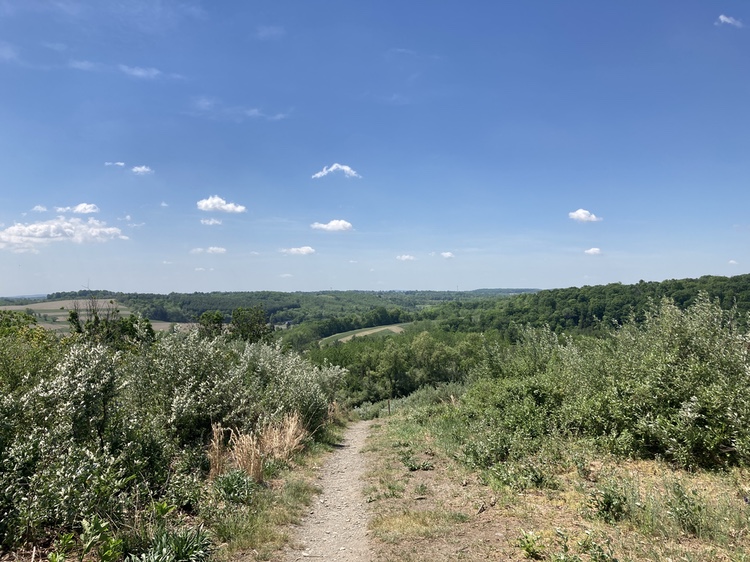
The rolling hills of Pennsylvania

The other day, in the glorious sun and breeze, I got an irresistible urge to get in some single-track miles. I grabbed ‘B’ off the hook and went somewhere I’ve never been.

CREATE SPACE BETWEEN THINGS — “Add padding to everything. Do half of what you imagine you can do. What would it be like if we did less?” ~ Leo Babauta

ɕ


The source of yearning

Chasing after the things one yearns for is inferior to chasing after the source of the yearning.

~ Wu Hsin

slip:4a343.


Intention

One of the toughest parts of coming to grips with how we communicate is being really honest with ourselves about our default intentions.

~ Angie Flynn-McIver from, Being honest about what we’re thinking

slip:4uiibo2.

Angie makes a good point. Go read her post while it’s top-of-your-mind. (It’s short. I’ll wait here for you…)

I have this perennial itch to try to teach people how to use the tools I’m using to wrestle the Internet into being a source of wonder, inspiration and knowledge about our universe. But for the life of me I can never figure out a good way to do it. I feel like I should be able to take 30+ years of learning and futzing with computers and the Internet, and generate some manageably-sized chunks of learning that others could use. I’ve an Internet tech tag that, I suppose, is me doing my best.

What’s that? …what does that paragraph have to do with that quote? Oh, right, sorry…

I enjoy being able to notice when Angie writes, and I appreciate that I get exposed to what she writes when it works for me. That’s thanks to my use of RSS tools.

ɕ


Correct opinions

For this reason philosophers exhort us not to be contented with mere learning, but to add practice also, and then training. For we have long been accustomed to do the opposite of what we should, and the opinions that we hold and apply are the opposite of the correct ones. If, therefore, we do not also adopt and apply the correct opinions, we shall be nothing more than interpreters of the judgements of others.

~ Epictetus

slip:4a658.