Over the last decade, I’ve watched AI challenge — and augment — humanity in astonishing ways. Every few years, a new innovation seems to raise the same questions: can we compute human intelligence? Can our labor be automated? Who owns these systems and their training data? How will this technology reshape society? Yet there is one question I rarely hear asked: how will AI change our understanding of ourselves?
This article—from the ever-interesting halls of The Long Now Foundation—got me thinking about intelligence from a new direction: instead of a tool or collaborator for us, a new way to learn about ourselves.
In 2007, on my first trip to New York City, I grabbed a brand-new DSLR camera and photographed all the fonts I was supposed to love. I admired American Typewriter in all of the I <3 NYC logos, watched Akzidenz Grotesk and Helvetica fighting over the subway signs, and even caught an occasional appearance of the flawlessly-named Gotham, still a year before it skyrocketed in popularity via Barack Obama’s first campaign.
But there was one font I didn’t even notice, even though it was everywhere around me.
Last year in New York, I walked over 100 miles and took thousands of photos of one and one font only.
What. WHAT? WAT?! Words fail me… there are 600 photos in this article. I couldn’t stop staring at the technology parts, and keyboards—so much of that reminds me of my youngling days. I leaned in for the photography, which is gorgeous macrophotography. And fell headlong into the nostalgia.
As someone who writes a lot about knowledge work in the digital age, I’m fascinated by this model of cooking, which I define as follows: a workflow designed to enable someone with a high-return skill to spend most of their time applying that skill, without distraction.
For a decade I’ve been aware of this point. I’m, basically, a one-person creative process. If one leans into this way of thinking, then you immediately want to start figuring out how to not do all the other things. Which is fine if I were a one-person business process. But I am not. I’m not only a creator of valuable (in some sense other than money) work. I’m also the person who is nourished, enabling said creative work, by the random other parts. Whichever way you think of it though, Newport makes interesting points.
ɕ
Automatic, clickable time-references in our show notes?! →
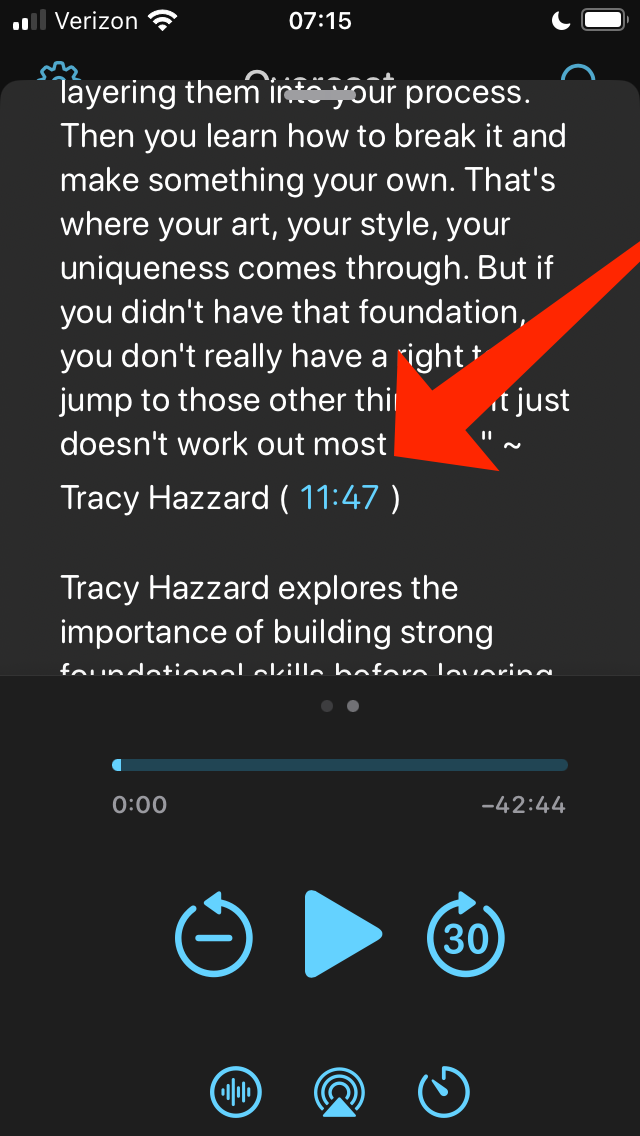
Well this is interesting! I’ve been adding time-references to quotes when I include them in show notes. I simply put the <minute>:<seconds> after the quote.
Today I realized that Overcast auto-magically makes those time codes clickable — touching the time code jumps play right to that point!
This is amazingly great for the listener.
For years there’s been discussion about chapters in podcast episodes. They are supported, yes. But there’s complicated to actually set up. The original way, is to embed the information within the mp3 audio file—that requires either special software which does just that, or your DAW has to support marking the chapters as you’re editing. Either way, a bit tedious.
But if this little feature of link-up-time-references in the notes works across more players… this is HUGE.
So: Take a look at your favorite player. Find an episode (any episode of Podtalk, for example) that has time-references in the show notes… and tell me if it works in your player.
There’s two different main purposes for routines, and advice-givers mix them up. They lump these two quite different things under “morning routine” and it causes trouble when you try to design your own.
Partly, I include this because The Whippet is a sometimes quirky, often insightful, but always interesting little missive that I enjoy following/reading.
But also, WAIT WAT! …how is it I’ve never heard this idea/distinction before? Scroll down about 2/3 in issue № 185 to find this neat stuff about habits.
How can podcasters build meaningful relationships that expand their reach, create new opportunities, and grow their shows—without relying on promotion or algorithms?
A five-step method helps you land dream collaborations by being helpful, not pushy.
[One little shift?] That’s it. If I hadn’t have gone to that event, if I hadn’t have just dumped my coat and helped direct people, if I hadn’t offered to help for free, if I hadn’t got to know the team, if I hadn’t, if I’d asked for the wrong thing or too much or too, I don’t know if I’d got the ask wrong, any one of those things could have ended up being like a Sliding Doors [the 1998 film -ed] moment where I then I go from 3000 leads to just going about my life as a coach.
~ Robin Waite (15:00)
Robin Waite shares how he reinvented his business growth strategy by focusing on building partnerships rather than following conventional marketing playbooks. Feeling burnt out by social media and traditional outreach, he adopted an “outside-in” approach—intentionally targeting people he admired, getting in the same room with them, and offering help without expectation. His approach centers on showing up, adding value, and making intentional asks that are aligned with what others actually need.
He illustrates this with a detailed story of how he ended up as a guest on Ali Abdaal’s Deep Dive podcast, which generated over 3,000 leads and $300,000 in business. Key elements included making himself useful at events, building relationships with team members, and being ready with a modest but well-timed ask. Waite expands on this philosophy by identifying five steps: be intentional, get in the room, be helpful, find the inside person, and offer something on a silver platter. The conversation underscores the power of authentic connection, strategic generosity, and long-term thinking in business development.
Price’s research comes at a moment when a growing number of archaeological finds and genetic analyses of ancient animal remains are adding layers of nuance to the story of domestication and partnership. Canines and humans, through their dynamic interactions, have formed one of the most unique, complex, and mutually beneficial relationships in history.
Another interpretation is that everyday life, for most people, is an untapped gold mine. Certain undone tasks represent huge gains, waiting just a short time away, behind one session of elbow grease. Even ten or fifteen minutes of directed effort, judiciously applied, can improve your life far more than the wages you earn for the same period.
It’s interesting to note that I only just read this, this evening… after fix a table on my patio today. Yesterday, I grouped together a pile of errands—four different stops with multiple “I need…” for different chores and repairs at each stop. The table is a hulking cedar and steel pipe beast. I need some wood putty, and spar varnish. Today, I got out the sander and mixing little work sessions, with other things, I worked through various sandpaper grits, wood putty iterations, and 3 coats of spar varnish. I did an “80%” jobs at every step of the way. By tomorrow it will be completely dry and ready for use again. I use it every day spring through fall, and this couple hours of work will now yield—probably—3 more seasons of unfussy use.
I also used the rest of the little can of varnish to slap a coat on the garden gate.
For example, fasting stimulates the natural production of growth hormone. So does vigorous exercise, particularly resistance exercise with a strong anaerobic component (not cardio though). And, to the surprise of many people, deep sleep stimulates the natural production of growth hormone, perhaps more than anything else. (Although only once every 24 hours; sleeping all day does not seem to work.)
But, when you work in six week cycles, or relatively short time frames, later means something else entirely. There’s no time for later. It’s now or not. Later doesn’t mean we’ll get to it at the end of this cycle. It means we’ll drop it. Later means another time, not this time. Later isn’t an obligation, it’s a maybe. Later isn’t a cage, it’s freedom. It’s not a debt to pay off, it’s an asset. There’s no pile of pile ups, there’s no guilt, there’s no feeling of late nights and crunch time ahead. Later simply means not now, not soon, and not for sure.
I read this and it really landed. Six weeks. Six weeks is an amount of time I can truly apprehend and plan for. Six weeks has become my new project size. If it cannot be done in six weeks, it needs to be broken down into multiple projects.