Dec 4, 2019

Where you put your mind

There’s a hard-won lesson I learned about getting things off of my mind. If my mind is stuck on something I need to deal with that immediately. Sometimes I still make the mistake of just doing the whatever, to resolve the thing on my mind. But that’s my artificial urgency problem kicking in, and I continue working to avoid that. No, by ’deal with’ I mean simply: Figure out what it is that is making that thing stick in my mind, do the thinking required to figure out the next action, and capture it somewhere not in my mind.

What’s on your mind right now that you could write down/capture outside of your head which would then free your mind for having ideas, rather than using it to try to store ideas?

ɕ

Jan 20, 2020

Getting less done

I believe I’ve mentioned that my touch-stone motto for 2020 is, “Get less done.” I’ve been working on this. I’ve been setting smaller daily goals, and I’ve been keeping the “today I should…” list shorter.

Yesterday was a curveball. Didn’t feel well the night before… very little sleep, spent some time napping on the bathroom floor, etc. Nothing serious, nothing major, just… a curveball. So Saturday was a crazy-slow start. …later than normal start. …maybe I’ll just read a little before I even stretch. …maybe I’ll do my little exercise route later. …there are a couple things I need to prepare for a small car trip, but I’ll just do them quickly, rather than my usual thoroughly. …maybe I’ll skip this. …maybe I’ll do that later.

It’s not yet my usual bed time, and I’m stumble down tired. But I’ve gotten more done today than— well, it’s like one of the most productive days in ages. What’s up with that? Was it the slow-and-steady pace that led to all-day success? Was it the complete lack of any real goals for the day; and then, well I did that one thing, so I guess I can do this next thing…

“Curiouser and curiouser,” said Alice.

ɕ

Mar 20, 2020

Focus

I’ve touched on the importance of focus frequently. Today I just wanted to remind myself of two ways that I often lose focus.

First, shiny-distraction syndrome gives me the urge to try all the things, do all the things, build all the things, fix all the things, improve all the things… This does not end well for me. I’ve been getting much better at sitting with, (as Leo Babauta would say,) the urge to chase the shiny thing. Like a dog being trained to resist an urge; OH A SQUIRREL! …no, sit! …wait …wait (the squirrel moves out of sight) …good boy!

Unfortunately the second way I lose focus is pernicious; I’ll call it shifting-sands syndrome. This happens when I decide to take something on—maybe it’s something small, maybe it’s big, whatever, it’s something I feel moves me towards some goal. “Ok, yes, this is a good thing to work on. This is definitely not shiny-distraction syndrome. I’m in. Let’s do it.”

And then someone else moves the goal posts.

I fall for this all the time. It’s like the sunk-cost fallacy. “I was going to do 42 units of life-energy-work, what’s 2 more?” Hey Craig! I’ll tell you what 2 more is: 2 more is 44 units. Stop and think! Don’t make the decision based on, “it’s only 2 more.” Rather, I need to start over: What’s the task/thing/etc., how much work is it (now 44 units, not just 42), do I want to do it, is it worth it, and so on.

ɕ

Apr 5, 2020

Start before you are ready

It’s Einstein’s principle of relativity: all points in the universe are created equal. “There’s no need,” Patricia teaches, “to find the right starting place.”

~ Steven Pressfield from, Principles of Improv

Elsewhere, this is 4usepi1. — slipbox

After considerable consideration, I remain unsure what to think of, “start before you are ready.” I agree with it, in the sense of one’s needing to avoid the opposite behavior: Never actually starting because one is busy preparing procrastinating. If Pressfield’s admonishment to, “start before you are ready,” gets you around procrastination, terrific!

However, I have a different problem: Taking on too much. At this point in my insanity, I’m desperately trying to insert an emphatic “wait, no, don’t!” in front of any urge to start any project. But my thinking becomes circular. What if all the things I’m doing—which I’m trying to avoid starting… What if all the things I’m doing are actually just me procrastinating. What if there’s some other thing that I do need to “start before I am ready,” but I just don’t see what that is yet?

Are you starting? Are you procrastinating? …how do you tell the difference?

ɕ

Apr 30, 2020

Quitting at quitting time

The best thing you and I can do at the end of the writing day is to stash our work gloves in our locker, hang our leather apron on a hook, and head for the workshop door. If we’ve truly put in our hours today, we know it. We have done enough. It won’t help to keep at it like a dog worrying a bone.

~ Steven Pressfield from, “The Office is Closed”

Elsewhere, this is 4usete6. — slipbox

…and similarly: Perfectionism is a Loser’s Strategy

Elsewhere, this is 4ucabo10. — slipbox

I’ve recently learned that “inertia” as a word, was first applied to the cosmos during a fairly recent philosophical shift in thinking. People like Copernicus were looking at the cosmos and used “inertia” to point out the universe’s inherent, not-alive property; as in, the cosmos possesses inertia, the property of being inert. Newton’s idea of inertia, in the sense that slow moving dump trucks have a lot of inertia, aligns with the idea that the inert cosmos resists. It resists starting and it resists stopping. Newton’s equation, “F=ma” is a result of inertia; If (F)orce is zero on the left, then (a)cceleration is zero on the right. If acceleration is zero, then velocity remains constant.

Aside: “velocity” is speed, “how fast?” and direction, together as one property. Turning a corner in a car, at the same speed, is a change in velocity. To do so requires force from the steering tires of the car. The steering wheel is simply a well designed control for applying lateral force to the front of your car to control your velocity without changing your speed.

Where was I? …oh, right! Inertia. The cosmos. Back to it…

The inert cosmos resists starting and stopping. But I am not inert! I long ago recognized that when I was not moving—figuratively speaking, moving by being engaged making progress toward some goal… When I was not moving, then I needed to do something to get moving. I needed to start, and realizing that I was bad at starting, I needed to practice starting. Okay, did that.

Unfortunately, I have created a new problem: I don’t know how to stop. It turns out one really needs to also be able to start and to stop. Now that I’ve mastered starting, I can finally begin to learn to stop.

<sarcasm>And surprise!</sarcasm> F=ma. Starting and stopping are equally difficult.

ɕ

Jun 16, 2020

I try to forget my ideas

Keeping track of project ideas, in my experience, is usually a waste of time. I used to fear that if I didn’t capture and review my sparks of brilliance I’d forget them and an opportunity for impact would be lost.

The reality, however, is that most people (myself included) have waymore ideas for things to work on than they have time to work. Forgetting ideas is not your problem. Having too many ideas competing for your attention to execute any one well is a more pressing concern.

~ Cal Newport from, Deep Habits: Forget Your Project Ideas (Until You Can’t Forget Them) – Cal Newport

Elsewhere, this is 4ucabo4. — slipbox

In the beginning I didn’t try to do anything with my ideas. Even though—my mom may disagree—I had mastered bathing and dressing, I was still under the false-impression that my mind was for holding ideas. It’s not good at that. Actually it’s terrible at that.

It took me a few decades to figure out— …honestly, I never did figure it out. Rather, I started reading a bunch of stuff about how to get my arse organized, and started to write things down. College helped. 43 Folders helped, a lot. Reading Getting Things Done made the final pieces click into place.

Whereupon I entered the Second Epoch of Craig. At this time I dutifully studied, and earned my title, Wizard of Process and Organization, with a specialization in Internet Dark Arts. Do not meddle in the ways of Process and Organization Wizards; we are quick to anger and you are tasty with ketchup. As you can tell, I completely lost my marbles in the process. Near the end of this Second Epoch I reach the epitome of my list-building, (and project management setups, and universe-domination plans.) I was completely drowning in over-planned, over-committed, over-stressed, over-organization.

Cue, Thus Spoke Zarathustra, and the dawning of the Third Epoch of Craig. Wherein I straight-up deleted most of my lists of ideas and plans. The really important stuff continues to live in my level-37 wizard process-management systems. I know they’re working when I forget they’re working and yet things magically appear when I need them to.

Ideas are worthless. It’s execution, (plus luck, and timing,) that makes them valuable. I’ve a few ideas that I cannot get out of my head. Those are the ones I’m working on in an attempt to make them go away. But it’s a good day any time I can manage to just forget about some idea having blissfully done nothing with it.

ɕ

Aug 16, 2020

Closed loops

The point of life is not to get things done. But life is better if you are able—at your own pace, if and when you want—to get things done.

Aside: In addition, other people will like you if you are also consistent and reliable.

The point of reviewing what I’ve captured is two-fold. Get everything done, (some of which I may have freshly captured yesterday.) But also to not do things. Yes, it’s delightful to finish something; it’s delightful to close a loop. But it’s also delightful to simply not do something. I have countless ideas, and the vast majority of them get captured… and then summarily deleted to be not done.

ɕ

Aug 23, 2020

Wherever I go

Your freedom will not come from trying to ignore all the “stuff” or by trying to complete everything—it requires truly detaching from it.

~ David Allen from, GTD and stress – Getting Things Done®

Elsewhere, this is 4ugega2. — slipbox

Detaching from all the stuff is a linchpin behavior for me. Wherever I go, there I find myself; if I want to not be swept away by all the stuff on my mind I have found exactly four things which work:

  1. Sleeping — This however is cheating. This is being unconscious and is simply a form of escape. Depending on what’s on my mind, and how poorly I’ve physically set myself up, (alcohol, caffeine, food, etc.,) sleep may even not be an option.
  2. Distraction — Visual entertainment switches off my brain. Movies, streaming TV, etc.. 100% waste of my life… but it’s an escape which does work.
  3. Focus — I can sweep away the crush of things on my mind if I’m sufficiently focused. Rock climbing, (not just the time literally climbing, but the entire day and experience of it,) is great for this. Lots of other activities indoor, (reading in various mediums and writing,) and outdoor, (walking and biking for example.) This is in fact, still a form of escape from the things on my mind.
  4. Capture and process — This is the only thing I’ve found which works for me. To be clear, a single idea had in a flash might require two full waking-hours days of capture and processing for me to fully flesh out the idea. If there’s even the slightest nook or cranny left unexplored, my broken mind will snag on that like a nick in a fingernail. Harmless, but very very repetitive redundant and repetitive.

I really hope you have no idea what I’m talking about here. If you do, I offer my sincere condolences.

ɕ

Aug 24, 2020

Bad planning

It’s a long to-do list that doesn’t translate into action. A spreadsheet where you gather information in order to forget about it. A long chain of thought culminating in an epiphany that goes nowhere. An argument about an issue that you never work on directly.

Bad planning like a belief in telepathy. It makes you feel like your private thoughts can change the world. The quintessential example? A college humanities essay that gets read by the student, the professor, and nobody else, but which the student remains proud of for the rest of their life.

~ “AllAmericanBreakfast” from, Change the world a little bit — LessWrong

Elsewhere, this is 4ulepo15. — slipbox

Planning, todo list management, goal setting… for me it all comes down to beginning with the end. What does “done” look like? What would a solution to this problem look like if I had a magic wand? When this is done what effect will it have [on me or the world]? Far too many people struggle with lists, and with getting things done—also with Getting Things Done. The real challenge is to figure out if the idea you just had pop into your head… is that a how to do something, or a what [as in, a goal] to do? If you have a how you really need to figure out that what. Because otherwise…

How are you going to figure out why you are doing anything that you are doing?

ɕ

Sep 21, 2020

Getting Less Done

My touch-phrase for 2019 was, “no.” In terms of self-imposed stress and crippling depression, 2019 was the worst year ever; I’ve more than 10 years of journals and I’ve checked. 2018 was bad, but 2019—the year I set out specifically to reduce the problems—was definitely and significantly worse than 2018.

I remain convinced that it is not possible to optimize one’s way out of burn-out. If I have 500 things I want to get done and I’m burnt-out, the solution is to reduce the number of things, not get better at getting things done. I’m speaking from personal experience, not from theory.

2020 has to be the year of getting less done.

In 2019, the “no” touch-phrase was meant to guide me to developing the habit of saying no to things coming towards me. A huge amount of ideas and opportunities come at me, and I’ve gotten much better at saying, “no.” (I’m not quite ready to say I’ve gotten “good” at it; but I’ve definitely gotten better.) I’ve gotten better at evaluating Big Asks from the world, and saying, “no.” A textbook example of that is people/groups which reach out to me, asking for my input or participation.

“No, I do not have the time to do that well.”

“No, I cannot to do that the way it deserves to be done.”

…and so on. Note particularly the absence of the societal lubrication, (a.k.a., the usual lie,) “I’m sorry, but…” Because, I’m not sorry. I’m defending myself, and I’ve reached the point where if my candid, timely, and honest response feels like a wack on the head… Bummer. Life’s hard; get a helmet.

2020 has to be the year of getting less done.

In a previous post (on my personal blog) I mentioned the idea of leverage; positing that I should focus on asking myself, “how much leverage does this opportunity afford me?” This still doesn’t feel quite the right fit for 2020 because leverage per se isn’t a value I’m interested in maximizing.

So that leaves me where?

2020 has to be the year of getting less done.

GLD — Get less done.

Maybe that’s the touch-phrase for 2020?

ɕ


Meta: I had posted this in the Movers Mindset Forum early in 2020. But, for some reason I cannot fathom—perhaps it was simply an oversight—I didn’t post this here on the ‘ol blog in very-early 2020 when it was written. ;)
Oct 23, 2020

The Disciplined Pursuit of Less

If success is a catalyst for failure because it leads to the “undisciplined pursuit of more,” then one simple antidote is the disciplined pursuit of less. Not just haphazardly saying no, but purposefully, deliberately, and strategically eliminating the nonessentials. Not just once a year as part of a planning meeting, but constantly reducing, focusing and simplifying. Not just getting rid of the obvious time wasters, but being willing to cut out really terrific opportunities as well. Few appear to have the courage to live this principle, which may be why it differentiates successful people and organizations from the very successful ones.

~ From The Disciplined Pursuit of Less

Elsewhere, this is 4uhote1. — slipbox

This is insightful, useful, wise and directly actionable.

ɕ

Oct 26, 2020

Festina lente

From the Roman historian Suetonius, we learn that festina lente became Octavian’s motto. Octavian, making Athenodorus’ influence clear, “thought nothing less becoming in a well-trained leader than haste and rashness.” His favorite sayings were: “More haste, less speed”; “Better a safe commander than a bold”; and “That is done quickly enough which is done well enough.” The first one is rendered simply enough in Latin that it’s worth saying again: Festina lente. Make haste, slowly.

~ From Who Is Athenodorus Cananites?

Elsewhere, this is 4udaae1. — slipbox

I’m taking up the phrase Festina Lente, (make haste, slowly,) in place of “unrestrained moderation.”

There are countless examples of this idea throughout history. The archetype is, I think, “Slow is smooth. Smooth is fast.” Perhaps, “festina lente,” though, is the archetype? …or maybe the original Greek? Anyway.

I’m trying to keep it in mind as a touch phrase for those moments—say, when I’m literally knee deep in tree trimmings stumbling around my yard, exhausted and I should quit soon before I get hurt… “festina lente.”

ɕ

Oct 28, 2020

One you can finish

The worker must be stronger than his project; loads larger than the bearer must necessarily crush him. Certain careers, moreover, are not so demanding in themselves as they are prolific in begetting a mass of other activities. Enterprises which give rise to new and multifarious activities should be avoided; you must not commit yourself to a task from which there is no free egress. Put your hand to one you can finish or at least hope to finish; leave alone those that expand as you work at them and do not stop where you intended they should.

~ Seneca

Elsewhere, this is 4a370. — slipbox

Nov 4, 2020

What can be accomplished in a day

As usual, I’m forced to face the reality that what I want to get done, will never fit into my today. On one hand, it would be serene to have nothing that I wanted to do; it would be serene to simply “be” through the course of one day. On the other hand, there are things I would deeply enjoy doing which also generate benefit for myself, those around me, and the world at large. This creates tension.

The point of life isn’t to resolve that tension, but rather to live within the tension.

ɕ

Nov 8, 2020

Horizons of focus

Your priorities are determined from the top down—i.e. your purpose and values will drive your vision of the purpose being fulfilled, which will create goals and objectives, which will frame areas of focus and accountability. All of those will generate projects which will require actions to get them done.

~ David Allen, from The GTD Horizons of Focus® for determining your priorities – Getting Things Done®

Elsewhere, this is 4ugete2. — slipbox

Thinking about one’s purpose is…

Okay, I generally try to dial down my vocabulary in blog posts. Not because I think you, Dear Reader, are dumb; I dial it down because I tend toward prolixity, pontification, posturing, and preaching. Things I’d be better a person if I did less of. But today, I feel irresistibly compelled to trot out vertiginous…

Thinking about one’s purpose is vertiginous. When I sit still—physically and mentally still—as I do quite often, and climb the stairs to the highest view of the farthest horizon, the vertigo is physical. Who am I? Why am I here? What is the purpose of life? …or the hopefully smaller and more tractable: What is my purpose? I have no clear answer to any of those. But I have 100% absolutely for-sure take-it-to-the-bank found something that enables me to continue looking for answers…

Simply sit with the feeling and gaze at that horizon.

ɕ

Nov 23, 2020

Ready. Aim. Aim.

If you’re holding back and looking for a reason why, and that reason is replaced by another reason, then… you might be stalling.

~ Seth Godin from, Are you stalling?

Elsewhere, this is 4useae1. — slipbox

I’m sure I must have been stalling at some point in my life, but ain’t nobody got time for that now. Sometimes my stalling manifested as frenetic deck-chair arranging when I was actually stalling on the rudder improvement project. Sometimes it manifested as deep, pensive stretches of prodigious cogitation. Now I’m all like: Manifest destiny!

ɕ

Apr 8, 2021

Wrangling life’s admin tasks

Just as with job-related admin, “life admin” represents some of our least favorite, and most procrastinated on, to-dos. And yet completing them is essential to keeping our lives organized, functioning, and moving ahead.

~ Brett McKay from How to Better Manage Your Life Admin

Elsewhere, this is 4uaoai7. — slipbox

A couple years ago I simply threw my hands up in the air and picked one day of the week which I’ve literally labeled as my “admin” day. On that day each week, I tackle everything related to life admin. It’s awesome; Stuff gets done.

But even better than that: It frees me on the other six days of the week. During the other six days each week, whole swaths of things are trivially lobbed onto the pile for the next admin day.

Try this: Pick a day of the week to be admin day, and start lobbing stuff to that day. Laundry, housecleaning… hell, I don’t even open postal mail until admin day. Pay bills, schedule things, shopping, errands…

ɕ

Nov 13, 2021

Not grinding away

Critically, as Gribbin’s explains, during this period Galileo was also occupied in part by his success in “leading a full and happy life,” in which “he studied literature and poetry, attended the theatre regularly, and continued to play the lute to a high standard.” He was not, in other words, locked up, grinding away in relentless pursuit of results. Yet results are what he did ultimately produce.

~ Cal Newport from, On Pace and Productivity

Elsewhere, this is 4ucabo29. — slipbox

Everything wears down, wears out, and wears away. The light that burns twice as bright, lasts half as long. There are cautionary tales about the hedonic treadmill. The tortoise and the hare. The ant versus the oxen; I’ve always liked that aphorism from Lao Tzu.

Let’s grant that the ant walks a great distance, removes debris from the colony, and collects food for 10 ants. Meanwhile, the ox accomplishes nothing. But when he awakes refreshed from his nap, he can plow a field in a few hours. For comparison, how long will it take the ant to plow the field?

I’ve always liked that aphorism from Lao Tzu: It reminds me to always be the dozing Ox.

I am frequently asking myself two questions:

What would world-class look like?

Is this thing I just did world-class?

I may fall short— honestly I think I always fall short of executing world-class. That does not mean I stop asking those questions. That does not mean I stop trying. The mantra is not, “do more!” It’s not, “hurry up!” I am not alone in this thinking:

The constructive evaluation of activities, asset allocations, communications, policies, and procedures against purposes and intended outcomes has become increasingly critical for every organization I know of. The challenges to our companies continue to mount, with pressures coming these days from globalization, competition, technology, shifting markets, erratic economic swings, and raised standards of performance and production, making outcome/action thinking a required twenty-first-century behavior.

“What do you want to have happen in this meeting?” “What is the purpose of this form?” “What would the ideal person for this job be able to do?” “What do we want to accomplish with this software?” These and a multitude of other, similar questions are still sorely lacking in many quarters. There’s plenty of talk in the big meetings that sounds good, but learning to ask, “Why are we doing this?” and “What will it look like when it’s done successfully?” and to apply the answers at the day-to-day, operational level—that will create profound results.

~ David Allen, p272, Getting Things Done circa 1989

ɕ

Jul 21, 2022

Priorities

Lack of time is lack of priorities. If I’m “busy,” it is because I’ve made choices that put me in that position, so I’ve forbidden myself to reply to, “how are you?” with “busy.” I have no right to complain. Instead, if I’m too busy, it’s a cue to reexamine my systems and rules.

~ Tim Ferriss

Elsewhere, this is 4a954. — slipbox

Aug 2, 2022

You’ll know it when you experience it

Yet while the application and discussion of burnout has greatly expanded, what burnout is, exactly, and what causes it has remained stubbornly difficult to pin down. There is no clinical definition of burnout, no universally agreed upon yardstick for what constitutes it, no official diagnostic checklist as to its symptoms.

~ Brett McKay, from A Counterintuitive Cure for Burnout

Elsewhere, this is 4uaoca19. — slipbox

McKay draws our attention to a feature of burnout that spans all the various types of people, epochs, living situations, employment and work where we see burnout: Sameness. Monotony. Repetition without variety. This is clearly a feature of what causes me to burnout. I don’t think it’s sufficient to cause me to burnout, but it’s definitely necessary.

If I can change this feature, for whatever-it-is that I’m approaching burnout with, I can avert the catastrophe. When burnout approaches, I’ve tried planning, thinking that wrangling with the process to reduce the cognitive load might help. I’ve thought that better planning—break this huge long thing into manageable steps—would give me space and energy to recharge. But this never works. The long slog which I can clearly see, after I do a bunch of planning, simply makes the onset of burnout accelerate.

Instead, if I figure out how to bring novelty into the mix, that seems to always work. (I say “seems” because, although I cannot think of case where it did not work, I’m a pragmatist.) Often this works if I simply find the aspect of whatever-it-is which represents the biggest amount of work, and delete that. Whatever-it-is was going to slump to non-existence anyway, when I burnout, so I may as well cut to the chase. I find that having stripped away something that I thought was essential, whatever-it-was turns out to contain a little nugget of, “hunh, that’s interesting.”

ɕ

Aug 12, 2022

This is the trick

Sanderson argues you should instead experiment to figure out what combination of motivation, and circumstances, and accountability work best for your particular personality. He responds well to tracking a daily word count in a spreadsheet. Others, he notes, thrive under the social pressures of a writing group, while others lean on deadlines to induce work. The key is recognizing that the urge to avoid hard things is human, and should be expected. It’s part of the process.

~ Cal Newport from, Brandon Sanderson’s Advice for Doing Hard Things – Cal Newport

Elsewhere, this is 4ucabo38. — slipbox

I’m filing this under “things I wish I had learned 30 years ago”. Some things I really track, and some things I just do whenever I feel like. One way or another though, it’s important that I be honest with myself. “Do I really want to do this?” …or do I just like the idea of being able to say “I did that”?

ɕ

Sep 19, 2022

Strategy

Most of us in life are tacticians, not strategists. We become so enmeshed in the conflicts we face that we can think only of how to get what we want in the battle we are currently facing. To think strategically is difficult and unnatural. You may imagine you are being strategic, but in all likelihood you are merely being tactical. To have the power that only strategy can bring, you must be able to elevate yourself above the battlefield, to focus on your long-term objectives, to craft an entire campaign, to get out of the reactive mode that so many battles in life lock you into.

~ Robert Greene

Elsewhere, this is 4a1014. — slipbox

Apr 30, 2023

What does done look like?

And then they got home, and there were piles of tasks, emails and messages waiting for them. The urgency of those piles threw them off their best intentions.

The urgency of piles throws off all of our best laid plans.

~ Leo Babauta from, The Urgency of Piles

Elsewhere, this is 4uzepi1. — slipbox

If I could have one wish this holiday season (maybe I should start marking silly pop-culture references in a different typeface) it would be that you’d just go read everything he’s written. If I could have two wishes, it’d be for you to click on his name which takes you to a listing of all of my posts related to him, and then for you to continue onward to read each of his things I’ve linked. But, to dig specifically into his topic of piles, I’ll try to make a point about working all the way to done.

Some things are never going to be done in the sense of disappearing from your life; our household will always have a gentle snow of tax-related paperwork accumulating through the year. That’s technically a pile. But that pile has a home (out of sight) and related things always, immediately go on that pile, where they sit until tax season. That pile has no tension associated with it. Laundry is the same way; of course there’s always some dirty laundry in a “pile” (both a physical pile and in baskets which have homes.) But again, no tension. That’s where dirty laundry belongs.

What causes tension is when your expectations (I want things a certain way—like a tidy, uncluttered home) conflict with reality (the mail, taxes and laundry are strewn about.) The key is to realize that the second 90% of anything is the unglamorous part we’d prefer to skip. We want to jump ahead to the first 90% of the next thing.

What do I mean by the second 90%? Filling up the gas tank as you approach your destinationis part of the journey. What does done look like driving somewhere? The car’s normal state is to have some reasonable amount of gas in it. Drive it (the first 90%… the fun part involving getting somewhere) and get gas (the second 90%… the un-fun part including leaving early enough to have time to stop for gas.) What does done look like mowing the lawn? I need the time and energy to clean the mower at the end. What does done look like doing laundry? I have time and energy to do the ironing, folding and putting-away parts. And yes, big project that involve multiple sessions of working? Each session has it’s own done to reach.

Do this for everything. Every. Thing. Ask: What does done look like? Do I have enough time and energy to actually get to done? …or am I just excited by that first 90% and I’m going to quit there?

You’ll quickly realize you cannot get everything (literally everything) to a “done” that corresponds to your expectations. The hardest part starts once you realize that you’ve over-stuffed your life. The real problem is that you really don’t have the time and energy to do the second 90% of every thing. The real solution then is to make the hard choices to undo the mistakes that un-simplified one’s life.

And by “you” I mean “me.”

ɕ

Jun 26, 2023

Gatekeepers

If there’s somewhere I need to be, I need to start walking. It’s insightful, but it begs a few questions. Do I really understand “where” I need to be (that is to say, what does the word “where” really stand for if I’m to use the proverb)? Is there a path from “here” to “there”? And really sticky question: Are there any true obstacles, like gates with gatekeepers, between “here” and “there”?

The world is full of gatekeepers who think they have veto rights. Don’t believe them. If you need them to invest time or resources then they deserve to have a say, otherwise the responsibility remains with you to decide how to proceed and to suffer the consequences or reap the rewards, as the case may be.

~ Andrew Bosworth from, Ask for Advice, Not Permission

Elsewhere, this is 4uboai2. — slipbox

There are many ways (metaphorical and literal) to go over, under, around and through gates and gatekeepers. I’ve always visualized the proverbial gatekeeper as part of a structure surrounding something, keeping me out. But why that orientation?

Recall Douglas Adam’s Hitchhiker’s Guide wherein one character builds an asylum for the world; A “house” with the “interior” stuff (carpet, furniture, lights, curtains, etc) on the outside, exposed to the elements, and with a central space with no roof, faced with the exterior parts of a home. In that center was “outside” the asylum and the entire rest of the world was therefore “inside” the asylum thus constructed.

Why aren’t the gatekeepers seen as denying us access to exit? I don’t want “in” to gain access to some resource or some people. I want “out” to regain my freedom.

ɕ

Aug 7, 2023

Priorities

Having priorities isn’t enough for me to end up sane. I’ve overcome the naive urge to line up everything into a single-file queue; That’s not how life actually works. Leaning into parallel-ism is the way. Social engagements bubble up on their own, and I lean into those whenever I can. Maintenance and administrivia need to be regimented and so I’ve process-ified everything so the important but not-urgent things get attended to. One must have the mental space—the ability to sit with one’s thoughts—to really think about life.

At the individual level, it is not enough to work on good ideas. You must only work on the best ideas. It is not enough to ask “is this good” you must also ask “is there something better?” As painful as ruthless prioritization is, it is not as painful as failing to do it.

~ Andrew Bosworth from, Half Staffed is Unstaffed

Elsewhere, this is 4uboai6. — slipbox

Unfortunately, prioritization stands upon the idea that “best” or “better” have meaning. I have no interest in being particularly disciplined at anything. (Setting aside various comments people make about how much I get done.) I have no interest in doing what’s “best”. I have a moral compass I’m comfortable with, and I enjoy creating things (like great conversations).

ɕ

Jul 17, 2024

Lists

To-do lists tend to be long; Success lists are short. One pulls you in all directions; The other aims you in a specific direction. One is a disorganized directory and the other is an organized directive. If a list isn’t built around success, then that’s not where it takes you. If your to-do list contains everything, then it’s probably taking you everywhere but where you really want to go.

~ Gary Keller

Elsewhere, this is 4a1441. — slipbox

Dec 27, 2024

How about ‘never’?

One of the reasons we work in six week cycles, is that it gives us a different definition of later.

~ Jason Fried, from Avoiding pile-ups

Elsewhere, this is 4uheja1. — slipbox

I often remind myself (in my mind, in my journals, in blog posts, in 7 for Sunday… because I need a lot of reminding) that all of my problems arise because I overestimate what I can get done in the short term. Yes, that usually has a second part about the long term. And that’s not where my problems arise from. For me, it’s all about teeing up too much to do. Working in relatively short cycles, as Fried describes, and put things into the “now” (in this cycle) or “never” (not “later”!) categories is a big part of how I manage to not explode into chaos and depression three times a week.

ɕ

May 3, 2025

What if I just did the thing?

Another interpretation is that everyday life, for most people, is an untapped gold mine. Certain undone tasks represent huge gains, waiting just a short time away, behind one session of elbow grease. Even ten or fifteen minutes of directed effort, judiciously applied, can improve your life far more than the wages you earn for the same period.

~ David Cain, from Fix Three Broken Things

Elsewhere, this is 4urafi1. — slipbox

It’s interesting to note that I only just read this, this evening… after fix a table on my patio today. Yesterday, I grouped together a pile of errands—four different stops with multiple “I need…” for different chores and repairs at each stop. The table is a hulking cedar and steel pipe beast. I need some wood putty, and spar varnish. Today, I got out the sander and mixing little work sessions, with other things, I worked through various sandpaper grits, wood putty iterations, and 3 coats of spar varnish. I did an “80%” jobs at every step of the way. By tomorrow it will be completely dry and ready for use again. I use it every day spring through fall, and this couple hours of work will now yield—probably—3 more seasons of unfussy use.

I also used the rest of the little can of varnish to slap a coat on the garden gate.

What’s next?

ɕ

Jul 11, 2025

It’s the messiness

It turned out in retrospect that the messy diversity of the forest had been the source of its resilience. When stresses such as storms, disease, drought, fragile soil, or severe cold struck, a diverse forest with its full array of different species of trees, birds, insects, and animals was far better able to survive and recover. A windstorm that toppled large, old trees would typically spare smaller ones. An insect attack that threatened oaks might leave lindens and hornbeams unaffected. The rigidity and uniformity of the system meant that failures were not small and contained but systemic.

~ Tiago Forte, from Productive Disorder: The Hidden Power of Chaos, Noise, and Randomness

Elsewhere, this is 4ufobo11. — slipbox

I’m simply stuck, staring at: “The rigidity […] of the system meant that failures were […] systemic.” I’m filing this under Stuff I Wished I’d Learned 30 Years Ago. I often say that I use systems and structure as a way to multiply my efforts. And that’s true. But I’ve learned that the real reason is that I’m afraid. The big why behind my hyper-organization, maximally-complex systems, and endless aligning of figurative ducks is my desperately trying to control the world around me. With realization comes… the recognition that I have a lot more work to learn to not do.

ɕ

Jul 30, 2025

Try being useless

This is the paradox of our time: the very tools designed to free us from labor are trapping us in an endless cycle of escalating work. As our productivity increases, our standards and expectations rise even faster, creating a psychological Jevons Paradox that threatens to consume our humanity in the pursuit of ever-greater output. We become victims of our own efficiency.

~ Tina He from, Jevons Paradox: A personal perspective

Elsewhere, this is 4usupe9. — slipbox

After I looked up Jevons Paradox, I couldn’t agree more with He’s point. It seems the way to break the paradox is to simply sit in “not doing”— To simply be useless. Perhaps not all of the time, but definitely some of the time.

ɕ

Sep 20, 2025

Limited time

Limited time

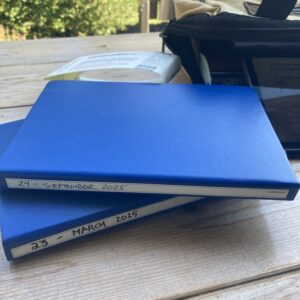
Every 6 months or so I reach the end of another volume in my journaling. At the front of each journal, I write my oath. I use the act of cracking open a new notebook as a prompt to reflect on my journaling process itself.

I reflect on what, and how, I capture things each day. Why am I journaling? Am I seeing longterm trends? Is there any change for better, or for worse?

ɕ