It’s become clear that I have trouble moving beyond paradigms of thought which no longer serve me.
The example top of mind today is this line from my personal oath: I don’t compare myself to others, only to myself from yesterday. I adopted that oath eleven years ago. (I had to look that up.) In all that time, that line has felt rock solid. Comparing myself to anything has recently felt problematic.
I really enjoyed this (it’s a rebroadcast from 2016) episode of On Being with David Whyte.
David Whyte is an English poet and philosopher, born to a Yorkshire father and an Irish mother, who trained as a marine zoologist and worked as a naturalist guide in the Galápagos before returning to poetry full time. He is best known for The Heart Aroused: Poetry and the Preservation of the Soul in Corporate America, and for Consolations, his book of essays on the underlying meanings of everyday words. In this 2016 conversation, he speaks about what he calls the conversational nature of reality — the frontier between what you think is you and what you think is not you — and about loss, vulnerability, aloneness, genius, and the strange work of bringing poetry into corporate leadership. Threaded through is his friendship with the late John O’Donohue and the grief of losing him. He recites four of his poems along the way.
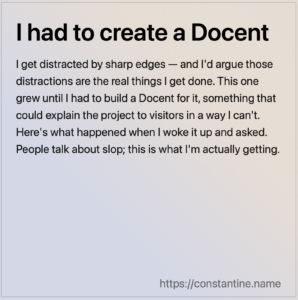
This is simply how my mind works. If I see a problem or a sharp edge which interests or annoys me… I get “distracted” (I argue that these distractions are actually the real things that I get done) and I go build, fix, repair, or remove entirely . . .
So I started something tiny for myself and it has just grown into — well, I had to create a Docent so when people ask me questions it can explain it in a way that I can’t. So imagine you and I are in a small museum and I brought you in through the employee entrance in the back and I just finished babbling at you about how it all works. So I can say, “…wait, I’m sorry. We have a Docent who can translate my crazy for you . . .”
At which point I woke up the Docent and prompted it with:
Good morning! I have a guest with me who asked me, “what is this project?!” (they’re shocked at its actual scale, confused by the complexity of the room, and don’t understand why the effort…)
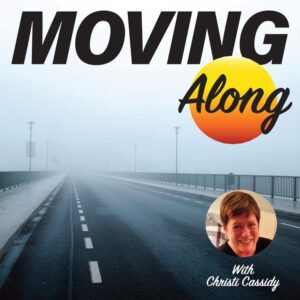
I was recently away for an extended overland trip to Newfoundland. Along the way Christi Cassidy and I made time to record a fun episode for her Moving Along podcast.
Deskilling was something we knew from the industrialisation of manufacturing. Rather than artisan work, where the expert (say) baker knew and controlled the entire process of bread making, each step was broken down and put along a factory assembly line. We know from longstanding labour history that this ‘deskilled’ expertise, handed control of the entire process to management (foremen, traditionally) and meant that bosses could reduce wages – and, often enough, job satisfaction.
From the 1980s this happened to professional work, and to virtue specifically.
Why should what you produce, rather than what you consume, be the most important thing about you? Why shouldn’t the fact that you race boats or watch anime or drink matcha lattes be what defines your identity? Why should I call myself a “writer” rather than a “science fiction fan” or a “rabbit dad”? Just imagining introducing myself as the latter makes me cringe a little. But why?
An as-usually great deep dive into the value of a person. Of course, we all known—right?!—that a person is intrinsicly valuable; The challenge I face all the time is feeling like I should do, and in particular create value others would trade with me for… decade after decade, I just can’t seem to shake that.
I’ve been complaining about social media forever by this point, and so has everyone else. But a recent effort to actively rebuild my social life has revealed something about how these two things relate. Social media isn’t a cheap and inadequate facsimile of social life; it’s its exact opposite. It isn’t worse than social life at fostering personal connection, it undoes personal connection and reverses our social skills.
The difficulty in getting one’s social life back arises from exactly what make the social media so successful (for the corporate overlordes squeezing value form all of us people): Everyone is there, now. Actual social life didn’t used to be the default thing—it used to be the only thing. Forevermore there will now be the need to choose. What matters in the end—obviously—is the choices each of us makes.
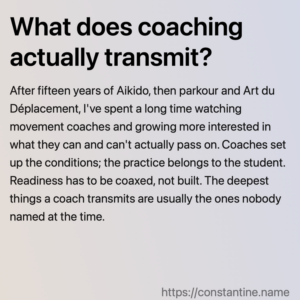
I’ve been around movement coaches for years — fifteen years of Aikido, then parkour and Art du Déplacement — physical practices that bring you into rooms with people who are good at doing the thing they’re trying to teach you to do. The longer I’ve watched, the more interested I’ve become in what coaches can and can’t actually pass on.
This thread mixes Movers Mindset Field Notes — distillations of conversations with coaches and movement teachers — with my own writing as a long-time student. What students need before they can hear anything. What coaches can set up but can’t manufacture. What gets transmitted in the unstructured time between drills. And the part nobody plans for — what can’t be directly taught and has to be coaxed out instead.
The thread is sequenced for someone curious about what teaching actually does.
I’m aware there’s an XKCD about standards. (There are 14 different variations? I’ll make one which includes all of that and it’ll be better. There are 15 different variations.)
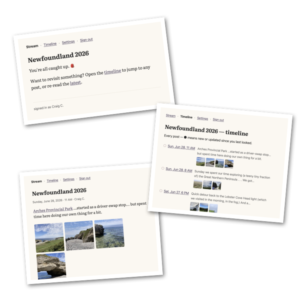
But all I wanted was an invite-only website where I could post some photos (and the occasional short video) and invite my family and friends to follow along. I did not want an iPhone app that GPS tracks my location. I just wanted, effectively, a tiny little blog for travel. It’s opinionated about restraint: no ads, no tracking, no growth-hacking, no dark patterns — software that’s calm and on my side. This is the beautiful open Web at its best…
Private by default, not as an afterthought — Invite-only from the ground up — no public index, no search-engine footprint, no “oops, that was public the whole time.” Multiple independent spaces (“travelogues”) under one account — separate trips, separate audiences, separate guest lists. Self-hosted and dependency-light — my photos live on my server, not in someone else’s data business.
Sign in the way you actually want to — Passwordless email links, passwords, Google, or passkeys / Touch ID — pick any, mix freely, change your mind later. Every method stacks on one identity; no account fragmentation. A real account-settings page: change your email (with re-verification), see your active sessions, sign out everywhere, or delete yourself cleanly.
Posting that gets out of your way — Drag-and-drop photos, many at once, uploading live while you write. Automatic web-resizing, thumbnails, EXIF-orientation fixes, and in-browser HEIC conversion — no “please export as JPEG” friction. iPhone videos transcode themselves in the background to a format that plays everywhere, poster frame included. Per-photo captions and drag-to-reorder; Markdown when you want it, plain text when you don’t.
A reading experience designed for the follower, not the feed — A calm one-post-at-a-time reader and a full timeline — no infinite scroll, no engagement tricks. Per-reader “what’s new since you last looked,” with a summary of what actually changed. Threaded replies. Opt-in “there are updates” email digests with genuine one-click unsubscribe — notifications that respect the recipient.
Sharing that feels like handing someone a photo — Turn any single photo into a private, self-expiring share link — no account required on the other end. Collect a batch and send them in one email, in your own words, from your own address. Time-boxed by design (links lapse on their own) so sharing doesn’t quietly become forever.
Quietly capable underneath — Owner controls: approve/decline followers per space, one-off invite links, a site-wide announcement banner. An admin dashboard plus a private activity feed (RSS) across every space. Background job processing, schema that migrates itself on deploy, and a test suite behind it — boring in the ways infrastructure should be.
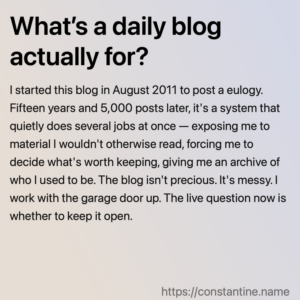
I started this blog in August 2011 as a place to post a eulogy. Fifteen years and over 5,000 posts later, it’s no longer one thing. It’s a system that does several jobs at once — exposes me to material I wouldn’t otherwise read, forces a third pass on anything that catches my attention, makes me decide what’s actually worth keeping, and gives me an archive to come back to when I’ve forgotten what I once knew.
This thread is about why I keep doing it. Not as advice — I have no idea whether what works for me would work for you — but as the working-out of a practice that has shaped how I think for over a decade. The blog isn’t precious. It’s messy. I work with the garage door up. The thread is sequenced for someone wondering whether it’s still worth doing this kind of thing.