The amateur believes he must first overcome his fear; Then he can do his work. The professional knows that fear can never be overcome. He knows there is no such thing as a fearless warrior or a dread-free artist.
~ Steven Pressfield
slip:4a1512.
The amateur believes he must first overcome his fear; Then he can do his work. The professional knows that fear can never be overcome. He knows there is no such thing as a fearless warrior or a dread-free artist.
~ Steven Pressfield
slip:4a1512.
If you have your primary needs of security and health fulfilled (as billions of us now do) how then do we proceed? It seems I have two options. The option I default to, is to feel I should first do what I must—the work that others have assigned, the work that brings in the dollars, the work I feel that I should do. The second option is, of course, doing what I wish to do. My defaulting to those shoulds directly conflicts with my pursuit of the wish-tos. This creates enormous tension, and alarming swings of focus, energy and mood.
The message is clear: you should do what you do to the best of your ability, and whether you gain recognition for it or not is secondary. This is the ethic of the Japanese shokunin, the true craftsman. These masters are completely dedicated to perfecting their craft, whether it is cookery or calligraphy, woodwork or weaving. Honour comes simply from the work, not from the recognition others give you for your doing it.
~ Julian Baggini from, Recipe for success
slip:4uaeea3.
What, actually, happens if we flip things? Rather than first doing what we must, we first do what we wish. Don’t misread; I’m not proposing we do what we wish instead of doing what we must. What if we simply flipped the priorities— a reversal of the ordering?
ɕ
Reading time: About 4 minutes, 800 words
Get 7 for Sunday in your inbox. → Subscribe here.
This issue is https://7forsunday.com/13
Thank you for reading! I appreciate your time and attention, and I don’t take it for granted.
In years past I’ve posted some links to things which I pay for—if I’m not paying for something, then I’m probably the product being sold. So I prefer to pay for things when I can (when I’m able and when paying directly is possible.) Here are few things I use, which I pay for: Hindenburg, Overcast, Reeder, Feedbin, Tower, Transmit, OmniFocus, OmniOutliner, iaWriter, Discourse, Basecamp, Bluehost, Hover, Zencastr, Zoom, Otter, Mailchimp, Substack, Supercast, and Front.
ɕ
If you set your goals ridiculously high and it’s a failure, you will fail above everyone else’s success.
~ James Cameron
slip:4a715.
Never use a long word where a diminutive one would suffice. When you want to keep a story moving don’t spend a lot of time going on circuitous side trips when you could instead proceed directly to the most interesting, active parts. Like that time I was in the Antarctic with Ernie and we had to abandon the Endurance to the ice, it’s important to use good visuals to make your point in as few word as possible. Also, there are clear rules for writing, such as: One should only write authoritatively about that which one actually knows. Other rules include: Don’t overuse colons; It’s important to know how to use a semi-colon.
Not sure how I got on that train of thought. It simply struck me to try writing a paragraph which was maximally incorrect. I should probably exercise more restraint. But what started this post— What prompted my title selection was:
I’ve decided to stop tracking my waist measurement. It simplifies my crazy list of things I try to do every day, sure. It also eliminates the number of times I go to weigh/measure and have to double-back for reading glasses to see the tailor’s tape. I had started tracking it so that I could calculate my waist to weight ratio. After a few years I’ve learned that the ratio is telling. Not in a depressing way, but it’s a very interesting number—I can tell my level of fitness, how I’ll feel if I try to do something (say, go run, or boulder,) and it’s a great indicator. But having the data didn’t enable to do anything. ¯\_(ツ)_/¯ So, lest I go ever onward adding processes and things and systems and numbers— ahem. Dropped it.
ɕ
It took me many years to develop my personal habit and routines around reflection. On this blog, I’ve written a lot about the changes I’ve attempted in my journey of self-improvement, including a post in particular detailing what my morning reflection looks like. However, I’m not going into great detail of my habits and routines.
What are you thinking right now, after reading that paragraph?
(Sit with that question for a bit.)
What do you think about what I wrote?
Are you curious to know my story in more detail?
What do you think about being reflective?
Are you curious to know more about yourself?
Whatever you’re thinking, that’s perfect.
What you’re going to do—now through March 1st, is practice being reflective. You’ve done the easy part: You’ve decided to practice.
The first three posts—this one, January 2, and Sunday January 3—are going to explain how this works. In this post, I’m simply introducing you to being reflective upon being prompted.
That’s all for today.
ɕ
As a PDF — You can download Practicing Reflection as a single e-book.
My touch-phrase for 2019 was, “no.” In terms of self-imposed stress and crippling depression, 2019 was the worst year ever; I’ve more than 10 years of journals and I’ve checked. 2018 was bad, but 2019—the year I set out specifically to reduce the problems—was definitely and significantly worse than 2018.
I remain convinced that it is not possible to optimize one’s way out of burn-out. If I have 500 things I want to get done and I’m burnt-out, the solution is to reduce the number of things, not get better at getting things done. I’m speaking from personal experience, not from theory.
2020 has to be the year of getting less done.
In 2019, the “no” touch-phrase was meant to guide me to developing the habit of saying no to things coming towards me. A huge amount of ideas and opportunities come at me, and I’ve gotten much better at saying, “no.” (I’m not quite ready to say I’ve gotten “good” at it; but I’ve definitely gotten better.) I’ve gotten better at evaluating Big Asks from the world, and saying, “no.” A textbook example of that is people/groups which reach out to me, asking for my input or participation.
“No, I do not have the time to do that well.”
“No, I cannot to do that the way it deserves to be done.”
…and so on. Note particularly the absence of the societal lubrication, (a.k.a., the usual lie,) “I’m sorry, but…” Because, I’m not sorry. I’m defending myself, and I’ve reached the point where if my candid, timely, and honest response feels like a wack on the head… Bummer. Life’s hard; get a helmet.
2020 has to be the year of getting less done.
In a previous post I mentioned the idea of leverage; positing that I should focus on asking myself, “how much leverage does this opportunity afford me?” This still doesn’t feel quite the right fit for 2020 because leverage per se isn’t a value I’m interested in maximizing.
So that leaves me where?
2020 has to be the year of getting less done.
GLD — Get less done.
Maybe that’s the touch-phrase for 2020?
ɕ
When your environment is cluttered, the chaos restricts your ability to focus. The clutter also limits your brain’s ability to process information. Clutter makes you distracted and unable to process information as well as you do in an uncluttered, organized, and serene environment.
~ Erin Doland from, «https://unclutterer.com/2011/03/29/scientists-find-physical-clutter-negatively-affects-your-ability-to-focus-process-information/»
slip:4uuusi1.
My personal experience agrees. Having spaces set aside for whatever-it-is-you-want-to-do pays off. Sometimes that’s a dedicated space. But sometimes it’s a space which has multiple purposes, which I somehow convert when I’m changing uses.
Having a space which I intend to be uncluttered also gives me the opportunity to clean it up and prepare it for the activity. Sometimes I’m just not feeling the vibe I need to begin whatever-it-is, and taking a few minutes to prepare the space — and maybe prepare some coffee too ;) — puts me into a focused and energized mood.
ɕ
Paring down one’s possessions and schedule are go-to ways to seek simplicity because they are outward, accessible, concrete actions that produce fairly immediate results. Their weakness, when practiced as their own ends, however, is that they lack a set of overarching criteria for how they should be carried out, as well as intrinsic motivation for following them through.
Practicing outward moves towards simplification, without this set of criteria, is like placing spokes in a wheel, without connecting them to a hub.
Simplicity needs a heart, and its center must be this: having a clear purpose.
~ Brett McKay, from The Spiritual Disciplines: Simplicity
slip:4uaosi1.
Throughout 2017 I’ve been slowly paring down. Fewer physical things sure, but also changing out some things and hobbies and projects and people. Can I eliminate one? Can I replace two of something with a simpler one?
I’m a “systems” person. I get things done via the observe, orient, decide, and act loop. For 2018 I’ve no delusions of rewiring my brain and kicking all my systems and processes to the curb.
I’ve realized, (far too recently,) that I need to take more time to “zoom out” and to take the time to consider how the really big things in my life fit together. Do they fit together? What if some really big component of who I am — even if it’s a great, fine thing — doesn’t fit with the rest of everything? What should I change; everything else, or that one great, fine thing?
I don’t do New Year’s resolutions, but I do love to spend the indoor, chilly, winter season thinking about the big picture — and now, perhaps a bit more of the really big picture.
Goodbye 2017! I will look back on you fondly.
MEMENTO MORI
ɕ
It’s not the mountain we conquer but ourselves.
~ Edmund Hillary
slip:4a442.

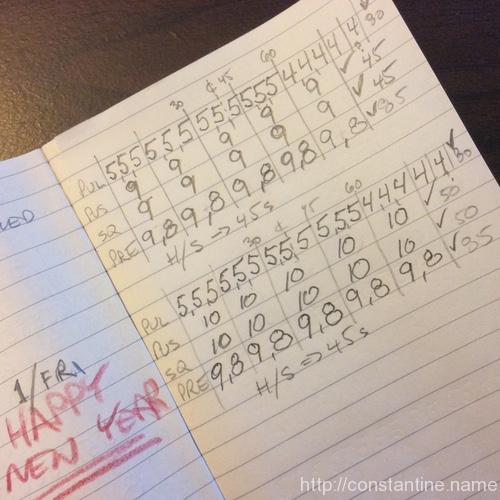
Today was challenging: Up late for New Year’s Eve. Nothing major, but snacking late into the night, short on sleep, alcohol… all adds up on the negative side of the balance sheet. I did my usual warmup, started into things, and then had to stop for my back. I could just tell it wasn’t feeling 100% and that I would have been in pain before I was done. So I started over doing range-of-motion and a second, longer warmup — it took me forever to get up to speed. BUT, I’m very happy that I managed to pull out of the nose dive and get the workout done without injury!
So today’s workout is done as planned. Pushups, squats were 5×10 (numbers are creeping up, but this is still easy :), 2×25 handstands — even managed a few seconds free-standing at the end of each handstand, 85 bar precisions as 5×9 and 5×8, and a tedious 80 pullups as 5×12, and 4×5. I’m definitely stuck on a plateau with pullups! But with the holiday “weighted vest” currently holding me down, I’m hoping to move on in the coming weeks… Saturday and Sunday are rest days.
Next week has three workouts, on Monday, Wednesday and Saturday. That’s planned to work around my Tuesday and Sunday travelling days to/from Boston. Monday I’ll finish banking bar-precision reps so that I don’t have to do any while in Boston (since I can’t be 100% sure I can find a handy bar precision.) So the two workouts while I’m away are just pushups, squats, pullups and handstands… I know I can get those in. I’m thiking of going to Brooklyn Boulders (a huge climbing gym where the parkour group has scaffolding setup for indoor classes) on Wednesday; that would let me use the scaff for pullups and get my workout in. Saturday I’ll see what’s happening.
Here’s next week filled in:

ɕ
A wise man hopes things will change, but remains upbeat when things do not.
~ unknown
slip:4a1127.
A Design Pattern? You mean from the ’90s?
~ Robert C. Martin from, A Little About Patterns.
slip:4uceue1.
ɕ