Getting started with 16-hour fasting

This post is about ways to incrementally change when you are eating, to shift yourself from how you are eating today, to a particular time-pattern of fasting called 16:8 (pronounced “sixteen eight”.) 16:8 means every day you have a 16-hour fast (the “not eating” window,) and then an 8-hour eating window.

I’m going to start by assuming you already want to begin fasting. I’ve written more generally about fasting if you’d prefer to start with WHY you might want to try being more intentional about when you choose to eat.

Putting yourself into “intentional” mode

You SHOULD discuss your fasting with your primary care physician. Ask them what you should be aware of, or how it may affect you—they know the specifics of your body. You will discover they actually know all about fasting and diet. If you are proactively engaged in your own welfare, your physician will be happy to be a font of useful information.

For example: My primary care doctor is well aware of the beneficial effects of diet, exercise and fasting on my cholesterol markers. They are also convinced that my lifestyle changes will not be able to sufficiently improve those markers quickly enough. Thus, our discussions and my choices continue.

(And—yikes!—if your physician isn’t helpful, knowledgeable, and open to discussion, you should find a better physician.)

Fasting is about WHEN you eat

Fasting is easy to understand: It’s about WHEN you eat. Whether we use the word fasting, intermittent fasting (IF), or time restricted eating (TRE), we’re simply referring to when you eat versus when you don’t eat.

Fasting—here, and whenever I talk about it—is not about depriving yourself, nor about starvation or suffering. It is SIMPLY being intentional about WHEN you CHOOSE to eat.

I know, I know… 16 hours without eating probably sounds like a crazy-long time to not eat. But as I said at the top, I’m assuming you are motivated to try this.

(more…)
Persistence with Tim Winders

What does redefining success look like after you’ve lost everything?

Podcasting becomes a vehicle for self-discovery, long-form connection, and client engagement.

I’ve talked to a lot of podcasters. I’m able to talk to people for roughly 60 minutes without any interruption. It nourishes my soul, and I love it. That’s the real foundation.

~ Tim Winders (19:18)

This conversation explores the origin and evolution of the long-running podcast, Seek. Go. Create., and its relationship to Tim Winder’s personal and professional journey. Tim describes how the podcast began as a response to a client’s needs, but quickly became a spiritually driven endeavor. He was encouraged to share personal stories, including difficult experiences like financial collapse and homelessness. Over time, the show developed into a platform that not only supports a coaching business but also nourishes a desire for deep, uninterrupted conversations.

This conversation also touches on the structure and process behind maintaining consistency over hundreds of episodes, the relationship between control and creativity, and the integration of podcasting with writing and coaching work. Tim explains how the podcast serves as both an outlet and a tool for building content across platforms like YouTube and LinkedIn. There’s a recurring theme of redefining success, with reflections on audience size, personal growth, and the impact of letting go of expectations.

(more…)

7 for Sunday — March 31, 2024 #78

https://7forsunday.com/78

Branded — It’s sublime that the little word “brand,” which we toss about so lightly these days, has…
Representation — [T]his is quite central to my fiction and to my analysis of the problems of creating a new nation today.…
Honka! Honka! — Godin’s writing frequently—it might be fair to say always—attempts to inspire. But from some…
Uncertainty — I can live with doubt and uncertainty and not knowing. I think it is much more interesting to live not…
Virtues — One must have a practice. Because the alternative would be to aimlessly wander. Ancient Stoicism aimed to be…
Pressure — To achieve great things, two things are needed: A plan and not quite enough time. ~ Leonard Bernstein
Reflection — I sometimes talk about the three words, discovery, reflection and efficacy. It’s the reflection that is…


Quotations

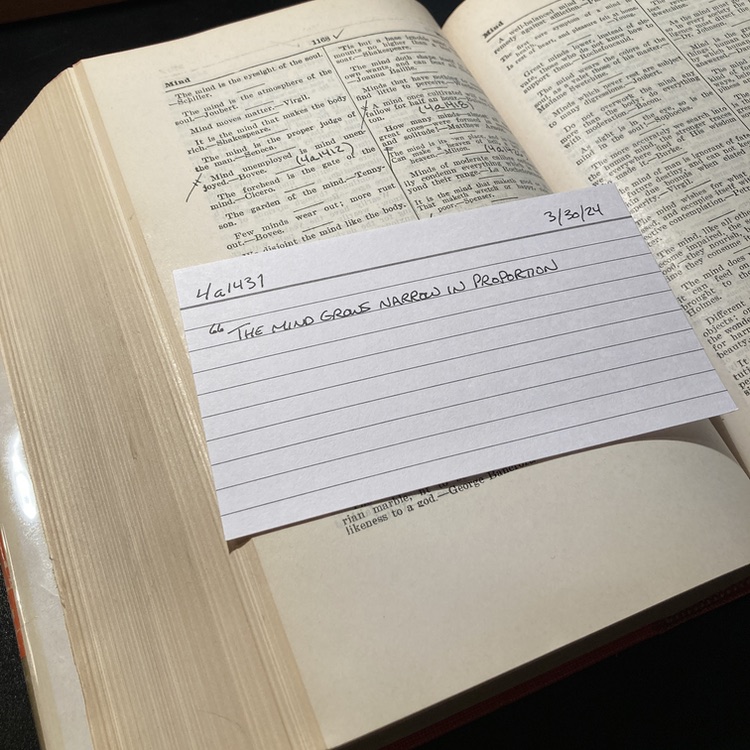
30 years ago, I put a few quotes on my first blog. Then things escalated. I collect quotes from all over the place. But sometimes, I dive (using a random number tool to pick one of the 2,000 pages) into this door-stop of a book, 40,000 Quotations Prose and Poetical. Found a few on this page. This one is becoming number 1,431.


March 31, 2024 — #78

Reading time: About 5 minutes, 900 words
Get 7 for Sunday in your inbox. → Subscribe here.
This issue is https://7forsunday.com/78

The cathedral is outside

Branded

It’s sublime that the little word “brand,” which we toss about so lightly these days, has definitions that are horrific when juxtaposed: A type of product manufactured by a particular company under a particular name, and an identifying mark burned on livestock or criminals or slaves with a branding iron.

The internet has made it so that no matter who you are or what you do — from 9-to-5 middle managers to astronauts to housecleaners — you cannot escape the tyranny of the personal brand. For some, it looks like updating your LinkedIn connections whenever you get promoted; for others, it’s asking customers to give you five stars on Google Reviews; for still more, it’s crafting an engaging-but-authentic persona on Instagram. And for people who hope to publish a bestseller or release a hit record, it’s “building a platform” so that execs can use your existing audience to justify the costs of signing a new artist.

~ Rebecca Jennings from, Everyone’s a sellout now

slip:4uvocu1.

No one has to go in for being personally branded (in the marketing sense. And it should go without saying, but I will anyway, that no living thing should ever be branded in the physical assault and torture sense.) Everywhere, I do my best to show up just as me.

I don’t try to ram everything down everyone’s throat. I don’t need a personal brand, because I’m not selling myself—I’m not marketing me. Anyone, across everything I do, can easily figure out how to engage with whatever it is that I create, and if that involves paying me, that’s easy enough to figure out. I’m just working with the garage door up. Hi, I’m Craig. This is what I did yesterday, do in general, or am doing today.

ɕ


Bitter or better?

The Stoics would agree that the world can be ugly and awful and disappointing. They would just remind us that what we control is what we do about this. We control what difference we try to make. We control whether it makes us bitter or makes us better—whether we complain or just get to work.

~ Ryan Holiday from, Why I Pick up Trash at the Beach

slip:4urywy1.

My grasp is failing. My ability to keep track of this, and make a plan for organizing that, is waning. Each year I more quickly become frustrated at unforeseen twists and foreseen complexities. Believing I’m successfully juggling just two things, I’m surprised to discover one has already hit the floor. I’ve moved beyond having a to-do list long enough that many items are below the fold; the regularity of adding items near the top means the items below the fold will never get done. Instead, I have multiple systems piled up in sedimentary fashion. Entire segments of my life, which I thought were integral to my identity, have fallen below the fold.

And every day my life gets better. I wish I’d learned the lesson sooner.

ɕ


Voice with Gaelen Poage

How can podcasting serve as a platform for self-expression and meaningful connections while addressing challenges like monetization and content creation?

Behind every podcast lies a blend of creative passion and logistical hurdles.

If I can watch somebody else’s process of finding their way then that can help me in mine as well.

~ Gaelen Poage (4:49)

The conversation explores the evolution of podcasting as a medium for self-expression and connection. Discussions center on the shift from traditional written content to spoken storytelling and how podcasting allows individuals to explore their thought processes in real time. Gaelen emphasizes the value of sharing raw, unpolished processes, enabling listeners to find inspiration and clarity in their own journeys. This dynamic format contrasts with polished, scripted content, highlighting the richness of podcasting as an art form.

Challenges like monetization and the logistics of podcast production are also addressed. The difficulty of sustaining a podcast financially without compromising creative integrity is a recurring theme. Gaelen discusses using podcasting as a tool to complement other ventures, such as coaching or community-building, rather than a primary source of income. This multifaceted approach underscores the balance between passion for content creation and practical necessities.

(more…)

Comfortable with AnnSofie Svensson

How do personal experiences and challenges shape an individual’s approach to movement practices and training?

Exploring the intersection of circus arts, Parkour, and fear-facing techniques reveals unique approaches to movement.

I feel [my rail work] is like somewhere— I think, a middle ground because it connects both what I used to do in the air, and what I do on the floor.

~ AnnSofie Svensson (1:44)

The conversation explores the interplay between different movement disciplines, highlighting how unique environments and personal experiences influence training approaches. Topics include adapting Parkour to locations with limited infrastructure, integrating circus arts with traditional movement practices, and balancing personal challenges like fear and overcommitment.

A strong focus is placed on the social versus individual aspects of training. While some movement is shared socially, other practices stem from isolation, driven by a lack of community or environmental factors. The discussion also touches on broader themes, such as facing fears, redefining consistency, and finding humor in challenges. AnnSofie shares insights into building movement opportunities in remote areas and reflects on the intersection of personal growth and physical exploration.

(more…)

Communication with Andrea Wojnicki

How do communication strategies and frameworks influence personal and professional growth, particularly in podcasting and coaching?

Authenticity and personal branding redefine success in communication and podcasting.

These people have a growth mindset, and they are clearly ambitious and they know that they are probably done with the majority of their—if not all of their—formal quote-unquote education in terms of going to University or College. But they also look around, and they’re like: ‘I got more in me.’

~ Andrea Wojnicki (2:24)

The conversation examines the significance of communication frameworks in personal and professional settings. It begins by highlighting the traits of ambitious individuals with growth mindsets who seek to refine their communication skills, focusing on confidence, storytelling, and practical frameworks. Andrea underscores the value of establishing habits and linking small, consistent actions to larger goals of self-improvement.

The discussion moves to challenges faced by podcasters, especially those who struggle with confidence and imposter syndrome. Emerging podcasters often lack the self-assurance they exhibit in their primary careers when transitioning into podcasting. Andrea emphasizes the importance of maintaining a growth mindset to navigate such hurdles, explaining how curiosity and openness can help individuals learn and adapt effectively. Personal branding is also explored as a tool for authenticity and transformation rather than a means of self-promotion.

(more…)

The reward

For the important work, the instructions are always insufficient. For the work we’d like to do, the reward comes from the fact that there is no guarantee, that the path isn’t well lit, that we cannot possibly be sure it’s going to work.

~ Seth Godin

slip:4a831.


Suggestions too

It’s harder to see it when we’re the ones who are complaining so often. And in fact, in my experience most of us are in the habit of complaining, either out loud or to ourselves. Myself included.

~ Leo Babauta from, Practicing with the Complaining Habit

slip:4uzeco1.

I am not a complainer. (I’m not pushing back on Babauta’s post. It’s excellent, as usual.) If you spot me complaining, I’d appreciate being called out. Certainly, there was a time when I complained, but it is not now.

Being a “suggester” correlates with being a complainer. People who complain also suggest. “You should do that this way…” “This would be better with more…” “If I was in charge I would…” Ridding oneself of one of these flaws, will make the other intolerable, which begins the work of ridding oneself of the other.

ɕ


Craig Constantine: Experience, pruning, and benefit

What motivates and defines meaningful conversations in podcasting, and how does preparation and intentionality shape these interactions?

Doing the ‘same’ thing over 100 times seems like a lot, but feels like much less when each time is a unique and valuable experience. Craig discusses the process he uses to create space and have authentic conversations with each guest. He unpacks the idea of ‘pruning’ your projects and how reflection is integral to the process. Craig shares his personal reasons for creating the podcast, why video is not on the agenda, and changes we may see moving forward.

If you think about how… This is actually really hard to do, I think. If you think: ‘I am going to go over to my friend’s house at three o’clock on Tuesday, and I’m going to have a good conversation!’ With that, I mean, that’s basically what we’re trying to do.

~ Craig Constantine (14:17)

This conversation navigates the dynamics of podcasting, emphasizing the intentional shift from traditional interviews to organic conversations. Key points include the importance of preparation, balancing listener needs with authentic dialogue, and creating a space where guests feel seen and heard. Insights into reflective practices reveal how curiosity and follow-through shape meaningful exchanges.

The discussion also touches on challenges in managing creative projects, with pruning as a metaphor for intentional decision-making. The process of saying no to certain projects to create room for impactful endeavors highlights the speaker’s philosophy. Other topics explored include the importance of diversity in guest selection and the iterative process of refining the podcast’s mission.

(more…)

Already knowing

The most difficult subjects can be explained to the most slow-witted man if he has not formed any idea of them already; but the simplest thing cannot be made clear to the most intelligent man if he is firmly persuaded that he knows already, without a shadow of doubt, what is laid before him.

~ Leo Tolstoy

slip:4a392.


On podcasting

The short version of this story is simply: I’m simply curious. I try things. I make mistakes. I ask questions.

My podcasting journey began with the Movers Mindset project, which grew from conversations I started having as part of my personal journey rediscovering movement. Started in 2015, at first it was just a web site that shared others’ writing. But as I travelled, I kept finding myself in cool conversations until one day someone said, “you should have recorded that. I’d listen to that podcast.” Excited, but with no clue how much work it would be, I kicked off the Movers Mindset podcast at the start of 2017. For the first dozen episodes I did far too much of the work myself, until I wised up and started finding a few incredible people to share my new passion.

By this point I was devouring anything I could about interviewing. I smashed through thousands of podcast episodes in the process of wondering, “how does everyone else do it?” Podcasts, books, online courses… Everywhere I turned I found something new to work on in my own journey.

In the fall of 2018 I had about 30 interviews published on the podcast. I was getting comfortable travelling by plane, train and automobile, being invited into people’s lives to capture the Movers Mindset interviews. I was invited to the North American Art of Retreat, a Parkour leadership retreat, in the Cascade mountains outside of Seattle. There I did a series of interviews with the event’s presenters and organizers, and handed those recordings off for Art of Retreat to create their own podcast.

When 2019 rolled around, on a whim, I jumped into an Akimbo course called The Podcast Fellowship. I wanted to search for unknown-unknowns, to rethink everything I had done so far, and much about the Movers Mindset podcast changed in this period. To my surprise, I was invited back to be part of a small group of alumni who assist the coaches for the 4th, (and then the 5th, and 6th) running of the course. It’s mind-bogglingly inspiring and energizing to hang out daily with hundreds of people who share your passion. I even tried to summarize the fun of it in The Journey.

Meanwhile, the Movers Mindset episode numbers kept climbing and I’ve been branching out to interview more challenging guests; challenging for me as I’m forced to converse and discuss topics I know less and less about, but which none the less intrigue me endlessly. In the fall of 2019, this time with help from some of the Movers Mindset team, I was invited back to Art of Retreat. There, we did a second series of interviews for Art of Retreat’s podcast.

If you want to see a more up-to-date listing of what I’ve done in the podcasting space, see my Podchaser creator page.

ɕ


Raw material

Just as the nature of rational things has given to each person their rational powers, so it also gives us this power – Just as nature turns to its own purpose any obstacle or any opposition, sets its place in the destined order, and co-ops it, so every rational person can convert any obstacle into the raw material for their own purpose.

~ Marcus Aurelius

slip:4a292.


Beware the man

But I worry that most smart people have not learned that a list of dozens of studies, several meta-analyses, hundreds of experts, and expert surveys showing almost all academics support your thesis – can still be bullshit. Which is too bad, because that’s exactly what people who want to bamboozle an educated audience are going to use.

~ Scott Alexander from, Beware the Man of One Study

slip:4usabe1.

The way our civil discourse currently works, one has to be loud (or strident, or be an animated-GIF) to be heard. If one thinks, “This topic is complicated. I should learn more about it before engaging…”, then by definition you are not [yet] participating in the civil discourse.

Meanwhile, the discourse continues led by those who are willing to engage, and who may [or may not] be better informed than you.

So here’s a challenge — something to consider trying, not a challenge in the sense of me saying, “I challenge you, sir, to a duel!”…

Actually start those conversations where you don’t feel well-equiped. So for example, I should more often say, “I disagree with you because I’m not convinced that yours is the correct position . . . but I’m not entirely certain of my position either . . . can we help each other by unpacking our thinking a bit more?”

There’s a real skill to being fine with not winning the discussion. I engage, I discuss, and the other person holds their position not moving one iota. We each walk away disagreeing but at least we better understand that other individual human being. That would be civil discourse.

ɕ


Painful experience

An expert is a person who has found out by his own painful experience all the mistakes one can make in a very narrow field.

~ Niels Bohr

slip:4a193.


Gift of silence

“You have a grand gift of silence, Watson,” said he,
“It makes you quite invaluable as a companion.”

~ Arthur C. Doyle

slip:4a34.


America’s Real Criminal Element: Lead

Lead

Gasoline lead may explain as much as 90 percent of the rise and fall of violent crime over the past half century.

slip:4umoei1.

ɕ