I saw this magazine a year (or more?) ago and seriously considered subscribing.
Has anyone read any of them?
Recent PodNews post has discount subscription pricing (and more details)…
https://podnews.net/press-release/good-tape-threat
ɕ
I saw this magazine a year (or more?) ago and seriously considered subscribing.
Has anyone read any of them?
Recent PodNews post has discount subscription pricing (and more details)…
https://podnews.net/press-release/good-tape-threat
ɕ
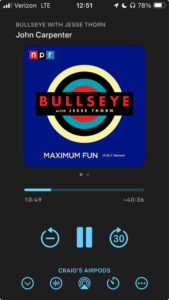
Tune in to this Bullseye episode…
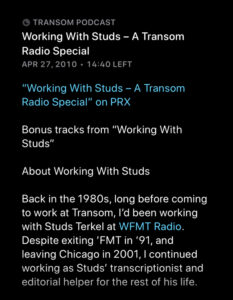
If you’re a podcaster—or even just a fan of aural history—you’ll enjoy this, from PRX.
ɕ
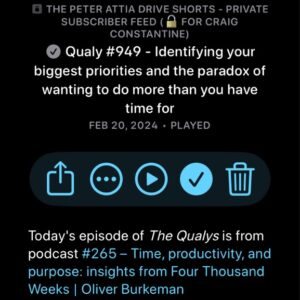
If you’ve not heard of Burkeman’s book (Four Thousand Weeks, I’ve not yet read it) the seed is simple: Your life will be about 4,000 weeks in duration.
In this podcast episode, Burkeman talks about the common advice to prioritize your work and to do the important things first—an echo of Stephen Covey’s metaphor of rocks, pebbles and sand to be put into a jar representing your limited time. Burkeman zooms in on the implication—missed by most people—within Covey’s advice.
You only have finite time. If you have a prioritized list of what’s important to you, it’s the stuff in the middle that will do you in.
Your top 5 items are clearly those big things you should work on. But, your number 6 item—that one feels almost as important as number 5. You need to actively avoid the danger of getting sucked into that number 6 (and the other almost as important items right behind it.)
ɕ
Ira Glass is a champion for the Many Voices that public radio’s mission says it values. This American Life is not the voice of record, but a record of the voices around us. The stories are as fully strange and hopeful and funny and harsh and romantic as America itself…and occasionally all at the same time. They sprawl outside the usual standard-issue broadcast confines, telling about the way it actually was, what it felt like, what really happened. Ira is their shepherd, their piper. But it was not always that way. Ira’s Transom Manifesto, which will appear in serialized form over the course of his time with us, begins with his utter lack of talent at this work. We think Ira’s failures will give you hope. — Jay Allison
~ from Ira Glass – Transom
Elsewhere, this is 4utaia1. — slipbox
This is a sprawling, multi-part piece by Glass. It’s part manifesto and part autobiography. It’s well worth the read. I know my may seem odd—it’s just the opening paragraph that’s written by Allison.
ɕ
In the most-recent Podcaster Community campfire we got to talking about what tools and services are we currently paying for as part of podcasting. So today I put up a simple post in a few places to ask just that.
It’s one thing to talk about what we prefer, it’s another for us to have voted with our dollars. Me?
ɕ
Well this is interesting! I’ve been adding time-references to quotes when I include them in show notes. I simply put the <minute>:<seconds> after the quote.
Today I realized that Overcast auto-magically makes those time codes clickable — touching the time code jumps play right to that point!
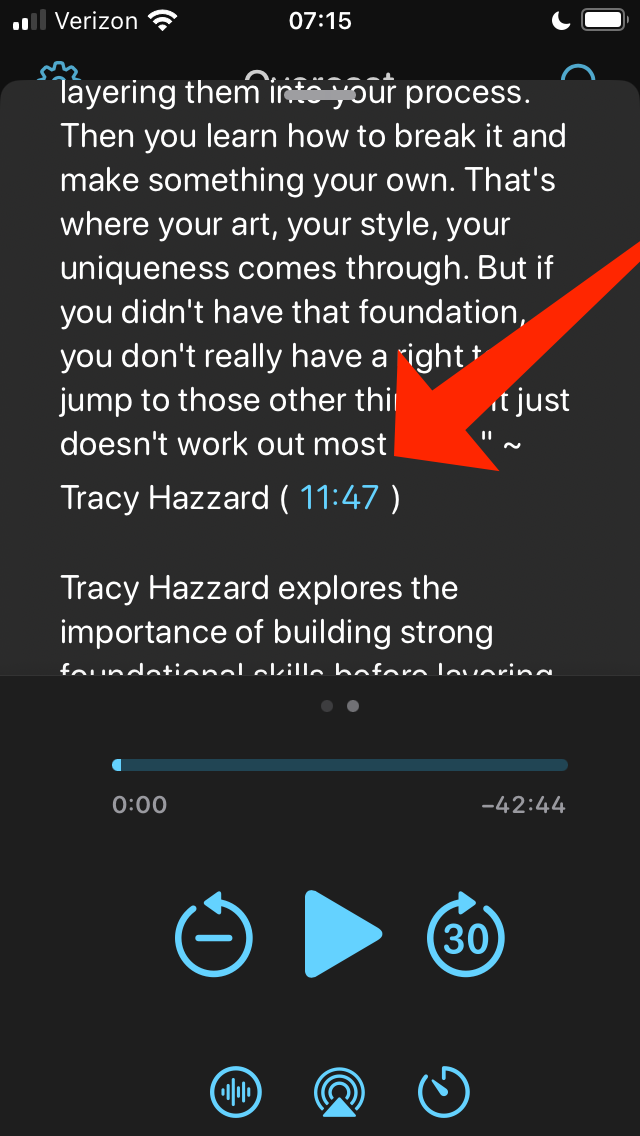
This is amazingly great for the listener.
For years there’s been discussion about chapters in podcast episodes. They are supported, yes. But there’s complicated to actually set up. The original way, is to embed the information within the mp3 audio file—that requires either special software which does just that, or your DAW has to support marking the chapters as you’re editing. Either way, a bit tedious.
But if this little feature of link-up-time-references in the notes works across more players… this is HUGE.
So: Take a look at your favorite player. Find an episode (any episode of Podtalk, for example) that has time-references in the show notes… and tell me if it works in your player.
ɕ
We’re told to “just ship it,” but also to “make it great.” Where do you draw the line? When do you prioritize polish, and when do you hit publish?
I had to learn—the way you learn to ride a bicycle: do it over and over, the “principle” of the thing doesn’t help you do the thing—that the tension is a good sign. Now when I feel the tension between quality and consistency I know I’m in the correct place.
This morning, I’m thinking about a rowing metaphor: One oar is quality and the other is consistency. Pull evenly and the boat goes straight-ish. Also, if you try to row too hard, you get exhausted. The best way to make long-term progress is to row these two things, in balance, at a sustainable pace.
ɕ