Thomas Droge and Brenda Kahn: Story, history, and self-perception

What are the ways in which personal narratives, self-perception, and mentorship influence an individual’s path to growth and transformation?

If you want to know someone, have a conversation with them. But if you want to know who they really are, have a conversation with their partner. Thomas Droge and Brenda Kahn share their story and how they’ve changed over the years. They explore the idea of our internal narratives and self-perceptions, finding your own way, and the human experience of time. Brenda and Thomas discuss ways to change the world and the importance of investigating your history.

I’ve been writing a memoir. And I had a really fascinating experience with it, because I got all the way through it, and realize that everything that I told myself about myself was totally not true. […] the stories we tell ourselves, literally, inform our lives in a way that have real consequences in the real world. And when you take a step back and look at yourself and decide, wait a second, you know, they actually did a lot of really cool things, you know— this was kind of amazing. So then I had to start the whole thing over again from this whole different slant.

~ Brenda Kan (38:24)

This conversation explores how personal stories and perceptions shape our lives and how reevaluating them can unlock growth. Brenda reflects on writing a memoir and discovering that her past achievements were much more significant than she initially believed, illustrating the transformative power of storytelling. Thomas complements this idea by discussing mentorship and the value of learning from both older and younger generations to stay connected with evolving perspectives.

And he said, for me, one of the things that I think people always miss in mentorship is that you need mentors who are younger than you, to share with you what’s changing in the world, and keep you connected to what’s happening. And mentorship is really a two way street, of the younger generation, connecting you with the world and what’s happening and showing you what’s changing from their point of view. To teach you so that you don’t get stuck in your static view of the world.

~ Thomas Droge (33:17)

The discussion also touches on movement practices, mindfulness, and self-discovery, connecting these to larger themes like time perception and narrative transformation. By examining personal experiences, they highlight the importance of self-awareness and adaptability in personal and professional contexts, as well as the role of mentors and shared knowledge in shaping these journeys.

Takeaways

Mentorship’s reciprocal nature — Younger mentors help connect older generations to evolving perspectives, making mentorship a two-way exchange.

Personal narrative’s power — Revisiting and reframing personal stories can completely transform self-perception.

Movement as insight — Physical practices like Tai Chi or Parkour help reveal inner narratives and foster growth.

The interplay of time and perception — Understanding time through different lenses offers tools for navigating personal transformation.

Storytelling and compassion — Approaching one’s story with compassion opens up new possibilities for growth and healing.

Resources

Thomas Droge

Brenda Kahn

Dolores Huerta Foundation — Civil rights organization founded by Dolores Huerta.

Taoism and Dragon Gate Teachings — An overview of the Dragon Gate Taoist philosophy.

(Written with help from Chat-GPT.)

ɕ

Performing with a safety net

When recording conversations for the Movers Mindset podcast the guests know I’m not going to edit what they say to change their meaning. They know I’m bringing journalistic integrity to the conversation. (I’m not doing strict journalism, but that feature of journalism is present.) I do my best to set up the correct space (physical, emotional and mental,) so that we can co-create the best conversation possible. I’m not digging for dirt, creating tension, nor trying to create any other saccharine artifice. But that doesn’t change the fact that we are performing for an audience. The final necessary piece to facilitating a great conversation is a safety net.

Each conversation… each performance is better if we can reach just a bit farther than we might normally be comfortable doing. That’s why I bring a safety net. I very clearly give the guest a safe word which they can incant at any time to take back what they’ve said.

I don’t include the guest in the post-production process. They’re not invited to review the material, or to give additional thoughts about what to keep or what to cut. In fact, the only people who have time to do that, are wanna-be cooks, who will only mess up the soup if I let them in my kitchen. Instead, I and my team do all the post-production difficult work which is in fact our responsibility. The guest already did the really hard work of being themselves on-mic.

I do also say, “take your time— silence is free and we can easily trim out 30 seconds of you thinking before you speak.” I’ve also a few other little coaching tidbits I share to prep them for being recorded. But it’s the safety net which makes them feel comfortable trying something they might otherwise hesitate about. Part of the magic of a great conversation is how it develops organically, and without the safety net most people dial their caution up a few notches to be safe. With a safety net, most people are delighted to take a leap to see what they can do.

ɕ


Cara-Michele Nether: Aikido, wellness, and honesty

How can personal experiences with Aikido and wellness practices be used to help others improve their lives through self-awareness, physical health, and personal growth?

Unexpectedly inheriting an Aikido school may sound overwhelming, but Cara-Michele Nether took it in stride. She sits down to share her journey in Aikido and acupuncture, and what she’s learned from both. Cara-Michele unpacks her views on overall health, and how she helps people improve their lives by focusing on their ‘why.’ She discusses her grandmother, the importance of self-awareness, and her thoughts on Aikido’s usefulness.

Nobody wants to do something that they feel awful about. So you have to make it easy and smooth for them and give them small reasons to celebrate and have a good time and feel like they want to come back.

~ Cara-Michele Nether (38:42)

The discussion focuses on personal growth and the impact of martial arts, particularly Aikido, on physical and emotional health. Aikido serves as a tool for self-awareness and developing resilience, as Cara-Michele shares her journey from discovering the practice to inheriting and leading a dojo. The themes of humility, connection, and navigating challenges in teaching and practice are explored in depth.

Health and wellness are central topics, as Cara-Michele integrates practices like acupuncture, nutrition, and functional movement into their work. She emphasize the importance of understanding personal motivations, or “why,” to make meaningful changes in health and lifestyle. Stories of overcoming challenges and helping others through tailored approaches highlight the transformative power of these practices.

Takeaways

Functional movement — Emphasis on exercises that enhance daily life skills like lifting, climbing stairs, or squatting.

Humility in practice — The necessity of maintaining an “empty cup” mindset for growth in martial arts and personal development.

Health connections — The integration of acupuncture, nutrition, and movement to improve overall well-being.

Legacy and impact — Encouraging others to recognize their unique contributions and preserve family histories.

Community and belonging — The importance of fostering connections and seeing oneself as valuable to others.

Resources

Strength and Vitality Wellness Center — A wellness center offering acupuncture, nutrition, and movement classes, designed to help clients achieve overall health and vitality.

Falls Road Aikido — A dojo founded by Cara-Michele Nether that emphasizes Aikido practice with a focus on personal growth and connection.

Kinokawa Aikido — An Aikido organization that strongly influenced Cara-Michele’s martial arts journey, known for its emphasis on martial and philosophical aspects of Aikido.

(Written with help from Chat-GPT.)

ɕ

Some thoughts on file organization

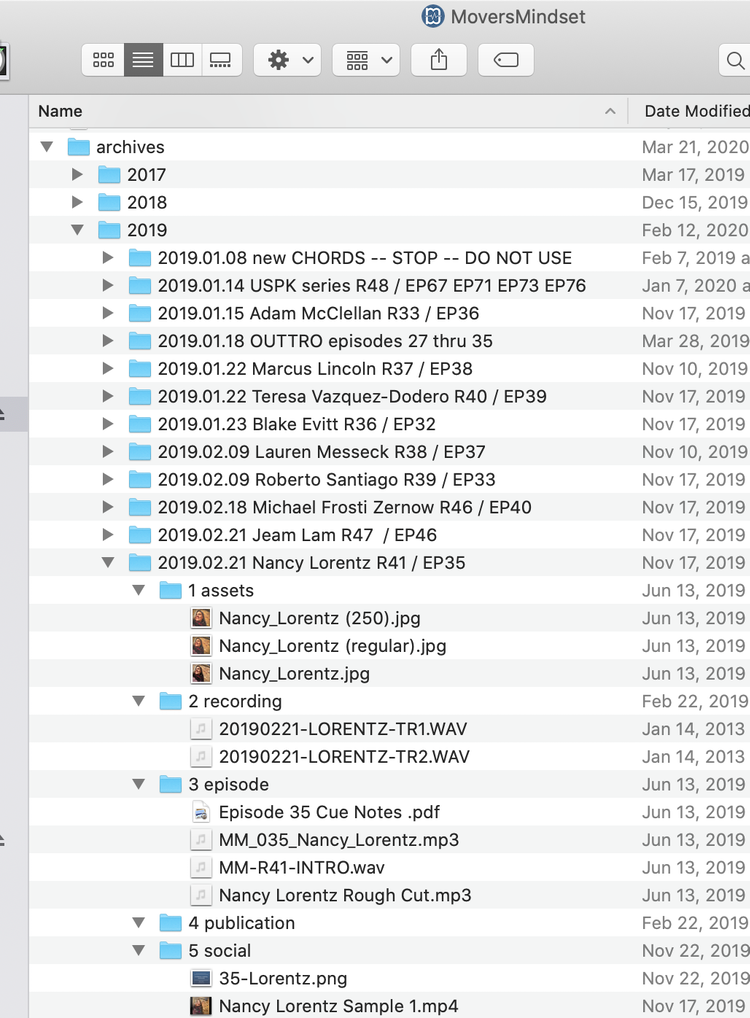
Within the team that creates the Movers Mindset podcast, we assign numbers to our projects. We use “R42” for our 42nd recording project, then R43, and so on. This enables us to start naming things from day one, in a way that we don’t have to change later. If you’re putting your files in a folder, what would you name it, that you could be sure wouldn’t change?

We also use our podcast’s initials on file names, “MM.” When we see files whose name contains, MM-R42… we know what it belongs too. It’s part of the Recording-42 project for Movers Mindset.

We also exclusively use people’s family names on files. So a raw WAV file from an interview is 20200423-MM-SMITH-TR1.wav … April 23, 2020 recording for Movers Mindset, of someone named “Smith”, and this is track one [a recording from one microphone.] 20200423-MM-SMITH-TR2.wav is track two, and so on. No matter where you toss that file, it’s going to make sense.

Eventually, a recording project might lead to one (or more!) episodes of our podcast. They get assigned episode numbers, EP56, EP57, etc. Then we have filenames like MM-EP57… and it’s always clear what that is.

Sometimes we have a dozen files to keep track of in a podcast episode and we end up with
20200423-MM-SMITH-TR1.wav
20200423-MM-SMITH-TR2.wav
MM-EP56-INTRO.wav (introduction recorded after interview)
MM-EP56-OUTRO.wav (outro recorded in post production)
MM-GCORD.wav (a little music ‘button’ used when joining bits of interview)
…the final episode is then MM-EP56-SMITH.mp3

Since I’ve typed this much, here’s another thing we do: We use consistently numbered folders to store the files. Every project has a folder, 2020.04.23 Bob Smith R42/EP56 — we create 2020.04.23 Bob Smith R42 in our archives when we do the raw recording, and at the very end we add the /EP56 to make it easier to find things. In side each project we create five folders 1 assets, 2 recording, 3 episode, 4 publication, and 5 social — the leading number ensure they sort in nice order in various displays. 1 contains anything the guest gives us (photos, writing) or any photos we take during recording. 2 is the raw original recordings, 3 is everything to make a podcast episode (intro, outro, whatever we have to assemble, AND the finished MP3), 4 is anything we create as part of publishing the episode (transcript, articles, highlights ) and 5 is anything that’s ok for social media and sharing. And then we have a multi-terabyte file server with a “few” files on it:

ɕ


Thea Rae: Programming, Stunts, and Cross training

How can diverse physical practices and creative disciplines inform and enhance each other to foster personal growth and adaptability?

Any mind hell-bent on problem solving inevitably seeks challenge. Thea Rae discusses many things, including her movement background, coding, and stunt work. She unpacks the connections between her art, movement, aerial circus, and programming. Thea explains her varied interests: stunts, circus, cycling, climbing, and ice skating, and why cross training is so important to her practice.

Movement is also a language to me. Just as much as we can communicate with words, we can also communicate with our bodies and we can say so much.

~ Thea Rae

Thea Rae discusses her multifaceted journey through movement arts, creative technology, and life, emphasizing the significance of cross-training in her personal and professional development. She reflects on how disciplines like gymnastics, aerial arts, and ice skating have shaped her understanding of physicality and creativity. Her experience with rock climbing has also been pivotal in teaching her how to remain calm and adapt to challenging situations.

In addition to physical movement, Thea digs into her artistic pursuits, including kinetic sculpture and interactive installations. She explains the parallels between her programming and movement practices, highlighting the problem-solving mindset that underpins both. Throughout, she underscores the value of viewing movement as a language and a means of communication, shaping her approach to teaching, performing, and everyday life.

Takeaways

Movement as a language — Physical movement can communicate as much as words, offering nuanced expressions of thought and emotion.

Cross-training benefits — Engaging in varied physical practices enriches skills across disciplines and fosters adaptability.

The interplay of art and movement — Artistic and physical pursuits inform and enhance each other, creating a holistic creative process.

Resilience through rock climbing — Climbing teaches problem-solving, calmness, and persistence in the face of physical challenges.

Ice skating’s impact — Ice skating has improved Thea’s balance, core stability, and understanding of subtle movements.

Rehab and pre-hab importance — Maintaining physical health requires intentional rehabilitation and preventative exercises to stay active.

Creative problem-solving — Both programming and movement rely on structured thinking and the ability to adapt to complex situations.

Resources

New England Center for Circus Arts — A school where Thea studied aerial silks and acrobatics.

Brooklyn Zoo — A parkour gym where Thea began exploring movement in New York City.

Motiv NY — A physical therapy center that has assisted Thea with movement optimization and injury recovery.

Wonderfruit Festival — A music festival in Thailand where Thea built interactive installations.

(Written with help from Chat-GPT.)

ɕ


Self-esteem box

Today, two thoughts popped into my head in rapid suggestion: “Self-esteem box,” and “I’ve never pull-quoted Movers Mindset.”

Brandee Laird

Craig: So for me it’s I know if I go for a walk that’s almost, not always, almost always enough to make it so I can go back into the cave of ugliness and get back to work kind of thing. So what are some things that will help you turn that corner, brighten you up or energize you?

Brandee: Yeah, that’s a great question, because I do get very dark moods pretty often actually, because with compassion comes the pain of caring so much about all these people and all this situation, it feels very futile a lot of times, like what can I do to change this. Yeah, I get there and I have a few tactics, I basically build protocols for myself for when I get in those moods. So one of the first things I go to is my self-esteem box.

Craig: This sounds like a good idea.

Brandee: And my self-esteem box is digital, it’s a digital self-esteem box and what I have done, is I have taken screenshots and copy/pasted and just dumped in all kinds of nice things that people have said, either to me or about me over the years.

So I have this file that is just full of gratitude and compliments and just stuff that I have had to read over and over and over in order to actually believe it. So that’s actually more like last resort is the self-esteem box. If nothing else works, open the self-esteem box, look through here.

Craig: In case of emergency, break glass, right?

Brandee: Totally. Totally. So that’s something I think everyone could and should do that. I guess I’ve never really told anyone about that. But it’s a nice thing.

Craig: I think that’s a really good tactic. People talk about doing gratitude journaling, but the gratitude journaling. I mean, I know that you know what it is, but gratitude journaling is a process which you have to execute on the spot when you feel like you’re having a bad mood. But the idea of having a self-esteem box is a clever one.

Brandee: Why, thank you.

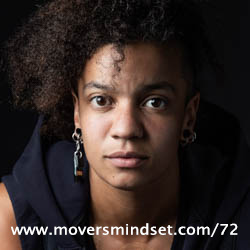
~ Brandee Laird from 46’30”, https://moversmindset.com/72

I think these two thoughts popped into my head as the photo-frame on my wall changed. One of the smartest things I’ve ever done is set up a digital photo-frame. I email it photos of things—you know, all those digital photos you never do anything with. :)

Anyway. I love love LOVE my photo-frame. It’s chock full of hundreds of great photos. It’s not quite a self-esteem box. But it generally has the same effect. Every single time I glance at it it makes me smile.

Meanwhile, ever since I had that conversation with Brandee, (in September 2019,) I’ve been toying with the idea of creating a self-esteem box. I’m not quite sure where to put it [digitally] though; Also, I really do not need to make up yet another system for myself for organizing and storing things.

But the idea keeps calling to me.

ɕ


Andrew Suseno: Ancestors, Parcon Resilience, and Racism

How can movement practices like Parcon Resilience foster connection, empathy, and anti-racism in diverse communities?

Andrew Suseno’s Parcon goes beyond the physical to create community and fight racism. Andrew discusses his family, ancestors, and their role in his identity. We explore what Parcon is, why he created Parcon Resilience, and his vision for the anti-racist work it does. Andrew unpacks various pieces of racism in modern America, how Parcon Resilience addresses it, and shares why the work he does inspires him.

When somebody is Parcon’ing with somebody who might be in a chair— who might have the ability to maybe do a couple steps if they had somebody in kind of a dynamic balance with them or helping take off some of their weight— Then all of a sudden it becomes possible! There’s this invitation across ability to be able to create new possibilities for being in public, for being in the world, and it’s not just a singular thing.

~ Andrew Suseno (17:48)

The discussion explores Parcon Resilience as an innovative practice combining movement, community, and anti-racist principles. Andrew goes into the origins of Parcon Resilience, blending influences from contact improvisation and parkour to create relational and environmental somatic experiences. The practice emphasizes inclusivity, enabling people of all abilities to connect and express themselves, often in public spaces, to challenge societal norms about movement and relationships.

The conversation also addresses broader themes of racism, intersectionality, and ancestral connections. Andrew explains how Parcon Resilience helps people embody anti-racism by fostering empathy and honoring diverse experiences. Discussions include the socio-political implications of movement and the transformative potential of connecting with one’s environment, others, and ancestral history.

Takeaways

Inclusivity in movement practices — Parcon Resilience allows individuals of all abilities to engage in meaningful interactions.

Contact improvisation — The foundational principles emphasize shared weight and nonverbal communication between participants.

Anti-racism through movement — Parcon Resilience focuses on fostering race consciousness and addressing societal inequalities.

Connection to environment — Participants explore nontraditional spaces and movements to form deeper relationships with their surroundings.

Empathy and relational practices — The focus on shared experiences builds mutual understanding and challenges societal divisions.

Intersectionality in practice — The framework centers on people of color across various intersecting identities.

Cultural and ancestral connections — Honoring one’s past and culture through movement deepens personal and collective identity.

Challenging ableist norms — Activities break barriers between able-bodied individuals and those with disabilities.

Transforming public spaces — Movement activities in public invite diverse interactions and challenge conventional use of urban environments.

Resources

Moving Rasa @moving.rasa

People’s Institute for Survival and Beyond — Organization providing anti-racism workshops and initiatives.

Andrea Smith’s article on Heteropatriarchy — A piece discussing the three pillars of white supremacy.

High Line Park — The location for one of Parcon Resilience’s public flash mobs in New York City.

(Written with help from Chat-GPT.)

ɕ


Nikkie Zanevsky: Coaching, inclusivity, and empathy

How can inclusive coaching practices and a focus on empathy improve learning and growth for diverse groups in movement disciplines like parkour?

When she first learned about parkour back in ’06, Nikkie Zanevsky never dreamed it would lead to her quitting her day job and starting her own movement company. Nikkie sits down to reflect on her approach to coaching, structuring classes, and creating an experience for her students. She shares her own methods of learning and growing, and how it impacts her coaching. Nikkie shares her insights on success, inclusivity and gender in parkour, and the importance of starting before you’re ready.

For me, my favorite part of coaching is activating everyone in the space to work with each other and to learn from each other, but I feel like I can do that better if I know something about each of the people and how to activate that.

~ Nikkie Zanevsky

The conversation explores the integration of empathy, inclusivity, and diverse movement modalities in coaching practices. Nikkie discusses her approach to creating a supportive environment for learners of all ages and skill levels. She emphasizes the importance of understanding individual needs and fostering collaboration among participants.

Key themes include the role of failure as a pathway to growth, the psychological barriers faced by older participants, and the value of blending disciplines like parkour, strength training, and playful movement. The discussion also highlights how societal expectations can influence participation and the importance of challenging norms to create equitable learning experiences.

Takeaways

Empathy in coaching — Nikkie emphasizes understanding and adapting to the needs of each participant.

Failure as a learning tool — Regularly facing challenges and setbacks builds resilience and empathy.

Diverse modalities — Combining parkour with strength training and playful elements enhances learning.

Psychological barriers — Older adults often face mental and social hurdles to engaging in new physical practices.

Inclusive environments — Structured indoor and outdoor spaces can make movement more approachable.

Impact of societal norms — Challenging expectations about age, gender, and ability fosters inclusivity.

Resources

Wildly Fit — Nikkie’s New York-based movement coaching and team-building company.

Grit — Angela Lee Duckworth’s book referenced for its focus on perseverance and passion.

The Movement Creative — A collaborative movement community co-founded by Nikkie.

Firestorm Freerunning & Acrobatics — Mentioned as a model for a thriving parkour business.

American Rendezvous — An event noted for its inclusivity across all skill levels.

(Written with help from Chat-GPT.)

ɕ


The process of reflection

Much of the power of the Movers Mindset podcast’s signature question, “three words to describe your practice?” comes from thinking about one’s personal understanding of the word practice. In the podcast episodes, sometimes the guest’s discussion of that understanding is a profound part of their interview. Sometimes their surgical statement of three words is its sublime culmination.

In 2019, we posed the three-words question of the project itself. This turned out to be a surprisingly fruitful exercise. We came up with three words to describe our practice, and I subsequently adopted them as the three words to describe my practice:

Discovery. Reflection. Efficacy.

If those three words describe my practice—the journey of my whole life—then what is the purpose of this web site? Why go through all this work? It’s taken me 9 years and the previous 2,499 posts to understand:

It’s a vehicle for my process of reflection.

I used to think I wrote because there was something I wanted to say. Then I thought, “I will continue to write because I have not yet said what I wanted to say”; but I know now I continue to write because I have not yet heard what I have been listening to.

~ Mary Rueflé from, Madness, Rack, and Honey

ɕ


Bryan Riggins: Awareness, process, and books

What can be learned from training parkour and engaging with challenges of height about composure, awareness, and personal growth?

Bryan Riggins discusses his motivation, goals, and process of training descents, and his experiences and relationship with fear. He shares how it relates to his love of coaching children, and the challenges he personally works on. Bryan unpacks his reasons for training parkour before delving into the many books that have influenced him and what is on his reading list.

I think that fear has a place always. I think that if people think that it doesn’t exist or that they don’t have it, they’re lying to themselves.

~ Bryan Riggins (14:18)

The conversation discusses the lessons drawn from parkour, particularly training descents, and how these experiences shape personal awareness and composure. Central themes include managing fear, the importance of intentionality, and the application of these principles in teaching children and coaching others. Bryan reflects on how parkour serves as a means for self-discovery and resilience building.

The discussion also drops into the philosophical aspects of parkour, such as the value of breaking challenges into manageable parts and the role of journaling in tracking progress. Broader reflections on teaching emphasize equipping students with tools to manage emotional responses, fostering a growth-oriented mindset, and creating meaningful connections between physical practice and personal development.

Takeaways

Awareness in training — The importance of being present and intentional in physical practice.

Fear as a tool — Fear is acknowledged as a constant presence, offering opportunities for growth rather than avoidance.

Coaching children — Effective teaching strategies involve mindfulness and providing tools for emotional management.

Challenge breakdown — Success in parkour often depends on dividing large challenges into smaller, manageable steps.

Journaling for reflection — Documenting training helps reinforce learning and track progress.

Social media’s role — Social platforms are seen as both an opportunity for connection and a potential distraction from meaningful practice.

Mindset in challenges — A fixed mindset can limit growth, while a focus on adaptability fosters resilience.

The influence of books — Literature and philosophical insights inform both training and teaching methodologies.

Resources

The Rock Warrior’s Way —  Arno Ilgner’s book that discusses awareness, attention, and intention in training.

Parkour Visions — An organization where the speaker coaches and develops programs.

Momo — Michael Ende’s’ magical realism book mentioned as inspiring.

A Thousand Plateaus — by Gilles Deleuze and Félix Guattari, a philosophical work exploring complex ideas.

(Written with help from Chat-GPT.)

ɕ