What is defeat? Nothing but education; nothing but the first step to something better.
~ Wendell Phillips
Elsewhere, this is 4a1534. — slipbox
What is defeat? Nothing but education; nothing but the first step to something better.
~ Wendell Phillips
Elsewhere, this is 4a1534. — slipbox
What motivates and shapes the mindset behind an individual’s pursuit of excellence in parkour, both in terms of personal practice and contributions to the broader movement community?
George McGowan discusses his journey through Parkour and his philosophical approach to movement, sharing insights on achieving perfection through relentless practice and creativity.
I think that carried over into my style, and then as I progressed it just got more… I was more critical of myself. But it’s my style of training, and I want the line to be—in my eyes—perfect and if I’m happy with it, then that’s all that matters. And having the clip at the end is just a bonus to me.
~ George McGowan, (04:30)
Craig Constantine welcomes George McGowan, a Freerunning and Parkour enthusiast and filmmaker, to discuss his experiences and insights into the world of movement. Early in the conversation, they discuss a recent documentary featuring George, emphasizing the dedication and meticulous approach required to master Parkour moves. George elaborates on his collaboration with notable figures like Robbie Corbett and his participation in events like the USA Parkour Cup, highlighting how these experiences have fostered valuable relationships and opportunities in the Parkour community.
George shares his philosophy on training and Parkour lines, explaining that achieving perfection in his movements is paramount, a sentiment reflected in his rigorous practice routine as seen in the documentary. He talks about his preference for efficient and fluid movements over showy, disconnected tricks, underscoring his focus on the aesthetics and functionality of each sequence.
Additionally, George discusses the influence of his peers, particularly from his early days training in Belfast, on developing a perfectionist approach to Parkour. This mindset extends into how he visualizes and plans his movements, often laying in bed thinking about the next day’s potential lines and challenges.
(more…)The linked post is an Apple-specific, nerdy deep dive related to technical details in recording. In the specifics it’s about people ripping on Apple for certain claims about something being “shot on iPhone.”
I much prefer the other way of looking at this same rig, which is that it is incredible that this entire professional workflow is being funneled through a tiny sensor on basically the same telephone I have in my pocket right now.
~ Nick Heer from, How Apple Shot ‘Let Loose’
Elsewhere, this is 4upoli1. — slipbox
Heer is so spot-on here. Hear! Hear! I love this sentiment. When I take a moment to mentally zoom out, I’m knocked out by the incomprehensibly-advanced super-computers which are now everywhere. If this isn’t nice, I don’t know what is.
ɕ
To fulfill a dream, to be allowed to sweat over lonely labor, to be given a chance to create, is the meat and potatoes of life. The money is the gravy.
~ Bette Davis
Elsewhere, this is 4a1122. — slipbox
What insights can a photographer share about the collaborative process of capturing movement, particularly when working with athletes?
Discover the intersection of art and athleticism through the lens of a movement-focused photographer.
Having been around so many different athletes, I think what’s really fascinating to me is the process, where you get a front-row seat to the process of them breaking a jump. And working through the challenges. And I can’t get enough of that. That is— I find that so amazing, where someone just gets in a zone. And then they can do this thing.
~ Ben Franke (16:11)
The conversation highlights the intricate collaboration involved in capturing dynamic movement in photography. Ben shares his approach to working closely with athletes, emphasizing the importance of understanding the movement art they practice. This partnership allows him to create compelling images while respecting the athletes’ physical limits. The interaction between artist and subject enriches the process, enabling both to come away with something meaningful.
A significant portion of the discussion revolves around the creative process, from compositional choices made in the moment to post-processing decisions. Ben also reflects on the evolution of their practice, highlighting a preference for collaborative and thoughtful work over impersonal or candid photography. Practical advice is offered to aspiring photographers, encouraging experimentation and active exploration as a path to discovering personal style.
(more…)What motivates and challenges individuals when starting and developing a podcast?
Posting a daily question for years transforms a personal habit into a creative legacy.
I am a creator, like— I have this creative— …how did I do this? I just— …just made a decision one day.
~ Ken Kaus (28:35)
The conversation explores the challenges and motivations behind starting a podcast. It begins with reflections on technical aspects such as editing, which surprisingly becomes manageable for Ken due to previous experience with audio software. Imposter syndrome and self-doubt are discussed as significant obstacles to creativity, alongside strategies for pushing through discomfort, like publishing imperfect episodes and focusing on growth rather than perfection.
Another theme revolves around self-expression and communication. Ken reveals how podcasting helps clarify their thoughts and improve everyday communication. He share his practice of posting daily questions as a way to cultivate creativity and build a consistent habit, which now informs his identity as a creator. Both Craig and Ken agree that small steps and persistence are crucial in creative pursuits, offering listeners insights into overcoming personal and professional barriers.
(more…)I read and hear a lot about how excessive “screen time” is bad. But there’s a distinction that has to be made: Is the “screen time” tool-use to accomplish something meaningful? …because tool-use is not bad for you. We don’t begrudge the time a mechanic spends wielding his tools; we call that “working.”
Today I spent nearly every waking minute in front of one of four different computer screens. For reasons of sanity and physical health, sometimes I was sitting, sometimes standing, sometimes indoors and outdoors for long stretches too. I also take intentional “vision breaks” to allow my eye muscles to relax—literally relax to infinite focusing distance, which they would otherwise never do facing a screen, or anywhere indoors.
What did I do? I did an enormous number of things. Here are a few examples from today: I submitted a presenter application for an in-person event in September. I worked on my presentation notes for a different, in-person event in 2 weeks. I researched and experimented with exporting the contents of a WordPress site, and then read and interpreted the massive data which was output, to verify that I could later write a program to parse it. I then planned out the work needed to disassemble the project, of which that WordPress site is but one piece. I estimate I spent three hours reading text articles I’d previously queued up to read later. I helped a member of a community sort out a problem they were having.
I, truly, don’t know about you. I however, am an excellent mechanic, with the finest tools, and there remain far more things worth doing than I can ever get done. My problem is not, “screen time.”
ɕ
Creating anything of consequence or magnitude requires deliberate, incremental and consistent work. At the beginning, these efforts might not look like they are amounting to much. But with time, they accumulate and then compound on each other. Whether it’s a book or a business or an anthill or a stalagmite, from humble beginnings come impressive outcomes.
~ Ryan Holiday
Elsewhere, this is 4a890. — slipbox
Creating anything of consequence or magnitude requires deliberate, incremental and consistent work. At the beginning, these efforts might not look like they are amounting to much. But with time, they accumulate and then compound on each other. Whether it’s a book or a business or an anthill or a stalagmite, from humble beginnings come impressive outcomes.
~ Ryan Holiday
Elsewhere, this is 4a890. — slipbox
Sometimes I manage to remember that lesson.
…usually that my remembering happens during my morning routine. I won’t bore you with the specifics, but: I regularly read things which spur the sorts of thinking I’d like to do more of; I spend time writing in, and re-reading, my journals; time reading good-old printed-on-dead-trees books; time thinking about how to create some thing I’m building; lots of thinking and jotting in outlines.
Things take me vastly more time and work than it appears from the outside.
ɕ
On Castbox.fm — Stephen Leung | Growth Hacking your Parkour Business
How can growth hacking techniques help small Parkour businesses compete and succeed in a market dominated by larger competitors?
The key to building a successful Parkour business lies in understanding and addressing the real needs of the community through product-market fit.
[I]f you want to build a business, you want to build a brand. It’s a little meta— but it’s having a clear understanding of your product-market fit. And I spent the beginning of the session there, even teed it up… that some of you may not want to hear this. It’s a really big thing, going back to the tech startup world.
~ Stephen Leung (4:38)
The conversation explores how growth hacking techniques from the tech industry can be applied to small Parkour businesses. A core focus is the importance of identifying product-market fit, emphasizing that no amount of marketing or tactics will succeed without a real understanding of what the market needs. The discussion highlights that Parkour businesses may need to rethink their identity, realizing they are not simply competing within their own community but addressing broader lifestyle needs.
Another topic discussed is the idea of “jobs to be done,” suggesting that businesses succeed by identifying the fundamental problems customers are trying to solve. Parkour businesses could benefit by addressing tangential needs like community building, after-school care, or personal growth, rather than solely promoting physical training. Collaboration among Parkour businesses, rather than competition, is emphasized as a key driver for collective growth.
Takeaways
Growth hacking — Small businesses can leverage creative tactics to compete with larger companies.
Product-market fit — A Parkour business must align with real market needs to grow sustainably.
Jobs to be done — Understanding the broader needs customers seek to fulfill is critical to success.
Community focus — Parkour businesses can benefit by emphasizing the community aspect rather than just physical training.
Collaborative competition — Growth should focus on lifting the entire community rather than outcompeting peers.
Market adaptation — Parkour businesses must adapt to serve evolving market needs rather than clinging to narrow identities.
Resources
(Written with help from Chat-GPT.)
ɕ
I’m finding myself draw to this phrase. It’s clearly messing with me; At first brush it might seem to be an oxymoron. However it depends on which definition of “moderation” I choose. If moderation is something I have—say, I am moderate in my opinions—then that moderation simply is. That moderation is neither short nor tall, slow nor fast, and neither restrained nor unrestrained.
But if moderation is thought of as an action—something I am doing continuously, like running or living or talking—then it can clearly be done to different degrees. My running can be slow or fast. (Technically, my running is uniformly slow, but bear with me for this simile.) My living can be conservative or outlandish. And so my moderation can be restrained or unrestrained. Currently, my moderation dial is turned to about, 2; Picture me knocking on the control panel asking, “Hello? Is this on?” I need to twist that moderation up to 11.
ɕ
Update Oct 2020: See also, Festina Lente.
What can be learned from training parkour and engaging with challenges of height about composure, awareness, and personal growth?
Bryan Riggins discusses his motivation, goals, and process of training descents, and his experiences and relationship with fear. He shares how it relates to his love of coaching children, and the challenges he personally works on. Bryan unpacks his reasons for training parkour before delving into the many books that have influenced him and what is on his reading list.
I think that fear has a place always. I think that if people think that it doesn’t exist or that they don’t have it, they’re lying to themselves.
~ Bryan Riggins (14:18)
The conversation discusses the lessons drawn from parkour, particularly training descents, and how these experiences shape personal awareness and composure. Central themes include managing fear, the importance of intentionality, and the application of these principles in teaching children and coaching others. Bryan reflects on how parkour serves as a means for self-discovery and resilience building.
The discussion also drops into the philosophical aspects of parkour, such as the value of breaking challenges into manageable parts and the role of journaling in tracking progress. Broader reflections on teaching emphasize equipping students with tools to manage emotional responses, fostering a growth-oriented mindset, and creating meaningful connections between physical practice and personal development.
If we support a foreign war or oppose it, it’s because of what effect it’s having on us, either individually or collectively. Our soldiers are dying. Our President is making us look bad. Our corporations are manipulating us. Our national debt is out of control. My taxes might go up. My budget might be stretched. My family member might be killed. We aren’t encouraged to consider such situations from the viewpoint of planet earth as a whole, or how our actions today might affect future generations. We perceive each other as separate and distinct individuals as opposed to cells in the same body.
~ Steve Pavlina from, What Lies Beyond the Haze of Social Conditioning?
Elsewhere, this is 4usebo6. — slipbox
This isn’t about “us” versus “them. It’s about “I”. How do I see my world? How do I see myself? Have I been conditioned? (duh. Of course I have.) Now that I’ve discovered I have a brain, do I like how I’ve been conditioned?
…oh sorry, got to talking to myself there.
ɕ
Our destiny is frequently met in the very paths we take to avoid it.
Elsewhere, this is 4a525. — slipbox
With the foot as the only contact point between the body and the ground – much of this “noise” enters our nervous system through the feet. If this foot “noise” is tuned out or unable to be sensed by the nervous system inaccurate movement patterns and delayed time to stabilization (i.e. injury) is the result.
~ Emily Splichal from, How “tuned in” is your nervous system? Advances in barefoot science.
Elsewhere, this is 4ubaho1. — slipbox
ɕ
So this happened in Cartegena.
This is funny, but that’s not why I posted this. See the bottom.
Imagine if you will, a bus load of 45 tourists — a perfect stereotype bus tour from a cruise ship. We all walk up a hill/road to see the Castillo overlooking Cartegena. (Very nice by the way! Photos coming soon.) Then we walk all the way back down. We reach an intersection, near our bus in the home stretch, and across the street is a small park with one of those long railings meant to keep people from J-walking.
The cross-walk says “go”, so there’s no traffic. Without thinking, I J-walked straight across and vaulted the rail.
…and I hear 44 people do a group groan. They had all followed me across the intersection and everyone had to walk all the way around the railing. (My mom shouted out, “Brat!”)
SO? Well, I did it without thinking, but FORGET ME.
Imagine what YOUR LIFE would be like if you vaulted a little railing after a long walk AND THOUGHT IT WAS FUN. What, really, is your excuse?
(…and if you’re in shape, or under 20, or can already vault a rail. Kudos to you! …but I’m not talking to you.)
ɕ
Postman argues that our modern concepts of childhood and adulthood (and the gulf between them) were birthed by the printing press. Literacy became the dividing line between these stages of life; adults were competent readers, children were not, and they thus had to become adults by mastering written language.
~ Brett Mckay from, The Printing Press, Literacy, and the Rise and Fall of the Secret Society of Adults
Elsewhere, this is 4uaose1. — slipbox
ɕ
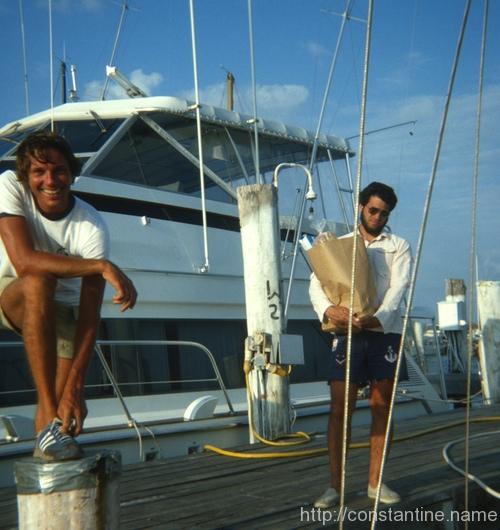
Way back in 1980, my dad arranged to help a friend (a navy buddy if I recall correctly) named Drew move his yacht from Cat Island (in the Bahamas) to Miami.
It was as much a vacation for us, as it was us helping Drew and his wife move their boat. We took a commercial flight to Nassau and spent a day or two there. From Nassau, we took this little charter plane to Cat Island… which is just a spit of sand with nothing on it other than a tiny “runway”. From there we sailed the 200+ miles to Miami.
To make the “crossing”, my dad and Drew had to stay up in shifts sailing through the night. Although it does take some attention to detail to navigate, the real concern is that the area is thick with commercial shipping and the “rule of gross tonnage” suggests it is unwise to assert right-of-way (any sailing vessel has the legal right-of-way over any powered vessel.) So we prudently dodged enormous ships who couldn’t see us (visually) and probably didn’t care even if they did notice us on radar (via Drew’s radar reflector.) Anyway.
Do I remember anything in particular? Absolutely. I remember staying up all night, on the open sea, in the pitch black. You couldn’t see your hand in front of your face… nothing but star-light. And the stars… The constellations looked to fall out of the sky onto your head.







ɕ