Sub-cockle area

So we set out to find a new hack. What followed was a sordid tale of noscript tags and dynamically injected base tags, of document.write and evalof rendering all of our page’s markup in a head element, to break preparsing altogether.

For some of you, the preceding lines will require no explanation, and for that you have my sincerest condolences. For everyone else: know that it was the stuff of scary developer campfire stories (or, I guess, scary GIF-of-a-campfire stories). Messy, hard-to-maintain hacks all the way down, relying entirely on undocumented, unreliable browser quirks.

~ Mat Marquis from, Responsive Images – A List Apart

slip:4uaiai9.

I don’t often laugh out lead reading geeky CSS techno-mumbo-jumbo. But when I do—and especially if it warms the cockles of my heart—you can be sure I’ll lovingly craft a blog post about it.

More seriously, if you’ve ever wondered how images are put into pages— What on Earth is wrong with you?! Why would you ever wonder about that?! Definitely do not click on that link above…

ɕ

P.S.: The title is a Denis Leary reference.

Fish

Give a man a fish and you feed him for a day;
teach a man to fish and you feed him for life.

Age-old aphorism, right?

The first point I want to make is that both options—giving and teaching—are not necessarily viable. If we’re in a desert, my giving you a[n edible] fish is helpful, while teaching you to fish is not; there’s an overriding resource constraint. This is a minor point which we’re all comfortable sweeping under the rug because that aphorism is screaming out that it’s far better to be teaching people to proverbially fish.

The second point is more serious: Things do not go well if you disagree on which is supposed to be happening. If I think we’re doing fishing lessons and you just want me to shut up and hand you a fish—that’s a recipe for, not broiled trout, but rather steamed people.

Anyway, no fish today—gone fishing.

ɕ


Splintering of the Internet

What is new is the increased splintering in the non-China Internet: the U.S. model is still the default for most of the world, but the European Union and India are increasingly pursuing their own paths.

~ Ben Thompson from, India, Jio, and the Four Internets – Stratechery by Ben Thompson

slip:4usaii1.

Sometimes my blog briefly turns into a technology blog—recall, this blog has a purpose; It’s a vehicle for my process of reflection. Boop! It’s a tech blog.

This terrifically clear overview of how the different Internets work together, and will be working together less in the future, is a must-read for anyone using the Internet. (Hint: That’s you.) We—ok, not me, but I bet you—don’t think about where exactly all the things we interact with are located. This article by Thompson will give you a basic picture. …literally, there’s like a crayon drawing at the end of it.

ɕ


Open Graph and oneboxing

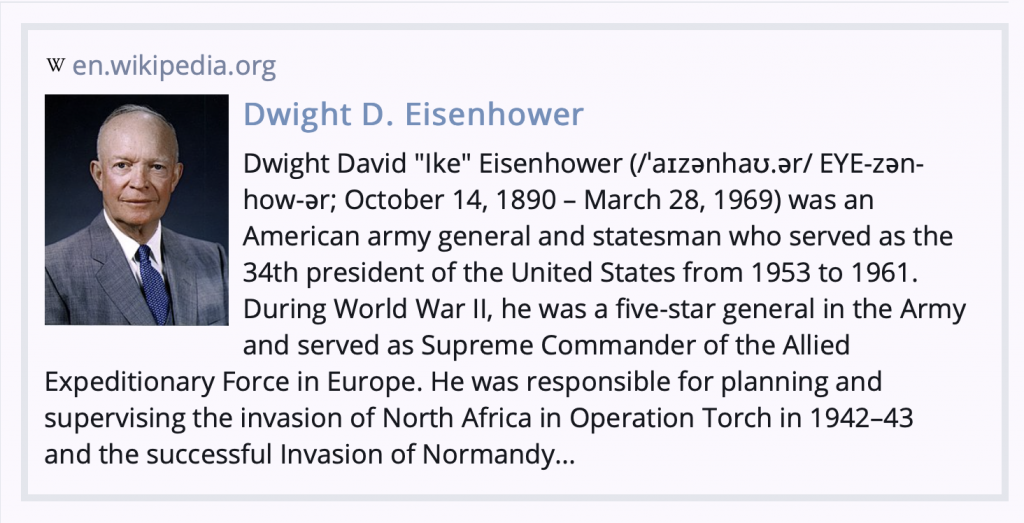
This is a standardized way to present a preview of a URL. Instead of just showing a URL, like this:

https://en.wikipedia.org/wiki/Dwight_D._Eisenhower

It can be presented as a “onebox,” like this:

That’s just a screenshot from a system which is able to do oneboxing. The magic is that when editing, (wherever you are editing,) you simply paste in a raw URL and the oneboxing is done automatically by the system.

What wizardry is this?

It’s based on the Open Graph Protocol (OG). Facebook started this as a way to get sites on the open web to provide software-understandable, summary information. It took off everywhere because it’s just downright awesome.

A web site includes information stuffed out of sight, in the source HTML of the page. Software can fetch the URL, notice the OG information and craft a meaningful summary. This grew into the idea of presenting a single box summary—”one boxing”—of a URL if it has OG information.

Testing it

When something doesn’t onebox as you expect, how would you figure out which end has the problem? (Was it the end serving the URL content that doesn’t have OG data? Or is the end fetching the URL that couldn’t parse the OG data?) So someone wrote a handy tool that lets you see what (if any) OG data there is at any URL you want to type in:

http://debug.iframely.com/

ɕ


The web is like water

There is no question that apps are here to stay, and are a superior interaction model for some uses. But the web is like water: it fills in all the gaps between things like gaming and social with exactly what any one particular user wants. And while we all might have a use for Facebook – simply because everyone is there – we all have different things that interest us when it comes to reading.

~ Ben Thompson from, Why the Web Still Matters – Stratechery by Ben Thompson

slip:4usawe1.

That’s from 2014, and holds up pretty well I think. That the web, “fills in all the gaps,” is insightful. Sure, the technology that defines “the Web” drives an enormous amount of stuff other than written content. But even just the smaller portion that is the written word is a huge swath of time and attention. That speaks well for us in the aggregate.

I still believe that the problem, currently, is simply that people rarely bother to figure out how things actually work. People don’t tinker and change things. Once someone gets the bug of curiosity, it’s a slippery slope from poking and prodding, to tinkering and experimenting, to building and creating; It’s a slippery slope lined entirely with reading.

ɕ


Interrupt driven

Think about this question for a moment. The Apollo program was massive in size and complexity. It was executed at an incredible pace (only eight years spanned Kennedy’s pledge to Armstrong’s steps) and it yielded innovations at a staggering rate.

And it was all done without e-mail.

~ Cal Newport from, How We Sent a Man to the Moon Without E-mail and Why it Matters Today – Cal Newport

slip:4ucabo5.

Not just without email, but without computers or networks or cell phones or even hand calculators. They did it with paper, drafting tools and slide rules. Meetings, planning, and most importantly:

Communication.

All these tools that I have are only useful if I understand how they work. When you first start working in some field, you get the most basic tools—two manual, screwdrivers; one straight-blade and one Philips head. When you can tell me why the Philips head was invented, you can have a hand driver with interchangeable driver heads (“bits.”) When you can use them all… When you see a screw-head and pick the right bit… When you’ve exhausted your forearm from driving screws, then you can have a power driver. When you use the friction clutch correctly, you can have a larger power driver. And so on. (You can tell the quality of the craftsman by the way they maintain their tools. Yes, skilled persons can do great work with shitty tools. But at mastery level, the art is expressed in the tools themselves. Yes, all arts.)

So yes, you really do need to understand the different between wifi, cellular and Ethernet; between Apple’s IM, carrier SMS, and WhatsApp; between email, Google Docs, and Word.

As Carl Sagan wrote, “We live in a society…

ɕ


Sound of thunder in the distance

I’ve written before about the sounds of summer thunderstorms. I’m completely trained to relax and drift away to these sounds.

It’s said there are three things you can stare at endlessly: running water, fire, and other people working. I believe the first two trigger something deep within our brains; I believe there’s something about the small, random movements of water and fire which hypnotize the predator part of our brains… something about those movements stimulates our visual cortex.

But sound! The auditory part of our brain is older still, and the sound of running water is—at least for me, how about you?—deeply alluring. I’ll sit under cover on my patio and freeze my ass off just to hear the rain falling and the sound of water in the gutters.

Anywho. What brings up this train of thought? …on a gloriously sunny and blue-skied day?

…”sounds of rain and thunder,” is a thing you can listen to on Pandora.

ɕ


An online advertising bubble?

The story that emerged from these conversations is about much more than just online advertising. It’s about a market of a quarter of a trillion dollars governed by irrationality. It’s about knowables, about how even the biggest data sets don’t always provide insight. It’s about organisations and why they are so hard to change. And it’s about us, and how easy we are to manipulate.

~ Jesse Frederik and Maurits Martijn, from The new dot com bubble is here

slip:4utete2.

For years I’ve been beating the drum about how we individually need to take control of how we use social networks and the Internet in general. There’s still time for us to turn away from the dystopian future where everything has become an algorithm optimized for profit for profit’s sake.

I’ve long known that we are individually fighting an uneven battle. The companies running the social networks are using technology and psychology to manipulate us via our basic human instincts and our basic human cognition. (Each of us, thanks to our biology, has big, ergonomic, grab-handles enabling others to manipulate us.) I think it’s possible that we can each practice using our rational minds and make good decisions; It’s possible, but all evidence shows it is not likely. Meanwhile, I continue to fight the good fight. Those of you reading, seem to be similarly interested.

This article planted a new idea in my mind: The dystopian future is made possible only because someone is paying. We, individually, are not paying. (Reminder: We are the product being sold to the advertisers.) Every single pixel on every single social network is powered by advertising revenue.

What happens if the companies paying to advertise online realize that advertising online doesn’t work the way they think it does?

Victory snatched from the jaws of defeat? …perhaps.

ɕ


If Lincoln had email

If the Internet is robbing us of our ability to sit and concentrate, without distraction, in a Lincoln log cabin style of intense focus, we must ask the obvious question: are we doomed to be a generation bereft of big ideas? Will we lose, over time, like some vestigial limb, our ability to focus on something difficult for extended stretches? As a graduate student, I’ve had to put in place what are, in essence, rigorous training programs to help pump up my attention span. It’s a huge struggle for me. Somehow, I imagine, if Lincoln was in my position, he wouldn’t be having this same problem.

~ Cal Newport from, Would Lincoln Have Become President If He Had E-Mail?

slip:4ucabo24.

I usually quote things I agree with whole-heartedly. This one is a little different. I like the topic Newport has raised and he brings up several good points, but my thinking differs a bit.

The Internet is only a tool. There’s nothing magical about how it works to change your brain, distract you, or [as I’m found of describing it] eat your face. The power of choice remains with each of us. What do we use the tool for? What things do we talk about? Whom do we associate with? What change are we creating?

The Internet is only a tool. Make what you will of that.

ɕ


Tis the season

I like paying for my software when I’m buying it from a company that’s responsive, fast and focused. I like being the customer (as opposed to a social network, where I’m the product). I spend most of my day working with tools that weren’t even in science fiction novels twenty-five years ago, and the money I spend on software is a bargain–doing this work without it is impossible.

~ Seth Godin from, On paying for software

slip:4useoa1.

Tis the season… to talk about paying for the things we get value from. Last year Seth wrote that great gem about software and I whole-heartedly agree.

Here’s a short list of a few pieces of software which I gleefully pay for, without which everything I do would be vastly more difficult or outright impossible: Hover, BBEdit, Hindenburg, Overcast, Reeder, Feedbin, Tower, Transmit, OmniFocus, OmniOutliner, iaWriter, Discourse, Basecamp and Front.

As a bonus round, here’s a short list of a few online services or publications which I also gleefully contribute to, because they provide me with magnificent information that makes my world a better place: Brain Pickings, Müvmag, PodNews, Once is Never, and WikiPedia.

My challenge to you for the holiday season: Post your own lists somewhere public, and share the love for the software and services that make your life better throughout the year!

ɕ