Ray Liotta died on May 26, 2022. I wasn’t a particular fan of his, but he was definitely an actor who was a significant part of the culture I grew up in. There are many such people; actors of course, and also authors, musicians, journalists, teachers, scientists, politicians, military leaders, activists, and others less classifiable.
It’s one thing to think: That huge band that I love, which I’ve seen in concert… they’ve retired and hung up the act. Just knowing the people are still around however, means that something of, whatever it was that I loved, continues on in whatever it is, (public or not,) that they’re doing. Nostalgia rises up as people retire and things become, “remember when?”
But slowly, year by year, those people die and that makes it clear: Everything has its time, and that time ends. There but for the grace of God go I, is a beautiful turn of phrase.
This sudden loss has gotten me to face my own death this week. I know it is coming, just not when. I rarely think about it, because life is so in-my-face, but it’s there, waiting. Tyler’s death is such a stark reminder that we never know how much time we have left.
There are exactly two things about my life of which I am certain. I was born, and I will die. I spend a lot of time contemplating my end; Not in a fatalistic, “come at me bro’!” way, but rather with the intention of reminding myself to make the most out of every moment.
There are many moments where I’m unconscious—quite a few of those moments are while I’m sleeping, but also there are mindless moments aplenty throughout my days. But there are increasingly more mindful moments every day.
An extremely fast way to get to mindfulness—this is the fastest way I’ve found so far—is to think: This may well be the last time I do this. The last walk. The last boulder I scramble upon. The last conversation with this person. The last conversation ever. The last word I type. The last sentence I jauntily scribble with a pen. The last time I drive a car. The last time I ride a bicycle. The last time I wrench my back shoveling snow. The last time something scares the crap out of me. The last time I laugh until I lose control of my bladder. The last time I’m stuck as part of the traffic. The last time I’m part of the solution. The last time I’m the source of the problem. The last time I smash the hell out of my toe on something.
In every one of those cases, I can now enjoy it… if I can manage to remember: This could be the last time I get to experience this.
I’ve even decided that if I can manage it, my last words will be: “Well, if that wasn’t nice, I don’t know what is.” (And just maybe with a literal hat tip to Vonnegut.)
As the Island of Knowledge grows, so do the shores of our ignorance—the boundary between the known and unknown. Learning more about the world doesn’t lead to a point closer to a final destination—whose existence is nothing but a hopeful assumption anyways—but to more questions and mysteries. The more we know, the more exposed we are to our ignorance, and the more we know to ask.
It feels as if everything I know is fractal! Things are complicated by the fact that everything I discover, read, and learn creates a network of connections in my knowledge. I’m always trying to get enough perspective to see where that network is inbred; I’m always looking for ways to break out of my knowledge bubble. But sometimes, the knowledge bubble can be used to make manageable a task that would otherwise be impossibly large.
Consider the writings of Lucius Annaeus Seneca, known as Seneca the Younger, or most often just written as Seneca. Even just his series of letters to a student make for a 500 page tome. Worse, there are notes, references and multiple very different translations into English. As an example of the complexity, consider these translations of a small excerpt from letter 42. (There are 124 letters plus some additional fragments.)
So, concerning the things we pursue, and for which we vigorously exert ourselves, we owe this consideration—either there is nothing useful in them, or most aren’t useful. Some of them are superfluous, while others aren’t worth that much. But we don’t discern this and see them as free, when they cost us dearly.
~ Holiday and Hanselman from, The Daily Stoic, p75.
If I’m correctly understanding their notes, that’s their translation from the original Greek and Latin texts. I find this translation frequently on the Internet, sometimes crediting those authors/that book, and sometimes crediting, Seneca, Moral Letters, 42.6.
Next, this is from Richard Mott Gummere. My limited digging suggests his original work was published in 1917. I’m guessing it went out of copyright in 2017, because it’s pretty easy to find it entirely republished. (Search for “Seneca Richard Mott Gummere”.) The copy I have is a crappy version from Barnes and Noble. (It’s as if they printed the book at 50% oppactiy.) Gummere titled letter 42, “On Values.” (Seneca did not title them, he simply wrote letter after letter after letter to his student.)
Therefore, with regard to the objects which we pursue, and for which we strive with great effort, we should note this truth; either there is nothing desirable in them, or the undesirable is preponderant. Some objects are superfluous; others are not worth the price we pay for them. But we do not see this clearly, and we regard things as free gifts when they really cost us very dear.
~ Seneca, 42.6, translated by Richard Mott Gummere
Finally, here’s the rendering from a very new publication from Chicago Press, which—again if I’m interpreting things correctly—takes as its primary sources translations from 9 different authors, (including Gummere,) published between 1914 and 2010. The same section is presented with letter 42 titled in the Table of Contents as, “Good People are Rare.” (But the letters in the body of the text are not presented with their titles—recall, Seneca didn’t title them.) Interestingly, I cannot find the following text anywhere on the Internet, the book only having been published in 2015 may be the reason.
This indeed is a point we should keep in view. Those things we compete for—the things to which we devote so much effort—offer us either no advantage, or greater disadvantage. Some are superfluities; others are not worth the trouble, but we don’t realize it. We think things come for free, when in fact their price is very steep.
~ Seneca, 42.6, and translated by Margaret Graver and A.A. Long
As the length of this blog post attests: What starts simply as, “I’d like to read some of Seneca’s writing,” quickly gets complicated. Frankly, it gets impossibly complicated. Impossible as in: Never mind, I don’t have time for this. But I do want to read some of Seneca’s writing. (I have already read many of his letters.)
So my current plan is to use my collection of Seneca quotes to choose which letters to read again and more thoroughly. Thanks to the Internet, I can find the source letter given a snippette of text. Then I can enjoy the letter using my exquisite University of Chicago Press translation, which is magnificently annotated.
I’ve recently made a startling discovery: Maybe there really isa tulpa in my head.
First, I’ve said for many years that my brain is broken. (Yes, I am aware I have terrible self-talk.) Here’s why I call it broken: I am literally unable to NOT see problems. I notice an endless onslaught of things that, in my opinion, could be improved. I don’t mean, “that sucks, I wish it could be better.” No, I mean, “that sucks and it’s obvious this way would be better and if you’d just let me get started . . . ” Adderall might help, I suppose.
Everyone loves that I get stuff done, and try to make things better. But unless you have this same problem, I’d imagine it’s hard to understand how this is debilitating. I am aware that this is recursive—I see my own brain as a broken process that I feel I should repair. All I can say is that you should be happy, and thank your fave diety if that’s your thing, that you don’t understand. Because to understand is to have the problem, and you do. not. want. this. problem.
Second, I’ve also said for many years that, “the remainder cannot go into the computer.” I’m referring to a endless source of struggle in programming and systems administration; Computers are exact, and the real world—with its real people, real problems, and things which really are subjective shades of gray—is not. So programmers and systems administrators factor, in the mathematical sense of finding factors which when multiplied give you the original, reality into the computers. And when factoring reality, there is always a remainder. That remainder shows up when you find your software does something weird. That could be a mistake, but I tell you from experience, it is more often some edge case. Some people had to make choices when they factored.
The result of that second point is that I’ve spent the majority of my life factoring, (and “normalizing” for your math geeks who know about vector spaces,) problems into computers. And then trying to live with the remainders that didn’t go into the computer. The remainders are all in my head. Or on post-it notes on my wall, (back in the day.) Or the remainder is some scheduled item reminding me to check the Foobazzle process to ensure the comboflux has not gone frobnitz. To do that I had to intentionally be pragmatic and logical. And the really scary part is I also learned that the best way to do all of that was to talk to myself—sometimes literally, bat-shit crazy, out loud, but usually very loudly inside my own mind—to discover the smallest, least-worst, remainder that I could manage to live with.
What if those two things were sufficient to create a Tulpa. (I am serious.)
I think there’s a Tulpa in here! (My title is the sign on the front gate.) It is absolutely pragmatic. It knows an alarming amount of detail about things I’ve built, (or maintained, or fixed.) It is cold and calculating. It is terrified that it will forget about one of those details, 2347 will happen, and everyone will run out of ammunition defending their canned goods from the roaming bands of marauders. I definitely don’t “have” the Tulpa. It’s more like discovering there’s an extra person living in your house. Although, I don’t hold hope of banishing this Tulpa, Yoda does make a good point if I’m going to try. So, I should definitely give it a name.
Maybe, Sark?
That is an intriguing idea indeed! Sark, what do you think?
I was leisurely tinkering my way through my morning, and my mind kicked out a few ideas. It always does that. Yes, I talk about my mind in the third person, because sometimes I think I have a Tulpa.
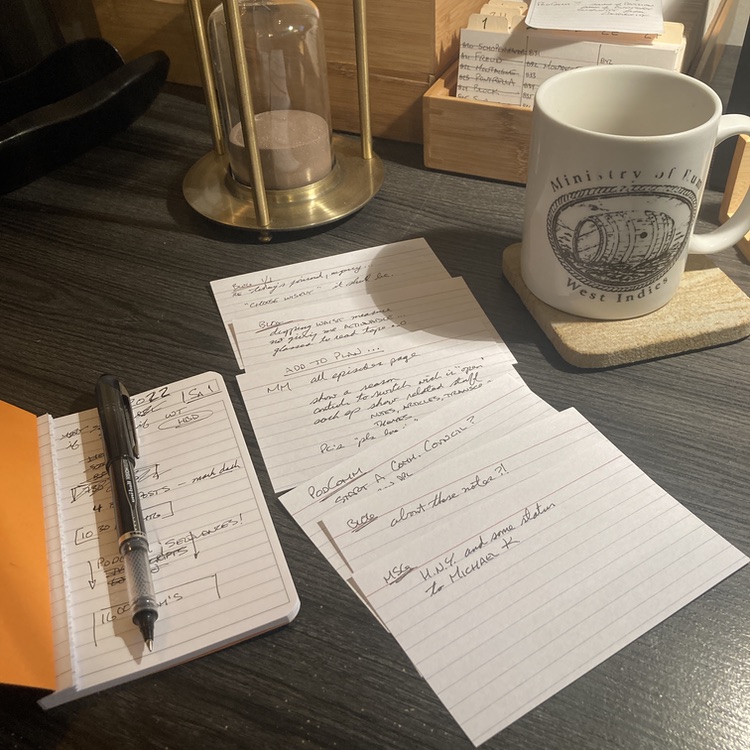
The first idea that popped up was about sending a message to someone to wish them a Happy New Year. At the time, I had not yet awakened the sleeping dragon—my computer. (I could say: My personal Eye of Sauron was still closed.) Things change for me once I awaken the dragon each day. But I have this idea to send a message, and it’s important, but I don’t dare awaken the dragon to ask if I can just send this one quick message. I’ll look up again and it’ll be 4 in the afternoon. Instead, I grabbed one of my precious slips and jotted a note.
Holding the slip I realized this was brilliant. I recently bought a brick of 1,000 3×5 cards because the slipbox is voracious. I have plenty of these little slips. So why hadn’t I done this for the past year that I’ve been keeping a slipbox? Why did it happen for the first time today? It happened because I used to see the slips as precious; They were nice, heavy, beautiful 3×5 cards that sit close at hand and are supposedly waiting to become immortal slips in the slipbox. Just the other day, I used the last one of my original stash, and I broke open that new brick… and realized I’d bought cheap-ass crappy Amazon knock-off 3×5 cards. (I had only spent $13 for 1,000 so I wasn’t too upset.) When that idea to send a message popped into my brain, I thought: “well, I have 1,000 crappy slips to use up . . .” and this little queue of individual ideas quickly appeared on my desk.
No, the coffee mug does not currently contain rum.
The lesson I re-learned this morning is that even a slight change of context can have an outsized affect on something. (In this case, my “precious” slips [you’re hearing Gollum aren’t you?] had become “crappy” slips.)
Setting aside what you think of my specific anecdote here, where might you make a small change and discover some surprising benefit?
…when the goal isn’t to end up with a pile of notes?
There are many scenarios where, over time, I do want to end up with a collection of notes. This is straight forward; start taking notes, and keep them somewhere. Bonus points if you review them, or use them as reference, or do anything with them.
But what if I have a scenario where I want to “do a better job” but I don’t care at all about the notes themselves. Suppose you have a regularly scheduled recurring meeting, but you don’t need a historical collection of notes. In fact, suppose you don’t actually need notes, but you think: It would be nice to know what we did last time, so we can follow-up next time.
And so I’m thinking this would be easy. I’ll just have a pile of notes (physical, digital, whatever) and I’ll go through them and … wait, what, actually? Recopy them? gag, that’s tedious. How many do I keep? How long do I keep the old ones? Here’s what I came up with…
I’m working in a single digital document. I have a heading, “Ongoing,” at the top that has the big things we currently have on our radar. The list has some dates with notes; “Oct 2020 — started that big project” and similar things.
Next I have a heading, “Jan 5, 2022” with the date of our next scheduled meeting. When that meeting arrives, I start by doing something very weird: I add “9876543210” on the line below the heading. Then I take simple bullet-point notes under that heading. “We discussed the foo bazzle widget needs defranishizing,” and similar items. Before our meeting ends, I add a heading for the date of the NEXT meeting, ABOVE this meeting’s heading. This pushes the heading and notes down the page a bit.
Then I continue reading. The heading just below this meeting’s, is the date of our last meeting. Just below the heading is “9876543210”, which I put there when we had that meeting. I delete the “9” from the front. I read my notes from the meeting. I may even edit them. Sometimes things that were obvious then, don’t seem so obvious a week later.
Then I continue reading. The next heading is the one from two meetings ago. Just below it is “876543210” — think about that, if it’s not obvious that last week, I read this part and already removed the “9”. So this week, I remove the “8.” Read the notes.
I work my way down each of the historical dates. Snipping a lead number, off the front of the line after each heading. 7. 6. 5. etc.
At the very end of the document, I find a heading that is from 11 meetings ago. Below the heading is “0” — because I’ve looked at these notes 9, 8, 7, 6, etc deleting a digit each time. These notes are now quite old. In fact, they should be irrelevant after 11 meetings. If they are not, I figure out what I have to add to “Ongoing” (the very topmost heading)… or perhaps I put a note under the coming meetings heading (just below “Ongoing”.)
It sounds wonky, but it’s magic. One digital document, you can skim the entire thing right in any of the meetings. You can search in the document. I can be sure I’m not forgetting things, but I can be sure I’m not making a huge collection of crap I’m never going to look at again.
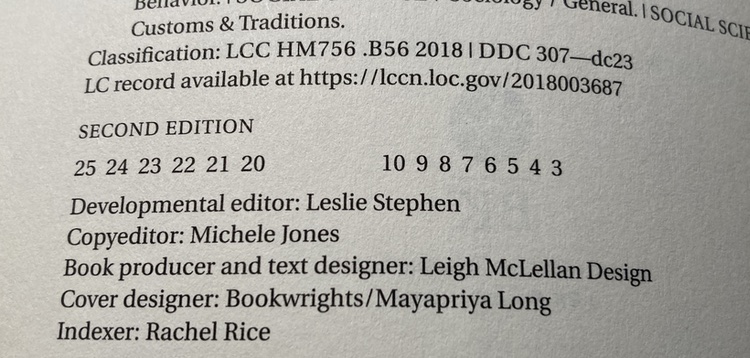
Care to guess where that delete-a-digit each time comes from? It’s an idea from book printing. When they used to set type (physical lead type in trays) they would put “1 2 3 4 5 6 7 8 9 10” (or other orderings of the numbers) in the cover plate. Then print the book. What printing? This one is “1” Next printing? …they’d just chip off the “1” and print “2 3 4 5…” in the book… second printing. They still print those weird sequences of digits in digitally printed books. I believe this one is a second edition, 3rd printing…
As always, I continue my project of self-improvement. I’ve long been aware that I take on too much— and yet, all efforts to “take on less” only seem to lessen the problem; Like pulling Dandelion weeds but not getting the entire root out. I’ve made an insane effort in countless ways over several decades to make progress towards “take on less.” I’ve long known there must be something underlying.
I love to use a tool I refer to as a “wedge”, to affect changes by altering the normal sequence of things. A wedge can be used to create a space for consideration, to divert my thinking, or to initiate (or change) an activity. It works because the presence of the wedge alters the mental context. My mind proceeds from idea to idea, with an evolving context for that thinking. As the context changes, it constrains—or maybe, “helps select” is a better description—what ideas are going to come to the fore of my mind next. Trains of thought develop this way. The inserted wedge causes, (if it’s done right,) enough of a shift in my mental context.
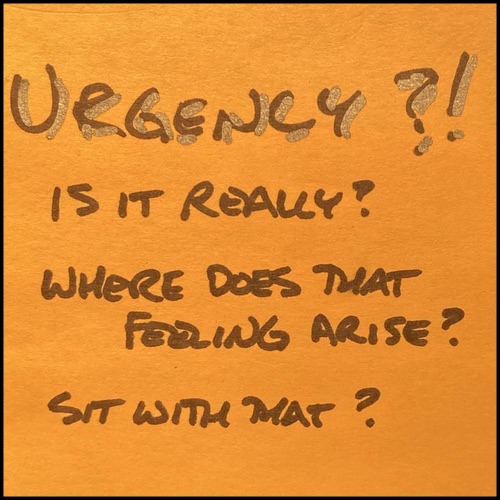
It’s really difficult to have the wedge be a thought. But orange sticky notes work well. (Until you no longer notice them, of course.)
The action of this wedge is to make me think about why I’m about to do this next thing that feels so urgent.
“Is it really [urgent]?” …like, how a smoke detector sounding off is urgent? Okay, so it’s not that urgent.
“Where does that feeling [of urgency] arise?”
And that is where my train of thought shifts. (So far it has been every time I’ve felt urgency to do something.) Because the feeling comes from my desire for control; There are countless examples. That explains why I’m forever taking on too much.
“Sit with that?” Sit with that realization that the urgency is a reaction to a desire for control. Sit with the knowledge that every attempt at control—all types, all sizes, all shapes, all degrees… attempted control of anything external—has never ended well for me.
Despite having been published in 1910, Arnold Bennett’s book How to Live on 24 Hours a Day remains a valuable resource on living a meaningful life within the constraints of time. In the book, Bennett addresses one of our oldest questions: how can we make the best use of our lives? How can we make the best use of our time?
I’ve mentioned Arnold Bennett before, and my opinion remains the same: How to Live on 24 Hours a Day, is a delightful little read. Although this post from Parrish isn’t where I first heard of the book, it remains a terrific summary. If you’ve ever thought, “I wish I could find time to…” you should read Bennett’s thoughts.
Conflicting opinions. Confusing data. Unexpected developments. Interpersonal conflict. We sometimes miss the bliss of the vision and despair. I’m not sure I can do this. You respond immediately, “It seems an impossible thing. Of course it’s hard, but we are going to do this together and I’ll explain how.”
There’s an array of skills that a leader has to master to be a good leader. Explaining things is one of those skills. Everyone who knows me even slightly, knows I’m great at explaining things. But as I try to lead more, I’m realizing that no, actually I’m a mediocre—possibly even a poor—explainer. I’ve recently realized that vastly too much of my explanations are about attempting to control other people’s reactions, (or their opinions,) to what I’m suggesting.
“Take this jacket. It’s lightweight, water proof and will keep you dry if we encounter rain. And rain is likely on the mountain we’re setting out to climb. I once went without such a jacket, and I wound up wet and miserable. The color also happens to be one you normally like, and it looks good. It’s got lots of pockets, which are all taped and the design of the flaps keeps water out.” (Alas, a decade ago, that explanation would have also unpacked what “taped” means, and why it’s a desirable feature.)
But that’s way too much information, all intended to convince the listener. It’s a sign of attempted consensus building. It’s all hedging. It’s all me sharing the reasons why you too would make the same decision—to bring this jacket—if you too had all the information and perspective that I have.
A real leader would say, “This is the correct jacket to take, considering the weather we are going to face when we climb that mountain.” Because then, if it turns out it is in fact not the correct jacket, then I’m on the hook for that error. Which is exactly where—on the hook that is—a true leader should be.
I’m a child of the vinyl album era. We had a collection—about 5 feet of shelf space—of classic rock, some jazz, the usual suspects collected during the 60s, 70s and into the 80s. There was sublime magic in that vinyl. My dad wasn’t an audiophile per se, but he had a few nice things that comprised the stereo system, and the crown jewel was a Marantz turn-table. We had special soft-cloth cylinders for gently lifting dust off the surfaces. We even had a little space-ray-gun-looking thing that [as far as I recall] neutralized static charge on the vinyl, (which apparently can accumulate when you pull them out of their sleeves.) A classic Pioneer amp… at one point he found someone who rebuilt his speakers for him—repair rather than replace was, at one time, the norm in America. There was a dedicated cabinet for the gear, with a built-in power strip, and lighting…
And the CD was invented while I was a kid. We—society at large—had endless arguments about sound. I even did a high-school presentation about how CDs actually work to encode the sound digitally, and how that encoding uses compression, and how quality is lost… and I bought more and more CDs. I skipped right over collecting cassette tapes; I made countless of my own from albums and CDs, but I don’t believe I ever bought a single one. The Sony Walkman was the driver for my recording cassettes. Then the portable CD players arrived and all hell broke loose. I only purchased a handful of vinyl albums and I never ever set up the Marantz after my dad died. (I passed it to my cousin who did get into collecting vinyl as a kid. I made him promise to spin the helll out of it, and play music loud— damn loud.) And my CD collection grew to thousands. Then I mixed in my dad’s extensive CD collection which had almost zero overlap with mine. My stereo? I keep a scary-old little AirPort Express plugged in, with a cheap-ass set of “computer” speakers, with a woofer, plugged into the AirPort’s 3.5mm headphone jack.
This morning… “I think some Mozart would be nice.” Click, click… and click… and Symphony no. 39, recorded in 1977 by the Berlin Philharmonic Orchestra streams from the little stereo. Rather loudly I might add.