§7 – Lemons

This entry is part 19 of 37 in the series Study inspired by Pakour & Art du Déplacement by V. Thibault

“Lemons” simply reminds us that sometimes we need to make lemonade from whatever lemons we find before us.

I am acutely aware of this aspect of Parkour; This searching what is right in front of me for something to do. Initially I felt like a one trick pony. Every time I’d be faced with some little area, I’d stare at it thinking, “I can only do, literally, a step vault. What am I going to do here?!” Yet somehow, I manage to force myself to stand in the face of my ineptitude and to search for inspiration.

Eventually I came up with a sort of “wedge” for the problem. I would seize on, literally, the first thing I could think of. Often that would be something even I felt was ludicrous. But this first ludicrous movement, got me moving. (That’s the wedge.) From there, I invariably saw something else.

Usually the second thing was also ludicrous, but sometimes it was better (whatever “better” might mean to me at the time). So I’d change to doing the second thing. I’d throw my shame and ego to the wind and start doing repitions of whatever that first ludicrous thing was, then the second thing if it was better, and so on. Sometimes, I could only see a single thing which I feared, and so I’d start with ludicrously simple progressions to the thing I feared.

In my mind, I called this “busting rocks”. Pick the biggest, ludicrous rock and smash it. Pick the next biggest rock, and so on. As I smashed, I’d remind myself of something I’d written years ago: “Parkour is the grueling work of self destruction.”

One day, I participated in the most surreal jam session. On a sign. It was just a slightly sloped, big flat sign with a map on it and four skinny legs into the ground. One person did something near it, “interesting,” I thought. Then a second person did a little sliding thing across it. And I thought, “I wish I could do something on there.” And the wedge happened automatically and I thought, “I can try this ludicrous move.” And I tried it, and someone said, “Craig, what are you doing?”. And I failed. And someone else said, “OH! That’s totally a thing!” And in the blink of an eye a dozen world-class traceurs — people whose abilities all boggle my mind — LINED UP to play on this little sign. And for what seemed like eternity, we all took turns trying crazy stuff on a sign, at night, in a busy public square. And passers-by stopped and some even applauded or cheered. And we all ate ice cream and drank milk-shakes as we waited our turn and pondered our next go. And I for one wanted it to never end.

It was the greatest lemon pie I have ever tasted.

ɕ


Ocean’s Gate NJ

Much movement later, I’m sure. …but first some “lion time”

ɕ


5,000

This entry is part 28 of 36 in the series 10,000 Reps Project

5,000. five thousand. FIVE. THOUSAND!!!

So excited to be half way through the numbers of my year-long project. I have about 110 days remaining to do the second 5,000 reps of all the activities. But at this point, it is now possible to do 120 reps (pull-ups being the limiting activity) in a single workout. Granted, that workout takes about two hours but it means it is finally possible to warm up, get started, and get it done.

Last week was a lot of random-seeming numbers of pull-ups just shoved into every day. That took a real toll on my arms. So I was particularly careful about getting back on the pull-up bar.

But first…

5,000 bar precisions…

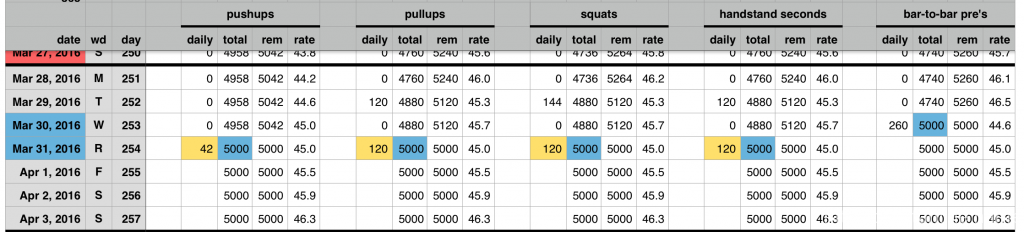
This seems inconceivable to me. I remember starting all of this…. and now? Well, here’s the worksheet from the last workout on bar precisions:

Screen Shot 2016-04-02 at 10.59.06 AM

I did 260 bar precisions (I still have the bars set at 64″ like in the video I recently posted). This seems like an insane number when you step up on the bar. But I start counting to 26, then make a mark in my little book… and then do that 9 more times. It is VERY difficult to stay focused for the entire time. I mean, REALLY REALLY difficult. I don’t see how I can fully convey the experience here (in a quick update), so I’ll leave it at that. I’d love to talk about it some time… so chat me up. :)

Meanwhile, I had planned to do the magical 5,000 milepost workout of the other activities on the following day (Thursday, in the screen grab above.) I headed to the bar, did a bunch of range-of-motion movements, some joint rotations, etc. Then tried a pull-up and OW! …not happening. Normally, the FIRST pull-up always sucks, but on Thursday I felt discretion was warranted. I mustered a LOT of courage and pushed the workout back until my arms felt better. (ie, so it didn’t feel as if they were going to be ripped off my torso at the same time my forearms exploded.)

5,000 pullups!

…also, 5,000 pushups! 5,000 seconds in handstand! 5,000 body-weight squats!

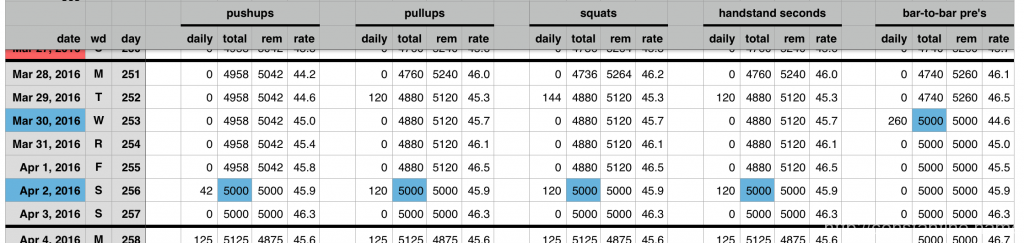
Saturday morning, it was conveniently raining (delaying our plans to tackle yard-work) and I decided to get at it. I warmed up and spent just over 2 hours trying to stick to a ten-minute circuit combining pull-ups, squats, handstand, sitting in a resting squat position (another of my projects is to get a full resting squat). Note the screwball “42” pushups in this workout; That’s just a result of a recent push-up challenge I was doing with some friends where I banked a pile of pushups, so in this workout I can just coast to 5,000.

Screen Shot 2016-04-02 at 11.01.16 AM

There it is. April 2nd… 5,000 across the board.

Next week…

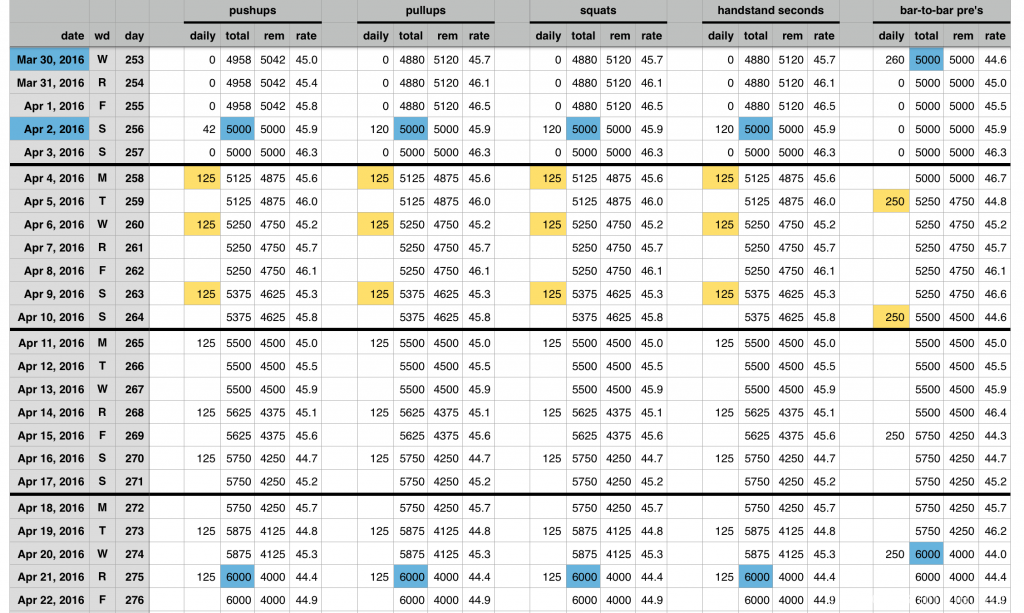
I’m going to tweak the circuit just a bit so I can get 125 reps into a workout. At that rate, I have this miraculous spreadsheet projection, where one thousand reps happens in just 8 workouts. boo-YEAH!

…assuming of course I can manage to follow through on this ambitious pace:

Screen Shot 2016-04-02 at 11.03.08 AM

ɕ


Decorating Easter eggs

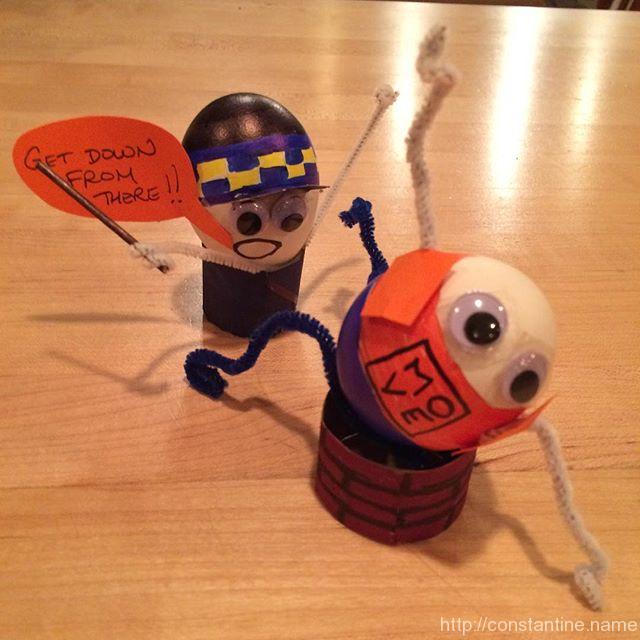
Family egg decorating contest; Suddenly inspired to imagine @zepvalue @themovementcreative visiting the famous Vauxhall walls!

ɕ


Working on controlled precisions

This entry is part 44 of 72 in the series My Journey

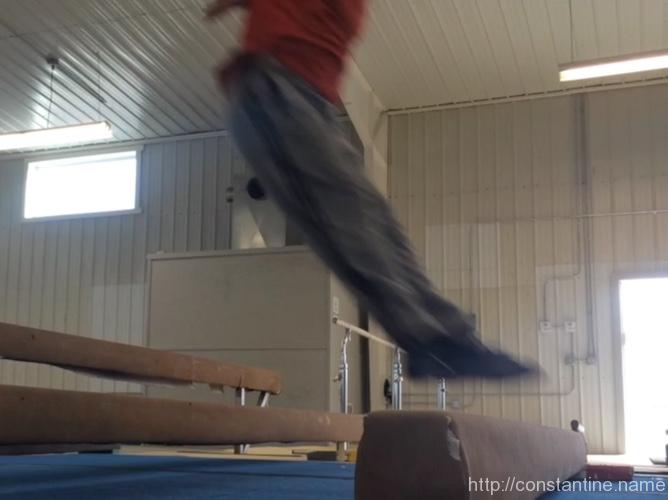
Fun with controlled precisions: I finally got around letting the camera run while repeating a jump. Here’s two that I was working on yesterday. These were just a wee bit odd for me to sort out. This is the aspect of indoor gyms that I love; being able to set up something very specific. This was taken at Innate Movement Parkour -Kingston, NY.

ɕ


Crash, burn, reboot

This entry is part 20 of 36 in the series 10,000 Reps Project

Workout catchup…

…ok, so yes, I’ve been sick, but I’m still a slacker. This past week, I went to the doctor and got some good cough medicine to improve my sleep. Friday I was feeling better and coughing less, so I talked myself into going out and trying to finish the 30-reps, second-half of the workout I had split in half the previous week. So I got that done, but, ….brrrrrrrrr CHILLY!

Bar-precisions…

This is challenging again. My latest scaf setup has higher bottom bars. Used to be about 4 inches off the floor — scary as hell when you start out, but at the low height, it’s nearly impossible to hurt yourself if you slip long or short. New setup has the bars about a foot high, so this is again SCA-RY when you slip or don’t have your feet where you want them. Also, the current setup makes the bars rock-solid. So the old setup you could pre-load the bar flex just before jumping and then the landing bar is nice with just a bit of flex. Now, if you don’t do the legs correctly on the landing, it’s a bone-jarring bang when you land. Anyway, just yakking about an exercise that I’ve tweaked just a bit and is suddenly a fresh challenge.

Squats…

Hip ROM is one of my current “projects”. I’ve been working (desk-type work) on the floor in my living room using my coffee table as a desk. It’s like japanese-style living :P I’ve a couple yoga blocks to sit on as a starter-crutch and I cycle through cross-legged, one-straight, seiza, etc to work on hip ROM/flexibility. I usually run a 15 minute or so timer as I work and then shift to a couple of minutes of working on a flat foot squat. So doing body-weight squats is ever-so-slightly easier. I can take a bit-wider-than-shoulder stance and do a full squat to seated, but up into multiple sets numbers it starts to feel tight in the knees and then I let my heels unload… I’m thinking going forward I should keep the heels planted and just not squat all the way down. (Would also increase the difficulty on the descent as I’d have to do more negative work to stop before the movement limit. Probably also a good thing.) As soon as I unload the heels (even the slightest) I can feel that I’m no longer pushing the hip/ankle ROM like I could be. So I think just stopping before the last few inches of squat depth would yield more results in hip ROM. I can take a *wider* stance, but then it seems the knee pull/torque comes to my attention *sooner*.

Pullups…

These are definitely a “can do” exercise now. Getting better velocity/acceleration from the dead hang, and the consistency of height, and height in general are slowly improving. (I don’t dead hang most of them — I prefer to run up and down with the shoulders/lats remaining activated at the bottom.) I’m convinced the next step in my progression is to shave off a bit more dead weight. There’s 5, maybe even 10, pounds I can easily drop just by paying attention to carbs. So I’m off to try and get that in the coming weeks.

Related, two weekends ago I did my first ever “climb up” in perfect form. Basically, a fingers-over-top wall grab, feet on the wall, arms fully extended, pull up to max height and with the last of the momentum, hop your hands up on top of the wall, so the heel of you hand can bear weight. Haul your chest forward (low) over the top of the wall so you center-gravity moves into where you can push up through the dip part of the lift. Never managed the fluid hand transition before as a continuation of the pulling movement. It’s crazy difficult; the transition of hands is pretty easy, but if you do it and end up too low, you’re not able to tricep-push your way out of the dip (because the wall is in your way in front of you) …can make for a smash-your-chin/face train wreck if you mess it up. ANYWAY, my point is, pullups are really paying off in some of the functional movements that have been on my list for years. The grip-strength gains alone are crazy-useful.

Now for the problem: My right forearm is no longer sore/aching in general. Before this two-week-ish sick break, I could make the muscles ache just by making a fist and flexing my wrist pinky-side. That’s healed/gone away. But as soon as I start pullups, that exact muscle/area complains. I did 6×5 on Friday and it was a consistent “you better cut that out”. So again, losing a few pounds would help.

But my workouts require getting 70+ pullups in to make the 10k goal. I have the general strength/stamina to do it in an hour-ish workout, but it’s going to trash that right forearm if I go at it. So I’m going to experiment with a few things: 1) Banking pullups indoors; I have a smaller sized bar indoors versus the 1-1/4″ scaf pipe outside that is way harder to grip. So doing 5 or 10 reps, a few times through the day will allow me to vastly reduce the pullup reps when I do the “main” workouts. (Bonus, reduces how much I have to take my gloves off to do pullups outside… fr-fr-fr-fr-icking cold scaf pipes!) 2) Changing the grip; perhaps switch to the easier chin-up grip on one side. I’m not sure if its better to switch the right grip to not aggravate the muscles, or switch the left grip so I can do more work on the left to lessen the load on the right. I’ll also try removing pinky finger from the right grip since that corresponding side of the forearm muscle is the part that complains. 3) shift the hanging position (eg slight archers) to just load the left side more.

So, lots of work remains with pullups.

Worksheet/workouts…

Snapshot attached with usual-looking plans for next week. Bearing in mind that for the pullups, I’ll be working on banking reps in the day(s) before each workout.

Screen Shot 2016-02-13 at 11.45.08 AM

ɕ


§4 – Close the gap

This entry is part 12 of 37 in the series Study inspired by Pakour & Art du Déplacement by V. Thibault

“What would the greatest version of myself do?”

I can think of no better personal compass than that simple question. I whole-heartedly agree with its sentiment; that exploring your own concept of “greatness” is the single most important thing you can do. Each of us will come to a different answer; potentially very different answers. But, the act of honestly exploring your own conceptions, and the act of self reflection, are what will move you in a positive direction.

I had already begun embracing this idea of seeking the greatest version of myself. As part of that effort, I took up a personal Oath which clearly reflects the idea.

What is Parkour?

Thibault’s section 4 is about seeking personal greatness and striving to constantly improve. That’s clearly a “big picture” goal involving one’s entire self. But we can also use this idea of “closing the gap” to investigate our every-day description of what Parkour is.

When asked, many people say that Parkour is about “efficiency”. They say that Parkour is about “moving efficiently” or “getting from A to B efficiently.” (“Quickly” is also used.) Alternatively, there are many people who dislike the “efficiency” description. Some prefer “personal expression through movement”, “pushing the boundaries of human movement”, or even simply “freedom”. There are many alternatives to the “efficiency” description, but it is undoubtedly one of the most dominant descriptions.

Where did I stand before reading this section?

If you practice Parkour, you will be asked (and often!), “What is Parkour?” I realized I would do well to have a one-sentence answer to that question. I’ve found that people are pleasantly surprised when I have a clear, one-sentence answer. Almost everyone asks further questions and a conversation about Parkour grows naturally from there.

My one-sentence answer is: Parkour is using challenges to improve oneself.

And now?

When I read Thibault’s section 4, it struck me that Parkour is exactly about “getting from point A to point B as efficiently and quickly as possible.”

Point “A” is here; the me of today.

Point “B” is there; the me of tomorrow.

ɕ


Alternative paths

This entry is part 8 of 37 in the series Study inspired by Pakour & Art du Déplacement by V. Thibault

Post class thoughts? Not many. Class is usually pretty visceral, (as one would expect,) and there’s not much time for an internal dialog of philosophical thinking. There were of course various opportunities to come up with relatively creative solutions to physical movements and challenges. But nothing particularly interesting in the context of this discussion. I think the primary reason this “alternate paths” section didn’t stand out in class was that everyone there already thinks this way. Almost everyone in class is already applying this section’s ideas — at least applying it in the physical context.

And so, I hadn’t bothered to put up a “nothing to report” report. Until I happened to read:

As you begin to learn something, notice when you feel frustrated with sucking. It might be really difficult, confusing, full of failure. You’re out of your comfort zone, and you want to go back into it.

Now turn to this feeling of frustration, or whatever difficult feeling you’re having: confusion, impatience, boredom, feeling bad about yourself, wanting to quit.

Turn to the feeling, and instead of trying to stop it or avoid it … try sitting with it (or running with it). Just be there with it. Let it be in you, give it space.

~ Leo Babauta, from The Gentle Art of Trying Something & Sucking at It – Zen Habits Website

slip:4uzesu2.

I’m pulling disparate threads together here of course. But this is the feeling! I look at something really sketchy, challenging or downright scary, and my mind flees to the easy path. Took a lot of work to get my body to NOT flee to the easy path, which eventually gave my mind a bit of time to look at the “I don’t think so…” path and give it some consideration. In hindsight, I think it’s what Babauta describes so succinctly.

So, uh, yeah. What Thibault said. And also what Babauta said. :*)

ɕ


A student of Art du Déplacement

This entry is part 22 of 72 in the series My Journey

Art du Déplacement, (a French phrase meaning ‘art of movement’,) is a method of improving oneself through challenge. The founders say that to practice the art means to work toward: Being mentally and physically strong; being useful; being a positive contribution to your community; being better than you were yesterday.

But what about competition, flips, stunts, jumping roof gaps and gymnastics tumbling? …are those things part of it? Certainly, some people do those things as part of their practice. Competition can make you physically stronger. Jumping roof gaps can make you mentally tougher. So these things can be part of your practice, but your practice does not have to be these things.

For me, swallowing my pride and starting over in physical fitness with a group of people about half my age… That was a challenge. For me, pull-ups are a challenge. But that’s the whole point. It’s is about me improving me, and you improving you.

But I didn’t know that when I first tried Parkour, (before I understood the Art du Déplacement roots of what I was learning,) in the spring of 2012. I had met Adam McClellan during a martial arts demonstration and he talked me into coming out to play with the growing Lehigh Valley Parkour community. I am continuously delighted to be the big, old, slow, lumbering gorilla in a community of enthusiastic, supportive and happy people. After two years of serious training, at the age of 42, I passed the ADAPT Level 1 certification through Parkour Generations. Art du Déplacement, Parkour, and this unique community, have changed my life.

ɕ


A student of Aikido

In college, I briefly practiced Taekwondo, and I spent 5 years practicing, and informally teaching, modern fencing. (Epée!) But I didn’t begin martial arts training in earnest until 1998, at age 26, when I began practicing Aikido under the direction of Sensei Michael Wirth. I practiced non-stop, reaching shodan (1st-degree black belt) in 2003 and godan (5th-degree) in 2013.

Sensei Wirth’s Aikido is an unaffiliated, no-nonsense, art; It is built on the bedrock principles of a soft and flowing Aikido, while honestly seeking to be physically functional and practical. On the mat, his Aikido is soft and flowing; It can vary very quickly from a light touch to vigorous atemi. In more recent years, I’ve repeated catch-phrases such as “No this. No that. No delay.” and “Relax beyond any indication of every injury you’ve ever received.” to convey the idea that you can be your most powerful only when you relax and eliminate all the unnecessary thinking and movements.

In the beginning, I had no clue how unique the Aikido group was that I’d stumbled into. It wasn’t until ten years or so into my journey that I realized the incredible luck of my timing: I started training just young enough to survive the tail-end of what I call Sensei Wirth’s “Does this work?” epoch, and was just old enough to thoroughly appreciate the subsequent, “Yes, it works. What can we do with it?” epoch. Those who experienced the former epoch nod knowingly with a serious expression. Those who experience the later epoch have the luxury of following the now more direct path that Sensei Wirth has arrived upon. The later epoch is certainly better, but the few of us who experienced both are indeed, very lucky.

Along the way, as I’ve wandered (physically and mentally), I’ve taken the opportunities to experience a wide range of Aikido styles, groups and teachers. I’ve gone to fundamentally different Aikido groups’ seminars just to honestly try the “when in Rome…” thing. I also made an honest effort of a couple years in Tai Chi. I expanded my practice by reading from a wide range of topics directly, and indirectly, related to Aikido including philosophy, physiology and spirituality. In fact, I would go so far as to say that I did my best to deconstruct and reassemble everything I’ve learned.

On the other hand, I make no claim to the quality of my reassembled puzzle since some pieces are missing, several are chewed on, and many which don’t fit remain to the side. All things considered? I’m delighted to still feel I am a beginner.

ɕ