UNESCO’s best kept secret

I was recently made aware of a UNESCO document known as their “International Charter for Physical Education and Sport”. I’m quite sure not a lot of people even know of its existence (and most certainly not within our community). This document contains some of the most beautiful thoughts and ideas on physical education and sport that I have ever come across, and what is more interesting, a lot of them seems to be identical with what we believe is good, beautiful and right with our chosen discipline of parkour/freerunning/ADD.

Mikkel Rugaard from, UNESCO’S Best Kept Secret

ɕ

Parkour bones

When training Parkour we learn a lot of different movements, jumping, rolling, running, swinging, pushing, pulling and so on. Sometimes we also learn how to fall without getting injured.

This is a skill, really. A skill that consists of awareness, reaction ability and the understanding that you need to keep the momentum, distributing the force through out the body. This is somewhat amazing to look at. And people, who train bail-techniques often, can become extraordinary at falling.

Marcus Grandjean from, PARKOUR BONES

ɕ


Being in balance

Being in balance is an amazingly complex process that our body handles at all times – sitting, standing, walking or simply moving. Without balance we would fall. And moving in diverse environments creates the need of very good balance. But as stated in the beginning, it is very complex. Because how do we even define balance? Is it the ability not to fall? Or is it the ability to react to falling – and adapt – in that specific moment?

Marcus Grandjean from, Balance the Edge

slip:4useto3.

ɕ


The War

Yet in the practice of parkour there is also a war being fought: a psychological battle that we are presented with every time we step up to a jump or a movement we have not yet mastered, every time the fear of failure or falling rests its dark gaze upon us and tells us to give up, to go home, to try it another day, to excuse ourselves into accepting defeat.

~ Dan Edwardes from, The War

slip:4udate2.

ɕ


Michael R. Eades blog

This entry is part 1 of 25 in the series M. Eades' Blog

What, who?

I recently (2015) discovered Dr. Eades blog. (I had not heard of his books.) His blog contains a wealth of medical science explained in layman’s terms. The first few articles I read convinced me to start at the beginning of his “blog archive” and try to read HIS ENTIRE BLOG. I quickly learned: He has a lot of personal and current events posts which I’m not interested in, and there’s way way too much get through in short order.

(more…)


Arrogant, slow and dogmatic

What does it mean to be a software craftsman? You can read the Manifesto for Software Craftsmanship and draw conclusions; but if you posed that question to different people across the software industry, you’d hear any number of different responses. And to some degree, they’re all true. Descriptions are ultimately bound to perspective, and there appear to be divergent perspectives on the software craftsmanship movement. What follows are three descriptions that are commonly wielded against the software craftsmanship community, accompanied by an explanation of the craftsman’s perspective on the same issue.

~ Paul Pagel from, What the heck?!

ɕ


History of Parkour

Truth is, there is no consensus on this. And – which really hefts a giant spanner into the works – you can’t just go and ask the founding father because this great movement is pretty damn far from being a nuclear family, 2.4 kids and all the rest. No. This child has had a whole host of surrogate step-parents influencing its development down through the years, the centuries, indeed even through the millennia. It has drawn on many sources, supped on inspiration from all over, and drunk from a hundred different cups as it has evolved – and by no means is this process over.

~ From, History of ADD / Parkour / Freerunning

slip:4ufipa1.

I’ve heard a mind-boggling number or ridiculous things about Parkour. If you EVER have the opportunity to talk about Parkour, please go read this. If this doesn’t fit with your view of history… great! Now you know.

ɕ


Refining the Spirit of Parkour

“Parkour is a movement discipline based on using only the body to interact with the environment and navigate one’s surroundings.”

It’s sort of long winded and it isn’t the kind of sentence that is going to sell parkour to an onlooker immediately, but I think that real philosophical grounding comes from strongly defined terms. Whether one’s style of parkour is efficient (fast), superfluous (flashy), direct (a to b), meandering (flow), applied (real situations), or supplemental (conditioning), I think that the above definition manages to cover the things that traceurs do.

~ Albert Kong, from «http://www.lethalbeef.com/blog/?p=193»

ɕ


What is a commutator brush?

So our washing machine quit this weekend (while I was away.)

“No user servicable parts inside.”

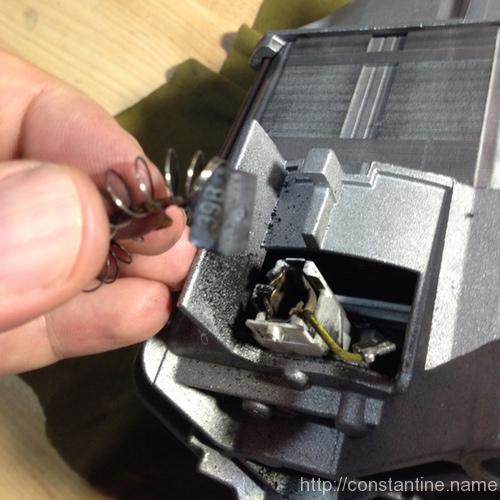
Not this user! Tools, snip, yank. A-HAH! The commutator brushes are worn out.

This is what my dad used to spend a lot of time on… changing commutator brushes on elevators; The thing in the picture with the “39B” on it, on the end of a braided wire with a spring to push it against the commutator… It’s a block of carbon (called a “brush”) and it should be about an inch long. :*) As the motor spins, it wears down. Eventually, the length of the cable limits it moving down against commutator, no electrical contact, no motor movement. The other brush, (motor has two brushes,) was still long enough to touch.

Physics/electrical geeks: Ask me about commutator brushes some time. :^D

Internet, click click click, order via drop-ship P1, parts for tomorrow. Washing machine back in business for wednesday.

Boo-YA!

ɕ


Stance and posture

In the most basic interpretation of an entry-level kata, the aggressor is allowed to grab a wrist, sleeve or lapel, and then you go through the prearranged movements step by step. In more advanced work, if one observes a higher-ranking exponent of the style, just before the aggressor makes contact, the defender moves to a different position in reaction to the upcoming grab. By the time the grab is made, the defender is already well into his movement to take advantage of the attacker’s momentum seamlessly, and then taking charge of the distance and “flow” of the encounter.

~ Wayne Muromoto from, 67. More on Kamae – The Classic Budoka

slip:4uwomo1.

ɕ