Thomas Droge: Body work, Writing, and Parkour Culture

What insights can practices like Tai Chi, Qi Gong, and Parkour offer about balance, healing, and personal growth?

Thomas Droge discusses balance and falling, as well as the physical and mental implications of each. He unpacks his thoughts on recovery, body work, injury and eastern and western medicine. Thomas also shares about the book he’s writing, his goals, and finishes with his thoughts on the culture of parkour.

The amount of attention it takes to stay balanced allows you to obliterate all the other thoughts in your mind, and you get into this awake conscious state really fast. To be in any kind of balanced state—especially if it’s new—is incredibly valuable to bring you into this moment.

~ Thomas Droge (1:51)

The conversation explores the concept of balance as a dynamic and transformative process, contrasting it with the common misconception of balance as a static endpoint. Through discussions of practices like Tai Chi, Qi Gong, and Parkour, it highlights how engaging fully in the present moment enables heightened awareness and flow states. The dialogue also examines how physical balance mirrors emotional and interpersonal dynamics, such as communication and relationships.

Another key theme is healing and recovery, approached through the lens of Chinese medicine and bodywork. Thomas discusses the principles of Dit Da Jow and how traditional and modern approaches address injury and recovery. The conversation also touches on the iterative nature of personal goals, emphasizing the importance of collaboration, adaptability, and finding meaning through both small and grand ambitions.

(more…)

Jonny Hart: Art, Coaching, and Breaking Jumps

What role do community, creativity, and challenge play in connecting personal passions with physical disciplines?

Jonny Hart shares the role of parkour in his life, and how that fits in with his career as an artist. He explains the parkour and anatomy art classes that he helped develop, and discusses the joy he finds in coaching and teaching. Jonny finishes by unpacking his thoughts on breaking jumps, and shares the story of the first jump he ever broke.

I specifically make sure that there’s something in there that I have no idea how to do. And none of my skill set has prepared me for it.

~ Jonny Hart (15:30)

The conversation explores Jonny Hart’s journey from fine arts to becoming an advocate and teacher of Parkour, merging art with movement. He shares his early fascination with Parkour, describing its intensity and the unique community bonds it fosters. He reflects on how his artistic background influences his Parkour practice, providing insights into anatomy and movement, and how this cross-disciplinary knowledge enriches his teaching and personal growth.

The discussion also digs into fear and challenges, likening “breaking the jump” in Parkour to creative hurdles in art. Jonny emphasizes how facing uncertainty in both fields leads to personal breakthroughs and joy. His innovative teaching approach combines drawing, anatomy, and physical movement, aiming to make art and Parkour accessible and transformative for kids and others in the community.

(more…)

Adam McClellan: Community, goal setting, and coaching

What lessons does the practice of Parkour teach about community, personal growth, and resilience?

Adam McClellan discusses his work with Parkour Generations Americas, the parkour community in America, and his local community. He goes into his transition from martial arts to parkour, before delving into goal setting and how he motivates himself. Adam finishes by sharing people he draws inspiration from and why coaching parkour is so important to him.

A rising tide lifts all boats, and through events like Art of Retreat, we’re realizing we can all benefit by working together.

~ Adam McClellan (0:53)

The conversation explores the broad implications of Parkour on personal growth, community development, and coaching philosophies. Adam discusses Parkour Generations’ work in creating partnerships with various organizations, emphasizing trust-building and long-term collaboration. He highlights the growing unity within the American Parkour community, describing a shift toward collaboration and shared growth over individual competition.

On a personal level, McClellan shares his journey from martial arts to Parkour, driven by the transparency and humility inherent in Parkour’s practice. He reflects on the physical and mental challenges of advanced training courses and the value of failure in pushing boundaries. The conversation also delves into his coaching philosophy, advocating for spreading Parkour’s core values effectively and inclusively.

(more…)

Still ahead of Andy

Car drop-off. Gonna miss this lil’ guy! Lot of miles covered @themovementcreative

ɕ


§1 – Introduction

This entry is part 1 of 13 in the series Changes and Results

I’ve lost a lot of weight and gotten a lot stronger in the last few years. But how, exactly, did I get to where I am now?

In 2011, I didn’t like where I was, and I don’t mean, “I was embarrassed about being fat.” I mean I was physically uncomfortable being sweaty, physically unable to get comfortable sitting, grumpy all the time, tired all the time, and more. I really wanted to change and I knew I needed to change before the Doctor started one of those, “Let’s talk about these numbers,” conversations.

Around that same time I’d discovered a few blogs…

I’d read a lot over at Nerd Fitness. I read all of Steve Kamb’s inspirational and motivational stuff.

The big take-away from NF was the loud-and-clear message about what does NOT work: Simply getting a gym membership does not work, declaring a New Year’s resolution does not work, and generally trying to “turn over a new leaf” does not work. Fortunately, rather than come away hopeless, I took it as a big comforting confirmation that I am not alone in sucking at changes.

Whatever it is that I’d been doing, that is EXACTLY what was NOT working.

I also read everything from Leo Babauta over at Zen Habits. For example, When Willpower is Trumped By Bad Habits is a great example of Leo-zen. Eventually, I finally teased a few more threads out of the Gordian knot that was my problem:

I am weak in willpower.

I need to stop beating myself up about failures and shortcomings.

I began by slowly making progress on some “health” projects, improving my sleep and more. (I’ll go into all of that in detail in subsequent parts.) As soon as I began taking Parkour classes, it became clear that I needed to ease into actual running. I also concluded that “regular” footwear was going to act as a crutch and slow down my progress in Parkour. (Long story. Just go with it for this discussion.) So I also switched to minimalist shoes for Parkour, for running and daily wear.

The result of running and Parkour? I was stiff, achy and sore literally all the time. It became glaringly obvious that I needed to start doing “recovery work” — stretching, massage, and basic range-of-motion movement if I was to have any hope of keeping up my hard work.

…and on and on.

I built upon each small success, one small step at a time.

Which brings me to today, and this series of posts. Here I’m going to document my journey by spelling out all the things I did. Hopefully, this roadmap will inspire others.

Next up, some Philosophy!

ɕ


Crossing the Williamsburg Bridge

This entry is part 1 of 13 in the series Williamsburg Bridge QM challenge

Having carefully examined every inch of the pedestrian pathway on the Williamsburg Bridge, I can authoritatively state that it is in fact, VERY long. When I stood up after 2,000 meters of quadrapedie-movement, I could hardly believe it was over! Two kilometers turned out to be possible!

The entire bit of madness started after I mentioned to several people I might be heading into NYC/Brooklyn on a particular weekend in October. Unfortunately, my plans changed and I forgot to tell Jesse.

As the weekend approached, he sent me a message, “I’ve been thinking of some good physical challenges for when you’re here…” I was just thinking, “Oops, I forgot to tell him I’m not coming into the city that weekend.” When he followed with an upbeat, “Let’s QM across the Williamsburg Bridge on Saturday!”

Now in my defense, I was feeling a little guilty that he had spent time thinking about a visit that I had to abort, and my train of thought went off the rails like this:

The problem with my schedule is that I need to be home by about 3pm on Saturday…
…actually, that gives me until about 1pm to do some QM in the city on Saturday…
…so if I went in Friday, and if we started early enough…
…sure, a little QM in the morning would be fun…
…and October’s weather has been so beautiful…

“Ok, sure! I’m in. Let’s do it!”

…and then I looked up the Williamsburg Bridge on Wikipedia, learned it was 2,200 meters long, and thought, “I have made a terrible mistake.”

ɕ


Chilly?

Nah. Not with these awesome Merino wool neck gators from @streetmovementdk mmmmm mmmmmm TOASTY :D

ɕ


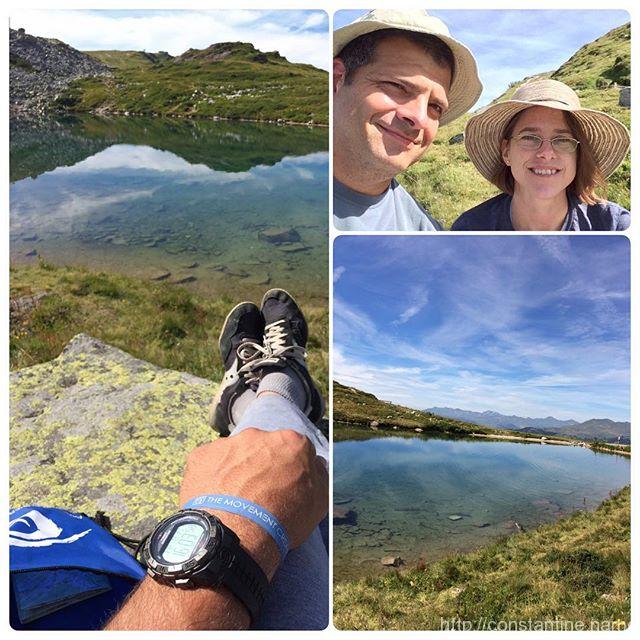
Lac Bleu part Deux

Tracy has arrived! +1 to all selfies. Yes, hiking in the Alps with Saucony Bullets… only shoes I have! @themovementcreative @pkgamericas

ɕ


Yes you can

This entry is part 56 of 72 in the series My Journey

Hello there! Welcome!

This post is where I’ve dumped a bunch of things intended to convince YOU that you really can do Parkour.

Why do I think you can do Parkour? Because, basically, everything the general public has heard about Parkour is wrong. You could totally do Parkour because…

I’m too old, over-weight, out of shape…

I did it, so can you.

I simply mean that when I started, I was very over-weight (BMI well over 30, definitely “obese”), very out of shape, and I was just over 40 years old. That combination is probably “worse off” than most people who end up reading this.

However, if you are older, in worse shape, or fatter than that, I do still think you can do it . . .

Do you think you can improve yourself?

Parkour is about improving yourself through challenge. So whatever is challenging for you, that’s going to be your practice. Maybe for you, it’s a warmup and then start working on some shoulder strength, but you spend a majority of the time watching class so you’re not over-exherting yourself. Maybe it’s a long talk about nutrition and diet (generally what you eat, not a specific diet fad) combined with your initial Parkour efforts.

What about that crazy stuff on TouYube?

It is NOT about big jumps! Why does everyone see the EXTREME movements, and then assume ALL Parkour has to be like that?

You can drive a car without getting into auto racing. You can do a cart wheel without being an Olympic gymnast. You can go for a jog without running a marathon. You can practice Parkour without jumping between roof-tops across an alley!

There’s nothing wrong with the extremes (in the “ultimate level of performance” sense) in any of those activities, but those extremes are NOT representative of the average activity of “driving”, “cart wheeling”, “running” or “Parkour”.

And anyway, here’s a link to my all-time favorite video of some Parkour. I think it’s spectacular, but not in the “huge jumps”, “extreme movement” sense: Julie Angel’s, Movement of Three (2’33”) Movement of Three – YouTube

But I’m a woman…

The answer is still: Yes. Yes you can.

I do understand that there are issues (not just in Parkour) that only women face. But those issues are either societal norms, or other bullshit caused by men. That has nothing to do with Parkour per se. (It’s about men. Actually it’s about boys. Real men don’t pull misogynistic crap.)

HOWEVER, do not take my word about anything regarding the woman’s point of view. Instead, go read this:

«http://www.risingtraceuse.com/2015/03/5-thoughts-that-keep-women-from-trying.html»

And the question almost no one asks…

How do I figure out where and with whom to train?

This is ACTUALLY the hard part. It’s always the same: finding the right coach is mission critical. And you have to perfom this most-important step BEFORE you know much about the thing you want to learn.

So here’s how you do it: You find the nearest place/people/group that purports to teach the thing. You go there. You put your “vibe radar” on and you don’t go back if anything weirds you out. If anything is high pressure (“Jump this! NOW!”, “Sign up for a year! NOW!”) then you back away slowly, and never return. They should be welcoming, intelligent and you should feel supported by most (if not literally) everyone in the class.

ɕ

I work like a gardener

This entry is part 55 of 72 in the series My Journey

I work like a gardener… Things come slowly… Things follow their natural course. They grow, they ripen. I must graft. I must water… Ripening goes on in my mind. So I’m always working at a great many things at the same time.

~ Joan Miro from, I Work Like a Gardener: Joan Miró on Art, Motionless Movement, and the Proper Pace of Creative Labor – The Marginalian

slip:4ubaio1.

In the beginning, my Parkour practice was simply “push. push! PUSH!” with the only moderating factor being to avoid serious injury.

Fortunately, I soon found my own way to the concept of auto-regulation (although I didn’t know the word at the time). Now, at each practice session, I simply start moving and practicing. Then depending on how I am actually performing (physically, mentally) I dial up or down the intensity, and level of challenge, to correspond to the moment/hour/day. The critical point being that I assess how I am actually performing. It’s not, “I roll out of bed, decide I feel sore (or lazy) and then skip the workout/class.”

Lately, I’m noticing there’s a seasonal component. (It’s one thing to say that. It’s another thing to really experience it over a few years.) In the Spring I charge ahead on new plans and goals, and by Summer I find I’m making progress by leaps and bounds. (See what I did there? .) Then Fall rolls around and I’m starting to chillax and really enjoy things; Meals with friends, vistas, the moments between gonzo training sessions, etc. By the time winter descends, I’m ready to burrow into reading and cooking up new schemes for the coming year.

Obviously, part of that is just the natural rhythm of life in an area that has four clear seasons.

…but part of it is exactly what Joan said about working like a gardener.

ɕ