We become so accustomed to disguise ourselves to others, that at last we are disguised to ourselves.
~ Rochefoucauld
Elsewhere, this is 4a1388. — slipbox
We become so accustomed to disguise ourselves to others, that at last we are disguised to ourselves.
~ Rochefoucauld
Elsewhere, this is 4a1388. — slipbox
What strategies can individuals use to manage administrative tasks efficiently while maintaining their creativity and productivity in other pursuits?
Jamie Holmes joins Craig to discuss life’s admin tasks, her journey through holistic healing from melanoma, and insights into the world of circus arts and personal fitness showcasing her multifaceted life and philosophies.
I think it was three months from when I had my first, initial consult with my surgeon, and he said, “okay I can get you in. It’s going to be a bit harder because you’re doing both hips at once, but I can get you in within three months.” And that was horrid to me! I was like, “I have to live three more months like this!?” It wasn’t just that it hurt a little bit when I walked— I couldn’t move— I could not move— I was having weird panic attacks all the time, because if I dropped something and had to bend over, it was— I’m a bit of a tough cookie, but that? That broke me pretty hard.”
~ Jamie Holmes, 35:15
Not your average bears, Craig and Jamie begin in left field discussing ways of managing life’s “admin” tasks. Jamie professes integrating everything into her daily flow, rather than reserving them for a single day. Her approach, she explains, allows her to work at a high speed, avoiding the buildup of dreaded tasks. Her method emphasizes efficiency and the mental ease that comes from staying ahead of administrative duties, reflecting a deeper understanding of personal productivity and time management.
The conversation shifts into Jamie’s profound journey through holistic healing after a melanoma diagnosis. Rejecting traditional treatment paths, Jamie opts for a holistic approach, guided by her conviction in the body’s healing capabilities and her passion for health and fitness. This segment of the discussion not only highlights her resilience but also serves as an inspiring testament to the power of our minds and bodies.
Jamie also shares insights into the world of circus arts and her studio, The Circus Fix, illuminating the challenges and rewards of managing a fitness and arts studio. Her narrative encompasses the delicate balance of artistic passion with the pragmatism of business management, underscoring the significance of adaptability and understanding in leadership roles.
(more…)Maybe, if I was feeling really brave, I’d say that there is just one thing that I need to get beyond. If I was feeling that brave, I’m not, I’d say it’s the drive drive drive I feel to do do do.
What we usually do is either be driven, driven, driven by this fear … or we conclude that we need to abandon everything and start with a fresh slate. With this fear, it can feel like these are the only two options.
~ Leo Babauta from, Transforming the Constant Feeling of Being Behind
Elsewhere, this is 4uzesi4. — slipbox
As Babauta of course goes on to point out: There aren’t, in truth, only two options. I’m still not feeling brave, but the idea that there’s a third-way sounds delightful.
ɕ
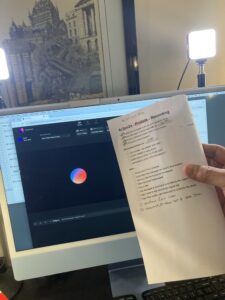
I’m a major process-person. Process is discipline. For me, inspiration always runs out. But process enables me to put one dumb foot in front of the other— and then course correct as I go. Pre-flight checklist here minutes before a guest joins me for a recording.
ɕ
What is the value of embracing transitional or “in-between” spaces in life and creativity, and how can these moments shape personal growth and future endeavors?
Explore the journey of creative transformation and the profound shifts that come from embracing the spaces between, as Alasdair Plambeck navigates the end of a significant chapter to discover what lies beyond the familiar boundaries of identity and purpose.
I knew there was a general sense. It’s like, “I’m meant for something more than this,” and I think a lot of people feel that when they’re in what I would call the over-culture. I was very much steeped in— trained for— prepared for— programmed by, all that kind of thing. I work with a lot of people who are maybe in that, but transitioning out, or wanting to transition out, or just maybe feeling that.
~ Alasdair Plambeck, 26:35
Alasdair Plambeck joins Craig Constantine to discuss the nuanced journey of personal and creative transformation. Alasdair shares his thoughtful approach to scheduling, aiming for times that harness his creative energy most effectively. His decisions reflect a deeper stance on being attuned to one’s energy levels and the optimal conditions for creativity and meaningful engagement.
The conversation extends into Alasdair’s personal story, illuminating his shift from feeling confined within the “over-culture” to embarking on a path that resonates with his true self. This transition is sparked by a profound moment of realization while working as a general manager, where success and societal expectations no longer aligned with his well-being and aspirations.
The dialogue also ventures into the realm of podcasting itself, exploring the evolution of Alasdair’s own podcasting journey and the decision to conclude his show after a significant run. This choice underlines a theme of knowing when to let go, to make space for new beginnings and growth. Alasdair reflects on how the podcast served as a medium for connection, self-discovery, and the cultivation of a deeper relationship with his wife through shared creative endeavors and discussions.
Further, Alasdair and Craig touch on the concept of the “in-between” spaces in life — those transformative periods where one is neither here nor there but in a state of becoming. Alasdair views these phases not as voids but as fertile ground for introspection, learning, and eventual emergence into new stages of life and identity. Through these varied topics, the conversation paints a vivid picture of the ongoing journey of self-exploration, the power of mindful changes, and the courage to pursue a life aligned with one’s authentic self.
(more…)To concentrate your mind on something is not the true purpose of zen. The true purpose is to see things as they are, to observe things as they are, and to let everything go as it goes.
~ Shunryu Suzuki
Elsewhere, this is 4a1387. — slipbox
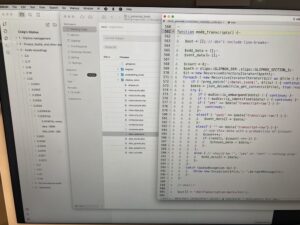
Currently in my personal knowledge system I have notes on ~400 audio recordings. (Raw recordings I’ve done, podcasts of my own I’ve published, other shows I’ve been on, etc.) That can be my episode notes and writing, but also program-readable meta information. Today, I spent time writing some new tooling to help me sort out transcripts (which recordings have them, which have been sent out, etc.)
Have you ever tried to read Gray’s Anatomy? I tried to read a modern printing of a 1901 edition that was given to me. It’s 1,200+ pages in a perfect-bound book! That might have been 30 years ago and I’m not sure if anything from that adventure stuck… and yet, I bet a huge amount of knowledge has stuck. I recall it was an endless succession of interesting rabbit holes.
Nasal congestion, I’ve learned in all this, is far weirder than I ever thought. For starters, the nose is actually two noses, which work in an alternating cycle that is somehow connected to our armpits.
~ Sarah Zhang from, Everything I Thought I Knew About Nasal Congestion Is Wrong
Elsewhere, this is 4utehe2. — slipbox
I’m struggling to resist the urge to see what Gray’s has to say about the nose. I do know that even the most fleeting search of the ‘ol Internet turns up a huge amount of material around this topic. I will also say that I’ve long known that lying on one’s side tends to open the opposing nostril’s nasal whatsit-stuff. Which I know only because I have a long history of sinus and allergy problems and have necessarily tried to sleep with a plugged schnozz, leading to creativity and experimentation.
ɕ
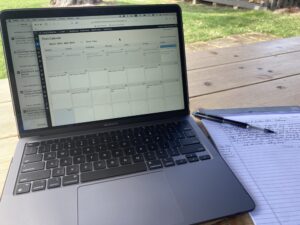
I describe my weekly email, 7 for Sunday, as “Hand-rolled and algorithm-free.” I’m using some custom code in WordPress to assemble separate posts into a single “thing” which then goes out via email. It’s definitely a lot of “hand-rolling”. A lot of hand writing my notes and mind-maps for each post, typing the posts, the quotes, ordering and organizing everything, handling links and images and… zoinks, it’s a lot. I love it.
Reading time: About 6 minutes, 1200 words
Get 7 for Sunday in your inbox. → Subscribe here.
This issue is https://7forsunday.com/76