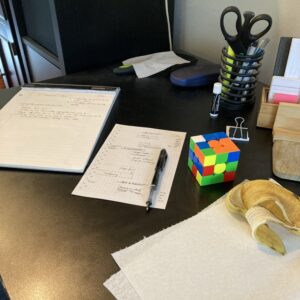
There’s a magnifying glass in the back there too. Extra pair of low-reflection reading glasses. Lip balm; don’t need it until I need it. Rubik’s cube so I can kill a few minutes without spinning off starting something that then turns into a rabbit hole. What do you keep at hand when working?
Tools at hand →
Pressure →
To achieve great things, two things are needed: A plan and not quite enough time.
~ Leonard Bernstein
Elsewhere, this is 4a1390. — slipbox
Reflection →
I sometimes talk about the three words, discovery, reflection and efficacy. It’s the reflection that is the force multiplier; the better I get at that, the more it looks like a super-power. Sometimes it’s not possible to view something after I’ve done it, but I can always mentally review.
Ask yourself: what went well? How did you prepare? What did you wear? Who was your audience? What was your internal monologue before you stepped up to speak? In that moment when you got distracted, what had happened? What were you thinking about? How did you get back on track (if you did)? What was on your mind that day?
~ Angie Flynn-McIver from, Good Public Speaking Isn’t Magic
Elsewhere, this is 4uiibo3. — slipbox
Flynn-McIver is talking about public speaking, but those are wonderful questions for any context.
Unfortunately, I can get caught up spinning in circles over-thinking things. I’ve recently had good luck using a particular question to create an exit–ramp from my over-thinking. I ask myself: If I could answer these questions, would it enable me to do something? Because when I’m spinning in my over-thinking, I’ve forgotten about that third word in my little mantra: efficacy.
ɕ
March 24, 2024 — #77 →
Reading time: About 5 minutes, 900 words
Get 7 for Sunday in your inbox. → Subscribe here.
This issue is https://7forsunday.com/77
Obliged to respond →
I recently heard a conversation between Brian Koppelman and Steven Pressfield (circa 2019 in Koppelman’s podcast, The Moment) where Pressfield mentioned a few great things for creatives to remember: Being a professional has nothing to do with getting paid. Resistance is real, it’s myself, and is waiting for me to invite it to stop me. The Muse is real.
The muse really does reward me for being found working. I’ve learned, no matter the work, the muse approves when finding me ready with pen and paper close. But if the muse taps me and I fail to treat the gift appropriately—if I think, “I’ll remember that. I don’t need to write that down.”—then I hear the muse scoff, “we shall see.” We shall see if I remember. And we shall see if the muse waits a bit longer before checking on me again.
That, of course, was the reason for the pen all along: it’s a physical reminder that you are not reading merely to consume the words of others passively, but that you have an obligation to respond.
~ Mandy Brown from, Ways of writing
Elsewhere, this is 4uaowi6. — slipbox
I’m realizing that books themselves also need room to sprawl. If I keep them shelved upright, or even more simply stacked flat, they still seem to be squished into submission. When I am able to lay a few of them out, with some room for them to wave their invisible tendrils, they seem to taunt me: go ahead, pick me up! If there’s a tablet or some writing scraps at hand, or garish sticky notes for flagging pages, then it begins to feel like its own room with unfolding conversations. In the end, it’s almost a composition just having the books lying about.
ɕ
True →
This above all: To thine own self be true, and it must follow, as the night the day, thou canst not then be false to any man.
~ Shakespeare
Elsewhere, this is 4a1389. — slipbox
Software power-tools →
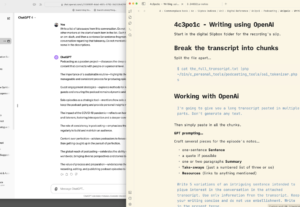
There’s a lot I can say about episode notes for individual podcast episodes. I have trouble writing them from scratch. But I’ve been using OpenAI’s LLM for a while now and tinkering on some prompts that work well. It takes me at least half an hour of writing (me writing and revising) to go from a raw transcript to solidly useful episode notes.
ɕ
Voices with Leticia Latino van Splunteren →
What are the key insights and lessons shared during a conversation with a podcast creator about sustaining creativity, connection, and the joy of podcasting?
Leticia Latino van Splunteren joins Craig Constantine to explore the relentless pursuit of podcasting excellence and the art of staying true to one’s essence.
The one thing people have always told me— […] I connect people. My friends, even from high school and elementary school when I go back home, […] I’m the one planning, making everybody see each other. I’ve always been that person.
~ Leticia Latino 10:05
Leticia Latino and Craig discuss the essence and challenges of podcasting. Leticia shares her journey of producing over 250 episodes of her podcast “Back2Basics,” highlighting the dedication and passion required to maintain such a consistent output. She emphasizes the importance of creating a sustainable podcasting routine that aligns with one’s lifestyle and commitments.
I think a lot of people get discouraged by seeing, sometimes the numbers and the statistics, and I don’t look at them. I don’t look at them because I look at the map of where it has been downloaded. And when I see it has been on every single continent [that’s] encouraging and empowering for me because I’ve reached a place that I will have never dreamt about reaching.
~ Leticia Latino 35:20
Their discussion shows how podcasting, while a solitary endeavor at times, blossoms into a fulfilling venture through connections made and stories shared, showcasing the intrinsic value and joy derived from engaging deeply with guests and audiences alike.
The conversation also explores guest engagement and the sometimes meticulous process behind selecting and interacting with guests. Leticia offers insights into her approach to guest outreach, and how she tries to ensure a balance between introducing new voices and maintaining a steady flow of content. She discusses the strategic use of solo episodes as a method to keep the podcast alive during guest droughts, inadvertently discovering the audience’s appreciation for her personal insights.
Finally, the conversation touches on the impact of the global pandemic on podcasting dynamics. Leticia notes a shift towards introspection among podcasters and listeners alike, suggesting a deeper engagement with content that resonates on a personal level, even today as the world again accelerates post-pandemic.
(more…)The payoff →
If I think about how some project or effort of mine affects the world, it’s hard to imagine the effects that I would never know about. A tree falls in the woods; if no one hears it, does it make a sound? Does it make a sound a microphone would pick up? Yes, of course. Does it make a sound that affects someone? No, of course not. The answer depends on what we mean when we ask the question. If I do something creative, and no one that I know of benefits from it, does it matter?
Why? Because anyone who has ever done anything worth a damn, knows that they probably weren’t the main beneficiaries of their efforts. Our work may have lit up the world, but we still remain down in the mud, somehow.
~ Cierra Martin from, What Samurai Teach Us About Service
Elsewhere, this is 4ugawa2. — slipbox
For some reason, I liked the overall shape of that little article. But I don’t like the imagery of “we still remain down in the mud.” I feel like the thankless creative work that I do, doesn’t leave me “down in the mud.” A better metaphor—the way I think of it—is that I’m “still in the workshop.” I’m in the workshop. I’m being creative. My work has affects (I presume), but the fact that I don’t see those affects doesn’t make them any less real.
ɕ
Putting pen to paper →
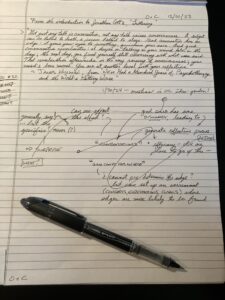
I’ve tried to do digitally the thinking and creative part of writing. It just doesn’t work as well as scribbling on paper. I use these tablets to capture ideas. This seed has been bumping around for 3 months (if you zoom in, it’s interesting that this seed happens to be _about_ reverberations!) Today it gets turned into a new something for Open + Curious.
ɕ