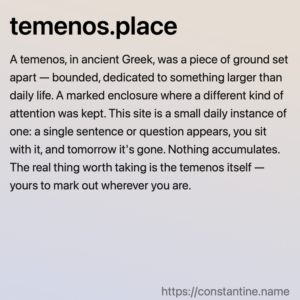
A small marked enclosure where a different kind of attention is kept.
A temenos, in ancient Greek, was a piece of ground set apart from ordinary use — bounded, dedicated to something larger than daily life, and respected as such. Not a temple, necessarily; just a marked enclosure where a different kind of attention was kept. People went there to do something they couldn’t quite do anywhere else — pay attention to what was hard to see in the noise of regular life. The marker around the place mattered as much as anything that happened inside it.
Temenos.place is an instance of one. A small daily instance. Each day, one thing appears on a page behind this one — a sentence, a question, a quote. Anyone who’s joined can sit with it. They can leave a short reply, where the others can see it but no one responds to it. Tomorrow the post is gone, the replies are gone, a new one is there. Nothing accumulates; there’s no archive, no body of work being built, no count of anything. People can show up today, or not, and either is fine. There is nothing to fall behind on.
The thing worth taking from this page is the temenos itself, which is yours to mark out wherever you are. A notebook, a chair, a corner of a morning, a daily walk — anywhere you decide that a particular kind of attention will be kept. If reading this gives you the word for something you’ve been doing already, or the permission to start, that’s enough.
ɕ