Quadrupedal Movement →

This entry is part 71 of 72 in the series My Journey

Quadrupedal Movement (QM) is a diverse collection of movements using both hands and feet on the ground to support one’s weight.

QM is almost always done using just the feet, and not the knees, since our knees are not capable of taking prolonged usage or impact. That said, there are some small-size, low-impact, movements using various surfaces of the knees, lower legs, buttocks, and thighs which integrate well with the usual hands-and-feet-only QM.

There are countless variations of QM. Many variations are physically demanding, but many are drastically easier than the more usual bipedal movements: Using a railing with your hands for balance and support as you ascend stairs, using walking sticks and canes, and “scrambling” on hands and feet up steep slopes, are all common variations of QM.

Start here https://gmb.io/locomotion/

Elsewhere, this is 4ugilo1. — slipbox

…and then take a look at some advanced options, Two Hours and a Slab of Concrete.

ɕ

Meta: I’m retiring this series, “My Journey.” Over the years, my blog has changed a lot. In the beginning I had a lot of more random things here and I used this series as a way to highlight this aspect of my blog writing. Today, the blog itself is basically a record of my journey.
Lauren Messeck: Projects, voice over, and play →

What motivates someone to blend parkour, yoga, and play into a movement practice that fosters creativity and personal growth?

Lauren Messeck describes her work with the Parkour Visions project, Movement for All, and her personal project, Yoga Move. She discusses her interest in climbing, bare feet versus minimalist shoes, and her background in the performing arts. Lauren reflects on her voice over work, and expresses her passion for helping people to rediscover play.

I can engage with the world in this way that I hadn’t done in a while. And it was awesome.

~ Lauren Messeck (7:00)

The conversation explores how an online search for playful movement led to the discovery of parkour and a thriving community. Lauren shares how parkour complemented a background in yoga and the performing arts, blending these disciplines to create new movement experiences. The discussion touches on the importance of play, the role of community in fostering personal growth, and the development of workshops that merge yoga and parkour.

Further, Lauren elaborates on her involvement with Parkour Visions, an organization dedicated to expanding movement-based programs. This includes efforts to secure funding for community-driven projects, support regional hubs, and make movement more accessible to the public. The conversation also reflects on personal growth through movement, the significance of reconnecting with play, and how simple tools like minimalist shoes and meditation enhance the experience.

(more…)

A grievous error →

“Setting the bar too high.”
“Setting stretch goals with the knowledge that coming up short will be the norm.”

…are symptoms of forward-looking assessment of progress. Assessing progress by looking forward is a grievous error. “What have I accomplished?” is only measurable by looking back at what has been accomplished. This error is one of my big problems—I’d even say it’s my problem. I’m working on it by practicing looking back to assess progress. :) My instinct and habit though is to look forward. Thus, more practice is needed to make looking back the default.

What have I accomplished?
What is the affect of what I have done?
How far have I moved?
How much have I learned?

Such questions can only be answered by considering the change between two points in my past.

The hard part—at least for me—is to keep out the “I wanted.” “I accomplished that much, but I wanted to accomplish [insert goal here],” creeps in through the open door of assessment.

By shifting my eyes just a bit to my left, I can see my personal oath which is stuck next to my monitor. There are a few phrases in it which are specifically meant to help me keep, “but I wanted to…” firmly locked outside.

ɕ


Everything is created twice →

Everything is created twice, first in the mind and then in reality.

~ Robin Sharma

Elsewhere, this is 4a284. — slipbox


Evolution of my field recording kit →

Day One

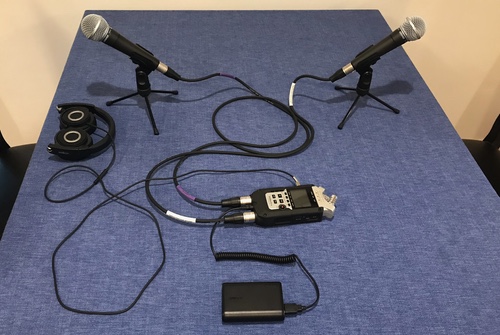
Zoom H4N recorder, a pair of SM58s (didn’t even have pop filter foam covers) with table-top mic stands. I went to the trouble of finding a power cord that matched the Zoom’s bayonette jack (on the chin at the left, between the XLR cables) and had a standard USB plug on the other. This of course only worked because the Zoom would accept 5v DC. One pair of Vogek folding headphones for me. Stand USB battery brick. I kept this all packed into a Pelican case much smaller than a shoebox.

(more…)

Open Podcast Directory — A proposal to globally enable auto-discovery of podcasts →

THIS POST IS HISTORICAL — See instead https://openpodcastdirectory.org/


When you want to visit a web site, you do not need to search for it in a central directory of web sites. Your web browser simply goes into the DNS system and finds the address to connect to.

Today, podcasts are managed inside a huge directory. But they do not need to be in a directory!

Meet the Open Podcast Directory

If you want to find the podcast for example.com why doesn’t your podcast player simply go find that podcast by looking it up in DNS?

(more…)

The power to break your back →

If you can lighten your burden you must do so. There is no straw which lacks the power to break your back.

~ unknown

Elsewhere, this is 4a73. — slipbox


Adam McClellan: Business, coaching, and outreach →

What are the inherent challenges of growing and monetizing a Parkour community without losing its core values and spirit?

35 episodes and 2 years later, Adam McClellan returns to Movers Mindset. Adam deserves a large measure of credit because he was willing to be the original guinea pig for this crazy experiment. Our first interview was a simple Q&A style but in this episode we have an in depth conversation about the cycles a community goes through, the nature of parkour, and the type of people who are drawn to it. Adam explores the intersection of parkour and business, and how the two coexist, before discussing the nuances of coaching children. He opens up about his knee injury and recovery, his thoughts on normalizing parkour to the public, and different ways to design a parkour gym.

One of the things we value about Parkour is there isn’t that hierarchy and structure in place. It’s just you and me, and we’re hanging out, you don’t have to call me anything— There’s no assumed authority, right? We’re just training together.

~ Adam McClellan (21:40)

This conversation explores the growth and evolution of a Parkour community as it transitions from informal outdoor training to a structured business model. The discussion highlights the shifts in community dynamics when money and formal structures are introduced, drawing parallels between martial arts schools and Parkour. Adam reflects on how scaling up often leads to a loss of intimacy and core values, raising questions about whether Parkour can retain its spirit as it grows.

Key topics include the role of leadership in shaping community culture, the unavoidable influence of business practices on Parkour, and the challenge of teaching children while preserving the deeper philosophical aspects of the discipline. There is also a focus on personal injuries, their impact on training, and how physical setbacks shape the journey of a Parkour practitioner.

(more…)

Flashback to August 2018 →

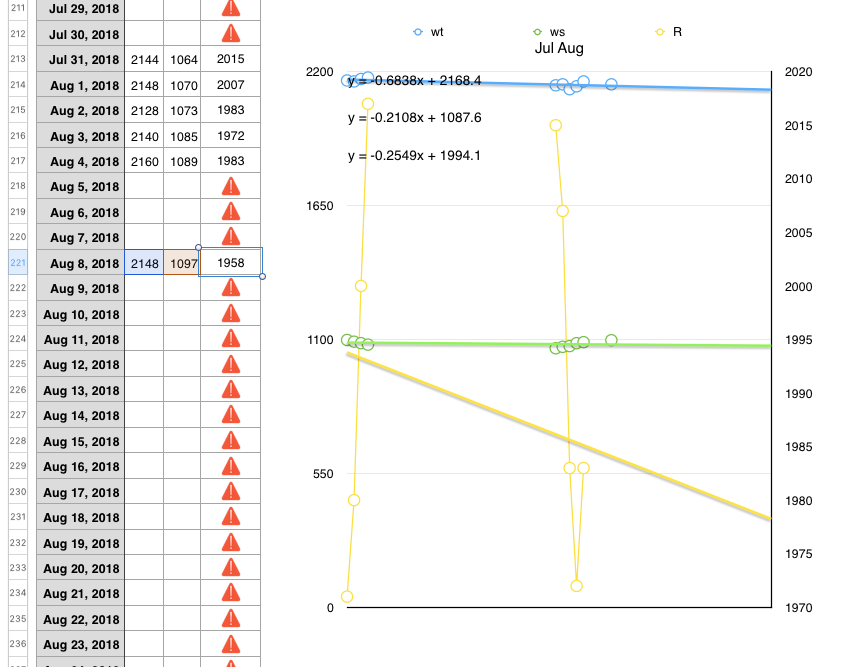
This post is from some quick notes I made in August 2018. I’m only just getting around to publishing it now, 8 months later, as part of this series. Today, at ~230 pounds, 215 seems like a dream.

—

I’m recently back from traveling to Denmark and France to attend two Parkour events back-to-back. As usual when I’m traveling, I don’t attempt to keep up my normal routines so there’s no data recorded for most of July 2018.

I’m happy to return still around 215 as I try to get back to my routine of “chaining together” my mornings. Compared to July, I’m not as active, but I’m trying to AVOID the, “let’s be super active and try the 100-days-of-activity challenge,” mistake I made in 2017 when I came home from the same events all excited about movement.

Anyway, what about that ratio of 1958? …it’s so low that it’s not even on the graph! This reminds me of two things I believe I’ve noticed:

  1. The ratio lags behind when I’m actively losing weight. My guess is that the different components (water, subcutaneous fat, visceral fat, and muscle) change at different rates. So when losing fat from calorie deficit, the peripheral/subcutaneous is liberated first—which aligns with my recollection that visceral fat is more tenacious.
  2. The best ratio is very hard to find—to actually see it in the measurements. I have to lose weight gradually, and then stay at the new weight for many weeks to see the ratio rebound to above 2000. (Reminder, the ratio is in wacky units of “tenths of pounds per millimeter midriff circumference” because of how I record the numbers. The numerical value of the ratio is of no concern; It’s only useful for trending.)


All comes out even at the end →

Weak as I am, I carry on the war to the last moment, I get a hundred pike thrusts, I return two hundred and I laugh. I see near my door Geneva on fire with quarrels over nothing, and I laugh again; And, thank god, I can look upon the world as a farce even when it becomes as tragic as it sometimes does. All comes out even at the end of the day, and all comes out still more even when all the days are over.

~ Voltaire

Elsewhere, this is 4a8. — slipbox