Being a great guest

This entry is part 5 of 5 in the series Parkour Travel

This post is entirely rules, tips, and ideas about how to be an insanely great guest in someone’s home. It’s organized into three sections. The first two sections are meant to get you thinking about how your host, and other guests, perceive you. The third section is focused on the day-to-day details of living in an unusual space. It’s meant to get you thinking about solutions to problems, and ways to make travel more enjoyable.

tl;dr: Empathy.

For my purposes here, empathy is the psychological identification with the feelings, thoughts, or attitudes of another person. I’m not suggesting that you must continuously empathize with everyone. I’m suggesting that empathy is a tool that can be used to inform your plans and behavior. Simply put, artfully using the soft skill of empathy will transform you into a great guest.

(more…)

Purpose in life

Everyone has a purpose in life. Perhaps yours is watching television.

~ David Letterman

slip:4a228.


Daily steps of weight tracking

My weight fluctuates a lot during the day, and day-to-day. So I picked a consistence time and procedure. I try not to over-think it, and simply do the same thing each time, generally, in the morning after I go to the bathroom.

After doing this for a few years, I no longer care about the fluctuations. The whole point of this is to get a handle on the trends. The individual jumping around of the numbers is irrelevant. Once you see the numbers jump all over the place for a few weeks, you learn to stop caring about what the scale says on any given day.

My scale measures in 2/10’s of pounds. So I can get “123.4” or “123.6”. It’s digital, has huge numbers, and it lives right in the open in the bathroom where I can just step on it at any time. This is important as it removes all possible “friction” to weighing myself. I don’t even need to slide the scale out to step on it.

Next to the scale hangs a tailor’s tape measure. I use the metric scale on the tape since that gives me centimeters and tenths. (If I used the inches scale, I’d have to convert the 1/8’s of inches into decimals, so it’s easier to get 4 digits from the metric side.)

I step on the scale and grab the tape measure. By the time I look down, the scale is done deciding my weight. I step off scale and measure the largest circumference. This requires honesty, but is very easy to do once I did it a few times: I just relax, let it all hang out, and slowly let the tape measure slip longer as I try to slip it down around my waist. (I suppose, that some day, when I have a “waist” in the proper definition, I’ll have to tweak my method. That will be a great problem to have.)

I might get 232.8 pounds– I just remember 2 3 2 8.
I might get 110.7 centimeters– I just remember 1 1 0 7.
…and I walk out of the bathroom mumbling, “2 3 2 8 1 1 0 7”

In subsequent posts I’ll go into what I do with the numbers in terms of math, spreadsheets and why the units are irrelevant. But for now, that’s the data capture that I try to do every day. It’s fast and easy. Step on scale, measure “waist”, and record eight digits.

ɕ

What feels right is probably wrong

This leads me to the point I wish above all to emphasize, namely, that when a person has reached a given stage of unsatisfactory use and functioning, his habit of ‘end-gaining’ will prove to be the impeding factor in his attempts to profit by any teaching method whatsoever. Ordinary teaching methods, in whatever sphere, cannot deal with this impeding factor, indeed, they tend actually to encourage ‘end-gaining.’ The instruction given to the golfer of our illustration to keep his eyes on the ball is typical of the kind of specific instruction given by teachers generally for the purpose of eradicating specific defects in their pupils, and, as we have seen in this case, this instruction was a stimulus to him to try harder than ever to gain his end, and so to misdirect his efforts worse than ever.

~ FM Alexander, The Use of the Self, pp66-67, 1932 (emphasis added)

I think there’s a lot more context necessary for that to make sense. One could go read the book; It’s small. But setting that aside for the moment.

Alexander raises the important point that what feels right may in fact be wrong. So the harder I try to do something correctly, by trying to do what feels right, the more likely I am to reinforce doing what is wrong. This starts to make more sense once I understood that the Brain is a Multi-layer Prediction Model. Once something is modeled incorrectly—when I move this way, it feels right—it’s going to be really difficult to change that model.

ɕ


Quadrupedal Movement

This entry is part 71 of 72 in the series My Journey

Quadrupedal Movement (QM) is a diverse collection of movements using both hands and feet on the ground to support one’s weight.

QM is almost always done using just the feet, and not the knees, since our knees are not capable of taking prolonged usage or impact. That said, there are some small-size, low-impact, movements using various surfaces of the knees, lower legs, buttocks, and thighs which integrate well with the usual hands-and-feet-only QM.

There are countless variations of QM. Many variations are physically demanding, but many are drastically easier than the more usual bipedal movements: Using a railing with your hands for balance and support as you ascend stairs, using walking sticks and canes, and “scrambling” on hands and feet up steep slopes, are all common variations of QM.

Start here https://gmb.io/locomotion/

slip:4ugilo1.

…and then take a look at some advanced options, Two Hours and a Slab of Concrete.

ɕ

Meta: I’m retiring this series, “My Journey.” Over the years, my blog has changed a lot. In the beginning I had a lot of more random things here and I used this series as a way to highlight this aspect of my blog writing. Today, the blog itself is basically a record of my journey.


Lauren Messeck: Projects, voice over, and play

What motivates someone to blend parkour, yoga, and play into a movement practice that fosters creativity and personal growth?

Lauren Messeck describes her work with the Parkour Visions project, Movement for All, and her personal project, Yoga Move. She discusses her interest in climbing, bare feet versus minimalist shoes, and her background in the performing arts. Lauren reflects on her voice over work, and expresses her passion for helping people to rediscover play.

I can engage with the world in this way that I hadn’t done in a while. And it was awesome.

~ Lauren Messeck (7:00)

The conversation explores how an online search for playful movement led to the discovery of parkour and a thriving community. Lauren shares how parkour complemented a background in yoga and the performing arts, blending these disciplines to create new movement experiences. The discussion touches on the importance of play, the role of community in fostering personal growth, and the development of workshops that merge yoga and parkour.

Further, Lauren elaborates on her involvement with Parkour Visions, an organization dedicated to expanding movement-based programs. This includes efforts to secure funding for community-driven projects, support regional hubs, and make movement more accessible to the public. The conversation also reflects on personal growth through movement, the significance of reconnecting with play, and how simple tools like minimalist shoes and meditation enhance the experience.

(more…)

A grievous error

“Setting the bar too high.”
“Setting stretch goals with the knowledge that coming up short will be the norm.”

…are symptoms of forward-looking assessment of progress. Assessing progress by looking forward is a grievous error. “What have I accomplished?” is only measurable by looking back at what has been accomplished. This error is one of my big problems—I’d even say it’s my problem. I’m working on it by practicing looking back to assess progress. :) My instinct and habit though is to look forward. Thus, more practice is needed to make looking back the default.

What have I accomplished?
What is the affect of what I have done?
How far have I moved?
How much have I learned?

Such questions can only be answered by considering the change between two points in my past.

The hard part—at least for me—is to keep out the “I wanted.” “I accomplished that much, but I wanted to accomplish [insert goal here],” creeps in through the open door of assessment.

By shifting my eyes just a bit to my left, I can see my personal oath which is stuck next to my monitor. There are a few phrases in it which are specifically meant to help me keep, “but I wanted to…” firmly locked outside.

ɕ


Everything is created twice

Everything is created twice, first in the mind and then in reality.

~ Robin Sharma

slip:4a284.


Evolution of my field recording kit

Day One

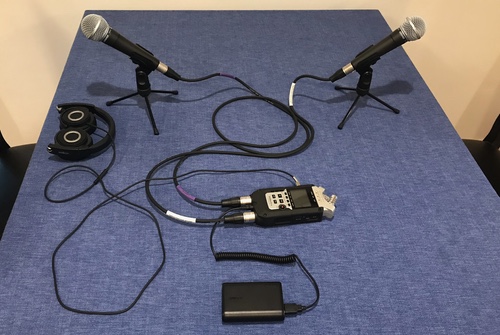
Zoom H4N recorder, a pair of SM58s (didn’t even have pop filter foam covers) with table-top mic stands. I went to the trouble of finding a power cord that matched the Zoom’s bayonette jack (on the chin at the left, between the XLR cables) and had a standard USB plug on the other. This of course only worked because the Zoom would accept 5v DC. One pair of Vogek folding headphones for me. Stand USB battery brick. I kept this all packed into a Pelican case much smaller than a shoebox.

(more…)

Open Podcast Directory — A proposal to globally enable auto-discovery of podcasts

THIS POST IS HISTORICAL — See instead https://openpodcastdirectory.org/


When you want to visit a web site, you do not need to search for it in a central directory of web sites. Your web browser simply goes into the DNS system and finds the address to connect to.

Today, podcasts are managed inside a huge directory. But they do not need to be in a directory!

Meet the Open Podcast Directory

If you want to find the podcast for example.com why doesn’t your podcast player simply go find that podcast by looking it up in DNS?

(more…)